
lovethailand home >Northeastern Travel Attractions >Nong Bua Lamphu Travel Attractions >Si Bun Ruang >Nong Bua Tai > Wooden Ubosoth of Wat Chaoreon Songtham
TL;DR: Wooden Ubosoth of Wat Chaoreon Songtham is located at Wat Charoen Songtham, Ban Don Po, Nong Bua Tai Subdistrict, Si Bun Rueang District, Nong Bua Lamphu Province, open Daily, hours 08.30 – 16.30.

Wooden Ubosoth of Wat Chaoreon Songtham
Open Days: Daily
Opening Hours: 08.30 – 16.30
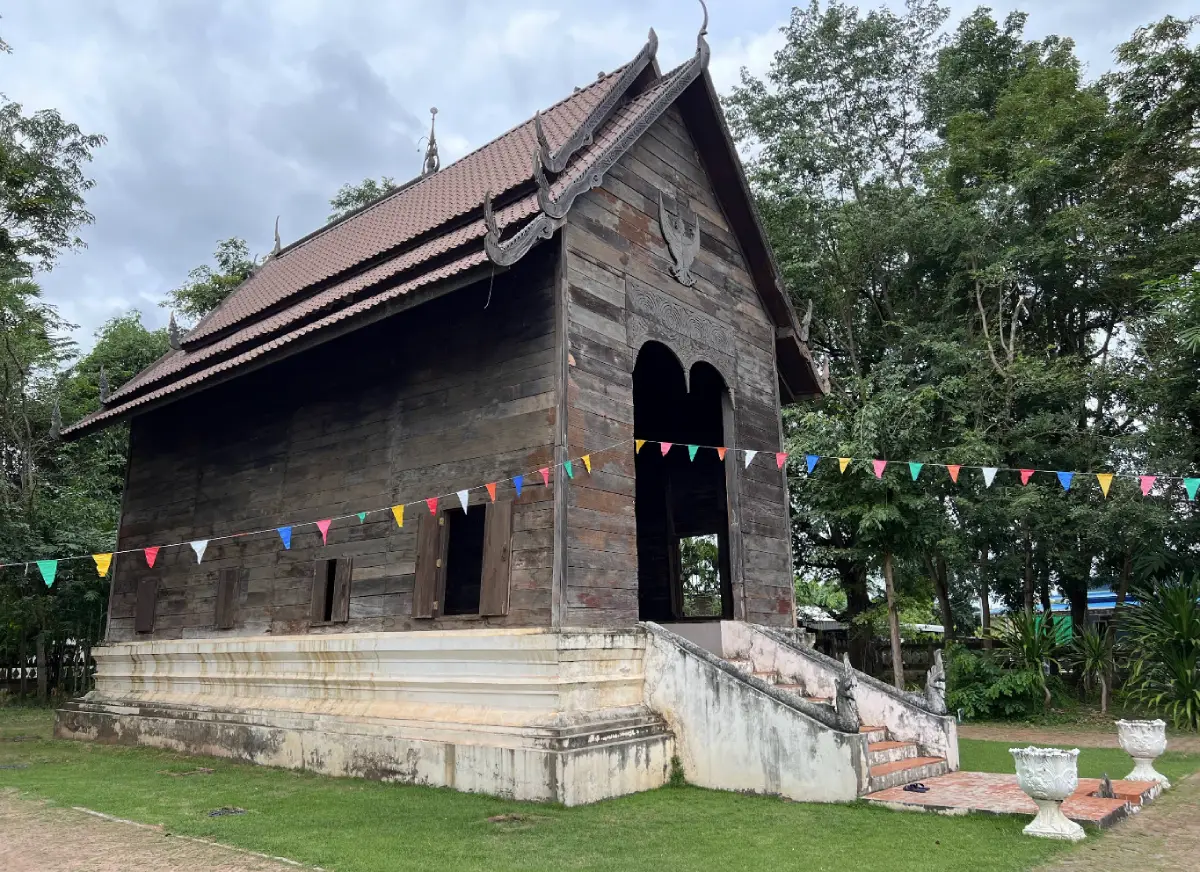
The Ancient Wooden Ordination Hall at Ban Don Po Temple in Nong Bua Lamphu, officially known as the Wooden Sim of Wat Charoen Songtham, is a rare vernacular Isan wooden ordination hall located at Wat Charoen Songtham, Ban Don Po, Nong Bua Tai Subdistrict, Si Bun Rueang District, Nong Bua Lamphu Province. Built in 1946, the structure was originally a water-based sim before being moved onto land around 1955. Today it is respected by local villagers and valued as one of the most distinctive wooden religious buildings in Nong Bua Lamphu, with a seated Buddha image known locally as Phra Khi Nor enshrined inside.
The Ancient Wooden Ordination Hall At Ban Don Po Temple is the name commonly used by local people and travelers for the wooden sim inside Wat Charoen Songtham in Ban Don Po. In northeastern Thai culture, the word “sim” refers to an ordination hall, the sacred building used by monks for important Buddhist rites such as ordination and formal monastic ceremonies. This wooden sim is therefore more than an old wooden building. It is a sacred space that has supported religious life and community devotion for generations.
Wat Charoen Songtham is located at No. 150, Moo 2, Ban Don Po, Nong Bua Tai Subdistrict, Si Bun Rueang District, Nong Bua Lamphu Province. The temple belongs to the Maha Nikaya Buddhist order and covers an area of 12 rai and 61 square wa. It was formerly known as Wat Don Po before later being restored and renamed Wat Charoen Songtham. The temple was established in 1926, making it an important spiritual center for the local community of Ban Don Po.
The wooden sim was built in 1946. Although it is often described locally as an ancient wooden ordination hall of around a century in age, records identify the present structure as dating to 1946. It was originally a water sim standing in a pond to the east of the temple. Around 1955, it was moved onto land on the northwestern side of the temple compound, and its brick-and-plaster base was completed in 1959. This transition from a water sim to a land-based sim gives the building special historical value, showing how the community adapted to preserve its sacred architecture.
The importance of this wooden sim lies in its rarity. It is a vernacular Isan sim built entirely of wood, and it is recognized as the only wooden sim of its kind in Nong Bua Lamphu Province. Wooden religious buildings are relatively rare in northeastern Thailand because wood requires continuous care and is vulnerable to age, weather, and decay. The survival of this building at Wat Charoen Songtham therefore makes it a valuable example of local craftsmanship, Buddhist devotion, and community-based preservation.
The building is compact in proportion, with its width and length relatively close to each other. Its overall form is a high, rectangular hall with a front porch facing east. The east-facing orientation is meaningful in Buddhist architectural tradition, as the east is associated with light, awakening, and symbolic beginnings. Although the building is modest in scale, its proportions are elegant, and its simplicity gives it a quiet dignity that suits the rural temple setting.
The roof is a two-tiered gable roof with a high, airy profile. This elevated roof form helps make the interior cooler and more comfortable, an important feature in the warm climate of northeastern Thailand. The original roofing material was wooden shingles, later replaced with corrugated metal to help protect the structure and extend its use. This change reflects practical conservation, allowing the old wooden building to remain standing while continuing to serve the temple and community.
The walls are made of horizontal wooden planks, showing the straightforward but skillful method of local timber construction. Each side wall has four windows, allowing air and light to enter the hall. The rear wall is solid, helping create a calm and enclosed interior space. These wooden plank walls are among the most visually distinctive features of the building, preserving the texture and character of vernacular Isan craftsmanship.
The front of the sim is especially striking. It has a front doorway and a brick-and-plaster stairway, with naga sculptures placed at the stairheads. In Buddhist and Mekong-region culture, the naga is an important symbol of protection, water, fertility, and sacred guardianship. Placing nagas at the entrance turns the stairway into more than a functional approach; it becomes a symbolic path into a sacred Buddhist space.
The gable is decorated with carved wooden panels depicting Garuda and rang phueng ornamentation. This carved woodwork is one of the hall’s most important artistic elements. The Garuda represents power, protection, and dignity, while rang phueng ornamentation creates a delicate decorative rhythm under the gable. Together, these features show the skill of local craftsmen and the way Buddhist symbolism was integrated into wooden architecture.
At the center of the roof ridge is a carved wooden ornament shaped in the form of an Isan-style relic shrine or that. This detail connects the wooden sim with broader Buddhist architectural symbolism in the region. Although the building is small, the combination of a two-tiered roof, carved gable, naga stairheads, and central roof ornament gives it a complete religious and artistic identity.
Inside the sim is a seated Buddha image in the meditation posture, known locally as Phra Khi Nor. This Buddha image is highly respected by local villagers and remains the spiritual focus of the hall. The interior atmosphere is calm and simple. The aged wood, soft light, and sacred image create a setting that allows visitors to feel both the architectural beauty and the living devotion that continues around the building.
Local accounts describe the structure as being made from durable hardwoods such as takhian and yang na. These woods are valued for their strength and long-lasting quality. The use of large timber for a sacred building reflects the faith and resources of the community at the time of construction. Building such an ordination hall required not only skilled carpentry, but also cooperation among villagers, monks, and supporters of the temple.
The sim is also associated with structural details such as tall wooden posts and an airy roof space. These features make the building feel both strong and cool inside. Its structural clarity shows how local craftsmen balanced function, climate, and sacred purpose. The result is an ordination hall that appears simple at first, but reveals great intelligence in its design and construction.
The wooden sim at Wat Charoen Songtham remains a place of respect for local villagers. Its value does not come only from its age or rarity, but also from the fact that it continues to be remembered as a sacred building connected to community life. It stands at the intersection of art, faith, craftsmanship, and local identity. Visitors should therefore approach it not only as a historic structure, but also as a living religious site.
Important sacred objects at Wat Charoen Songtham include the main Buddha image in the ordination hall, a meditation-posture Buddha image measuring 0.7 meters across the lap and 1 meter high, created in 1946, and another Buddha image in the sermon hall measuring 1.34 meters across the lap and 1.67 meters high, created in 1987. These sacred images show that the temple remains an active center of Buddhist devotion, not merely a place for viewing architecture.
The recorded line of abbots includes Phra Athikan Chan Daeng, Phra Athikan Phromma, Phra Khru Nawakon Koson, and Phra Maha Somyong Dhammarakkhito, who has served as abbot of Wat Charoen Songtham from 2007 onward. This continuity of leadership is important because the preservation of a wooden religious building requires long-term care, attention, and community cooperation. The survival of the sim reflects the work of monks, villagers, and local supporters over many generations.
Other monastic buildings within the temple include monks’ residences, a bell tower, a drum tower, and a kitchen. These buildings show that Wat Charoen Songtham is not simply a site of architectural interest, but a functioning Buddhist temple. The bell tower and drum tower are connected with the rhythm of temple life, while the kitchen and monks’ residences support religious activities and community gatherings.
The wooden sim has been registered as an ancient monument, with the protected historical area covering approximately 1 rai, 1 ngan, and 84 square wa. It was restored in 2012. This registration and restoration underline the cultural significance of the building as part of Nong Bua Lamphu’s local heritage. It is both a temple structure and a cultural asset that deserves careful preservation.
For travelers interested in vernacular architecture, the wooden sim at Ban Don Po is an excellent place to study Isan building traditions. Its history as a former water sim, its wooden construction, its carved gable, naga stairheads, horizontal plank walls, side windows, high roof, and sacred interior all help explain how local Buddhist architecture developed in rural northeastern Thailand.
For those interested in community history, the sim tells the story of Ban Don Po itself. A wooden ordination hall of this kind could not have been created without strong collective faith. It required timber, labor, carpentry skill, religious commitment, and long-term maintenance. The building therefore represents not only the work of craftsmen, but also the shared devotion of the entire community.
The best way to visit the sim is to start by viewing the front façade, where the naga stairheads, Garuda gable, and two-tiered roof are clearly visible. Visitors can then walk along the side walls to observe the horizontal wooden planks and the rows of windows before entering the interior respectfully to pay homage to Phra Khi Nor. This order of viewing allows travelers to appreciate both the exterior craftsmanship and the spiritual atmosphere inside.
The compact size of the building is one of its strengths. Unlike large royal-style ordination halls, this village sim is scaled to the community. It is modest, intimate, and closely connected with local life. Its beauty comes from proportion, material, and meaning rather than grandeur. This makes it especially valuable for travelers who want to understand real rural Buddhist architecture in Isan.
The aged wood gives the building a unique atmosphere. The darkened timber, the grain of the planks, the repaired details, and the marks of time all add to its character. The sim has the kind of depth that new buildings cannot easily reproduce. Visitors who take time to observe the structure slowly will see how age, use, repair, and faith are layered into the building.
Wat Charoen Songtham can be combined with other cultural places in Nong Bua Tai Subdistrict, such as the Don Po guardian shrine, Bueng Ngio, and Bo Sang Sian Sacred Well at Wat Chantharaprasit. This route allows visitors to experience temples, local beliefs, sacred water sources, and community landmarks within the same area. The visit becomes more meaningful when seen as part of the wider cultural landscape of Nong Bua Tai.
Getting There is most convenient by private car or rental car. From Nong Bua Lamphu town, travelers can take the route toward Ban Sang Sian or Si Bun Rueang District, then continue into Nong Bua Tai Subdistrict and Ban Don Po. The distance from the provincial town is about 30 to 38 kilometers depending on the route. Once in Nong Bua Tai, local residents can easily identify Wat Charoen Songtham because the wooden sim is an important landmark of Ban Don Po.
Travelers coming from Si Bun Rueang town can reach Ban Don Po more conveniently as a short half-day trip or as part of a one-day temple and community route. The road passes rural settlements and agricultural landscapes typical of Nong Bua Lamphu. Travelers planning to continue to Pha Sam Yot or Tat Fa Waterfall should prepare fuel, drinking water, and travel time before leaving the main town area.
The best time to visit is from morning to afternoon, when natural light reveals the details of the wood, gable, stairway, and roof structure clearly. Morning light is especially suitable for photographing the front of the sim, while afternoon visits are good for observing the exterior and interior details. Visitors should dress modestly, keep quiet inside the temple, and avoid touching old wooden elements unnecessarily.
Photography should be done respectfully because the sim is a sacred building with a Buddha image enshrined inside. Suitable photo angles include the front view with naga stairheads and Garuda gable, an oblique view showing the two-tiered roof, a side view showing the wooden plank walls and windows, and a respectful interior view that does not disturb worshippers. These images can help preserve the visual memory of the building while respecting its religious function.
For families and young travelers, the wooden sim is a valuable learning site. It introduces the word “sim,” the difference between Isan ordination halls and more common central Thai temple architecture, the use of local timber, the meaning of Garuda and naga decoration, and the role of a Buddha image inside an ordination hall. Seeing the building in person helps visitors understand local culture more deeply than reading about it alone.
The site can also be included in a broader Nong Bua Lamphu itinerary. Travelers can combine it with Si Bun Rueang community sites, the town of Nong Bua Lamphu, Wat Tham Klong Phen, Suwannakhuha Cave, and natural attractions in the province. With one full day, visitors can focus on Si Bun Rueang and Nong Bua Tai. With two days, they can extend the journey to the provincial town or Suwannakhuha area.
From a spiritual perspective, the ancient wooden ordination hall at Ban Don Po shows how Buddhism in rural Isan has been sustained through temples, monks, villagers, and local craftsmen. One wooden building can serve as a place of monastic ceremony, a site of worship, a work of craftsmanship, and a symbol of community identity at the same time. Local respect for the sim comes not only from its age, but also from the religious life it has supported for decades.
Overall, the Wooden Sim of Wat Charoen Songtham is one of the most important cultural and religious attractions in Nong Bua Lamphu Province. Its value lies in being a rare wooden vernacular Isan ordination hall, its history as a former water sim, its sacred Buddha image known as Phra Khi Nor, and its carved wooden details of Garuda, rang phueng, naga stairheads, and Isan-style roof ornamentation. It is an ideal destination for travelers interested in old temples, wooden architecture, Isan Buddhist art, village history, and quiet cultural travel.
| Name | Ancient Wooden Ordination Hall At Ban Don Po Temple / Wooden Sim Of Wat Charoen Songtham |
| Location | Wat Charoen Songtham, Ban Don Po, Nong Bua Tai Subdistrict, Si Bun Rueang District, Nong Bua Lamphu Province |
| Address | No. 150, Moo 2, Ban Don Po, Nong Bua Tai Subdistrict, Si Bun Rueang District, Nong Bua Lamphu 39180, Thailand |
| Coordinates | 16.920605, 102.36846 |
| Highlights | Rare vernacular Isan wooden ordination hall built entirely of wood, recognized as the only wooden sim of its kind in Nong Bua Lamphu Province, with Phra Khi Nor enshrined inside |
| History | Wat Charoen Songtham was established in 1926 and was formerly known as Wat Don Po. The wooden sim was built in 1946, originally stood as a water sim, was moved onto land around 1955, and its base was completed in 1959 |
| Name Origin | Local people often call it the ancient wooden ordination hall of Ban Don Po Temple, while official tourism and cultural references identify it as the Wooden Sim of Wat Charoen Songtham |
| Distinctive Features | High rectangular wooden hall with front porch facing east, horizontal plank walls, four windows on each side, naga stairheads, carved Garuda and rang phueng gable, two-tiered gable roof, and carved Isan-style roof ornament |
| Travel Information | Best reached by private car or rental car. From Nong Bua Lamphu town, take the route toward Ban Sang Sian or Si Bun Rueang District, then continue to Nong Bua Tai Subdistrict and Ban Don Po. The distance from the provincial town is about 30–38 km |
| Current Status | Open to visitors as a religious, artistic, and cultural learning site of Nong Bua Lamphu Province |
| Open Days | Daily |
| Opening Hours | 08.30 – 16.30 |
| Main Areas / Zones | Ancient Wooden Sim / Wooden Ordination Hall Phra Khi Nor, The Seated Buddha Image Inside The Sim Front Porch And Naga Stairway Carved Garuda And Rang Phueng Wooden Gable Wat Charoen Songtham Temple Grounds, Bell Tower, Drum Tower, And Kitchen Area |
| Abbot / Caretaker | Phra Maha Somyong Dhammarakkhito, Abbot Of Wat Charoen Songtham |
| Main Contact Number | Nong Bua Tai Subdistrict Administrative Organization, Tel. 0-4200-2252 |
| Official Website / Official Page | Nong Bua Tai Subdistrict Administrative Organization, nongboatai.go.th |
| Nearby Tourist Attractions | 1. Don Po Village Guardian Shrine, about 1 km 2. Bueng Ngio, Nong Bua Tai Subdistrict, about 7 km 3. Bo Sang Sian Sacred Well At Wat Chantharaprasit, about 10 km 4. Luang Por Than Jai At Wat Chantharaprasit, about 10 km 5. Wat Pa Pha Sam Yot / Pha Sam Yot, Si Bun Rueang District, about 35 km 6. Tat Fa Waterfall, Phu Wiang National Park, about 55 km |
| Nearby Restaurants | 1. R&B Cafe, Si Bun Rueang District, about 14 km, Tel. 089-283-1709, 095-706-9259 2. PunThai Coffee, Road 228 Si Bun Rueang, about 15 km, Tel. 061-414-3547 3. Na Khun Yai Restaurant, Si Bun Rueang District, about 15 km, Tel. 098-258-9838 4. Dab Samak Photchana Restaurant, Si Bun Rueang District, about 15 km, Tel. 082-126-5960 5. Sawanbanna Cafe, about 17 km |
| Nearby Accommodations | 1. P2 Garden View Si Bun Rueang, about 13 km, Tel. 061-079-7136 2. TonLiw Hotel Si Bun Rueang, about 13 km, Tel. 095-917-9073 3. Namfon Resort 24-Hour Rooms, about 14 km, Tel. 085-683-4162 4. Hi Creek Resort & Campsite, about 14 km, Tel. 082-570-5925 5. BANSUAN HOTEL, about 15 km, Tel. 087-225-4005 |
Frequently Asked Questions (FAQ)
Q: Where is the Ancient Wooden Ordination Hall at Ban Don Po Temple located?
A: It is located inside Wat Charoen Songtham in Ban Don Po, Moo 2, Nong Bua Tai Subdistrict, Si Bun Rueang District, Nong Bua Lamphu Province.
Q: What is the official tourism name of this wooden ordination hall?
A: It is commonly identified as the Wooden Sim of Wat Charoen Songtham. In Isan language, “sim” means an ordination hall.
Q: When was the wooden sim built?
A: The wooden sim was built in 1946. It was originally a water sim, later moved onto land around 1955, and its base was completed in 1959.
Q: What makes this wooden sim special?
A: It is a rare vernacular Isan wooden ordination hall built entirely of wood, with a carved Garuda gable, rang phueng ornamentation, naga stairheads, a two-tiered roof, and Phra Khi Nor enshrined inside.
Q: What are the opening hours?
A: The site is open daily from 08.30 to 16.30.
Q: Who is the abbot of Wat Charoen Songtham?
A: The abbot is Phra Maha Somyong Dhammarakkhito.
Q: How can travelers get there from Nong Bua Lamphu town?
A: Travelers can drive or rent a car from Nong Bua Lamphu town toward Ban Sang Sian or Si Bun Rueang District, then continue to Nong Bua Tai Subdistrict and Ban Don Po. The distance is about 30–38 km depending on the route.
Q: What nearby places can be visited together with this site?
A: Nearby places include Don Po Village Guardian Shrine, Bueng Ngio, Bo Sang Sian Sacred Well at Wat Chantharaprasit, Luang Por Than Jai at Wat Chantharaprasit, Wat Pa Pha Sam Yot, and Tat Fa Waterfall.
 Category: ●Places of Worship
 Group: ●Other Sacred Sites
Last Update : 2 MonthAgo
 Last Update : 2 MonthAgo
 Click to Access the Navigation Map GPS
Wooden Ubosoth of Wat Chaoreon Songtham Map

 Art, Culture and Heritage
 Historical Sites and Monuments(4)
 Landmarks and Memorials(1)
 Art, Craft Centres, Tradition(1)
 Museums(3)
 Temple(10)
Other Sacred Sites(6)
Temple(10)
Other Sacred Sites(6)
 Suburban Living
 Village, Community(3)
 Nature and Wildlife
 National Parks and Marine Reserves(3)
 Mountain (Doi)(5)
 Dam, Reservoir, Lake(5)
 Waterfalls(1)
 Caves(6)
 River, Canal(2)
 Bays and Beaches(1)
 Other natural attractions(3)


