
lovethailand home >Northeastern Travel Attractions >Nakhon Ratchasima Travel Attractions >Phi Mai >Nai Muang > Phimai Long Boat Race
TL;DR: Phimai Long Boat Race, Nakhon Ratchasima attractions : Art, Culture and Heritage, Art, Craft Centres, Tradition.
Phimai Long Boat Race
Open Days: Held Annually After Ok Phansa, Now As Part Of The Phimai Festival In November
Opening Hours: Boat-Racing Activities Follow The Annual Program, Generally Running From Morning Until Evening
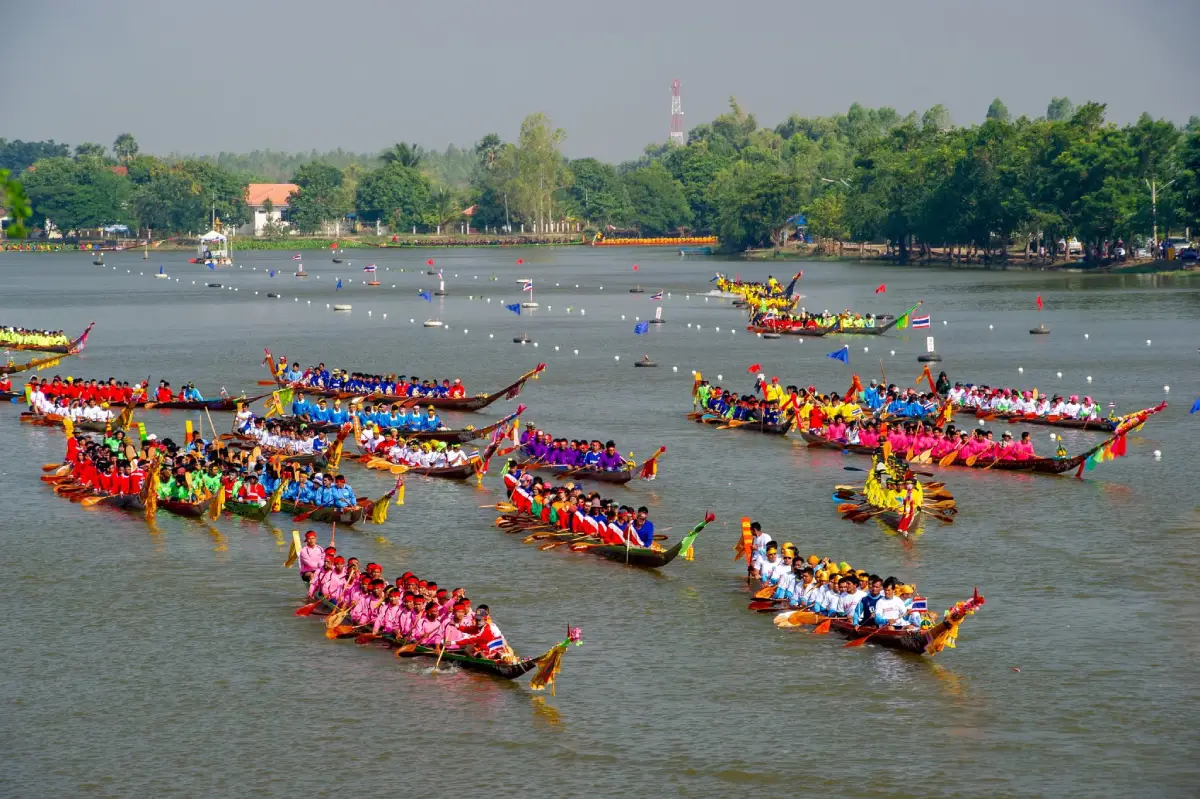
The Phimai Long Boat Race in Nakhon Ratchasima is one of the most important water-based traditions of Phimai District. Traditionally held after Ok Phansa and before the full moon of the twelfth lunar month, the race grew from the seasonal life of riverside communities during the high-water period. Today, it has developed into the Phimai Traditional Long Boat Race for royal trophies and is one of the major highlights of the Phimai Festival, held in November every year. The main racing venue is the Lam Nam Chakkarat watercourse in Phimai District, where local heritage, sport, community pride, and tourism come together in a vivid cultural event.
The significance of the Phimai Long Boat Race is not limited to speed, victory, or entertainment. At its heart, the tradition builds unity among people in the same village and across different villages. Preparing one racing boat requires the cooperation of boat owners, craftsmen, rowers, elders, monks, community leaders, families, and supporters. When a boat enters the race, it carries not only athletes but also the honor, identity, and collective spirit of its community. This is why the cheers from the riverbanks are so powerful. They are not only cheering for a team; they are cheering for a village.
Phimai has long been connected with waterways. The Chakkarat watercourse and nearby river systems shaped settlement, agriculture, transportation, merit-making, and seasonal gatherings in the district. While Phimai is widely known for Phimai Historical Park and its ancient Khmer sanctuary, the long boat race reveals another side of the town: the living culture of riverside people. It shows that Phimai is not only an archaeological destination but also a community whose traditions continue to move with the rhythm of water, season, and collective memory.
In earlier times, the race was held at the Ban Wang Hin river landing. It was later moved to Lam Talat, or Lam Nam Chakkarat, in Phimai District, where the venue could better accommodate racing boats and large audiences. This move did not weaken the meaning of the tradition. Instead, it helped the race grow from a local village gathering into a recognized racing field with wider participation. Today, Lam Nam Chakkarat is closely associated with the Phimai boat race and is one of the most memorable cultural settings of the district.
In the old village practice, once the race date was known, each community began selecting strong young men to become rowers. Physical strength was important, but it was not enough. A rower needed endurance, discipline, timing, listening skill, and the ability to move in perfect rhythm with the team. A racing boat moves quickly only when all rowers share one tempo. The training period was therefore not only athletic preparation. It was a process of building unity, patience, and trust within the village.
As the race day approached, the boat would be taken out for careful preparation. Villagers polished the underside with dry banana leaves, repainted the hull, decorated the patterns, and prepared the paddles. A racing boat was never treated as an ordinary object. It was a community treasure. Its colors, patterns, and name expressed the identity and hope of the village. Some boats had graceful names, while others had strong and powerful names that suggested speed, victory, protection, or prestige.
Before the boat was launched, villagers performed a ritual to honor Mae Ya Nang, the guardian spirit of the boat. This ritual is an important part of Thai boat culture. It asks for protection, good fortune, safety, and victory. After the offering ritual, the boat was pulled into the water, the rowers took their places, and the crew shouted together for auspicious victory. This shout was not merely noise; it was an announcement of readiness and a source of courage before the race.
On race day in the past, boats from different villages arrived together at the racing area after the monks had finished their morning meal. Officials would call each boat to present itself in order. Traditional boat names such as Muni Chom Khwan, Samian Sanoh Phro Sanan, or Muen Sathan Phaendin Wai carried poetic energy and local imagination. The names gave each boat a personality and made the race feel like a gathering of living community symbols rather than a simple sporting event.
After all boats had presented themselves, lots were drawn to match competitors. The boats were divided by size and number of rowers, such as large, medium, and small boats. In modern competition, the categories are more formal and may include divisions such as 55-rower long boats, 40-rower long boats, general long boats, and local-style long boats, according to the annual competition rules. This system allows teams of different levels and boat types to compete fairly.
The race itself is the most exciting moment. As two boats shoot forward from the start, rowers must paddle in one rhythm, the steersman must control direction precisely, and the rhythm caller must keep the team’s energy strong. A slight loss of timing can change the result. When a village boat wins, the people on the riverbanks shout, clap, and celebrate with pride. The race is therefore a public expression of joy, identity, and emotional connection between the people and their boat.
The Phimai Long Boat Race also preserves local craftsmanship. A racing boat requires knowledge of timber, hull shape, balance, weight, strength, and maintenance. A good boat must suit the water conditions, carry the right number of rowers, remain stable, and move quickly. Boat builders and caretakers are therefore as important as rowers. Cleaning, repairing, painting, storing, and blessing the boat are all part of a living body of local knowledge passed down through experience.
A major turning point came in 1989, when the tradition received support from the Tourism Authority of Thailand and related agencies and was developed into a national-level tourism activity. The schedule became clearer, with the race linked to the Phimai Festival in November. This development brought more visitors, larger organization, and greater recognition. At the same time, the original meaning of the tradition—community unity, respect for water, and pride in local heritage—remained central.
As part of the Phimai Festival, the boat race now connects with many other activities. Visitors can watch the long boat competition, enjoy the light-and-sound performance at Phimai Historical Park, walk through retro markets, experience local performances, taste local food, and explore the historic town. The festival combines sport, heritage, archaeology, performing arts, food, and community economy in one trip. This makes the Phimai Long Boat Race more than a race. It is part of a complete cultural journey.
The modern Phimai Traditional Long Boat Race is widely recognized because it includes competition for royal trophies. Teams from different areas come to compete, and the level of competition has become increasingly strong. The event now brings together local boats, experienced teams, athletes, officials, cultural organizations, and tourists. Viewers can enjoy both the grassroots charm of village racing and the intensity of a major long boat competition.
In the Phimai Festival 2025, the Traditional Long Boat Race for royal trophies was held at the Lam Nam Chakkarat long boat racing field in Phimai District. Many boats joined the competition across several divisions, including 55-rower boats, 40-rower boats, general long boats, and local-style boats. This confirmed that the Phimai race remains active, competitive, and meaningful to both the local community and Thailand’s wider long boat racing culture.
The Lam Nam Chakkarat race venue is especially attractive because it is close to Phimai Historical Park. Visitors can watch boats racing on the water while staying within the cultural atmosphere of one of Thailand’s most important ancient towns. During the festival, the surrounding area includes race administration points, viewing areas, food stalls, local product vendors, and walking connections to other festival activities. The sound of drums, rowing calls, and cheering along the river naturally connects with music and performances in the town.
The main zones of the boat race include the Lam Nam Chakkarat racing course, the starting point, the finish line, the race administration area, the boat team area, viewing areas along both banks, food and community product zones, and walking routes connecting the race with the Phimai Festival area near the historical park. Visitors should choose a safe viewing position, avoid blocking officials or teams, and stay away from launching areas unless authorized.
The race is suitable for many kinds of travelers. Families can bring children to learn about local sport and cultural teamwork. Photographers can capture colorful boats, synchronized rowers, and energetic crowds along the banks. Cultural travelers can observe boat rituals, team preparation, village pride, and the social life of the festival. Foreign visitors can quickly understand the power of teamwork by watching the rowers move as one body across the water.
To enjoy the race comfortably, visitors should arrive before the competition begins in order to find a good viewing point. It is practical to bring drinking water, a hat, an umbrella, or light rain protection because the weather can be hot or unpredictable. Comfortable shoes are recommended because visitors may need to walk between the riverbank, historical park, food stalls, and festival areas. Families with children should be especially careful around the riverbank and crowded zones.
Visitors who want to understand the culture should observe more than the race result. The boat blessing ritual, the shout for victory, boat names, hull colors, paddle designs, team uniforms, drumbeats, and cheering styles all reveal local meaning. The Phimai Long Boat Race is not only about which boat wins. It is also about memory, ritual, craftsmanship, and the relationship between community and water.
Economically, the race supports tourism in Phimai. During the festival period, hotels, restaurants, cafes, local markets, transport providers, souvenir shops, and small vendors benefit from the increase in visitors. The boat race draws people into the district and encourages them to continue exploring historical sites, museums, natural attractions, food areas, and community products. This makes the race an important part of Phimai’s cultural economy.
Local food is another highlight of a Phimai visit. Pad Mee Phimai, or Korat-style fried noodles, is one of the dishes visitors should try. The noodles are chewy and flavorful, often eaten with som tam, grilled chicken, grilled fish, roasted duck, or northeastern Thai dishes. Phimai is also known for roasted duck restaurants, riverside food, local eateries, and small cafes. Eating local food before or after the race makes the trip more complete.
Getting There from Nakhon Ratchasima city is convenient by private car. Take Highway 2, also known as Mittraphap Road, then continue onto Highway 206 toward Phimai District. Once in Phimai, follow signs to Phimai Historical Park and Lam Nam Chakkarat, where the race is held during the festival. From Bangkok, travel via Saraburi and Nakhon Ratchasima before continuing to Phimai. Public transport is also available by taking a Korat–Phimai bus from Nakhon Ratchasima Bus Terminal and continuing locally to the festival area.
Visitors driving during the festival should allow extra time for traffic and parking. The town becomes busy, especially on the final weekend when the long boat race and major performances take place. Staying overnight in Phimai or nearby areas is recommended for visitors who want to watch the daytime race and the evening light-and-sound performance without rushing.
Respectful behavior is important. Visitors should not enter team areas without permission, block boat launching routes, stand in unsafe riverbank areas, throw rubbish into the water, interrupt race officials, or climb temporary structures for photographs. If taking close-up photos of rowers or boat teams, keep a respectful distance because teams need focus before and after each race.
For foreign travelers, the Phimai Long Boat Race is highly visual and easy to appreciate. The speed of the boats, the unity of the rowers, the sound of cheering crowds, and the setting near an ancient town make the event memorable even for visitors who do not know the full history. When explained together with Phimai Historical Park and the Phimai Festival, the race helps foreigners understand that Phimai is both an ancient heritage town and a living community with active traditions.
The enduring charm of the race lies in its ability to adapt. It began as a local high-water-season activity, developed into a formal long boat competition, and now functions as part of a major provincial festival. Yet its core remains the same: respect for water, community unity, boat craftsmanship, village pride, and friendly competition. This balance between tradition and adaptation allows the Phimai Long Boat Race to remain meaningful for new generations.
Preserving the tradition requires attention to both sport and culture. The race should maintain knowledge about boat building, boat names, Mae Ya Nang rituals, rowing techniques, team training, and village stories, while also improving safety, visitor management, and tourism support. If only the competition result is remembered, the tradition becomes merely a sport. If the stories and meanings are preserved, it remains a living cultural heritage.
A recommended Phimai Festival route begins with Phimai Historical Park in the morning, followed by the long boat race at Lam Nam Chakkarat, lunch in town, a visit to Phimai National Museum or Sai Ngam in the afternoon, and the light-and-sound performance in the evening. This route allows visitors to experience Phimai through archaeology, water culture, local food, community life, and performance in one day.
In summary, the Phimai Long Boat Race is a living Thai tradition that expresses the deep relationship between people and water. From a local high-water-season event to a royal-trophy long boat competition in the Phimai Festival, it continues to preserve community unity, boat craftsmanship, ritual belief, and riverside culture. Watching the race is not only about seeing fast boats on the water. It is about experiencing the collective strength of Phimai people and the cultural spirit of one of Nakhon Ratchasima’s most important historic towns.
| Tradition Name | Phimai Long Boat Race / Phimai Traditional Long Boat Race For Royal Trophies / Long Boat Race At Phimai Festival |
| Main Venue | Lam Nam Chakkarat Long Boat Racing Field, Phimai District, Nakhon Ratchasima Province, connected with the Phimai Festival area near Phimai Historical Park |
| Address | Lam Nam Chakkarat Area, Nai Mueang Subdistrict, Phimai District, Nakhon Ratchasima 30110, Thailand |
| Annual Period | Traditionally held after Ok Phansa and before the full moon of the twelfth lunar month; now held as part of the Phimai Festival in November every year |
| Latest Confirmed Schedule | Phimai Festival 2025 was held from November 5 – 9, 2025, with the Traditional Long Boat Race for royal trophies on November 8 – 9, 2025, at Lam Nam Chakkarat, Phimai District |
| Opening Hours | Race activities follow the annual program, generally running from morning until evening |
| Fees | No Admission Fee For Viewing The Long Boat Race In Public Areas |
| Significance | A high-water-season tradition that strengthens unity among villages and preserves boat-building knowledge, boat maintenance, Mae Ya Nang rituals, and riverside community culture |
| History | The race was formerly held at Ban Wang Hin river landing, later moved to Lam Talat or Lam Nam Chakkarat, and since 1989 has been developed as a major activity in the Phimai Festival |
| Organizer / Caretaker | Nakhon Ratchasima Province, Phimai District, Nakhon Ratchasima Provincial Administrative Organization, Phimai Subdistrict Municipality, Tourism Authority Of Thailand, Fine Arts Department, local agencies, temples, communities, and the annual race committee |
| Main Contact Number | Phimai Subdistrict Municipality Tel. 044-002323, TAT Nakhon Ratchasima Office Tel. 044-213666, 1672 Travel Buddy |
| Main Areas / Zones | Lam Nam Chakkarat Racing Course Starting Point Finish Line Race Administration Area Boat Team And Rower Area Viewing Areas Along Both Riverbanks Food And Community Product Zone Walking Connection To The Phimai Festival Area Cultural Activity Area Near Phimai Historical Park |
| Main Rituals | Boat preparation and hull polishing Painting and decorating the boat Mae Ya Nang boat-spirit offering ritual Victory shout before launching Boat presentation ceremony Drawing lots for race pairs Award and trophy ceremony |
| Race Categories | General long boats, local-style long boats, and race divisions based on number of rowers such as 55-rower and 40-rower categories, according to the annual competition rules |
| Travel Information | From Nakhon Ratchasima city, take Mittraphap Road or Highway 2, then continue on Highway 206 to Phimai District. Follow signs to Phimai Historical Park and Lam Nam Chakkarat, the boat race area during the festival. |
| Visitor Tips | Arrive before the race to find a good viewing point, bring a hat, umbrella, drinking water, and comfortable shoes, avoid entering team or launching areas without permission, and check the annual schedule before traveling |
| Nearby Tourist Attractions | 1. Phimai Historical Park, about 0.5 km 2. Phimai National Museum, about 1 km 3. Phimai Victory Gate, about 1 km 4. Wat Doem Phimai, about 1 km 5. Sai Ngam Phimai, about 3 km 6. Phimai Dam, about 3 km 7. Thung Samrit Heroic Deeds Memorial, about 10 km |
| Nearby Restaurants | 1. Phot Roasted Duck, about 1.5 km, Tel. 044-928129, 098-162-3282 2. Thiw Phai Roasted Duck Phimai, about 1.5 km, Tel. 044-287500, 081-878-1466 3. Kiang Mool Phimai, about 2 km, Tel. 044-012-179 4. Tim Chong Sanguanklang, about 2 km, Tel. 081-064-6263 5. Khun Samruam Pad Mee Phimai Sai Ngam, about 3 km, Tel. 082-156-7543, 097-462-2649 6. Rim Khuean Sai Ngam Restaurant, about 3 km, Tel. 099-469-5192, 093-515-2199 |
| Nearby Accommodations | 1. Phimai Paradise Hotel, about 0.8 km, Tel. 044-287565, 044-471575, 086-4688402 2. Phimai Residence, about 1 km, Tel. 097-149-9992 3. Phimai Buri Apartment, about 1.5 km, Tel. 044-083875 4. Rabbit Hotel Phimai, about 2.5 km, Tel. 081-202-2250 5. Baan Lita Phimai, about 3 km, Tel. 088-595-2542 6. Kord Phimai Resort, about 5 km, Tel. 087-960-1177, 044-918600 |
Frequently Asked Questions (FAQ)
Q: When is the Phimai Long Boat Race held?
A: Traditionally, it was held after Ok Phansa and before the full moon of the twelfth lunar month. Today, it is held as part of the Phimai Festival in November, with exact dates announced annually.
Q: Where is the main race venue?
A: The main race venue is Lam Nam Chakkarat in Phimai District, Nakhon Ratchasima Province, near Phimai Historical Park and the Phimai Festival area.
Q: Why is the Phimai Long Boat Race important?
A: It is a high-water-season tradition that strengthens unity between villages and preserves boat-building knowledge, boat maintenance, Mae Ya Nang rituals, and riverside community culture.
Q: Is there an admission fee?
A: No. Visitors can watch the long boat race from public viewing areas along Lam Nam Chakkarat without an admission fee.
Q: What areas can visitors see at the race?
A: Visitors can see the Lam Nam Chakkarat racing course, starting point, finish line, race administration area, boat team areas, viewing areas along both banks, food stalls, community product zones, and festival walking routes.
Q: How is the race connected with the Phimai Festival?
A: Since 1989, the race has been developed as a major activity of the Phimai Festival, allowing visitors to experience boat racing, light-and-sound performances, retro markets, local food, and historic attractions in one trip.
Q: How can travelers get to the race venue?
A: From Nakhon Ratchasima city, take Mittraphap Road or Highway 2, then continue on Highway 206 to Phimai District. Follow signs to Phimai Historical Park and Lam Nam Chakkarat.
Q: What nearby attractions can be visited with the race?
A: Nearby attractions include Phimai Historical Park, Phimai National Museum, Phimai Victory Gate, Wat Doem Phimai, Sai Ngam, Phimai Dam, and Thung Samrit Heroic Deeds Memorial.
 Category: ●Art, Culture and Heritage
 Group: ●Art, Craft Centres, Tradition
Last Update : 2 WeekAgo
 Last Update : 2 WeekAgo

 Historical Sites and Monuments(20)
 Landmarks and Memorials(5)
Art, Craft Centres, Tradition(7)
Landmarks and Memorials(5)
Art, Craft Centres, Tradition(7)
 Museums(6)
 Art Gallery(1)
 Educational Places
 Educational Gardens, Farm(4)
 Places of Worship
 Temple(29)
 Mosque(1)
 Other Sacred Sites(6)
 Research and Development
 Royal Project(3)
 Suburban Living
 Village, Community(6)
 Local Market(4)
 Floating Market(1)
 Nature and Wildlife
 National Parks and Marine Reserves(3)
 Mountain (Doi)(5)
 Dam, Reservoir, Lake(8)
 Waterfalls(9)
 Hot Springs(1)
 Caves(2)
 Flower Field(1)
 River, Canal(8)
 Bays and Beaches(2)
 Other natural attractions(3)
 Entertainment and Agricultural
 Zoos and Aquariums(1)
 Animal camps and shows(1)
 Farms, Parks and Ecotourism(21)
 Waterpark(2)
 Outdoor and Adventure Activities(6)
 Shopping
 Shopping and Night Market(2)
 Travel Articles, Recipes
 Travel Review, Food Review(5)


