
lovethailand home >Northeastern Travel Attractions >Nakhon Ratchasima Travel Attractions >Si Khui >Lat Bua Khao > 4000 Year Paintings
TL;DR: 4000 Year Paintings is located at Ban Loet Sawat, Lat Bua Khao Subdistrict, Sikhio District, Nakhon Ratchasima Province, open Daily, hours Open 24 Hours.

4000 Year Paintings
Open Days: Daily
Opening Hours: Open 24 Hours
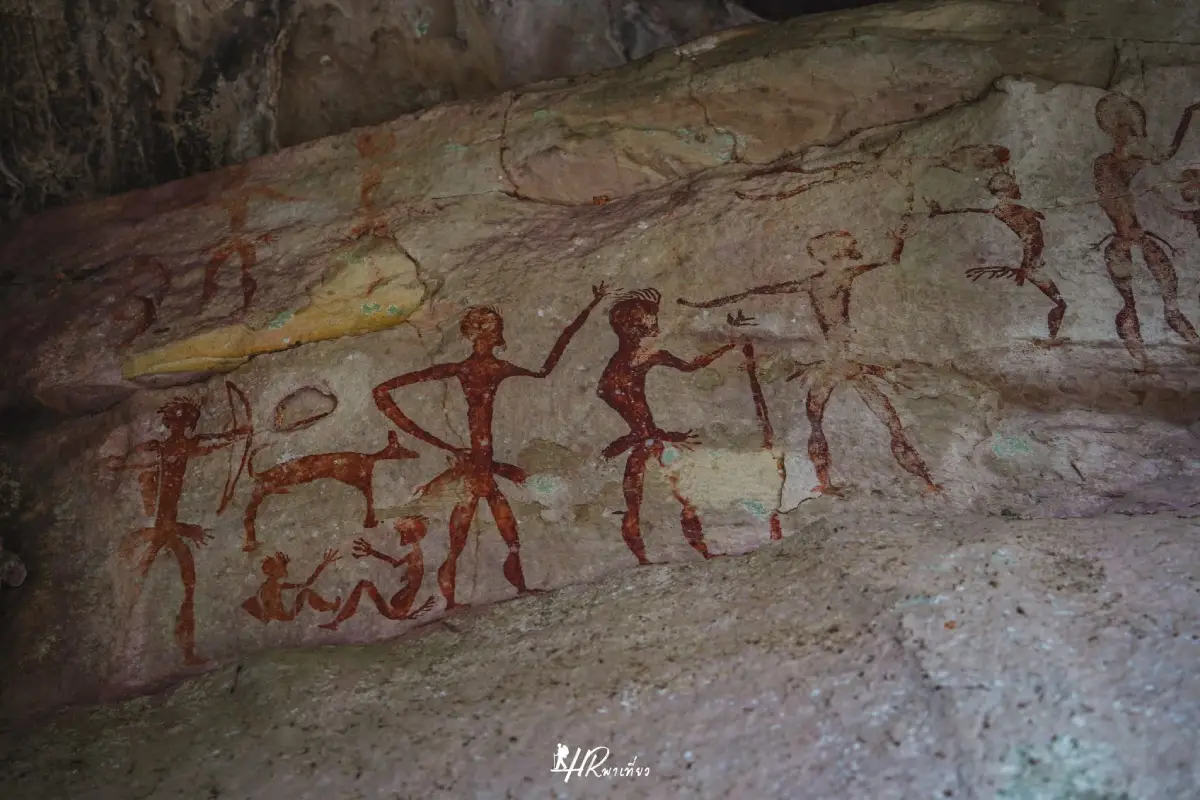
Khao Chan Ngam Prehistoric Rock Paintings at Wat Loet Sawat, also known as Wat Khao Chan Ngam, are among the most important prehistoric rock art sites in Nakhon Ratchasima Province and northeastern Thailand. Located at Ban Loet Sawat, Lat Bua Khao Subdistrict, Sikhio District, the site preserves red pictographs painted on natural sandstone shelters about 3,000–4,000 years ago. For foreign travelers, this is not just a quiet temple stop; it is an outdoor archaeological classroom where ancient human life, belief, movement, hunting, and symbolic communication can still be seen on the rock surface.
The rock paintings are located within Wat Loet Sawat, a forest temple and meditation site set on Khao Khuean Lan, near the Mittraphap Road corridor between Nakhon Ratchasima, Sikhio, Pak Chong, and Saraburi. The area is surrounded by large sandstone formations, forested slopes, walking paths, and peaceful temple grounds. Visitors come here to see prehistoric art in its original landscape, rather than inside a museum, which makes the experience more direct and memorable.
The paintings are mainly red and appear in several rock shelters and narrow sandstone passages. They have been divided into 12 groups according to their locations. The most remarkable images include human figures, animal forms, bows and arrows, line drawings, solid silhouettes, outline figures, and several symbols that remain difficult to interpret. Some human figures appear to be standing, sitting, dancing, moving, or holding weapons. These images suggest that the people who created them had a complex understanding of social life, nature, hunting, and possibly ritual activity.
One of the most distinctive aspects of Khao Chan Ngam is that the paintings are part of the natural rock environment. The sandstone boulders are arranged in a northwest-southeast direction, creating narrow passageways and sheltered spaces. Some paintings are located about 2–4 meters above the ground, so visitors need to look carefully at the rock surfaces. Certain images are faint, some are hidden in shadowed crevices, and others can be noticed only when viewed from the right angle. This makes a visit here slower and more reflective than a typical sightseeing stop.
The human figures are especially significant. Many are drawn with enlarged lower legs, simple body forms, and details that may represent clothing or body decoration. Some female figures appear to include ornamental elements. These details allow archaeologists and visitors to consider how prehistoric people may have represented gender, movement, dress, group activity, and social identity. The paintings are therefore more than decorative marks; they are visual traces of how ancient communities understood themselves and the world around them.
The animal images add another important layer of meaning. They may relate to wild animals, birds, dogs, reptiles, or other creatures known to the people who once lived in this landscape. The presence of bows and arrows suggests hunting or symbolic activity connected with animals and survival. Together, the human, animal, and weapon-like images create a visual record of the relationship between people, nature, and belief in prehistoric northeastern Thailand.
Khao Chan Ngam is generally associated with the late prehistoric period. This was a time when communities in many parts of mainland Southeast Asia were developing more settled ways of life, food production, tool use, social organization, and ritual expression. The rock paintings at this site help deepen the historical identity of Nakhon Ratchasima by showing that the area was significant long before later historical periods such as Dvaravati, Khmer influence, or the modern era.
Wat Loet Sawat itself is also important. It is a quiet Buddhist temple and meditation place surrounded by natural and cultural resources. The temple area includes religious spaces, walking routes, a path up Khao Khuean Lan, and sacred Buddhist features such as Phra Borom Saririkkathat, relics of Buddhist disciples, a reclining Buddha image, and a replica of the Four Buddha Footprints. This combination of archaeology, Buddhism, forest atmosphere, and sandstone landscape gives the site a calm and meaningful character.
The walking route to the paintings passes through temple grounds, paved sections, cement paths, earthen trails, stone gaps, and shaded forest areas. Visitors should wear comfortable shoes, dress respectfully, and bring drinking water, especially during hot weather. Since the paintings are ancient and fragile, visitors should never touch the rock surfaces, climb into restricted areas, or write on the stone. The value of the site depends on careful preservation by both local caretakers and travelers.
The site is maintained by Wat Loet Sawat together with relevant authorities, including the Fine Arts Department and the Royal Forest Department. Although many paintings remain visible, some have faded over time. This natural fading is part of the site’s long history, but human damage can be prevented. Responsible travel is therefore essential. Taking photos from a suitable distance is acceptable, but touching the paintings or using the rock surface as a photo prop is not appropriate.
For travelers interested in learning rather than rushing, Khao Chan Ngam is highly rewarding. The best way to experience it is to walk slowly, observe each wall carefully, and imagine how the rock shelters may have functioned for prehistoric communities. The relationship between the paintings, the stone formations, the shade, the height of the rock surface, and the surrounding forest helps explain why this place was chosen as a space for ancient visual expression.
Because the site is near Mittraphap Road, it can be included in a half-day cultural route or a stop between Nakhon Ratchasima city, Sikhio, Pak Chong, and Saraburi. Nearby attractions include Lam Takhong Dam, Khao Yai Thiang Viewpoint, Baan Suan Noi Wonderland, Wat Luang Pho To Sikhio, and Farm Chokchai. Travelers who enjoy archaeology, culture, scenic roads, local food, and quiet temples can combine several stops in one trip.
Getting There is most convenient by private car. From Nakhon Ratchasima city, drive west along Mittraphap Road, Highway 2, toward Sikhio District. The distance is about 50 km. Near the road section around km 200–201, turn toward Wat Loet Sawat and continue along the local paved road for about 3 km to reach the temple area. From Sikhio, drive west toward Pak Chong, then turn into the temple access road. Public transport is less convenient because the final approach to the temple requires local transfer or private transport.
The best time to visit is in the morning or late afternoon when the weather is milder. Natural light may help reveal some red details on the sandstone surface, although several images remain faint due to age. Visitors should allow enough time to observe the paintings carefully. This is not a place to rush through; it is a site where patient looking gives a much better experience.
Since the paintings are located inside a Buddhist temple, visitors should keep their voices low, avoid disturbing meditation areas, and dress modestly. A visit to Khao Chan Ngam can be both an archaeological trip and a Buddhist cultural visit. It offers a rare opportunity to connect with prehistoric heritage while also experiencing the peaceful atmosphere of a Thai forest temple.
For foreign travelers, Khao Chan Ngam is a meaningful alternative to mainstream tourist attractions in Nakhon Ratchasima. It shows that the province’s story began thousands of years before modern cities and historical monuments. The red human figures, animal forms, bows, arrows, and mysterious symbols on the rock face remain a quiet but powerful testimony to ancient creativity. They invite visitors to think about how people lived, communicated, hunted, gathered, believed, and remembered their world long before written history.
| Name | Khao Chan Ngam Prehistoric Rock Paintings, Wat Loet Sawat / Wat Khao Chan Ngam |
| Location | Ban Loet Sawat, Lat Bua Khao Subdistrict, Sikhio District, Nakhon Ratchasima Province |
| Address | Wat Loet Sawat (Khao Chan Ngam), Mittraphap Road, Lat Bua Khao Subdistrict, Sikhio District, Nakhon Ratchasima 30340, Thailand |
| Coordinates | RH7W+W2C, Lat Bua Khao, Sikhio, Nakhon Ratchasima |
| Highlights | Red prehistoric rock paintings on natural sandstone shelters, dated about 3,000–4,000 years old |
| History | Late prehistoric period, reflecting ancient communities on the Khorat Plateau |
| Distinctive Features | 12 groups of paintings, including human figures, animal images, bows, arrows, line drawings, and unresolved symbols |
| Main Areas / Zones | Temple area, meditation area, walking path up Khao Khuean Lan, sandstone shelters, rock painting viewpoints, reclining Buddha image, and replica of the Four Buddha Footprints |
| Abbot / Caretaker | Abbot: Phra Khru Bowon Silawat Caretakers: Wat Loet Sawat, the Fine Arts Department, and the Royal Forest Department |
| Travel Information | From Nakhon Ratchasima city, take Mittraphap Road, Highway 2, toward Sikhio District for about 50 km, then turn into the temple access road for about 3 km |
| Current Status | Open to visitors as an archaeological site and Buddhist meditation area within the temple |
| Open Days | Daily |
| Opening Hours | Open 24 Hours |
| Fees | No Admission Fee |
| Facilities | Parking area, temple grounds, nature walking route, meditation area, and rock painting viewpoints |
| Main Contact Number | 087-252-7496, 088-080-7530 |
| Nearby Tourist Attractions | 1. Lam Takhong Dam, about 6 km 2. Baan Suan Noi Wonderland, about 4 km 3. Khao Yai Thiang Viewpoint, about 18 km 4. Wat Luang Pho To Sikhio, about 22 km 5. Farm Chokchai, about 35 km |
| Nearby Restaurants | 1. The Rock At Mountain Creek, about 2 km 2. Mae Fong Kham Duck Noodle, about 3 km 3. Ban Rai Plai Noen, about 4 km 4. Krua Ban Suan, about 5 km 5. Campsite Bar And Cafe, about 5 km |
| Nearby Accommodations | 1. Mountain Creek Golf Resort & Residences, about 2 km, Tel. 044-756100-5, 088-885-3782, 094-889-8869 2. Baan Suan Noi Wonderland, about 4 km, Tel. 081-291-5160 3. The Green Land Farm, about 8 km 4. Hotels And Guesthouses In Sikhio District, about 15 km 5. Accommodations Around Lam Takhong Dam And Khao Yai Thiang, about 15 km |
Frequently Asked Questions (FAQ)
Q: Where are the Khao Chan Ngam rock paintings located?
A: They are located inside Wat Loet Sawat, also known as Wat Khao Chan Ngam, at Ban Loet Sawat, Lat Bua Khao Subdistrict, Sikhio District, Nakhon Ratchasima Province.
Q: How old are the Khao Chan Ngam rock paintings?
A: The paintings are approximately 3,000–4,000 years old and belong to the late prehistoric period.
Q: What can visitors see at Khao Chan Ngam?
A: Visitors can see 12 groups of red prehistoric paintings, including human figures, animal images, bows, arrows, line drawings, and ancient symbols on sandstone shelters.
Q: Is there an admission fee?
A: No. The site can be visited without an admission fee.
Q: How do travelers get to Wat Khao Chan Ngam?
A: The easiest way is by private car. From Nakhon Ratchasima city, take Mittraphap Road toward Sikhio District for about 50 km, then turn into the temple road for about 3 km.
Q: What should visitors prepare before visiting?
A: Visitors should wear comfortable shoes, dress respectfully, bring drinking water, and avoid touching or marking the rock surfaces.
Q: Who is this site suitable for?
A: It is suitable for travelers interested in archaeology, prehistoric art, Buddhist temples, nature, quiet cultural routes, and educational travel in Nakhon Ratchasima.
 Category: ●Art, Culture and Heritage
 Group: ●Historical Sites and Monuments
Last Update : 2 MonthAgo
 Last Update : 2 MonthAgo
 Click to Access the Navigation Map GPS
4000 Year Paintings Map
Recommend
 Historical Sites and Monuments(20)
 Landmarks and Memorials(5)
 Art, Craft Centres, Tradition(7)
 Museums(6)
 Art Gallery(1)
 Educational Places
 Educational Gardens, Farm(4)
 Places of Worship
 Temple(29)
 Mosque(1)
 Other Sacred Sites(6)
 Research and Development
 Royal Project(3)
 Suburban Living
 Village, Community(6)
 Local Market(4)
 Floating Market(1)
 Nature and Wildlife
 National Parks and Marine Reserves(3)
 Mountain (Doi)(5)
 Dam, Reservoir, Lake(8)
 Waterfalls(9)
 Hot Springs(1)
 Caves(2)
 Flower Field(1)
 River, Canal(8)
 Bays and Beaches(2)
 Other natural attractions(3)
 Entertainment and Agricultural
 Zoos and Aquariums(1)
 Animal camps and shows(1)
 Farms, Parks and Ecotourism(21)
 Waterpark(2)
 Outdoor and Adventure Activities(6)
 Shopping
 Shopping and Night Market(2)
 Travel Articles, Recipes
 Travel Review, Food Review(5)


