
lovethailand home >Northeastern Travel Attractions >Nakhon Ratchasima Travel Attractions >Huai Thalaeng >Thap Sawai > Farmer Wisdom Museum
TL;DR: Farmer Wisdom Museum is located at Wat Prachakhomaram, Thap Sawai Subdistrict, Huai Thalaeng District, Nakhon Ratchasima Province, open Open Daily, hours 08.00 – 17.00.
Farmer Wisdom Museum
Open Days: Open Daily
Opening Hours: 08.00 – 17.00
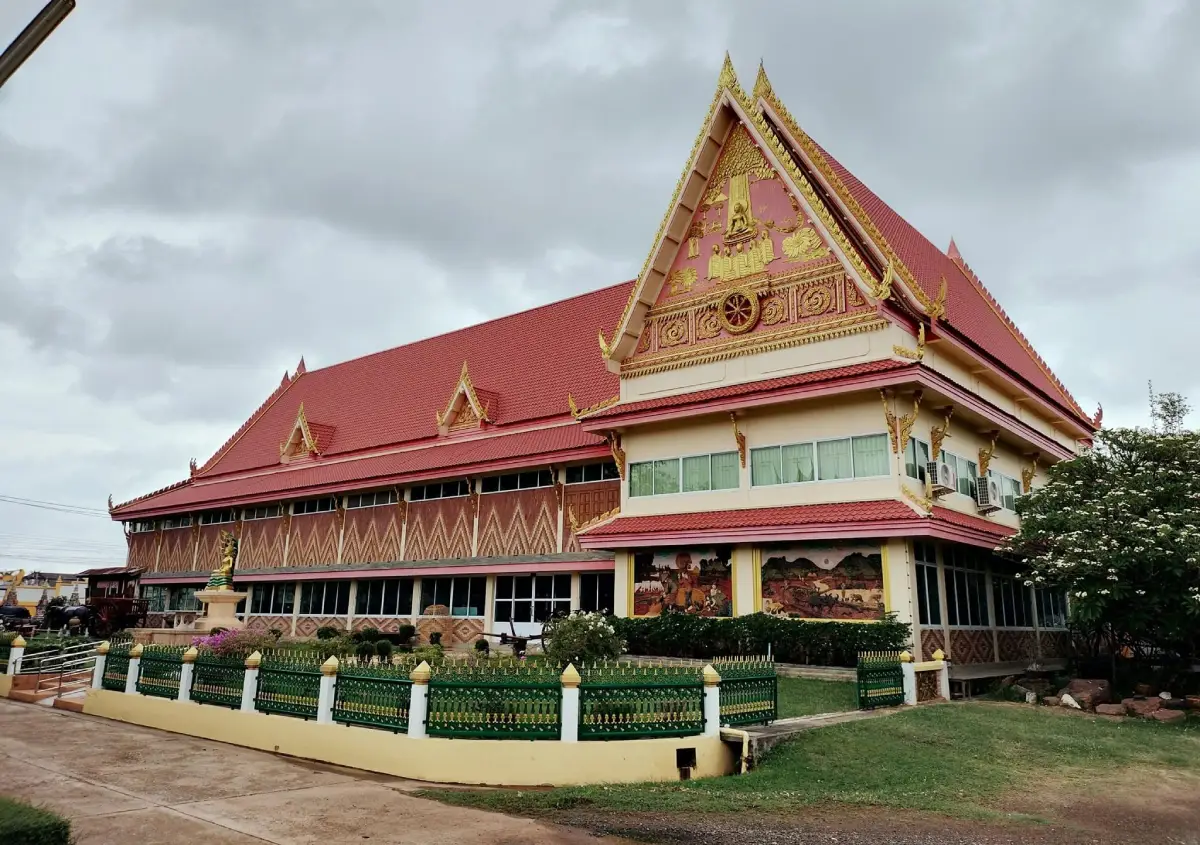
The Farmer Wisdom Museum in Nakhon Ratchasima Province is a community museum located inside Wat Prachakhomaram in Thap Sawai Subdistrict, Huai Thalaeng District. It was founded from the vision of Phra Khru Wisut Prayut, former abbot of Wat Prachakhomaram and a senior monk in Huai Thalaeng District, who believed that traditional farming tools and everyday rural objects were too valuable to be sold, discarded, or forgotten. To him, these objects were not merely old equipment. They were the material evidence of skill, knowledge, labor, patience, and the spirit of Thai farmers who sustained agricultural life for generations.
For international travelers, the museum offers a rare and meaningful opportunity to understand Thai rice-farming culture at community level. Many visitors know Thailand through rice fields, Thai food, temples, and major historical sites, but this museum reveals the practical world behind rice cultivation. It shows how farmers worked with soil, water, seasons, buffaloes, cattle, family labor, village cooperation, and handmade tools. The displays include carts, ploughs, harrows, yokes, rice-threshing tools, winnowing baskets, grain measures, woven containers, weaving tools, earthenware, brassware, textiles, and many other objects once used in everyday rural life.
The museum began when Phra Khru Wisut Prayut recognized that many traditional farming tools were disappearing as modern machinery replaced older ways of farming. Some villagers sold broken carts, old wooden tools, or unused agricultural equipment to furniture makers or scrap dealers. Objects that had once supported entire families were at risk of vanishing without their meanings being recorded. The former abbot therefore began collecting and preserving tools and household objects from people in Huai Thalaeng District and nearby communities. Wat Prachakhomaram became the place where these objects could be kept, studied, and shared as a learning resource for future generations.
The name of the museum, The Farmer Wisdom Museum, reflects its purpose clearly. The word “wisdom” refers not only to the technical knowledge of planting rice, but also to the broader system of rural life: selecting seeds, reading the seasons, preparing the soil, managing water, using animal labor, making and repairing tools, harvesting, threshing, winnowing, measuring grain, weaving, storing food, and living as a community. The museum therefore preserves more than objects. It preserves a way of thinking and a way of life shaped by generations of Thai farmers.
The museum has been open to visitors since 2002. Its roots became especially clear during the event known as the “Thai Farmer Wisdom Heritage Fair,” held on 20–21 January 2001 at Maneerat Khonkanalai Kindergarten School. During this event, Phra Khru Wisut Prayut began inviting villagers to donate farming tools and old household objects connected with rice cultivation. The response from the community was strong. Many people donated objects that had once belonged to their families. These donations were important because they represented trust in the temple and recognition that ordinary rural objects deserved to be preserved as part of local history.
A temporary one-storey wooden exhibition building was constructed around 2001. Inside, the temple displayed tools and equipment used in traditional rice farming, including ox carts, buffalo carts, wheels, different types of ploughs, wooden and iron ploughshares, rice-beating tools, yokes for cattle and buffaloes, harrows, and bamboo trays used for raising silkworms. The objects were arranged by category, and many items carried the names of their former owners. This is one of the museum’s most distinctive features. It honors the donors and reminds visitors that each object has a human story, a household history, and a connection with the local community.
The charm of the museum lies in its authenticity as a community museum. The objects are not displayed only as antiques or decorative items. They are presented as working tools that once formed part of real rural life. A cart was not simply transportation; it carried rice, firewood, crops, tools, and family belongings. A plough was not simply a wooden or metal implement; it transformed soil for planting. A yoke was not merely a frame placed on animals; it represented the relationship between humans and working cattle. A winnowing basket was not just a woven object; it was part of the careful process of separating good grain from light or empty grain. Each object speaks if visitors look closely enough.
Beyond rice-farming equipment, the museum also preserves many objects from daily village life. Some were once kept on the second floor of an old monks’ residence, including grain-measuring containers, tools used to blow away light rice grains, baskets, trays, earthenware pots, rice-sorting equipment, animal traps, and weaving tools. Other objects, including brassware and textiles, were kept separately by the abbot. These collections expand the museum’s story beyond the rice field. They show that farmers also lived as household managers, weavers, cooks, hunters, ritual participants, and members of a village economy shaped by seasons and shared labor.
As the number of objects increased, the original exhibition space became too small. Phra Khru Wisut Prayut therefore initiated the construction of a permanent building for the Farmer Wisdom Museum and the Huai Thalaeng District Cultural Center. The project began on 20 August 2005. The building was designed and supervised by the former abbot, using temple funds and donations from the community. Its purpose was to present the story of traditional rice farming and the way of life of local villagers in a more permanent and organized form. This development transformed the museum from a temporary local collection into an important cultural learning center for the district.
The museum’s location inside Wat Prachakhomaram gives it deeper meaning. In rural Thai society, a temple is not only a place for religious ceremonies. It is also a community center, a meeting place, a space for education, a place of memory, and a center of moral and cultural life. When a museum is located inside a temple, the objects remain close to the people who donated them and to the community that still remembers their use. The museum is therefore not separated from social life. It remains part of a living relationship between Buddhism, agriculture, local history, and village identity.
From the perspective of local history, the museum shows that history does not belong only to royal chronicles, ancient cities, or famous monuments. The history of ordinary people is equally important. Farming tools, weaving tools, baskets, clay pots, grain measures, and household equipment reveal how most people actually lived. They show how people worked, cooked, stored food, produced textiles, raised animals, managed crops, and supported their families. These objects tell the story of people whose names may not appear in official history, but whose labor formed the foundation of Thai society.
The carts displayed in the museum are among the most striking objects. In traditional agricultural society, carts were essential for transporting rice, firewood, crops, farming tools, and people. Their wheels, axles, wooden frames, and structural details show local knowledge of weight, balance, friction, repair, and the selection of durable wood. Even when old carts are worn or damaged, they still reveal the engineering intelligence of rural craftsmen. In the museum, they become silent teachers, showing visitors how Thai farmers moved through the landscape before modern vehicles became common.
Ploughs, harrows, yokes, and soil-preparation tools explain the work that came before planting rice. Ploughing was not simply cutting through soil. It required careful judgment about moisture, depth, direction, animal movement, and field condition. Farmers had to know when the soil was ready, how deeply to plough, how to control cattle or buffaloes, and how to repair or adjust tools. The different forms of ploughs in the museum show the development of local technology from wooden parts to stronger metal components. They also show how farmers adapted tools to changing work conditions.
Tools used after harvesting are equally important. Rice-beating tools, winnowing tools, grain measures, baskets, and containers reveal that rice production did not end with cutting the stalks. Farmers had to thresh, dry, winnow, sort, measure, store, and transport the rice carefully. These steps required physical labor and practical intelligence. Farmers had to understand wind direction, grain weight, moisture, storage conditions, and the difference between good grain and empty grain. The museum makes these invisible skills visible through the tools that once supported them.
Basketry objects such as bamboo baskets, trays, and carrying containers represent local knowledge of natural materials. Villagers selected bamboo, rattan, and other materials according to the function of each object. Some containers had to be strong enough to carry heavy loads. Others had to allow air circulation. Some were shaped for carrying on the shoulder, holding in the hand, or storing grain. Basketry in the museum is therefore not only craftwork. It is evidence of design intelligence, material knowledge, and practical problem-solving in rural life.
Weaving tools and textiles connect rice-farming life with household production. Traditional farming families did not rely only on market goods. They produced many necessary items themselves, including textiles. Weaving required skill, patience, knowledge of fiber, pattern, color, and function. Textiles also reveal the role of women and household labor in agricultural society. Seeing weaving tools displayed together with farming tools helps visitors understand that rural life was a complete system that included fieldwork, domestic work, craft production, and social cooperation.
Earthenware pots and household vessels tell the story of cooking, food storage, water storage, and family life after work in the fields. Clay pots show knowledge of local materials and firing techniques. Their shapes were designed for practical use, whether for cooking, storing, carrying, or preserving food. These objects connect the rice field to the kitchen. The rice grown in the field eventually entered the home, the cooking pot, and the family meal. Through these objects, the museum shows the full cycle of agricultural life.
Brassware and other household objects reveal another dimension of rural society: taste, ritual, beauty, and social meaning. Some objects were used in daily life, while others were associated with ceremonies or hospitality. Durable materials and refined surfaces show that rural life was not only about hardship. It also included aesthetic choices, social customs, and pride in household possessions. The museum allows visitors to see the elegance within ordinary village life.
The Farmer Wisdom Museum is especially valuable for children and students. It turns the idea of “the farmer” into something concrete and understandable. Instead of seeing rice only as a product in a market or a cooked dish on a plate, young visitors can see the tools, labor, skills, and processes behind it. They can ask how farmers prepared fields, how they used buffaloes, how they separated rice grains, how they measured grain, and how families made or repaired tools. Such questions help build respect for farmers and for the knowledge embedded in rural life.
For cultural travelers, the museum is best experienced slowly. Visitors should not treat the objects merely as old things. They should ask what each tool was used for, who used it, what material it was made from, how it was repaired, and why it was eventually replaced by modern equipment. This approach turns a simple museum visit into a deeper exploration of Thai agricultural knowledge. The museum rewards careful observation because many of its most important meanings are found in small details.
For international visitors, the museum provides a practical explanation of rural Thai rice culture. Thailand is often associated with rice, but the deeper culture of rice farming is not always visible to travelers. Here, visitors can see real tools and objects that explain how rice culture shaped families, temples, seasonal rhythms, animal labor, food habits, craft production, and community cooperation. The museum shows that rice farming in Thailand was not only an economic activity. It was a complete way of life.
Visitors should allow at least 1 to 1.5 hours for the museum. Those with a strong interest in rural culture, agriculture, or community museums may want to stay longer. The details of farming tools, carts, baskets, weaving equipment, and household objects can be understood more deeply when viewed patiently. A slow visit allows travelers to connect each object with a stage of rice production or with a part of village life.
Since the museum is located inside a temple, visitors should dress politely and behave respectfully. They should not move, climb on, touch, or handle displayed objects without permission. Old carts, wooden tools, and woven objects may be fragile. Children should be supervised closely. Respectful behavior protects not only the objects but also the memory of the families who donated them and the community that preserves them.
Getting There is most convenient by private car. Set the destination to Wat Prachakhomaram, Thap Sawai Subdistrict, Huai Thalaeng District, Nakhon Ratchasima Province. From Nakhon Ratchasima city, travel toward Huai Thalaeng District, then continue to Thap Sawai Subdistrict and Wat Prachakhomaram. The museum is located inside the temple grounds. Visitors without a private vehicle can travel to Huai Thalaeng first, then use local transport to reach the temple.
A private car is the most flexible option for visitors who want to combine the museum with other sites in the area. A cultural route may include the Farmer Wisdom Museum, community sites in Thap Sawai, Lam Chamuak Reservoir, or a longer connection to Phimai District. This route is suitable for travelers who want to see Khorat beyond the main city and understand rural heritage at community level.
The museum also connects well with the identity of Thap Sawai Subdistrict, which promotes rice-related community heritage, local products, and cultural activities. This connection allows visitors to understand both the past and present of an agricultural community. The museum is not only about old tools. It is part of a larger story about how a rural community continues to preserve and reinterpret its heritage.
Overall, the Farmer Wisdom Museum in Nakhon Ratchasima is a valuable cultural learning center for anyone interested in rice, rural life, local wisdom, and the role of temples in Thai communities. It preserves real tools and objects that represent the knowledge of ordinary people. It is open daily, has no admission fee, and is suitable for families, students, cultural travelers, researchers, and foreign visitors who want a more grounded understanding of Thai agricultural heritage.
In summary, the Farmer Wisdom Museum is not simply a place where old carts, ploughs, and farming tools are kept. It is a place where visitors can understand how farmer knowledge forms a foundation of Thai culture. Every object in the museum reflects the effort of earlier generations to live with nature, produce food, support families, and pass knowledge through real work. A visit here is both a tribute to Thai farmers and a meaningful lesson in the continuing value of local wisdom.
| Name | The Farmer Wisdom Museum |
| Location | Wat Prachakhomaram, Thap Sawai Subdistrict, Huai Thalaeng District, Nakhon Ratchasima Province |
| Address | 73 Moo 8, Thap Sawai Subdistrict, Huai Thalaeng District, Nakhon Ratchasima 30240, Thailand |
| Highlights | A temple-based community museum preserving traditional Thai farming tools, carts, ploughs, harrows, yokes, baskets, weaving tools, earthenware, textiles, and household objects related to rice-farming life |
| History | Initiated by Phra Khru Wisut Prayut, former abbot of Wat Prachakhomaram. The museum has been open since 2002, and the permanent museum and district cultural center project began on 20 August 2005. |
| Name Origin | The name reflects the mission to preserve and continue the wisdom of Thai farmers, especially knowledge connected with rice cultivation, rural tools, and village life. |
| Distinctive Features | Real objects donated by villagers from Huai Thalaeng District and nearby communities, many carrying the names of former owners, showing the connection between temple, community, and farming heritage |
| Travel Information | From Nakhon Ratchasima city, travel toward Huai Thalaeng District, continue to Thap Sawai Subdistrict, and proceed to Wat Prachakhomaram. A private car is the most convenient option, while local transport can be arranged from Huai Thalaeng. |
| Current Status | Open as a community learning center and folk museum inside Wat Prachakhomaram |
| Open Days | Open Daily |
| Opening Hours | 08.00 – 17.00 |
| Fees | No Admission Fee |
| Facilities | Temple parking area, exhibition building, religious area, community learning space, and advance booking for group visits |
| Main Areas / Zones | 1. Farmer Wisdom Museum Exhibition Building 2. Huai Thalaeng District Cultural Center 3. Carts, Ox Carts, Buffalo Carts, Wheels, And Cart Components Zone 4. Ploughs, Harrows, Yokes, Ploughshares, And Soil Preparation Tools Zone 5. Rice-Beating Tools, Winnowing Tools, Grain Measures, And Post-Harvest Tools Zone 6. Basketry, Bamboo Baskets, Trays, And Household Containers Zone 7. Weaving Tools, Textiles, Brassware, Earthenware, And Daily Life Objects Zone |
| Abbot / Caretaker | Abbot of Wat Prachakhomaram: Phra Khru Kittiprachakon / Founder of the Museum: Phra Khru Wisut Prayut / Museum Caretaker: Wat Prachakhomaram And Thap Sawai Community |
| Main Contact Number | 081-976-9523 |
| Local Administrative Office | Thap Sawai Subdistrict Administrative Organization, Tel. 044-391-374 |
| Nearby Tourist Attractions | 1. Rice Castle / Thap Sawai Community Activity Area, about 1 km 2. Thap Sawai Sufficiency Economy Model Village, about 2 km 3. Thap Sawai Community Fund Management Institute, about 2 km 4. Onson Na Cafe & Farmstay, Huai Thalaeng District, about 18 km 5. Lam Chamuak Reservoir, about 28 km 6. Phimai Historical Park, about 40 km, Tel. 044-471-568 7. Phimai National Museum, about 41 km, Tel. 044-471-167 |
| Nearby Restaurants | 1. Jungle Cafe Huai Thalaeng Branch, about 10 km, Tel. 086-023-0263 2. Phuean Rao Restaurant Huai Thalaeng, about 10 km, Tel. 044-301-245 3. Cartoon Café Huai Thalaeng, about 10 km, Tel. 081-760-4489 4. Phon Nuea Yang Branch 3, about 11 km, Tel. 081-997-7722 |
| Nearby Accommodations | 1. Tiyakorn Resort, about 3 km, Tel. 084-473-2626 2. Suksan Resort, about 8 km, Tel. 098-631-9795 3. Baan Nong, about 10 km, Tel. 088-782-3021 4. Phet Naka Resort Huai Thalaeng, about 12 km, Tel. 062-135-4358 |
Frequently Asked Questions (FAQ)
Q: Where is the Farmer Wisdom Museum located?
A: The museum is located inside Wat Prachakhomaram at 73 Moo 8, Thap Sawai Subdistrict, Huai Thalaeng District, Nakhon Ratchasima 30240, Thailand.
Q: What days and hours is the museum open?
A: The museum is open daily from 08.00 to 17.00.
Q: Is there an admission fee?
A: No. The Farmer Wisdom Museum does not charge an admission fee.
Q: Who founded the Farmer Wisdom Museum?
A: The museum was initiated by Phra Khru Wisut Prayut, former abbot of Wat Prachakhomaram, who collected farming tools and rural objects to preserve Thai farmer wisdom for future generations.
Q: What can visitors see inside the museum?
A: Visitors can see traditional rice-farming tools and rural household objects such as carts, ploughs, harrows, yokes, rice-beating tools, winnowing baskets, grain measures, basketry, weaving tools, textiles, earthenware, brassware, and other objects related to Thai farming life.
Q: How long should visitors spend at the museum?
A: Visitors should allow at least 1 to 1.5 hours to explore the main displays, understand the farming tools, and learn about traditional Thai rice-farming wisdom.
Q: How can travelers get to the Farmer Wisdom Museum?
A: From Nakhon Ratchasima city, travel toward Huai Thalaeng District, continue to Thap Sawai Subdistrict, and proceed to Wat Prachakhomaram. A private car is the most convenient option.
Q: What nearby places can be visited after the museum?
A: Nearby places include the Rice Castle and community activity area in Thap Sawai, Thap Sawai Sufficiency Economy Model Village, Onson Na Cafe & Farmstay, Lam Chamuak Reservoir, Phimai Historical Park, and Phimai National Museum.
 Category: ●Art, Culture and Heritage
 Group: ●Museums
Last Update : 2 MonthAgo
 Last Update : 2 MonthAgo
 Click to Access the Navigation Map GPS
Farmer Wisdom Museum Map
Recommend

 Historical Sites and Monuments(20)
 Landmarks and Memorials(5)
 Art, Craft Centres, Tradition(7)
Museums(6)
Art, Craft Centres, Tradition(7)
Museums(6)
 Art Gallery(1)
 Educational Places
 Educational Gardens, Farm(4)
 Places of Worship
 Temple(29)
 Mosque(1)
 Other Sacred Sites(6)
 Research and Development
 Royal Project(3)
 Suburban Living
 Village, Community(6)
 Local Market(4)
 Floating Market(1)
 Nature and Wildlife
 National Parks and Marine Reserves(3)
 Mountain (Doi)(5)
 Dam, Reservoir, Lake(8)
 Waterfalls(9)
 Hot Springs(1)
 Caves(2)
 Flower Field(1)
 River, Canal(8)
 Bays and Beaches(2)
 Other natural attractions(3)
 Entertainment and Agricultural
 Zoos and Aquariums(1)
 Animal camps and shows(1)
 Farms, Parks and Ecotourism(21)
 Waterpark(2)
 Outdoor and Adventure Activities(6)
 Shopping
 Shopping and Night Market(2)
 Travel Articles, Recipes
 Travel Review, Food Review(5)


