
lovethailand home >Northeastern Travel Attractions >Nakhon Ratchasima Travel Attractions >Muang Nakhon Ratchasima >Nai Muang > San Phra Narai Shrine
TL;DR: San Phra Narai Shrine is located at Chumphon Road, behind Wat Phra Narai Maharat Worawihan, west of the ordination hall in the lotus pond, Nai Mueang Subdistrict, Mueang, open Daily, hours 08.00 – 17.00.
San Phra Narai Shrine
Open Days: Daily
Opening Hours: 08.00 – 17.00
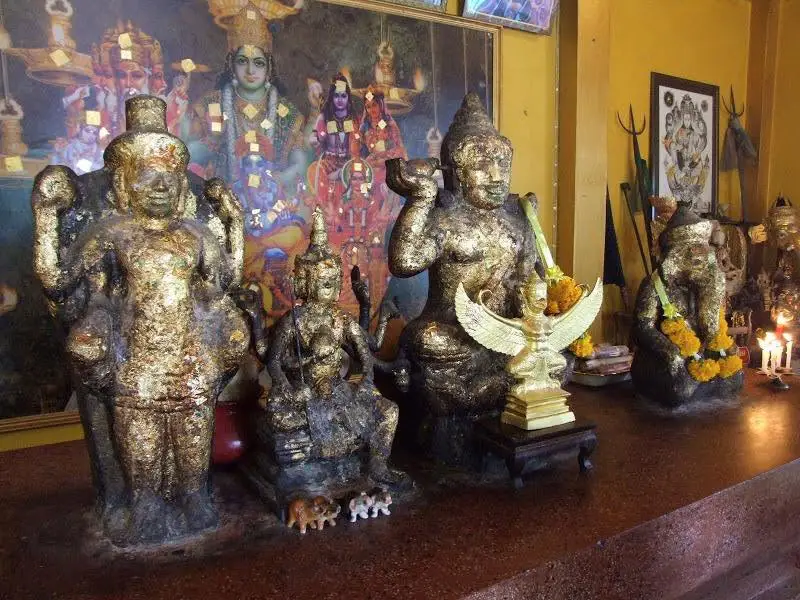
San Phra Narai Shrine, also known as Thevasathan San Phra Narai, is located on Chumphon Road behind Wat Phra Narai Maharat Worawihan, on the western side of the ordination hall in the middle of the lotus pond, in Nai Mueang Subdistrict, Mueang Nakhon Ratchasima District. It is one of Korat’s long-respected sacred sites and a meaningful religious landmark within the old city of Nakhon Ratchasima. The shrine houses ancient stone images of Shiva, Narayana, and Ganesha, created in the ancient Khmer artistic tradition around 957–1157 CE. This makes the shrine important not only as a place of worship, but also as a cultural site where Buddhism, Brahman-Hindu belief, Khmer art, royal history, and the old urban landscape of Korat meet in one compact sacred space.
The value of San Phra Narai Shrine does not depend on size alone. Its importance comes from several layers of meaning: it is an old sacred shrine, it is closely related to King Narai the Great, it is located inside the historic Wat Phra Narai Maharat Worawihan, and it continues to be a living place of worship for local people. Visitors who come here can experience a sacred site located close to markets, old roads, Nakhon Ratchasima City Pillar Shrine, Chumphon Gate, and Thao Suranari Monument. The shrine therefore belongs to the spiritual and historical core of old Korat.
San Phra Narai Shrine reflects the natural coexistence of Buddhist and Brahman-Hindu traditions in Thai culture. Within the grounds of Wat Phra Narai Maharat, visitors find Buddhist sacred spaces, Buddha images, an ordination hall, a main viharn, and the shrine that houses Hindu deities. These sacred areas exist together without feeling separate from one another. This layered character shows how Thai religious culture often combines Buddhist devotion, Hindu cosmology, royal symbolism, local belief, and community practice in one shared setting.
Narayana, or Vishnu, is one of the major deities in Hinduism. He is associated with protection, preservation, cosmic order, and divine guardianship. In the context of Nakhon Ratchasima, the name Narai is also connected with King Narai the Great, who played an important role in the development of the city during the Ayutthaya period. The presence of San Phra Narai inside Wat Phra Narai Maharat gives the place strong religious and historical meaning, linking deity worship, city history, and royal memory.
During the reign of King Narai the Great between 1656 and 1688, Buddhist sites and Brahman-Hindu shrines were built or restored in many parts of the kingdom. Nakhon Ratchasima was an important frontier city and a gateway between central Thailand and the northeastern region. Wat Phra Narai Maharat became an important Buddhist site of the city, while San Phra Narai represented the Brahman-Hindu sacred dimension connected with auspiciousness, royal authority, and the protection of the city.
Wat Phra Narai Maharat Worawihan, formerly known as Wat Klang Nakhon, is an old temple in the heart of Nakhon Ratchasima. It stands among important city streets, including Atsadang Road, Jomphon Road, Prachak Road, and Chumphon Road. Historically, the temple functioned as a central religious site of the old city. Because San Phra Narai is located behind the temple near the ordination hall in the lotus pond, the shrine becomes part of a highly meaningful sacred landscape that includes Buddhist worship, Hindu deities, the old city plan, and local community life.
The Narayana image inside the temple area is an ancient sandstone sculpture in the Khmer style. It depicts four-armed Narayana standing and is regarded as an important sacred image of Nakhon Ratchasima. The presence of this sculpture reveals the influence of ancient Khmer art in the Korat region and the lower northeastern part of Thailand. Nakhon Ratchasima contains many historical traces connected with Khmer cultural networks, and the image at San Phra Narai helps link modern Korat with a much older cultural and artistic past.
In addition to Narayana, the shrine also contains images of Shiva and Ganesha. Shiva is associated with sacred power, transformation, and cosmic force, while Ganesha is widely respected as the deity of wisdom, success, and the removal of obstacles. The presence of these three deities in the same shrine gives San Phra Narai a broad devotional meaning. People come to pray for success, protection, wisdom, stability, and smooth beginnings in life, study, trade, and work.
On 22 December 1900, King Chulalongkorn, Rama V, visited Wat Phra Narai Maharat. During the royal visit, he offered worship to the Buddha images in the main viharn and the ordination hall in the middle of the lotus pond. He also offered ritual worship to the Narayana and Ganesha images at Ho Phra Narai. This event gives the shrine an additional royal historical dimension and confirms the importance of the site within the sacred geography of Nakhon Ratchasima.
The royal visit of King Rama V shows that Wat Phra Narai Maharat and San Phra Narai were important beyond local devotion. They were sacred places recognized within the wider history of the Thai monarchy and provincial administration. The area contained Buddhist worship, deity worship, and city ritual significance. This makes the shrine part of a network of sacred places that includes temples, shrines, city pillars, and old urban landmarks.
San Phra Narai was renovated and rebuilt in 1968, when the new shrine was established under the name Sathan Phra Narai. This renovation helped provide a suitable space for worship and allowed the shrine to continue serving devotees who came to make offerings and perform rituals. The shrine seen today is therefore the result of continued care, devotion, and adaptation within a changing urban environment.
The atmosphere of San Phra Narai is different from other parts of the temple. It has the character of a deity shrine, with offerings, flowers, incense, candles, and ritual objects presented by worshippers. People come to pay respect to Narayana, Shiva, and Ganesha for blessings related to work, study, trade, new beginnings, and general auspiciousness. The shrine remains active through living worship rather than functioning only as a historical display.
The position of the shrine behind Wat Phra Narai Maharat allows visitors to explore several important sacred spaces in one route. They can visit the ordination hall in the lotus pond, the main viharn, the old central temple area, the nearby City Pillar Shrine, and San Phra Narai. These places are close to one another and reveal the old city of Korat through Buddhist religion, Brahman-Hindu worship, city guardianship, markets, and old streets.
The ordination hall in the middle of the lotus pond is one of the most meaningful areas of Wat Phra Narai Maharat. It stands on an island in the pond on the eastern side of the temple, reflecting a distinctive sacred layout. Since San Phra Narai is located west of this ordination hall, visitors can clearly see the relationship between Buddhist sacred space and the shrine dedicated to Hindu deities within the same temple compound.
Wat Phra Narai Maharat is also connected with the memory of Thao Suranari. The temple was once the site of a monument containing the remains of Thao Suranari at the northwestern corner of the temple before it was moved to Chumphon Gate in 1934. This connection links Wat Phra Narai, San Phra Narai, Nakhon Ratchasima City Pillar Shrine, Chumphon Gate, and Thao Suranari Monument into one historical and spiritual landscape.
San Phra Narai is surrounded by markets and commercial buildings, giving the area an active urban atmosphere. Outside the shrine, the city is busy with shops, traffic, local people, and visitors. Inside the shrine, the atmosphere is more solemn and devotional. This contrast between urban movement and sacred stillness is one of the distinctive features of a shrine located in the heart of an old city.
For worshippers, a visit often begins with flowers, incense, candles, or suitable ritual offerings. Devotees then pray respectfully to Narayana, Shiva, and Ganesha. Some come for success in work or study, some for protection and stability, and others for auspicious beginnings. The shrine brings together several forms of belief in one place and allows worshippers to connect their personal wishes with a long-standing sacred tradition.
Visitors should behave respectfully inside the shrine. Modest clothing, quiet speech, careful movement, and respect for worshippers are important. Visitors should not touch sacred images or other people’s offerings. Photography should be done only when it does not disturb worship or ritual activity. Since the shrine is an active sacred place, its atmosphere should be preserved for those who come to pray.
Getting There is convenient because the shrine is located in central Nakhon Ratchasima. Visitors can go to Chumphon Road behind Wat Phra Narai Maharat Worawihan or use the approximate coordinates 14.975269, 102.108378. From Thao Suranari Monument or Chumphon Gate, the shrine is within a short distance. From Nakhon Ratchasima Railway Station, the bus terminal, or city hotels, visitors can use a songthaew, local taxi, or app-based ride to reach Chumphon Road and the Wat Phra Narai Maharat area.
Travelers arriving by private car from Bangkok or nearby provinces can enter Nakhon Ratchasima via Mittraphap Road, then continue toward Thao Suranari Monument, Chumphon Gate, Jomphon Road, and Chumphon Road. The area around Wat Phra Narai Maharat is part of the old city, with several connected streets. Parking may be limited at busy times, so many visitors park in an appropriate nearby area and continue on foot.
A typical visit takes about 30 minutes to 1 hour if visitors want to pay respect at the shrine, see the deity images, and continue to the lotus-pond ordination hall or the City Pillar Shrine. Visitors who plan to include Wat Phra Narai Maharat, Chumphon Gate, Thao Suranari Monument, and nearby museums should allow at least half a day. The old city of Korat contains many meaningful places located close together.
The best time to visit is in the morning or late afternoon. Morning is quieter and suitable for worship and walking within the temple area. Late afternoon is good for continuing to cafés, restaurants, and nearby old-city attractions. On weekends, holidays, or during city events, the area around Thao Suranari Monument, markets, and Wat Phra Narai Maharat can be busy, so extra travel time is useful.
San Phra Narai can be included in a meaningful old-city route. Visitors may begin at Nakhon Ratchasima City Pillar Shrine, continue to Wat Phra Narai Maharat and San Phra Narai, then walk or drive to Chumphon Gate and Thao Suranari Monument. This route shows the spiritual core of Korat through the city pillar, Brahman-Hindu shrine, central Buddhist temple, old city gate, and the heroine monument.
Maha Weerawong National Museum is another nearby place suitable for visitors who want to understand the art, history, and cultural heritage of Nakhon Ratchasima. Korat Museum at Nakhon Ratchasima Rajabhat University is also useful for learning about the city’s history, archaeology, local culture, and way of life. Combining San Phra Narai with these museums gives visitors a deeper understanding of Korat beyond a short worship visit.
Food options around San Phra Narai are varied because the shrine is located near the old city, Jomphon Road, Chumphon Road, Prachak Road, Ya Mo Market, and the Thao Suranari area. Visitors can pay respect at the shrine and then stop for coffee, local food, desserts, or a meal within a short walking or driving distance. The surrounding streets have cafés, Thai restaurants, market eateries, and small local shops.
Accommodation near San Phra Narai is available throughout central Nakhon Ratchasima. Visitors who want to explore the old city can stay near Jomphon Road, Atsadang Road, Pho Klang Road, Terminal21 Korat, or the Ya Mo area. Those planning to continue toward Phimai, Khao Yai, or other provinces may prefer hotels with easier access to Mittraphap Road or major transport routes.
For international visitors, San Phra Narai helps explain the religious diversity of Thailand in a clear and tangible way. In one compact area, visitors can see a Buddhist temple, a Brahman-Hindu deity shrine, a city pillar shrine, markets, and the old urban fabric of Korat. This shows that Thai belief has often developed through layers of Buddhism, Hindu cosmology, local worship, royal history, and community practice rather than through a single isolated tradition.
The ancient Khmer-style sculpture inside the shrine also opens a window into the history of the lower northeastern region. Nakhon Ratchasima was part of an important cultural zone connected with Khmer art and religious architecture. The sandstone deity images help visitors see traces of earlier artistic and religious traditions that continued to shape the meaning of the city long after the original period of the sculptures.
The shrine also continues to play a role in everyday devotion. Some worshippers come before starting a new job, beginning a business, taking an examination, or seeking encouragement. Others visit after paying respect to Thao Suranari or the City Pillar Shrine. These patterns of worship show that San Phra Narai remains part of the spiritual rhythm of Korat rather than a place visited only for sightseeing.
Photography should be done respectfully. Exterior views, shrine details, architectural features, and the relationship between the shrine and Wat Phra Narai Maharat are suitable subjects. If worshippers are present or a ritual is taking place, close photography and flash should be avoided. Respecting privacy and sacred atmosphere is essential at an active shrine.
Overall, San Phra Narai Shrine is an important sacred site for understanding Nakhon Ratchasima. It brings together the age of King Narai the Great, the old central temple of Korat, the coexistence of Buddhist and Brahman-Hindu traditions, ancient Khmer-style deity images, the royal visit of King Rama V, and living worship in the modern city. The shrine is valuable for visitors interested in history, art, religion, and the cultural identity of old Korat.
A visit to San Phra Narai feels different from visiting a large tourist site. The place is compact, but its stories are dense. Visitors can spend a short time paying respect and observing the shrine, then continue easily to the temple, City Pillar Shrine, market, Chumphon Gate, and Thao Suranari Monument. This old-city route reveals Korat through faith, sculpture, royal memory, and everyday urban life.
In summary, San Phra Narai Shrine is one of Nakhon Ratchasima’s sacred city shrines, important for its history, religious meaning, ancient art, and cultural setting. It houses Shiva, Narayana, and Ganesha images in the ancient Khmer style and stands behind Wat Phra Narai Maharat Worawihan, near the City Pillar Shrine, Chumphon Gate, and Thao Suranari Monument. The shrine reflects the layered identity of Korat as an old city where Buddhism, Brahman-Hindu belief, royal history, Khmer art, and local devotion continue to meet in one living sacred place.
| Name | San Phra Narai Shrine / Thevasathan San Phra Narai |
| Location | Chumphon Road, behind Wat Phra Narai Maharat Worawihan, west of the ordination hall in the lotus pond, Nai Mueang Subdistrict, Mueang Nakhon Ratchasima District, Nakhon Ratchasima Province 30000 |
| Address | Inside the Wat Phra Narai Maharat Worawihan area, Chumphon Road, Nai Mueang, Mueang Nakhon Ratchasima, Nakhon Ratchasima 30000, near the City Pillar Shrine, Chumphon Gate, and Thao Suranari Monument |
| Coordinates | 14.975269, 102.108378 |
| Highlights | A sacred city shrine of Nakhon Ratchasima, ancient Khmer-style images of Shiva, Narayana, and Ganesha, and a site showing the coexistence of Buddhism and Brahman-Hindu belief in old Korat |
| History | Associated with the reign of King Narai the Great between 1656 and 1688. The deity images are in ancient Khmer style from around 957–1157 CE. The shrine was renovated and rebuilt in 1968 under the name Sathan Phra Narai |
| Name Origin | The name comes from the Narayana image enshrined at the site and its relationship with Wat Phra Narai Maharat Worawihan |
| Distinctive Features | A compact deity shrine inside an old central temple, with offerings, flowers, and a living devotional atmosphere, located near the lotus-pond ordination hall and the Nakhon Ratchasima City Pillar Shrine |
| Important Sacred Objects | Images of Shiva, Narayana, Ganesha, and the four-armed Narayana sandstone sculpture in ancient Khmer style |
| Relationship With Wat Phra Narai Maharat | Located behind Wat Phra Narai Maharat Worawihan, west of the ordination hall in the lotus pond, within an old central temple of Nakhon Ratchasima |
| Travel Information | Accessible from central Nakhon Ratchasima via Chumphon Road behind Wat Phra Narai Maharat Worawihan, near the City Pillar Shrine, Chumphon Gate, and Thao Suranari Monument. Visitors can use private car, songthaew, local taxi, or app-based transport |
| Current Status | Open for worship and respectful visits as a sacred deity shrine in old Nakhon Ratchasima |
| Open Days | Daily |
| Opening Hours | 08.00 – 17.00 |
| Facilities | Worship area, offering area, deity image area, walkways within the temple grounds, and nearby shops in the old city area |
| Main Areas / Zones | Narayana worship area, Shiva and Ganesha worship area, offering area, the rear area of Wat Phra Narai Maharat, and the connection to the lotus-pond ordination hall |
| Caretaker | Wat Phra Narai Maharat Worawihan and shrine caretakers within the temple area |
| Nearby Tourist Attractions | 1. Wat Phra Narai Maharat Worawihan – within the same area 2. Nakhon Ratchasima City Pillar Shrine – about 200 m 3. Chumphon Gate – about 500 m 4. Thao Suranari Monument – about 600 m 5. Maha Weerawong National Museum – about 1 km 6. Korat Museum – about 3 km – Tel. 044-009-009 ext. 1011 |
| Nearby Restaurants | 1. Jompol Cafe – about 400 m – Tel. 081-547-4906 2. Jompol Boutique Cafe – about 500 m – Tel. 064-462-8787 3. Ta Sushi Ya Mo Market – about 800 m – Tel. 061-974-5885 4. Krua Mae Or Fish Maw Soup, Ya Mo Market – about 800 m – Tel. 095-447-7939 5. Jompol Nam Khaeng Sai – about 1 km – Tel. 098-638-2878 |
| Nearby Accommodations | 1. Korat Hotel – about 800 m – Tel. 044-341-345 2. Tokyo Hotel Korat – about 1 km – Tel. 044-242-788 3. Siri Hotel Nakhon Ratchasima – about 2 km – Tel. 044-341-822 4. Centre Point Hotel Terminal21 Korat – about 2 km – Tel. 044-498-880 5. The Imperial Hotel & Convention Centre Korat – about 4 km – Tel. 044-256-629 |
Frequently Asked Questions (FAQ)
Q: Where is San Phra Narai Shrine located?
A: San Phra Narai Shrine is located on Chumphon Road behind Wat Phra Narai Maharat Worawihan, west of the ordination hall in the lotus pond, in Nai Mueang Subdistrict, Mueang Nakhon Ratchasima District, Nakhon Ratchasima Province 30000.
Q: What are the opening days and hours of San Phra Narai Shrine?
A: The shrine is open daily from 08.00 to 17.00.
Q: Which deities are enshrined at San Phra Narai Shrine?
A: The shrine houses images of Shiva, Narayana, and Ganesha, including a four-armed Narayana sandstone image in the ancient Khmer style.
Q: Why is San Phra Narai Shrine important?
A: It is a sacred city shrine of Nakhon Ratchasima and reflects the connection between Buddhism, Brahman-Hindu belief, ancient Khmer art, and the history of old Korat.
Q: How is San Phra Narai Shrine connected with King Rama V?
A: On 22 December 1900, King Chulalongkorn visited Wat Phra Narai Maharat and offered ritual worship to the Narayana and Ganesha images at Ho Phra Narai.
Q: How can travelers get to San Phra Narai Shrine?
A: Travelers can go to Chumphon Road behind Wat Phra Narai Maharat Worawihan, near the City Pillar Shrine, Chumphon Gate, and Thao Suranari Monument. The shrine is accessible by private car, songthaew, local taxi, or app-based transport within central Korat.
Q: What attractions are near San Phra Narai Shrine?
A: Nearby attractions include Wat Phra Narai Maharat Worawihan, Nakhon Ratchasima City Pillar Shrine, Chumphon Gate, Thao Suranari Monument, Maha Weerawong National Museum, and Korat Museum.
 Category: ●Places of Worship
 Group: ●Other Sacred Sites
Last Update : 1 MonthAgo
 Last Update : 1 MonthAgo
 Click to Access the Navigation Map GPS
San Phra Narai Shrine Map
Recommend

 Art, Culture and Heritage
 Historical Sites and Monuments(20)
 Landmarks and Memorials(5)
 Art, Craft Centres, Tradition(7)
 Museums(6)
 Art Gallery(1)
 Educational Places
 Educational Gardens, Farm(4)
 Temple(29)
 Mosque(1)
Other Sacred Sites(6)
Mosque(1)
Other Sacred Sites(6)
 Research and Development
 Royal Project(3)
 Suburban Living
 Village, Community(6)
 Local Market(4)
 Floating Market(1)
 Nature and Wildlife
 National Parks and Marine Reserves(3)
 Mountain (Doi)(5)
 Dam, Reservoir, Lake(8)
 Waterfalls(9)
 Hot Springs(1)
 Caves(2)
 Flower Field(1)
 River, Canal(8)
 Bays and Beaches(2)
 Other natural attractions(3)
 Entertainment and Agricultural
 Zoos and Aquariums(1)
 Animal camps and shows(1)
 Farms, Parks and Ecotourism(21)
 Waterpark(2)
 Outdoor and Adventure Activities(6)
 Shopping
 Shopping and Night Market(2)
 Travel Articles, Recipes
 Travel Review, Food Review(5)


