
lovethailand home >Northeastern Travel Attractions >Nakhon Ratchasima Travel Attractions >Muang Nakhon Ratchasima >Khok Sung > Miss Bunluea Memorial
TL;DR: Miss Bunluea Memorial is located at Inside Bunlua Wittayanusorn School, Khok Sung Subdistrict, Mueang Nakhon Ratchasima District, Nakhon Ratchasima Province, open Daily, hours 08.00 – 17.00.
Miss Bunluea Memorial
Open Days: Daily
Opening Hours: 08.00 – 17.00
The Miss Bunluea Memorial in Nakhon Ratchasima is an important historical monument located inside Bunlua Wittayanusorn School in Khok Sung Subdistrict, Mueang Nakhon Ratchasima District. It lies about 12.5 km from central Nakhon Ratchasima along the Nakhon Ratchasima–Chaiyaphum route, also known as Suranarai Road. The memorial was built to honor Miss Bunluea, one of Korat’s respected heroines, and to commemorate the ancestors of Nakhon Ratchasima who sacrificed their lives during the Battle of Thung Samrit in 1826.
For foreign travelers who want to understand Korat beyond the famous Thao Suranari Monument in the city center, the Miss Bunluea Memorial offers a deeper and more local perspective. This is not a large commercial attraction or a busy sightseeing spot. It is a quiet memorial within a school compound, where history, education, remembrance, and local pride come together. A visit here helps travelers understand that the defense of Nakhon Ratchasima was not remembered through one figure alone, but through the courage of many people, including women whose actions became part of the province’s historical identity.
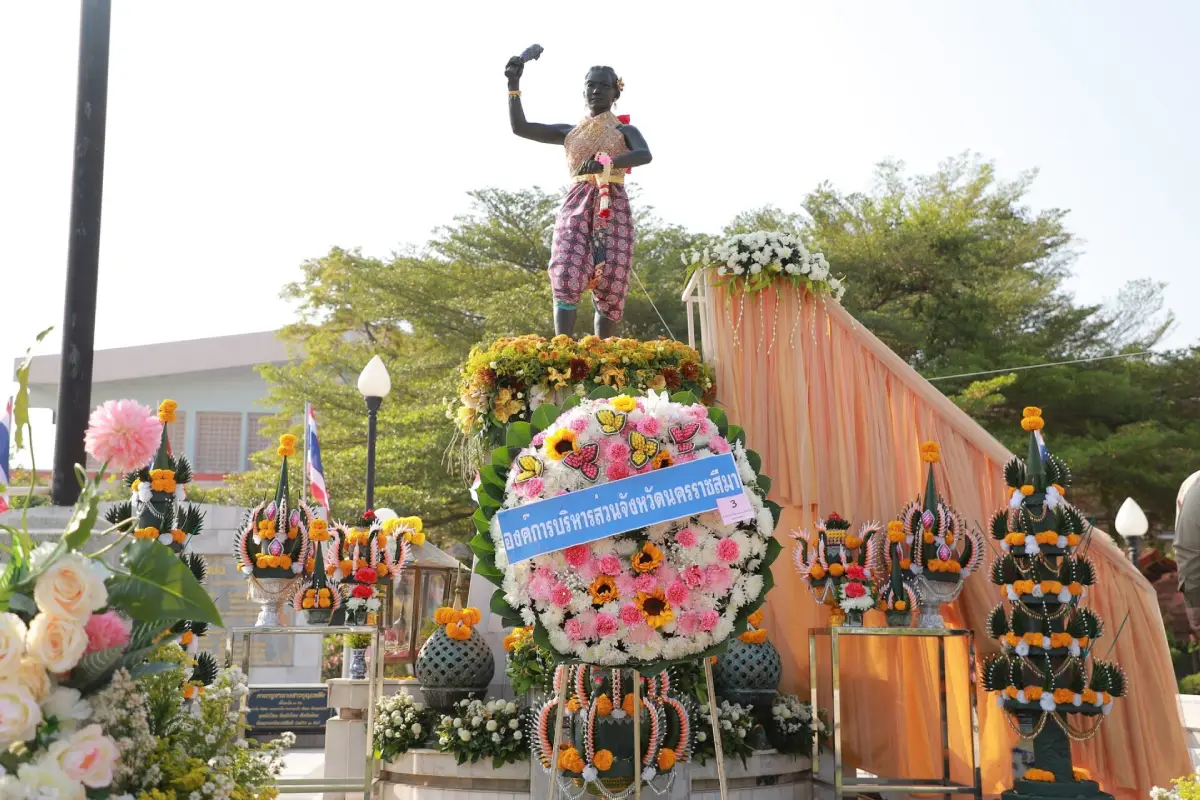
The bronze statue of Miss Bunluea is 175 cm high and was created as a symbol of bravery, sacrifice, and decisive action. The statue recalls the critical moment during the conflict with the forces of Chao Anouvong of Vientiane in the reign of King Rama III. During the events remembered as the Battle of Thung Samrit, Thao Suranari, Miss Bunluea, and the people of Nakhon Ratchasima worked together to resist and recover the city. Miss Bunluea’s role is especially remembered because of her bold act of destroying the enemy’s ammunition carts.
According to local historical memory, Miss Bunluea used a burning piece of firewood and threw it into the gunpowder carts of the opposing army. The explosion damaged the ammunition supply and helped change the situation of the battle. Miss Bunluea lost her life in the fighting, and her sacrifice became part of Korat’s collective memory. The image of a woman holding fire is therefore not only a sculptural pose; it represents courage, selflessness, and the willingness to protect one’s homeland even at the cost of life.
The Battle of Thung Samrit in 1826 is one of the defining historical events of Nakhon Ratchasima. It is remembered as a moment when local people, both men and women, joined together to defend their city. Thao Suranari, or Ya Mo, is the best-known heroine associated with this event, but Miss Bunluea, often respectfully called Ya Luea by local people, is another deeply honored figure. The memorial makes this wider story visible and helps visitors understand the collective nature of Korat’s resistance and memory.
The Miss Bunluea Memorial was officially opened on July 6, 1986. It stands within Bunlua Wittayanusorn School, whose name itself was chosen to commemorate Miss Bunluea’s sacrifice. This gives the memorial a special educational meaning. It is not only a monument for visitors, but also a living reminder for students who study in the school. The name of the school, the presence of the statue, and the annual commemorative ceremony all help transmit the story of Miss Bunluea to younger generations.
Every year on March 4, Nakhon Ratchasima holds a wreath-laying ceremony at the memorial to honor Miss Bunluea and the heroes of Korat. Provincial officials, local organizations, schools, community members, and students take part in the ceremony. This annual event shows that the memory of Miss Bunluea remains active in local culture. It is not only a historical story written in books; it is a public act of remembrance that continues to be practiced by the people of Korat.
The memorial itself is modest in size, but powerful in meaning. Visitors will see the bronze figure of Miss Bunluea standing in a determined posture, associated with the burning torch or firewood used in the historical account. The monument invites visitors to stop, reflect, and think about how an ordinary person can influence the course of a city’s history. Its emotional value lies not in scale or decoration, but in the story it preserves.
As a learning site, the Miss Bunluea Memorial is suitable for students, families, cultural travelers, history enthusiasts, and anyone interested in women’s roles in Thai history. Miss Bunluea was not merely a passive figure within a historical narrative. She acted in a moment of crisis, and her decision became a remembered act of heroism. For travelers, this makes the memorial a meaningful place to consider courage, community defense, and the role of local women in shaping history.
Because the memorial is located inside a school, visitors should behave respectfully. The site is both a historical place and an active educational compound. Travelers should dress modestly, keep their voices at an appropriate level, and follow any instructions from school staff or caretakers. This is especially important on school days, when classes and student activities may be taking place nearby.
In a wider travel context, the Miss Bunluea Memorial can be linked with other historical places in Nakhon Ratchasima, including the Thao Suranari Monument, Chumphon Gate, and the Thung Samrit Memorial. Together, these places tell the story of Korat’s defense during the Chao Anouvong conflict and help visitors understand why Nakhon Ratchasima is often called the city of Ya Mo. By visiting both the famous central monument and this quieter memorial, travelers gain a more complete understanding of the province’s historical memory.
Getting There is straightforward from central Nakhon Ratchasima. Take Suranarai Road, Highway 205, toward Non Thai District and Chaiyaphum Province. The memorial is located inside Bunlua Wittayanusorn School in Khok Sung Subdistrict, on the left side of the Nakhon Ratchasima–Chaiyaphum route. The distance from the city center is about 12.5 km. Private car is the most convenient option, but travelers can also use local transport or ride-hailing services from central Korat.
The best time to visit is during the daytime, especially between 08.00 and 17.00, when access to the school area is more practical. Visitors who come on March 4 may witness the annual memorial ceremony, which is one of the most meaningful times to visit. On ceremony days, travelers should allow extra time because officials, students, and local people may gather at the site in large numbers.
A visit to this memorial does not take a long time, but it is worth slowing down. Travelers should take time to read the available information, observe the statue, and understand the context of the Battle of Thung Samrit before continuing to other attractions. This is a destination for reflection rather than entertainment. Its value comes from the story of sacrifice and the continuing respect shown by the people of Nakhon Ratchasima.
The memorial also works as an open-air classroom. Students who attend Bunlua Wittayanusorn School grow up in a place that carries the name and memory of a local heroine. The presence of the monument encourages younger generations to connect local history with real space. When the annual ceremony is held, students and residents are reminded that remembrance is not distant or abstract; it is part of community life.
For travelers planning a half-day cultural route, the Miss Bunluea Memorial can be combined with several nearby places such as Rajamangala University of Technology Isan, Wat Sala Loi, the Thao Suranari Monument, Chumphon Gate, Maha Weerawong National Museum, and Terminal 21 Korat. This makes the memorial a practical stop for those who want to combine history, local food, urban sightseeing, and educational travel within Nakhon Ratchasima.
In local belief and feeling, Miss Bunluea is respectfully remembered as Ya Luea, just as Thao Suranari is lovingly called Ya Mo. This family-like form of address reflects how closely the people of Korat feel connected to their heroines. Many visitors come not only to learn, but also to pay respect and ask for blessings related to courage, success, and protection. The memorial therefore carries both historical and spiritual meaning.
Learning about Miss Bunluea also broadens the way visitors understand Thai local history. The history of a city is not created only by rulers or military leaders. It is shaped by many people, including villagers, women, elders, students, and community members who act during moments of crisis. The Battle of Thung Samrit is remembered as a collective struggle, and this memorial gives voice to one of the women whose sacrifice helped shape Korat’s identity.
When visitors stand before the statue, the burning torch or firewood should be understood as more than an object in a sculpture. It represents a moment of decision, the courage to act, and the power of personal sacrifice. In symbolic terms, the fire stands for bravery, community spirit, and the light of memory that continues to shine in the hearts of the people of Nakhon Ratchasima.
The Miss Bunluea Memorial may not be a large tourist attraction, but it contains deep historical meaning. It reminds visitors that Nakhon Ratchasima is not only known for shopping malls, highways, Khao Yai, or modern urban life. It is also a province with strong local memory and many historical places that preserve the spirit of its people. Visiting this memorial helps complete the story of Korat and gives travelers a clearer understanding of why local history is still honored with such devotion.
In summary, the Miss Bunluea Memorial is an important destination for anyone who wants to learn about the history of Nakhon Ratchasima through the story of sacrifice, courage, and local remembrance. It is easy to reach from the city, free to visit, and closely connected with other important historical attractions in Korat. For foreign travelers, this quiet memorial provides a meaningful window into the heart of the province and the continuing respect that local people hold for their heroines.
| Name | Miss Bunluea Memorial |
| Location | Inside Bunlua Wittayanusorn School, Khok Sung Subdistrict, Mueang Nakhon Ratchasima District, Nakhon Ratchasima Province |
| Address | Bunlua Wittayanusorn School, 244 Moo 10, Suranarai Road, Khok Sung Subdistrict, Mueang Nakhon Ratchasima District, Nakhon Ratchasima 30000, Thailand |
| Highlights | A 175 cm bronze statue honoring Miss Bunluea, a Korat heroine who sacrificed her life during the Battle of Thung Samrit in 1826 |
| History | Officially opened on July 6, 1986, to commemorate Miss Bunluea and the ancestors of Nakhon Ratchasima who defended the city during the Chao Anouvong conflict |
| Name Origin | Named after Miss Bunluea, a heroine remembered for her role in helping defend Nakhon Ratchasima together with Thao Suranari |
| Distinctive Features | The statue portrays the heroine associated with a burning torch or firewood, symbolizing her act of destroying the enemy’s ammunition carts at Thung Samrit |
| Main Areas / Zones | Memorial courtyard Bronze statue base Wreath-laying area Bunlua Wittayanusorn School compound Annual commemoration area |
| Caretaker | Bunlua Wittayanusorn School and provincial/local organizations involved in the annual commemorative ceremony |
| Travel Information | From central Nakhon Ratchasima, take Suranarai Road, Highway 205, toward Chaiyaphum for about 12.5 km. The memorial is located inside Bunlua Wittayanusorn School on the left side of the road. |
| Current Status | Open to visitors as an important memorial site in Nakhon Ratchasima, with an annual wreath-laying ceremony held on March 4 |
| Open Days | Daily |
| Opening Hours | 08.00 – 17.00 |
| Fees | No Admission Fee |
| Facilities | Memorial area, tribute space, school compound access when permitted, nearby food options in Khok Sung and Cho Ho, and parking access within the school area when available |
| Main Contact Number | Bunlua Wittayanusorn School Tel. 044-000825 |
| Nearby Tourist Attractions | 1. Rajamangala University of Technology Isan, about 8 km 2. Wat Sala Loi, about 10 km 3. Thao Suranari Monument, about 13 km 4. Chumphon Gate, about 13 km 5. Maha Weerawong National Museum, about 13 km 6. Terminal 21 Korat, about 13 km |
| Nearby Restaurants | 1. Krua Kan Eng - Khok Sung, about 1 km, Tel. 065-092-5619 2. Som Jai Yak Cho Ho, about 4 km, Tel. 061-519-3483 3. Tam Sang Cho Ho, about 5 km, Tel. 093-487-3682 4. Tam Laek Cho Ho, about 6 km, Tel. 080-012-6803 5. Krua Kor In Kin Cho Ho, about 6 km, Tel. 082-115-4536, 082-235-5351 6. 8080 Cafe Korat, about 7 km, Tel. 083-933-8854, 097-335-1632 |
| Nearby Accommodations | 1. KOCO HOTEL, about 8 km, Tel. 098-251-9388 2. Fahproudfon Hotel, about 10 km, Tel. 087-246-3838 3. Korapura Resort, about 10 km, Tel. 044-293-001 4. The Imperial Hotel And Convention Centre Korat, about 11 km, Tel. 044-256-629 5. MAA Korat Hotel, about 10 km |
Frequently Asked Questions (FAQ)
Q: Where is the Miss Bunluea Memorial located?
A: The memorial is located inside Bunlua Wittayanusorn School in Khok Sung Subdistrict, Mueang Nakhon Ratchasima District, about 12.5 km from central Nakhon Ratchasima.
Q: Who was Miss Bunluea?
A: Miss Bunluea was a heroine of Nakhon Ratchasima who played an important role in the Battle of Thung Samrit in 1826 and sacrificed her life while helping defend the city.
Q: When was the Miss Bunluea Memorial opened?
A: The memorial was officially opened on July 6, 1986, to commemorate Miss Bunluea and the ancestors of Nakhon Ratchasima.
Q: What are the opening hours?
A: The memorial is open daily from 08.00 to 17.00.
Q: Is there an admission fee?
A: No. Visitors can enter and pay respect at the memorial without an admission fee.
Q: When is the annual commemoration ceremony held?
A: The wreath-laying ceremony in honor of Miss Bunluea is held every year on March 4.
Q: How can travelers get there from central Nakhon Ratchasima?
A: Take Suranarai Road, Highway 205, toward Chaiyaphum for about 12.5 km. The memorial is inside Bunlua Wittayanusorn School on the left side of the road.
Q: What nearby attractions can be visited with the memorial?
A: Nearby places include Wat Sala Loi, Thao Suranari Monument, Chumphon Gate, Maha Weerawong National Museum, and Terminal 21 Korat.
 Category: ●Art, Culture and Heritage
 Group: ●Landmarks and Memorials
Last Update : 2 MonthAgo
 Last Update : 2 MonthAgo
 Click to Access the Navigation Map GPS
Miss Bunluea Memorial Map
Recommend

 Historical Sites and Monuments(20)
Landmarks and Memorials(5)
Historical Sites and Monuments(20)
Landmarks and Memorials(5)
 Art, Craft Centres, Tradition(7)
 Museums(6)
 Art Gallery(1)
 Educational Places
 Educational Gardens, Farm(4)
 Places of Worship
 Temple(29)
 Mosque(1)
 Other Sacred Sites(6)
 Research and Development
 Royal Project(3)
 Suburban Living
 Village, Community(6)
 Local Market(4)
 Floating Market(1)
 Nature and Wildlife
 National Parks and Marine Reserves(3)
 Mountain (Doi)(5)
 Dam, Reservoir, Lake(8)
 Waterfalls(9)
 Hot Springs(1)
 Caves(2)
 Flower Field(1)
 River, Canal(8)
 Bays and Beaches(2)
 Other natural attractions(3)
 Entertainment and Agricultural
 Zoos and Aquariums(1)
 Animal camps and shows(1)
 Farms, Parks and Ecotourism(21)
 Waterpark(2)
 Outdoor and Adventure Activities(6)
 Shopping
 Shopping and Night Market(2)
 Travel Articles, Recipes
 Travel Review, Food Review(5)


