
lovethailand home >Northeastern Travel Attractions >Nakhon Ratchasima Travel Attractions >Wang Nam Khieo >Wang Nam Khieo > Non-Toxic Agriculture Promotion Project
TL;DR: Non-Toxic Agriculture Promotion Project is located at 14 Moo 11, Ban Nam Sap, Wang Nam Khiao Subdistrict, Wang Nam Khiao District, Nakhon Ratchasima Province 30370, open Daily, hours 08.00 – 17.00.
Non-Toxic Agriculture Promotion Project
Open Days: Daily
Opening Hours: 08.00 – 17.00
The Royal-Initiated Non-Toxic Farming Promotion Project, widely known as Wang Nam Khiao Non-Toxic Farming Center, is located at 14 Moo 11, Ban Nam Sap, Wang Nam Khiao Subdistrict, Wang Nam Khiao District, Nakhon Ratchasima Province 30370. It is one of the most important agricultural learning centers in Wang Nam Khiao, presenting organic farming, non-toxic vegetable production, natural agriculture, community-based learning, and the Sufficiency Economy philosophy through a real working village system. The center was created by local farmers who wanted to move away from chemical-dependent agriculture and build a safer, more self-reliant way of farming. Today, it is not only a vegetable-growing site, but also a living community classroom where visitors can understand how safe food, farmer health, environmental protection, and local economic resilience are connected.
Ban Nam Sap is an appropriate setting for organic farming because Wang Nam Khiao is a highland district with cool weather, clean air, and important watershed areas. The district is connected with headwaters such as Lam Phra Phloeng, Lam Mun Bon, and Lam Chiang Sa. For this reason, reducing agricultural chemicals in the area has meaning beyond the farm itself. It helps protect soil, water, ecology, and public health. The center therefore represents a wider vision of agriculture, where food production is not separated from natural resources and where village income is not separated from responsibility toward the surrounding environment.
The Wang Nam Khiao non-toxic farming group was established on 27 January 1998 by farmers affected by the economic crisis of 1997 and by growing awareness of the harm caused by chemical residues in agriculture. Chemical use had affected farmers, consumers, and the local environment. The group began shifting toward organic farming, natural fertilizer, biological liquid fertilizer, crop rotation, mixed vegetable cultivation, and lower dependence on outside inputs. This beginning gives the center its strong community identity. It was not created as a display attraction, but as a practical response by villagers who needed a safer and more sustainable way to live and farm.
On 9 October 1998, the group was accepted under a royal initiative, giving the community’s non-toxic farming work clearer status as a development learning center. Later, the farmers registered as an agricultural cooperative under the name Wang Nam Khiao Non-Toxic Farming Cooperative in the Land Reform Area. Cooperative organization helped strengthen the system of production, collection, sorting, packaging, marketing, and knowledge transfer. Instead of farming separately without bargaining power, members could work through a shared structure that supported quality, planning, and market access.
The center is guided by the Sufficiency Economy philosophy and natural farming principles. Non-toxic farming here does not mean simply stopping chemical use. It means changing the whole way of thinking about agriculture: soil preparation, seed selection, water management, composting, biological pest control, household accounting, cost reduction, and honest relationships between producers and consumers. Farming in this way requires discipline and continuous learning because the produce must be safe, consistent, marketable, and economically worthwhile for farming households.
The center and its cooperative network are known for organic vegetable production. Members grow a wide range of vegetables, including salad greens, cabbage, Chinese cabbage, red leaf lettuce, morning glory, chayote shoots, sweet corn, cucumber, and many seasonal vegetables. Growing many crops helps reduce the risk of depending on a single product. It also gives consumers access to a wider selection of fresh organic produce throughout the year. The cool climate of Wang Nam Khiao supports many vegetable types, especially leafy greens and temperate vegetables.
A major strength of the center is that production and learning are integrated. Visitors can study several practical learning stations, including organic vegetable plots, organic compost, biological liquid fertilizer, charcoal burning, wood vinegar production, non-toxic pest management, Sufficiency Economy practices, community livelihoods, and cooperative production systems. Visitors therefore see not only attractive vegetable beds, but also the knowledge, planning, and labor behind safe food production.
Organic compost production is an important learning station because it helps reduce farming costs. When farmers rely heavily on purchased chemical fertilizers, their costs remain high and they depend on outside inputs. By producing compost from plant residues, animal manure, organic materials, and suitable microorganisms, farmers can improve soil health and manage costs more effectively. This learning base shows that good soil is not created instantly. It must be built and cared for continuously.
Biological liquid fertilizer is another important element in the non-toxic farming system. Farmers can use vegetables, fruits, herbs, and organic materials from the community to create fermented liquids for plant nourishment or natural pest control. This practice turns local materials and leftovers into useful farm inputs. It also demonstrates that chemical-free farming is not passive farming. Plants are actively cared for, but through methods that reduce harmful effects on soil, water, farmers, and consumers.
Charcoal production and wood vinegar are also part of the center’s learning process. Wood vinegar can be used in agriculture for certain pest-management and farm-related purposes when applied appropriately. This station helps visitors understand that non-toxic agriculture consists of many connected activities. The system includes producing farm inputs, managing organic waste, reusing materials, and making practical tools for farmers within the community.
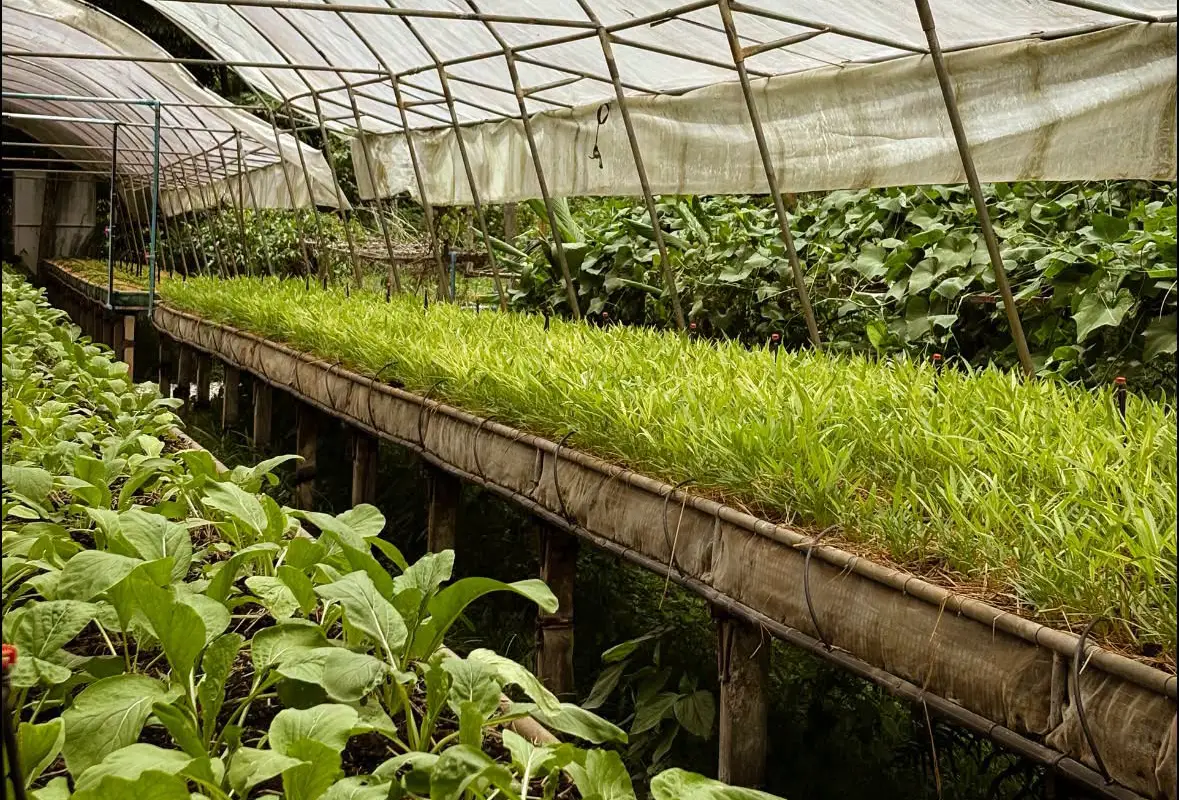
The organic vegetable plots are the most visually memorable part of the center. Visitors can see organized rows of vegetables, nursery areas, crop rotation patterns, and the care required to produce clean vegetables. Salad greens and highland vegetables grow well in Wang Nam Khiao’s climate, but good results still depend on careful soil preparation, watering, spacing, pest observation, and post-harvest handling. The beauty of the vegetable plots comes from disciplined farm management rather than decoration.
The cooperative has continued to improve product quality and market systems. Produce is collected from members, sorted, packed, and distributed to buyers that require safe and reliable vegetables. The cooperative helps farmers reduce the burden of selling individually. It also helps plan production, manage supply, reduce product loss, and build consumer confidence. This shows why organization is essential for organic farming to survive economically, especially when small farmers need stable markets and quality standards.
The center is often described as a people’s development learning center. This description is important because the knowledge here is rooted in villagers’ real experience. Local people experimented, adjusted, solved problems, and improved their system before sharing knowledge with others. Visitors therefore learn directly from people who practice this form of agriculture in real conditions. This makes the center different from a theoretical classroom or a purely commercial farm.
Socially, the center helps create jobs and income in the community. Organic vegetable production has become a meaningful source of local income when supported by cooperative collection, quality control, and market access. Farmers gain not only sales channels but also skills in production planning, post-harvest handling, and working together. The cooperative structure helps build shared ownership and community strength. As product quality improves and markets accept the produce, income circulates within the local area.
Environmentally, non-toxic farming is especially important in Wang Nam Khiao because the district is known for clean air, natural landscapes, and watershed value. Reducing chemical use helps reduce contamination risks in soil and water. It also supports safer working conditions for farmers and a healthier production environment. The success of the center is therefore connected with safe food, farmer health, consumer trust, environmental quality, and the identity of Wang Nam Khiao as a green agricultural and nature-based destination.
For general travelers, the center is suitable for visitors who want a meaningful agricultural experience rather than only sightseeing. Visitors can see organic vegetable plots, learn from farming stations, buy non-toxic produce, and understand how much knowledge and labor are required to produce safe vegetables. The center is suitable for families, students, farmers, health-conscious travelers, organic food businesses, and anyone interested in local livelihoods and the Sufficiency Economy philosophy.
Study groups should contact the center in advance. Since the site is a working learning area, some learning bases require explanation by local coordinators. Advance coordination allows visitors to receive a proper briefing, walk through key zones, and understand the production system, cooperative structure, composting, liquid fertilizer, wood vinegar, organic vegetable cultivation, and product handling. A planned visit gives much more value than a brief stop.
Getting There is easiest by private car. Visitors can search for 14 Moo 11, Ban Nam Sap, Wang Nam Khiao Subdistrict, Wang Nam Khiao District, Nakhon Ratchasima Province 30370, or use the coordinates 14.4282556, 101.8336669. From Nakhon Ratchasima city, travelers can follow the main road network toward Pak Thong Chai and Wang Nam Khiao, then continue into Ban Nam Sap by local roads. From Bangkok, travelers can reach Wang Nam Khiao through Nakhon Ratchasima, Pak Thong Chai, or routes connected with Khao Yai, depending on the travel plan.
Ban Nam Sap is located in a wider Wang Nam Khiao tourism area with natural and agricultural attractions. A private car is the most practical option because visitors can combine the center with Faprathan Farm, Flora Park, Wang Nam Khiao Farm, Khao Phaeng Ma, Pha Kep Tawan, Lam Phra Phloeng Reservoir, local restaurants, and nearby accommodations. For schools, organizations, or larger groups, the visit should be arranged in advance so that transport, timing, and study activities are well coordinated.
The best time to visit is from morning to afternoon during the general opening hours of 08.00 to 17.00. Morning is suitable for walking through vegetable plots because the weather is cooler and the light is comfortable. Afternoon can be used for learning stations or briefings. During the rainy season and the period after rain, the vegetable plots are especially green. During the cool season, Wang Nam Khiao’s weather makes agricultural travel particularly pleasant.
A general independent visit may take about 1 to 2 hours for viewing the plots, buying produce, and walking through the main areas. Study groups should allow at least half a day because the learning stations require explanation, observation, and discussion. Groups interested in cooperative systems, compost production, organic vegetable standards, packing, processing, and marketing should plan a full-day learning program.
Visitors should prepare comfortable shoes for farm walking, a hat or umbrella, drinking water, and reusable bags for purchasing vegetables or local products. Groups may bring notebooks or cameras for study purposes. Clothing should be practical and polite. Some areas are working vegetable plots, so visitors should move carefully and follow local instructions.
Proper behavior is important because the center is both a learning site and a real production area. Visitors should not step into vegetable beds, pick vegetables without permission, touch produce unnecessarily, or leave litter in the farm area. Cleanliness and order are essential for safe food production. Respectful travel helps protect the farm environment and honors the work of local farmers.
The main value of the center is that it turns principles into practice. Visitors can see how the Sufficiency Economy philosophy appears in farm cost reduction, compost production, cooperative marketing, organic standards, and safe food production. The farmers do not present sustainability only as an idea; they show it through everyday agricultural work, community organization, and responsible production.
For people who want to apply the idea to their own land, the center provides a framework rather than a fixed formula. The key lesson is to understand soil, water, crops, labor, household needs, and local markets before designing a farm. Visitors can observe the system at Ban Nam Sap and adapt the principles to their own conditions. This makes the center valuable for practical learning, not only for sightseeing.
Overall, the Royal-Initiated Non-Toxic Farming Promotion Project at Ban Nam Sap is a significant learning destination in Wang Nam Khiao. Its value lies in organic farming, cooperative organization, community-based knowledge, safe food production, environmental protection, and the application of the Sufficiency Economy philosophy. It is suitable for study visits, agricultural tourism, family learning, and anyone seeking to understand how a rural community can create safer food and stronger livelihoods through responsible farming.
| Name | Royal-Initiated Non-Toxic Farming Promotion Project / Wang Nam Khiao Non-Toxic Farming Center |
| Location | 14 Moo 11, Ban Nam Sap, Wang Nam Khiao Subdistrict, Wang Nam Khiao District, Nakhon Ratchasima Province 30370 |
| Address | 14 Moo 11, Ban Nam Sap, Wang Nam Khiao, Wang Nam Khiao District, Nakhon Ratchasima 30370 |
| Coordinates | 14.4282556, 101.8336669 |
| Highlights | Organic vegetable plots, non-toxic farming learning bases, compost production, biological liquid fertilizer, wood vinegar, Sufficiency Economy learning, and cooperative-based organic produce management |
| History | Founded on 27 January 1998 by farmers in Wang Nam Khiao who wanted to reduce chemical use in agriculture. The group was accepted under a royal initiative on 9 October 1998 |
| Type | People’s development learning center, organic farming learning site, and agricultural tourism destination |
| Distinctive Features | A community-based organic farming center with cooperative production, produce collection, packing, organic farming knowledge transfer, and local livelihood learning |
| Main Products | Organic vegetables, salad greens, cabbage, Chinese cabbage, red leaf lettuce, morning glory, chayote shoots, sweet corn, cucumber, and seasonal non-toxic vegetables |
| Travel Information | Private car is the most convenient option. Search for Ban Nam Sap, Wang Nam Khiao District, Nakhon Ratchasima, or use the coordinates 14.4282556, 101.8336669 |
| Current Status | Open as a learning center for non-toxic farming, organic agriculture, Sufficiency Economy practices, and community-based study visits |
| Open Days | Daily |
| Opening Hours | 08.00 – 17.00 |
| Facilities | Study areas, organic vegetable plots, learning stations, produce sales area, some group accommodation formats, food service for study groups, and parking area |
| Main Areas / Learning Zones | 1. Organic Vegetable Plots 2. Organic Compost Learning Base 3. Biological Liquid Fertilizer Base 4. Wood Vinegar Base 5. Sufficiency Economy Base 6. Community Livelihood Base 7. Produce Collection And Packing Area 8. Non-Toxic Vegetable And Local Product Sales Area |
| Caretaker / Coordinator | Mr. Amnat Maiyotklang, Chairman of Wang Nam Khiao Non-Toxic Farming Cooperative / Mrs. Waraporn Promma, Cooperative Manager / Khun Fakfon, earlier center contact coordinator |
| Contact Number | 044-249-107, 081-977-8699, 083-995-5309, 081-966-4247, 087-253-6515 |
| Fax | 044-249-107 |
| Nearby Tourist Attractions | 1. Wang Phoom Hork Farm & Homestay – inside the project / Ban Nam Sap area – Tel. 081-265-5665 2. Wang Nam Khiao Farm – about 12 km 3. Faprathan Farm / Flora Park – about 16 km – Tel. 093-328-5437 4. Khao Phaeng Ma – about 22 km 5. Pha Kep Tawan, Thap Lan National Park – about 30 km 6. Lam Phra Phloeng Reservoir – about 40 km |
| Nearby Restaurants | 1. Patta Wang Nam Khiao – about 9 km – Tel. 065-945-5168 2. Krua Ban Lek Thi 5 Thai Samakkhi – about 17 km – Tel. 083-467-4411, 086-243-4411 3. Jungle View Restaurant – about 18 km – Tel. 081-257-4462, 081-376-5929 4. Krua Ton Sai Wang Nam Khiao – about 18 km 5. Wang Nam Khiao Coffee Roastery – about 20 km 6. Na Siri Wang Nam Khiao – about 22 km – Tel. 088-354-0980, 080-229-6635, 081-733-2778 |
| Nearby Accommodations | 1. Wang Phoom Hork Farm & Homestay – inside the project / Ban Nam Sap area – Tel. 081-265-5665 2. Anapana Resort – about 8 km – Tel. 088-586-0209 3. Suan Phumimalee – about 9 km – Tel. 081-553-0316, 081-649-1505 4. Klong Sai Hill – about 10 km – Tel. 085-016-4433, 085-771-0033 5. Moon River Village – about 25 km – Tel. 092-888-0390 6. Bu-Ngasari Resort – about 24 km – Tel. 062-394-4246 |
Frequently Asked Questions (FAQ)
Q: Where is the Royal-Initiated Non-Toxic Farming Promotion Project located?
A: It is located at 14 Moo 11, Ban Nam Sap, Wang Nam Khiao Subdistrict, Wang Nam Khiao District, Nakhon Ratchasima Province 30370.
Q: What are the opening days and hours?
A: The center is open daily from 08.00 to 17.00.
Q: What is the main highlight of Wang Nam Khiao Non-Toxic Farming Center?
A: The main highlight is its community-based organic farming system, including organic vegetable plots, compost learning stations, biological liquid fertilizer, wood vinegar, Sufficiency Economy learning, and cooperative produce management.
Q: Who is this center suitable for?
A: It is suitable for farmers, students, study groups, families, agricultural travelers, health-conscious visitors, and anyone interested in organic farming, community livelihoods, and the Sufficiency Economy philosophy.
Q: What can visitors learn inside the center?
A: Visitors can learn about organic vegetable cultivation, composting, biological liquid fertilizer, wood vinegar, cooperative production, community livelihoods, produce collection, and non-toxic farming practices.
Q: How can travelers get to the center?
A: Private car is the most convenient option. Travelers can search for Ban Nam Sap, Wang Nam Khiao District, Nakhon Ratchasima, or use the coordinates 14.4282556, 101.8336669.
Q: What attractions are near the center?
A: Nearby attractions include Wang Phoom Hork Farm & Homestay, Wang Nam Khiao Farm, Faprathan Farm, Flora Park, Khao Phaeng Ma, Pha Kep Tawan, and Lam Phra Phloeng Reservoir.
 Category: ●Research and Development
 Group: ●Royal Project
Last Update : 1 MonthAgo
 Last Update : 1 MonthAgo
 Click to Access the Navigation Map GPS
Non-Toxic Agriculture Promotion Project Map
Recommend

 Art, Culture and Heritage
 Historical Sites and Monuments(20)
 Landmarks and Memorials(5)
 Art, Craft Centres, Tradition(7)
 Museums(6)
 Art Gallery(1)
 Educational Places
 Educational Gardens, Farm(4)
 Places of Worship
 Temple(29)
 Mosque(1)
 Other Sacred Sites(6)
Royal Project(3)
Other Sacred Sites(6)
Royal Project(3)
 Suburban Living
 Village, Community(6)
 Local Market(4)
 Floating Market(1)
 Nature and Wildlife
 National Parks and Marine Reserves(3)
 Mountain (Doi)(5)
 Dam, Reservoir, Lake(8)
 Waterfalls(9)
 Hot Springs(1)
 Caves(2)
 Flower Field(1)
 River, Canal(8)
 Bays and Beaches(2)
 Other natural attractions(3)
 Entertainment and Agricultural
 Zoos and Aquariums(1)
 Animal camps and shows(1)
 Farms, Parks and Ecotourism(21)
 Waterpark(2)
 Outdoor and Adventure Activities(6)
 Shopping
 Shopping and Night Market(2)
 Travel Articles, Recipes
 Travel Review, Food Review(5)


