
lovethailand home >Northeastern Travel Attractions >Nakhon Ratchasima Travel Attractions >Pak Chong >Klang Dong > Wat Thep Phithak Punnaram
TL;DR: Wat Thep Phithak Punnaram is located at Khao Si Siat A, Klang Dong Subdistrict, Pak Chong District, Nakhon Ratchasima Province, open Daily, hours 08.00 – 16.00.
Wat Thep Phithak Punnaram
Open Days: Daily
Opening Hours: 08.00 – 16.00
Wat Thep Phithak Punnaram, also widely known as Wat Phra Khao or the White Buddha Temple, is located on Khao Si Siat A in Klang Dong Subdistrict, Pak Chong District, Nakhon Ratchasima Province. The temple sits just off Mittraphap Road, around kilometer marker 150, and can be reached by following a paved road for about 2–3 kilometers from the main highway. It is one of the most recognizable Buddhist landmarks on the Bangkok–Saraburi–Pak Chong–Nakhon Ratchasima route because the large white Buddha image on the mountain can be seen clearly from a distance. For travelers entering the northeast of Thailand, this temple often feels like a symbolic gateway into Korat and the Khao Yai–Pak Chong landscape.
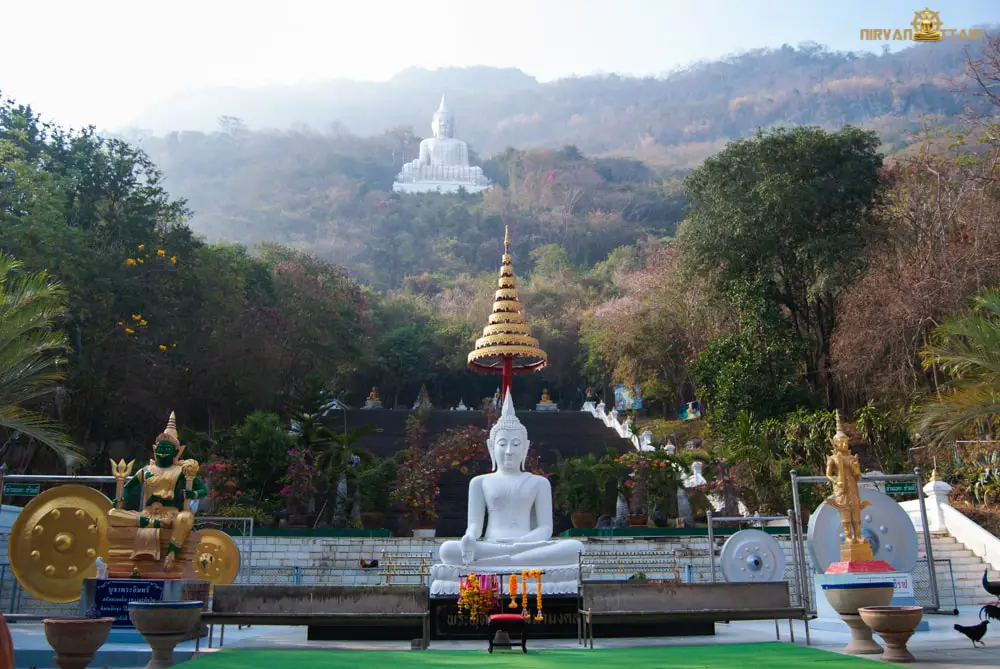
The main highlight of Wat Thep Phithak Punnaram is Phra Phuttha Sakon Sima Mongkhon, a large white Buddha image in the blessing posture. Local people commonly call the image Luang Pho Khao or Luang Pho Yai. The name Phra Phuttha Sakon Sima Mongkhon was royally bestowed by His Majesty King Bhumibol Adulyadej, King Rama IX. The Buddha image is made of reinforced concrete, has a lap width of about 27.25 meters, and stands about 45 meters high. It is positioned about 112 meters above ground level, or 56 wa in Thai measurement. These numbers are not accidental. The height of 45 meters refers to the 45 years during which the Buddha taught after enlightenment, while 56 wa refers to the 56 qualities of the Buddha.
Although the temple is easy to access from Mittraphap Road, its atmosphere changes quickly once visitors enter the temple grounds. The highway noise fades, the mountain becomes more dominant, and the white Buddha image appears above the trees. This gradual movement from the busy road into a calm Buddhist setting is part of the temple’s appeal. It is a place for worship, merit-making, quiet walking, photography, and reflection, but it should always be treated primarily as a sacred Buddhist temple rather than merely a scenic viewpoint.
The temple was officially established on 12 March 1971 under the Dhammayut order and received its consecrated boundary in 1972. Its origin is connected with the intention of Phra Sutthithammarangsi Khampiramedhachan, better known as Than Pho Lee Dhammadharo, a respected meditation master associated with Wat Asokaram. He had the intention to establish a temple at the foot of Khao Si Siat A and create a Buddha image on the hill, but he passed away before the project could be completed. His disciples and devotees later continued the work, eventually creating the temple and the great white Buddha image that remain a center of faith today.
The building of Phra Phuttha Sakon Sima Mongkhon required both devotion and technical effort. The image was enlarged from the Phor Por Ror Buddha model and constructed on the mountain as a monumental blessing Buddha. Its serene white form, set against the green mountain, gives it a strong visual and spiritual identity. Visitors often come to pray for auspiciousness, safety in travel, success in work, family peace, health, and mental strength. The blessing posture reinforces the sense of compassion and reassurance felt by many devotees.
One of the most memorable parts of the visit is the stairway leading up to the Buddha image. The stairs are divided into 2 sides and curve in a form reminiscent of a Bodhi leaf. Together, the 2 sides total 1,250 steps. This number refers to the 1,250 arahant disciples who gathered spontaneously on Makha Bucha Day, one of the most important events in Buddhist tradition. The stairway is therefore not only a physical route up the mountain. It is also a symbolic path of effort, mindfulness, and devotion.
Climbing the 1,250 steps requires preparation. Healthy visitors can walk up to pay respect to the large Buddha image and enjoy the mountain view from above. However, older visitors, young children, and people with health conditions should assess their physical condition before climbing. It is best to walk slowly, rest when needed, and avoid the climb during intense heat, heavy rain, or slippery conditions. The climb is most meaningful when approached with calmness rather than speed.
At the lower courtyard, visitors can pay respect at the worship points before deciding whether to climb the stairs. This area is suitable for those who want to make merit but are unable to climb all the way up to the large Buddha image. From the lower area, the white Buddha on the mountain remains clearly visible, allowing visitors to feel connected to the sacred image even without making the full ascent.
The temple also preserves the memory of important teachers connected with its history. Visitors may see statues of Phra Yanasitthachan Sing Suntharo, also known as Luang Pu Metta Luang, a former abbot, and Than Pho Lee Dhammadharo, whose original intention inspired the creation of the temple and the hilltop Buddha image. These memorial points help visitors understand that Wat Thep Phithak Punnaram is not only a place with a large Buddha statue. It is also connected with the Thai forest and meditation tradition, teacher lineage, and the continuity of Buddhist devotion.
The temple landscape is especially photogenic because of the contrast between the white Buddha image, the green mountain, and the long symmetrical stairway. The image of Luang Pho Khao above the hillside is one of the most memorable views in Pak Chong. However, photography should be done respectfully. Visitors should avoid inappropriate poses, blocking the stairway, disturbing worshippers, or treating sacred objects as casual photo props. The best photographs are those that preserve the dignity and calmness of the temple.
The surrounding area is shaded and peaceful, especially in the morning and late afternoon. Trees, mountain air, and the slope of the land create a calm atmosphere suitable for resting the mind. Although the temple is close to a major road, the inner area feels much more quiet. This makes it a convenient stop for long-distance travelers who want to pause, make merit, and experience a short moment of stillness before continuing to Pak Chong, Khao Yai, or Nakhon Ratchasima city.
Wat Thep Phithak Punnaram is also recognized as a provincial meditation practice center and has a Sunday Buddhist study center. This shows that the temple has an educational and spiritual role beyond tourism. Monks, laypeople, and local communities use the temple as a place for Dhamma learning, practice, and religious activity. Visitors should therefore be mindful that some areas may be used for monastic or meditation purposes and should avoid entering restricted zones without permission.
The temple has also been recognized for development and education-related work, including its role as an educational temple park and a model developed temple. These recognitions reflect the temple’s continuing role as a place of learning, faith, and community service. Its large Buddha image attracts visitors, but its broader value lies in how the temple supports religious education, meditation, and public devotion.
Getting There is convenient by private car, rental vehicle, van, or tour bus. From Bangkok or Saraburi, take Highway 2, also known as Mittraphap Road, toward Pak Chong and Nakhon Ratchasima. Around kilometer marker 150 in Klang Dong, turn onto the paved road leading to the temple and continue for about 2–3 kilometers. From Nakhon Ratchasima city or central Pak Chong, travel along Mittraphap Road toward Saraburi and follow signs for the temple in Klang Dong. Because the temple sits slightly inside from the main highway, navigation apps and road signs are useful.
The best time to visit is in the morning. The weather is cooler, the light is softer, and the climb to the Buddha image is more comfortable. Late afternoon is also a good time for photography and quiet viewing. Visitors who plan to climb the stairs should avoid the hottest hours of the day. The main recommended visiting period is during daylight hours, especially from 08.00 to 16.00, for safety and convenience.
Visitors should dress modestly and behave respectfully. Speak softly, do not climb on railings or religious structures, do not litter, and do not block others on the stairway while taking photographs. If climbing the stairs, walk carefully and allow space for people moving in both directions. Responsible behavior helps make the visit pleasant for worshippers, travelers, monks, and local caretakers.
For families, the temple is a meaningful place to teach children about Buddhism, perseverance, and temple manners. Children can learn why the Buddha image is white, what the numbers 45, 56, and 1,250 represent, and why people climb the stairs as an act of faith. Adults should supervise children closely, especially on the stairway, slopes, and higher areas.
For international travelers, Wat Thep Phithak Punnaram is a highly accessible introduction to Thai Buddhist culture. The site combines a large Buddha image, mountain scenery, symbolic numbers, a stairway of devotion, and a living temple community. It shows that Thai temple visits are not only about architecture, but also about faith, discipline, symbolic meaning, and respectful movement through sacred space.
The temple can be combined easily with attractions in Pak Chong and Khao Yai. Nearby places include Dairy Home, PB Valley Khao Yai Winery, Farm Chokchai, Suwan Farm, Khao Yai Premium Outlet, and Ban Tha Chang Natural Spring. Travelers from Bangkok can visit the temple as an early spiritual stop before continuing toward Khao Yai, while travelers staying in Pak Chong can include it in a half-day route with restaurants, cafes, vineyards, and family attractions.
Overall, Wat Thep Phithak Punnaram is one of the most meaningful Buddhist landmarks in the Pak Chong area. Its value lies not only in the scale of Luang Pho Khao, but also in the religious symbolism of its height, the 1,250-step stairway, the intention of the teachers who inspired its creation, and its role as a meditation and Buddhist learning site. Visitors who take time to approach the temple with respect will find more than a large white Buddha on a mountain. They will find a place where faith, effort, scenery, and inner calm meet along one of Thailand’s most important travel routes.
| Name | Wat Thep Phithak Punnaram / Wat Phra Khao / White Buddha Temple |
| Location | Khao Si Siat A, Klang Dong Subdistrict, Pak Chong District, Nakhon Ratchasima Province |
| Address | 253 Mu 4, Klang Dong Subdistrict, Pak Chong District, Nakhon Ratchasima 30320, Thailand |
| Coordinates | 14.616604, 101.265547 |
| Highlights | Phra Phuttha Sakon Sima Mongkhon or Luang Pho Khao, large white blessing Buddha, 1,250-step stairway, Khao Si Siat A mountain view, Buddhist landmark along Mittraphap Road, and peaceful temple atmosphere in Klang Dong |
| History | Established on 12 March 1971 under the Dhammayut order and granted its consecrated boundary in 1972. The temple originated from the intention of Than Pho Lee Dhammadharo and was later developed by disciples and devotees |
| Name Origin | The name Wat Thep Phithak Punnaram is associated with merit and protection of the Dhamma. The popular names Wat Phra Khao and White Buddha Temple come from the large white Buddha image on the mountain |
| Buddha Image Details | Phra Phuttha Sakon Sima Mongkhon is a white blessing Buddha image made of reinforced concrete, about 27.25 meters wide at the lap, about 45 meters high, and positioned about 112 meters above ground level |
| Stairway Details | The stairway is divided into 2 sides and curves like a Bodhi leaf. The total of 1,250 steps refers to the 1,250 arahants who gathered spontaneously on Makha Bucha Day |
| Travel Information | From Bangkok or Saraburi, take Highway 2 / Mittraphap Road toward Pak Chong and Nakhon Ratchasima. Around kilometer marker 150 in Klang Dong, turn onto the paved road and continue about 2–3 km to the temple |
| Current Status | Open for worship, merit-making, climbing to Luang Pho Khao, scenic viewing, and respectful visits according to temple rules |
| Open Days | Daily |
| Opening Hours | 08.00 – 16.00 |
| Fees | No Admission Fee |
| Facilities | Ubosot, sermon hall, monks’ residences, merit-making pavilion, crematorium, lower worship courtyard, stairway, rest points, viewpoint, small shops within the temple area, and designated parking areas |
| Main Areas / Zones | Lower worship courtyard, small Phra Phuttha Sakon Sima Mongkhon zone, 1,250-step stairway zone, hilltop Luang Pho Khao zone, viewpoint zone, teacher memorial statues zone, sermon hall zone, ubosot zone, monks’ residence zone, shop zone, and parking zone |
| Abbot / Caretaker | Phra Khru Phithak Tham Manuyut |
| Temple Contact Number | 081-294-3982 |
| Nearby Tourist Attractions | 1. Dairy Home Pak Chong, about 5 km 2. PB Valley Khao Yai Winery, about 8 km 3. Farm Chokchai, about 12 km 4. Suwan Farm / National Corn And Sorghum Research Center, about 13 km 5. Khao Yai Premium Outlet, about 18 km 6. Ban Tha Chang Natural Spring, about 28 km |
| Nearby Restaurants | 1. Klang Pa Homemade, about 2 km, Tel. 089-000-1993 2. Dairy Home Restaurant, about 5 km, Tel. 081-991-0271 3. @99 Klang Dong, about 7 km, Tel. 085-424-2333 4. Mountain Creek Golf Resort & Residences Restaurant, about 10 km, Tel. 044-756-100 to 105, 088-885-3782 5. Krua Phukan Khao Yai, about 20 km, Tel. 081-644-3612 |
| Nearby Accommodations | 1. Sirisumpan Camping, about 4 km, Tel. 080-964-2456 2. Ban Romyen Klang Dong, about 5 km, Tel. 099-234-8924, 081-660-4250 3. The Peri Hotel Khao Yai, about 9 km, Tel. 063-196-4999 4. Mountain Creek Golf Resort & Residences, about 10 km, Tel. 044-756-100 to 105, 088-885-3782, 094-889-8869 5. Watermill Resort Pakchong, about 24 km, Tel. 080-809-9155 |
Frequently Asked Questions (FAQ)
Q: Where is Wat Thep Phithak Punnaram located?
A: Wat Thep Phithak Punnaram is located on Khao Si Siat A in Klang Dong Subdistrict, Pak Chong District, Nakhon Ratchasima Province, about 2–3 km from Mittraphap Road around kilometer marker 150.
Q: What are the opening hours of Wat Thep Phithak Punnaram?
A: The temple is open daily from 08.00 to 16.00. Daytime visits are recommended for safety, especially for climbing the stairway.
Q: Is there an admission fee?
A: No. Wat Thep Phithak Punnaram does not charge an admission fee. Visitors may make merit according to their faith.
Q: What is the main highlight of the temple?
A: The main highlight is Phra Phuttha Sakon Sima Mongkhon, also known as Luang Pho Khao, a large white blessing Buddha image on Khao Si Siat A, together with the 1,250-step stairway and mountain views.
Q: How large is Luang Pho Khao?
A: Luang Pho Khao has a lap width of about 27.25 meters, a height of about 45 meters, and is positioned about 112 meters above ground level.
Q: How many steps lead up to Luang Pho Khao?
A: The 2-sided stairway has a total of 1,250 steps, referring to the 1,250 arahants who gathered spontaneously on Makha Bucha Day.
Q: Who is the abbot of Wat Thep Phithak Punnaram?
A: The abbot is Phra Khru Phithak Tham Manuyut.
Q: What nearby places can be visited on the same trip?
A: Nearby places include Dairy Home, PB Valley Khao Yai Winery, Farm Chokchai, Suwan Farm, Khao Yai Premium Outlet, and Ban Tha Chang Natural Spring.
 Category: ●Places of Worship
 Group: ●Temple
Last Update : 3 MonthAgo
 Last Update : 3 MonthAgo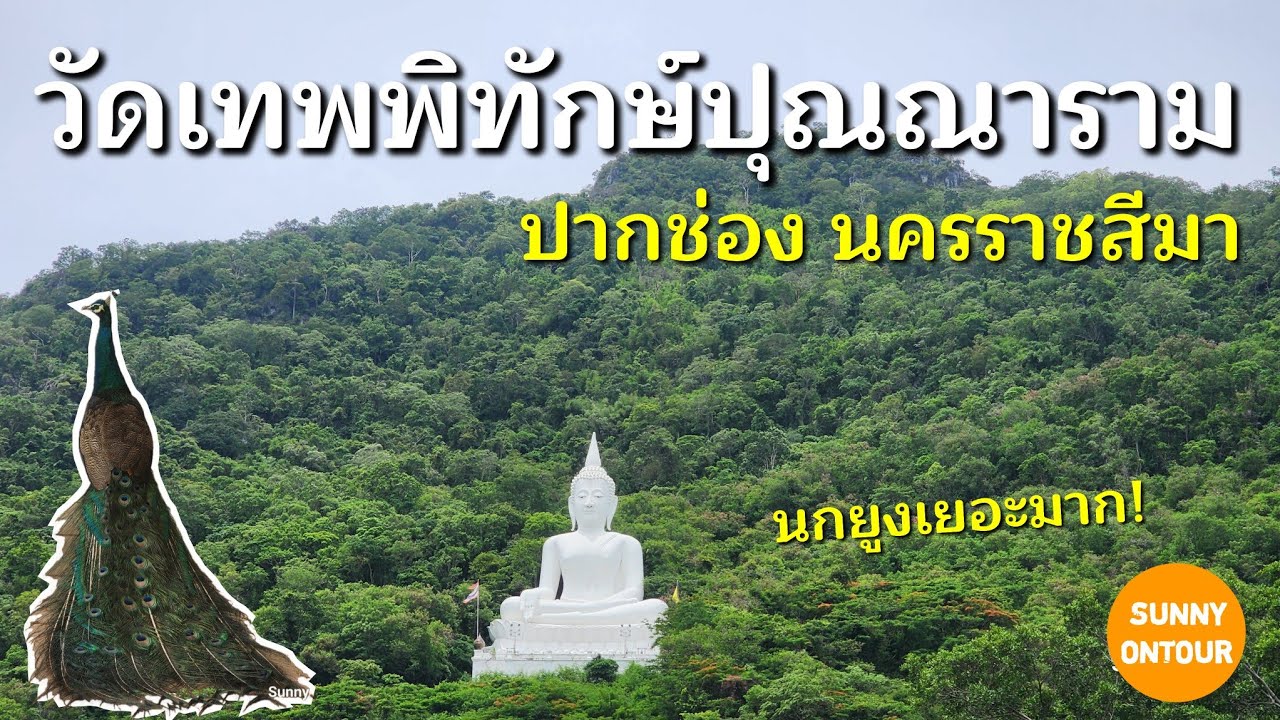
 Click to Access the Navigation Map GPS
Wat Thep Phithak Punnaram Map
Recommend

 Art, Culture and Heritage
 Historical Sites and Monuments(20)
 Landmarks and Memorials(5)
 Art, Craft Centres, Tradition(7)
 Museums(6)
 Art Gallery(1)
 Educational Places
 Educational Gardens, Farm(4)
Temple(29)
Educational Gardens, Farm(4)
Temple(29)
 Mosque(1)
 Other Sacred Sites(6)
 Research and Development
 Royal Project(3)
 Suburban Living
 Village, Community(6)
 Local Market(4)
 Floating Market(1)
 Nature and Wildlife
 National Parks and Marine Reserves(3)
 Mountain (Doi)(5)
 Dam, Reservoir, Lake(8)
 Waterfalls(9)
 Hot Springs(1)
 Caves(2)
 Flower Field(1)
 River, Canal(8)
 Bays and Beaches(2)
 Other natural attractions(3)
 Entertainment and Agricultural
 Zoos and Aquariums(1)
 Animal camps and shows(1)
 Farms, Parks and Ecotourism(21)
 Waterpark(2)
 Outdoor and Adventure Activities(6)
 Shopping
 Shopping and Night Market(2)
 Travel Articles, Recipes
 Travel Review, Food Review(6)


