
lovethailand home >Northeastern Travel Attractions >Nakhon Ratchasima Travel Attractions >Pak Thong Chai >Ta Khu > Wat Na Phra That
TL;DR: Wat Na Phra That is located at Mu 1, Taku Subdistrict, Pak Thong Chai District, Nakhon Ratchasima Province, open Daily, hours 07.00 – 18.00.
Wat Na Phra That
Open Days: Daily
Opening Hours: 07.00 – 18.00
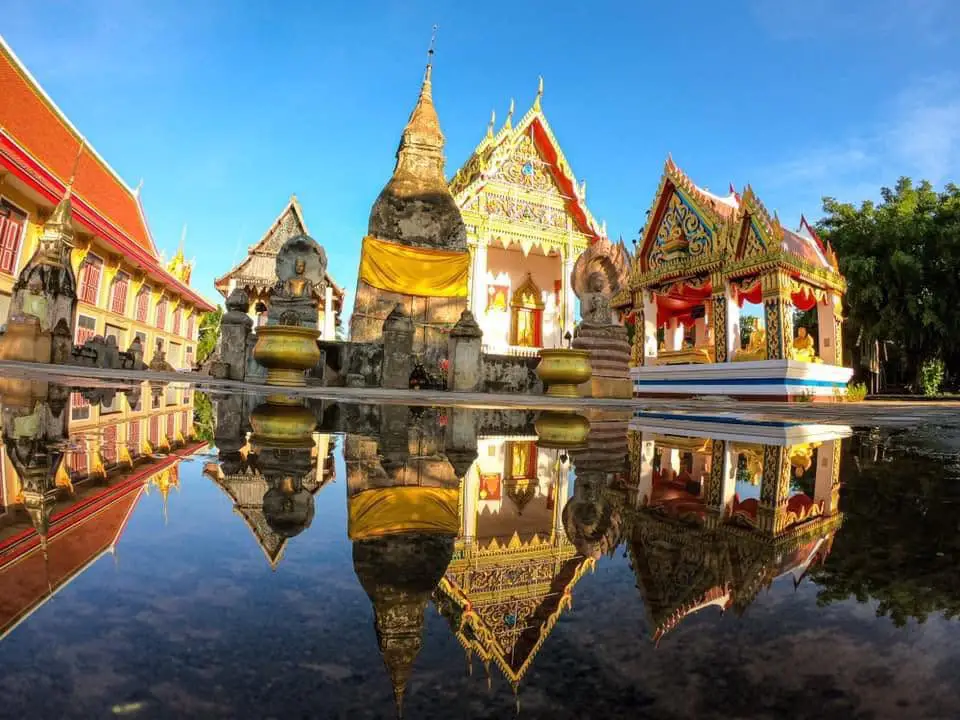
Wat Na Phra That, also known locally as Wat Taku, is located in Mu 1, Taku Subdistrict, Pak Thong Chai District, Nakhon Ratchasima Province. This historic Buddhist temple is one of the most valuable cultural landmarks in Pak Thong Chai, especially for travelers interested in early Rattanakosin art, northeastern Thai temple architecture, mural paintings, local Buddhist heritage, and the layered history of communities in lower northeastern Thailand. The temple is not a large monument in the conventional sense, but it holds exceptional cultural depth through its old ordination hall, mural paintings, waterside scripture hall, Lao-style chedi, and surviving evidence of the Taku community’s long history.
Wat Na Phra That is a local temple under the Mahanikaya order. The temple was established in 1797 and later received its official consecrated boundary on 10 March 1972. Local residents have long called it Wat Taku after the name of the village and subdistrict. The name Wat Na Phra That, meaning “the temple in front of the sacred relic monument,” relates directly to the important chedi standing near the old ordination hall. This name reflects the way sacred architecture shapes local memory and gives the temple its distinct identity.
The temple is closely connected with Ban Taku, an old community with a long cultural history. Taku Subdistrict contains archaeological traces, old settlement evidence, ancient reservoirs, local traditions, and historic religious sites that reveal the continuity of life in this area. Wat Na Phra That therefore should not be seen as an isolated temple. It is the spiritual and cultural center of a community whose local customs, kinship networks, Buddhist practices, and historical memory have developed over many generations.
The most important structure inside the temple is the old ubosot, or ordination hall. This brick-and-plaster building faces east, has a single entrance, and contains three windows on each side. Its architectural form is especially interesting because the base curves gently in a style associated with late Ayutthaya and early Rattanakosin craftsmanship. Unlike many familiar Thai ordination halls, the roof of this old ubosot does not prominently display the usual chofa, bai raka, and hang hong ornaments. This gives the building a restrained and distinctive character, while also suggesting a blend of early Rattanakosin royal taste and local Isan craftsmanship.
The old ubosot is best known for its mural paintings. These paintings appear on both the exterior front wall and the interior walls of the building. Although some sections have faded with age, many scenes remain legible and culturally significant. The murals were created using dry fresco or pigment-on-plaster techniques and depict Buddhist narratives such as the Buddha’s life, the Ten Jataka tales, celestial scenes, the Buddha’s victory over Mara, and the worship of the Buddha’s footprint. The west wall behind the principal Buddha image is especially important because it presents the scene of worship at the Buddha’s footprint, a major devotional theme in Thai Buddhist art.
What makes these murals especially valuable is the way they include scenes of everyday life. Within the larger Buddhist narratives, viewers can observe villagers farming, fishing, trading, playing traditional games, dressing in period clothing, and carrying out ordinary activities. These details transform the paintings into more than religious illustrations. They also function as visual records of local society, offering rare insight into the way people in the Korat and Lao-Vieng cultural sphere lived during the early Rattanakosin period. For foreign travelers, the murals are an excellent entry point for understanding how Thai Buddhist art often combines sacred stories with the lived reality of local communities.
In front of the old ubosot is a rectangular pond, and in the middle of this pond stands the temple’s Ho Trai Klang Nam, or waterside scripture hall. This wooden structure is one of the temple’s most distinctive features. It stands in the pond locally known as Lam Ta Noi, about 50 meters east of the old ubosot. The building has the form of a traditional Thai wooden structure with local northeastern details, wooden wall panels, and small baluster-style windows. Its entrance faces west, aligning with the direction of the old ordination hall. The base is supported by 20 round wooden posts standing in the water, a practical design used to protect sacred palm-leaf manuscripts from termites, ants, insects, and moisture.
The scripture hall is also remarkable for its decorative work. The entrance door carries gold-on-black lacquer designs narrating the story of Kaki, especially the scene in which Garuda carries away Nang Kaki. The surrounding panels show Phra Mae Thorani wringing water from her hair amid floral motifs, an auspicious symbol associated with fertility, merit, and the earth’s witness to the Buddha’s enlightenment. Other painted sections include lotus-bearing celestial figures, Buddhist narrative scenes, floral designs, Himavanta forest birds, and ceiling stars on a red background. These decorative details make the scripture hall both a functional religious building and an important example of local woodwork and painting from the late 18th to early 19th century cultural horizon.
Between the scripture hall and the old ubosot stands an old Lao-style chedi. This chedi was built by a community that migrated from Vientiane, and it preserves the memory of Lao-Lan Xang artistic influence in the Taku area. Its form resembles a local Lao relic monument with a low base, square body, and tapering upper section. The presence of this chedi confirms that Wat Na Phra That is not only a Thai Buddhist temple, but also a site shaped by movement, migration, and cultural exchange across the Mekong and lower northeastern region.
Another layer of history appears through ancient architectural fragments and artifacts associated with Prasat Sa Hin, a nearby archaeological site in Taku Subdistrict. Stone boundary markers, sandstone Buddha fragments, ritual platforms, and lintel fragments have been associated with the temple area. These remains point to a deeper historical landscape surrounding Ban Taku, showing that the community’s past extends beyond the early Rattanakosin period and connects with older cultural traditions in northeastern Thailand.
Wat Na Phra That remains an active temple. Monks continue to reside here, and the temple still serves as a spiritual center for local residents. Religious activities such as Buddhist holy day merit-making, annual temple events, Kathin ceremonies, and community rites continue to take place. This living religious function is important because it prevents the temple from becoming merely an archaeological attraction. Visitors experience both the atmosphere of an old heritage site and the living faith of the people who continue to care for it.
The temple is suitable for several types of visitors. Cultural travelers will appreciate the murals and architecture. Art lovers can study early Rattanakosin and local Isan painting traditions. Historians and archaeology enthusiasts can connect the temple with the wider Taku landscape and Prasat Sa Hin. Buddhist travelers can make merit and pay respect to the sacred structures. For visitors who want to understand Nakhon Ratchasima beyond major city attractions, Wat Na Phra That offers a quieter, deeper, and more local experience.
The best time to visit is in the morning or late afternoon, when the light is softer and the temple atmosphere is calm. Visitors who want to study the murals should allow at least 1 to 2 hours. The old ordination hall deserves careful viewing because many details are small and easy to miss. After seeing the murals, visitors can walk to the Lao-style chedi, the waterside scripture hall, and the surrounding temple grounds. This slow pace allows the temple’s cultural meaning to become clearer.
As a Buddhist temple and heritage site, Wat Na Phra That should be visited respectfully. Travelers should dress modestly, speak quietly, avoid touching mural paintings or old architectural fragments, and never remove stones, artifacts, or fragments from the site. The paintings and old buildings are fragile cultural heritage. Careful behavior helps preserve the temple for future generations and respects the local community that continues to use the temple as a place of faith.
Getting There is most convenient by private car or rental vehicle. From Nakhon Ratchasima city, take Highway 304 toward Pak Thong Chai District. After passing the Pak Thong Chai intersection, continue toward Ban Taku via Highway 2238 for about 4 km. The temple is on the left-hand side. From central Pak Thong Chai, the temple is only about 4 km away, making it suitable for a half-day cultural trip. Travelers can combine the visit with Prasat Sa Hin, Nakhon Chai Burin Silk Center, Chattong80 Gallery N Bistro, Wat Pathum Khongkha or Wat Nok Ok, and Pak Thong Chai silk-related attractions.
A good visiting route begins at the old ubosot, where the mural paintings provide the strongest historical and artistic impression. From there, continue to the Lao-style chedi and observe how its form differs from typical central Thai stupas. Then walk to the waterside scripture hall and study its wooden architecture and decorative paintings. If time allows, continue to Prasat Sa Hin to understand the deeper archaeological context of Taku Subdistrict, or visit Wat Pathum Khongkha, another cultural site in Pak Thong Chai with old architecture and mural traditions.
For foreign visitors, Wat Na Phra That is especially rewarding because it shows how local Thai temples can preserve multiple cultural layers in one place. The temple includes central Thai Buddhist elements, local Isan craftsmanship, Lao-Lan Xang chedi forms, early Rattanakosin mural conventions, and nearby ancient Khmer-related archaeological traces. These layers are not separate from one another. They blend naturally into the identity of the temple and the wider Taku community.
Pak Thong Chai is also known for silk production and local textile traditions. A visit to Wat Na Phra That can therefore be combined with a silk route experience. Travelers can explore temple heritage in the morning and continue to silk-related galleries, weaving centers, or local textile shops in the district. This makes the trip richer, connecting Buddhist heritage, local art, community history, and living craft traditions in one itinerary.
Wat Na Phra That is not a place to rush through. Its value lies in careful observation: the curve of the old ubosot base, the faded but meaningful mural scenes, the wooden scripture hall in the pond, the Lao-style chedi, and the quiet relationship between temple and village. For travelers seeking a deeper cultural experience in Nakhon Ratchasima, this temple offers one of Pak Thong Chai’s most meaningful heritage encounters.
| Name | Wat Na Phra That (Wat Taku) |
| Location | Mu 1, Taku Subdistrict, Pak Thong Chai District, Nakhon Ratchasima Province |
| Address | 78 Highway 2238, Taku Subdistrict, Pak Thong Chai District, Nakhon Ratchasima 30150, Thailand |
| Coordinates | 14.7228139592, 101.985274018 |
| Highlights | Old ubosot, early Rattanakosin murals, waterside scripture hall, Lao-style chedi, and the historic atmosphere of the Taku community |
| History | Established in 1797, the temple preserves important early Rattanakosin art and received its official consecrated boundary on 10 March 1972 |
| Name Origin | The temple was locally known as Wat Taku after the village name. It later became known as Wat Na Phra That because of the sacred chedi standing near the old ordination hall |
| Distinctive Features | Curved-base old ubosot, dry fresco murals, local Isan wooden scripture hall over water, and Lao-Lan Xang style chedi |
| Travel Information | From Nakhon Ratchasima city, take Highway 304 toward Pak Thong Chai, then continue on Highway 2238 toward Ban Taku for about 4 km. The temple is on the left-hand side |
| Current Status | Open to visitors and remains a living Buddhist, cultural, and historical center of the Taku community |
| Open Days | Daily |
| Opening Hours | 07.00 – 18.00 |
| Fees | No admission fee |
| Facilities | Parking area available inside the temple grounds |
| Main Areas / Zones | Old ubosot, new ubosot, waterside scripture hall, Lao-style chedi, monks’ residences, sermon hall, bell tower, merit-making pavilion, and areas containing old artifacts |
| Abbot / Caretaker | Phra Khru Aphiban Thammathat |
| Main Contact Number | 097-343-1855 |
| Nearby Tourist Attractions | 1. Prasat Sa Hin, about 2 km 2. Nakhon Chai Burin Silk Center, about 6 km 3. Chattong80 Gallery N Bistro, about 6 km 4. Wat Pathum Khongkha (Wat Nok Ok), about 7 km 5. Pak Thong Chai Silk Market, about 8 km |
| Nearby Restaurants | 1. Khanom Jeen Na Wat Phra That (Taku), Piam Suk Market, about 100 m, Tel. 064-226-2594 2. Lan Na Rong Rian, about 200 m 3. Whale Taku Branch, about 500 m 4. Lan Moo Kratha, about 500 m 5. Moo Thong Made-To-Order / Yam Moo Thong, about 900 m, Tel. 093-329-6197 |
| Nearby Accommodations | 1. Ban Ratchaphetchaburi Resort, about 4 km 2. Chatinapha Homestay, about 10 km, Tel. 097-015-5964 3. Ket Wong Gardena, about 16 km 4. The Sept Korat, about 17 km, Tel. 092-393-8788 5. Golden Land Resort Hotel, about 18 km |
Frequently Asked Questions (FAQ)
Q: Where is Wat Na Phra That located?
A: Wat Na Phra That, also known as Wat Taku, is located in Mu 1, Taku Subdistrict, Pak Thong Chai District, Nakhon Ratchasima Province.
Q: What are the opening hours of Wat Na Phra That?
A: The temple is open daily from 07.00 to 18.00.
Q: Is there an admission fee?
A: No. Visitors can enter the temple without an admission fee.
Q: What is Wat Na Phra That famous for?
A: The temple is famous for its old ubosot, early Rattanakosin mural paintings, waterside scripture hall, and Lao-style chedi built by a community connected with Vientiane.
Q: What stories are shown in the mural paintings?
A: The murals depict Buddhist narratives such as the Buddha’s life, the Ten Jataka tales, worship at the Buddha’s footprint, and scenes of everyday village life such as farming, fishing, trading, and local activities.
Q: Why is the waterside scripture hall important?
A: It is a wooden local Isan-style structure built over a pond to protect Buddhist manuscripts from insects and moisture. It also contains valuable lacquer work and painted decorations.
Q: How can travelers get to Wat Na Phra That from Nakhon Ratchasima city?
A: Take Highway 304 toward Pak Thong Chai, then continue on Highway 2238 toward Ban Taku for about 4 km. The temple is located on the left-hand side.
Q: What nearby places can be visited on the same trip?
A: Travelers can combine the visit with Prasat Sa Hin, Nakhon Chai Burin Silk Center, Chattong80 Gallery N Bistro, Wat Pathum Khongkha, and Pak Thong Chai Silk Market.
 Category: ●Places of Worship
 Group: ●Temple
Last Update : 2 MonthAgo
 Last Update : 2 MonthAgo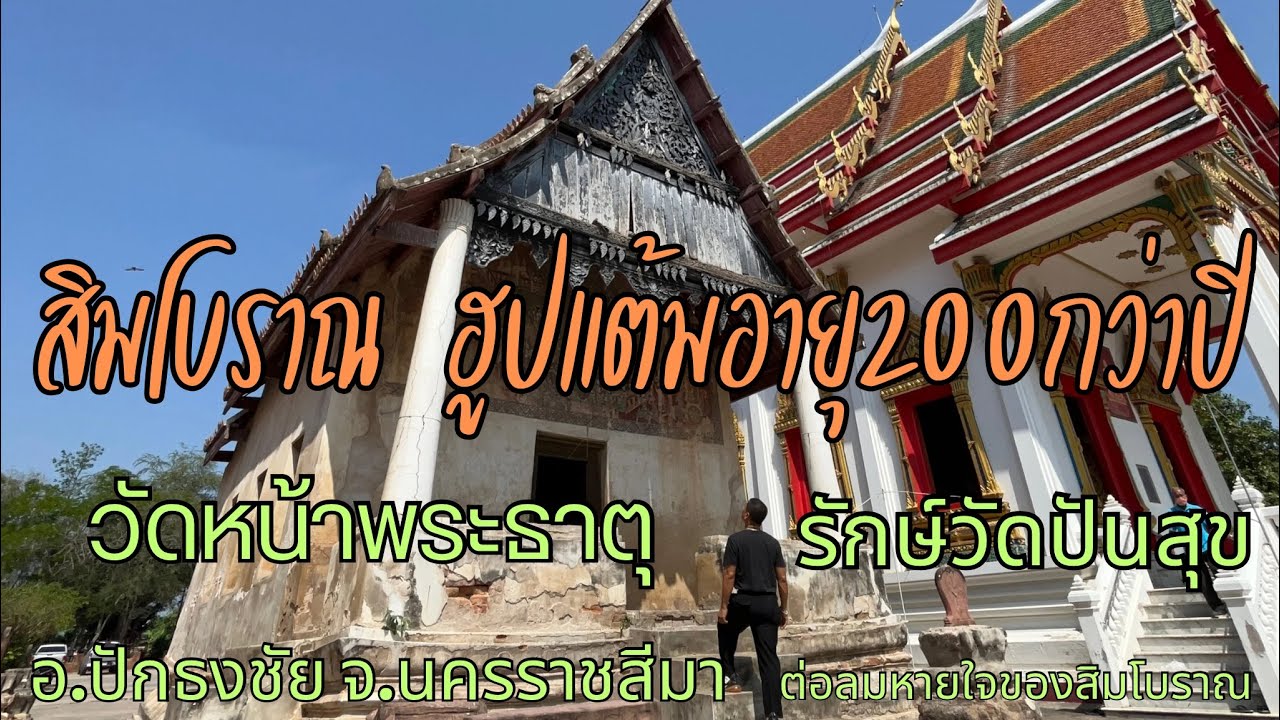
 Click to Access the Navigation Map GPS
Wat Na Phra That Map
Recommend

 Art, Culture and Heritage
 Historical Sites and Monuments(20)
 Landmarks and Memorials(5)
 Art, Craft Centres, Tradition(7)
 Museums(6)
 Art Gallery(1)
 Educational Places
 Educational Gardens, Farm(4)
Temple(29)
Educational Gardens, Farm(4)
Temple(29)
 Mosque(1)
 Other Sacred Sites(6)
 Research and Development
 Royal Project(3)
 Suburban Living
 Village, Community(6)
 Local Market(4)
 Floating Market(1)
 Nature and Wildlife
 National Parks and Marine Reserves(3)
 Mountain (Doi)(5)
 Dam, Reservoir, Lake(8)
 Waterfalls(9)
 Hot Springs(1)
 Caves(2)
 Flower Field(1)
 River, Canal(8)
 Bays and Beaches(2)
 Other natural attractions(3)
 Entertainment and Agricultural
 Zoos and Aquariums(1)
 Animal camps and shows(1)
 Farms, Parks and Ecotourism(21)
 Waterpark(2)
 Outdoor and Adventure Activities(6)
 Shopping
 Shopping and Night Market(2)
 Travel Articles, Recipes
 Travel Review, Food Review(6)


