
lovethailand home >Northeastern Travel Attractions >Nakhon Ratchasima Travel Attractions >Muang Nakhon Ratchasima >Sura Nari > Khorat Fossil Museum
TL;DR: Khorat Fossil Museum is located at Ban Krok Duean Ha, Mittraphap-Nong Pling Road, Suranari Subdistrict, Mueang Nakhon Ratchasima District, Nakhon Ratchasima Province, open Tuesday – Sunday, hours 09.00 – 16.00.
Khorat Fossil Museum
Open Days: Tuesday – Sunday
Opening Hours: 09.00 – 16.00
The Petrified Wood Museum, Ancient Elephants and Dinosaurs, also known as Khorat Fossil Museum, is one of the most important fossil and natural history learning centers in Nakhon Ratchasima Province. Located at 184 Moo 7, Ban Krok Duean Ha, Mittraphap-Nong Pling Road, Suranari Subdistrict, Mueang Nakhon Ratchasima District, the museum brings together three major exhibitions in one destination: the Petrified Wood Museum, the Ancient Elephant Museum, and the Dinosaur Museum. It is a highly suitable attraction for families, students, science lovers, cultural travelers, and visitors who want to understand the prehistoric world through real fossil evidence discovered in Khorat and Northeastern Thailand.
For travelers looking for meaningful things to do in Nakhon Ratchasima, this museum offers far more than a standard indoor exhibition. It explains the relationship between the Earth, ancient plants, prehistoric animals, river systems, sediment layers, landscape formation, and the long history of life before humans. Visitors can begin with large petrified wood specimens that range from hundreds of thousands to hundreds of millions of years old, continue to the story of ancient elephants that once lived around the Mun River basin and its tributaries, and finish with the dinosaur zone, where Khorat’s fossil discoveries help explain why Nakhon Ratchasima is often recognized as one of Thailand’s most important fossil provinces.
The main strength of the Petrified Wood Museum, Ancient Elephants and Dinosaurs is its ability to turn geology and paleontology into an accessible travel experience. Visitors do not simply look at wood, stone, bones, or teeth behind glass. They are guided through the processes that explain how ordinary wood can become stone, what the environment of ancient Khorat may have looked like, why so many ancient elephant fossils have been found in this region, and how the areas around Khok Kruat and Suranari are connected to dinosaur discoveries. The museum also helps visitors understand the broader role of Khorat Geopark as a natural heritage landscape.
The museum is operated under the Institute of Petrified Wood and Mineral Resources, Northeastern Research Center of Natural Resources, Nakhon Ratchasima Rajabhat University. Its mission covers exhibition, education, research, conservation, and public communication. The origin of the museum is connected to fossil and petrified wood conservation efforts in Nakhon Ratchasima during the 1990s. These efforts later developed into a research and museum project in Suranari Subdistrict. The museum began welcoming visitors in 2004 and was officially opened in 2008. Since then, it has become a major fossil landmark of Khorat and one of the most distinctive science-based attractions in Northeastern Thailand.
Petrified wood is ancient wood that has undergone a natural mineral replacement process. In general, logs or plant remains are buried under sediment such as soil, sand, gravel, or clay in low-oxygen conditions, slowing down decay. Mineral-rich groundwater then gradually seeps into the cellular structure of the wood and replaces the original organic material. Over a very long period, the form, grain, annual rings, and some microscopic details of the original wood can remain visible, while the material itself becomes stone. This makes petrified wood both a natural wonder and a scientific record of ancient forests and past environments.
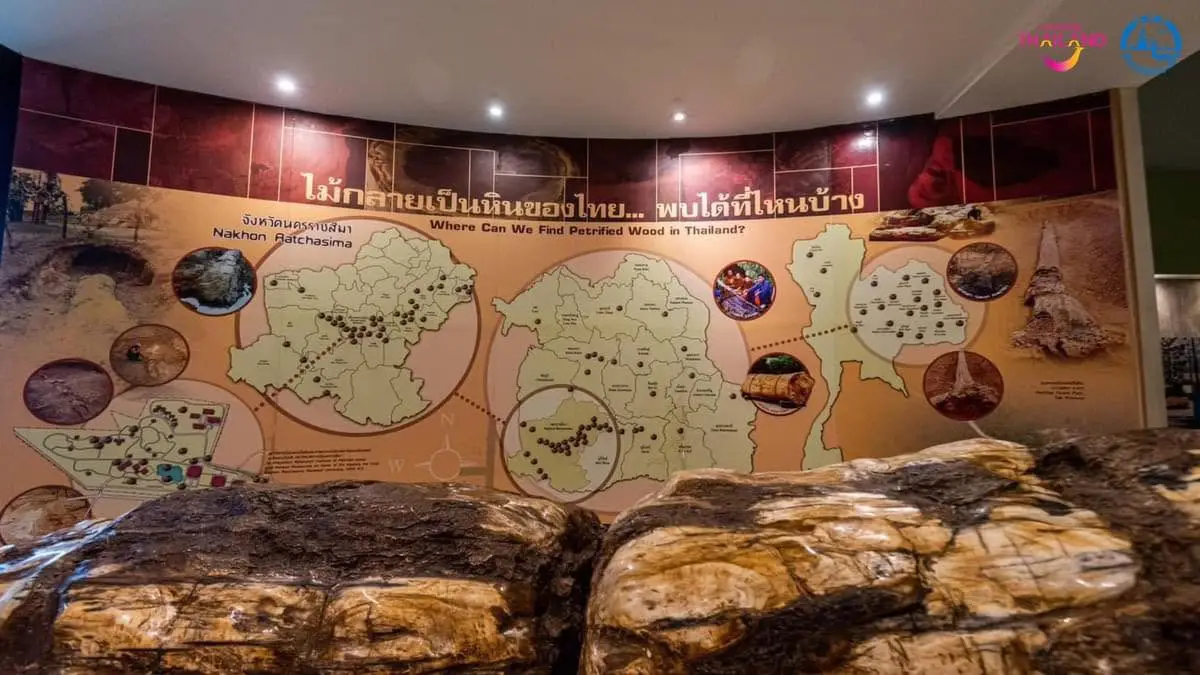
Northeastern Thailand is an important region for petrified wood, and Nakhon Ratchasima is particularly significant because of the diversity of specimens found in the province. Khorat’s petrified wood varies in size, age, texture, color, and mineral content. Some specimens are visually striking because of silica, opal, or other minerals within the fossilized wood. This gives some pieces a gemstone-like appearance and makes Khorat petrified wood distinct from many other fossil wood sites. The museum therefore presents petrified wood not only as beautiful natural material, but also as geological evidence that deserves long-term conservation and study.
The first major exhibition area is the Petrified Wood Museum. Here, visitors learn about ancient plants, the process of petrification, the diversity of fossil wood in Thailand, and notable specimens from different sources. The highlights include large petrified logs and polished pieces that reveal the preserved internal texture of the original wood. Some pieces show colors and patterns that make it clear why petrified wood is scientifically valuable and visually fascinating. This section helps visitors understand that petrified wood is not just a decorative stone; it is a natural archive that preserves evidence of ancient forests, plant life, and environmental change.
The museum also introduces the origin of the Earth and the evolution of life through films and learning media that help visitors connect geological events with living organisms across time. The story moves from the formation of the planet to the development of landscapes, sedimentation, fossil formation, and the evolution of plants and animals. For visitors without a science background, the exhibitions make complex ideas easier to follow. For children and students, seeing real specimens after learning about fossils in textbooks can make the subject far more memorable and engaging.
The outdoor petrified wood garden is another important part of the visit. It extends the learning experience beyond the indoor galleries and places large fossil wood specimens in a landscape setting that connects them with the natural environment of Northeastern Thailand, especially the Mun and Chi river basins. This outdoor section allows visitors to see the size, weight, surface texture, and physical presence of petrified wood more clearly. It is also a good area for photography and for explaining fossil formation to children in a relaxed, open-air setting.
The second major section is the Ancient Elephant Museum, one of the most memorable zones for many visitors. Nakhon Ratchasima is known for its rich ancient elephant fossil record, especially in the Mun River basin and around Tha Chang in Chaloem Phra Kiat District. The fossils found in Khorat cover a long period, from millions of years ago to much later prehistoric time. This makes the province highly important for the study of elephant evolution in Southeast Asia.
Inside the Ancient Elephant Museum, visitors can learn about several groups of prehistoric elephants, including four-tusked elephants and other ancient forms with distinctive tusks and molars. The exhibition also includes fossils of other mammals that once lived in the ancient environments of the Khorat region. These displays show that elephants of the past were far more diverse than the Asian elephants familiar today. Their body size, tusk form, molars, and ecological adaptations varied considerably. By seeing fossil teeth, jaws, tusks, and skeletons together with clear explanations, visitors can better understand how life changes over immense periods of time.
The Ancient Elephant Museum also encourages visitors to see Nakhon Ratchasima in a deeper historical context. The modern city, roads, farms, and communities of today stand on a landscape that once supported large mammals, river systems, floodplains, and fossil-bearing sedimentary environments. The discovery of many ancient elephant fossils in the region is not accidental. It reflects the geological and environmental history of the area. Through this section, the museum presents Khorat not only as a major city of Isan, but also as a key landscape for understanding ancient life in the region.
The third major section is the Dinosaur Museum, a favorite among families and children. Areas around Khorat, including Khok Kruat and Suranari, have produced bones and teeth of several dinosaur groups. These include carnivorous dinosaurs, large herbivorous dinosaurs, iguanodontians, and duck-billed dinosaurs. Such discoveries make Khorat highly relevant to the study of Early Cretaceous dinosaurs in Thailand.
Inside the Dinosaur Museum, visitors can explore displays related to important Khorat dinosaurs such as Siamraptor suwati, a shark-toothed carnivorous dinosaur of major scientific significance, and Sirindhorna khoratensis, an iguanodontian herbivorous dinosaur associated with discoveries in the province. The museum uses models, reconstructed skeletons, visual panels, and explanatory media to show the differences between dinosaur groups, including their teeth, diets, movement, body size, and the periods in which they lived.
What makes Khorat’s Dinosaur Museum especially interesting is that the dinosaurs are not presented as imaginary creatures from movies, but as animals connected to real fossil evidence found in Thailand. Visitors can learn how fossils are located, excavated, cleaned, studied, and interpreted by paleontologists. This process helps show that fossil discoveries require scientific work, patience, and careful conservation. For students and young visitors, it is an excellent introduction to how prehistoric life is reconstructed from fragments of bone, teeth, and rock layers.
In addition to the three main museums, the site includes visitor service areas, temporary exhibitions, children’s learning activities, Khorat Geopark displays, and outdoor spaces that expand the overall experience. At certain times, the museum also hosts special events such as night museum programs, workshops, simulated fossil excavation activities, and geopark-related events. These programs make the museum more than a static display space. It becomes a living learning center that visitors can return to for different experiences throughout the year.
For families with children, the Petrified Wood Museum, Ancient Elephants and Dinosaurs is an excellent destination. It combines serious scientific content with visually engaging exhibits. Large fossils, prehistoric skeletons, dinosaur models, and real petrified wood specimens naturally stimulate curiosity. Parents can use the visit to talk with children about the Earth, time, nature, extinction, environmental change, and conservation. This makes the museum a valuable learning experience outside the classroom.
For students, teachers, and academic visitors, the museum connects multiple fields of knowledge, including geology, paleontology, evolutionary biology, geography, natural history, conservation, and science communication. Seeing real specimens helps make technical ideas easier to understand. Concepts such as fossilization, sedimentary layers, mineral replacement, extinction, elephant evolution, and new dinosaur discoveries become much clearer when visitors can see physical evidence in front of them. The museum is therefore well suited for educational trips, research preparation, field reports, and science inspiration.
For general travelers, the charm of the museum lies in its unique Khorat identity. Many visitors know Nakhon Ratchasima as the gateway to Northeastern Thailand, the city of Thao Suranari, a food destination, or a stop before heading to Khao Yai. This museum reveals another side of the province: Khorat as a land of fossils, geological heritage, ancient elephants, and dinosaurs. Walking through the exhibitions feels like traveling back to a world that existed millions of years before human history.
Visitors should allow at least 1.5 to 2 hours to explore the museum properly. This gives enough time to walk through all three main sections, read the explanations, take photos, and let children learn at a comfortable pace. Those with a deeper interest in fossils or natural history may want to spend longer, especially if a special exhibition or activity is taking place. Visiting in the morning or early afternoon is recommended so there is enough time to continue to nearby attractions afterward.
Getting There from Nakhon Ratchasima city is most convenient by private car, rental car, or arranged transport. Take Highway 304 on the Nakhon Ratchasima–Pak Thong Chai route for about 16 km. At Gate 2 of Suranaree University of Technology, turn right and continue for about 2 km, then keep left toward the Mittraphap-Nong Pling bypass road for another 1 km to reach the museum. The route is suitable for private cars, family vans, and educational group buses.
Travelers arriving from other provinces can reach Nakhon Ratchasima by car, intercity bus, or train, then continue to Suranari Subdistrict by taxi, rental car, or prearranged transport. Since the museum is located outside the central city area, having a private vehicle is the most convenient option, especially for visitors planning to combine the museum with Suranaree University of Technology, Nakhon Ratchasima Zoo, Huai Yang Reservoir, or attractions in the city center.
The regular admission fee is affordable for families and educational trips: 50 baht for adults and 20 baht for children. Special activities, night museum events, workshops, or temporary programs may have separate ticket conditions depending on each event. Groups should contact the museum in advance to reserve a visiting round, especially schools or organized tours that require staff assistance or guided interpretation.
The best route through the museum is to begin with the Petrified Wood Museum, because it introduces the core story of fossilization and geological time. Visitors can then continue to the Ancient Elephant Museum to understand how mammal fossils relate to the Mun River basin and surrounding landscapes. The visit can end at the Dinosaur Museum, where the prehistoric story expands into the world of reptiles and Early Cretaceous discoveries. This sequence helps visitors understand how Khorat’s natural history connects plants, mammals, dinosaurs, and geological change.
The museum is also a strong starting point for understanding Khorat Geopark. Nakhon Ratchasima has a wide variety of geological, fossil, natural, and cultural resources. Beginning at the museum helps visitors understand the larger context before exploring other geological landscapes, fossil-related areas, river systems, and cultural sites in the province. A visit here is therefore not only an indoor museum experience, but also a gateway to understanding Khorat as a complete natural heritage destination.
The museum reflects the importance of fossil conservation. Fossils cannot be recreated once destroyed or removed from their context. Losing them means losing evidence of natural history. By collecting, studying, displaying, and explaining fossils to the public, the museum helps visitors understand why natural heritage should be protected. Conservation here is not simply about storing objects behind glass; it is about helping society recognize the value of ancient evidence and participate in preserving it for future generations.
The overall atmosphere of the museum is suitable for relaxed exploration. The exhibitions are rich in information, but visitors do not need to rush through every panel. They can focus on the highlights that interest them most, such as gemstone-like petrified wood, ancient elephant teeth, large skeletons, Khorat dinosaurs, or the media presentation on the origin of the Earth. This makes the museum enjoyable for both casual travelers and serious learners.
Photography is suitable in permitted areas, but visitors should avoid touching fossils or exhibition objects unless specifically allowed. Children should be supervised, and visitors should not climb, knock, or move any display items. Many fossils are scientifically valuable and more fragile than they may appear. Respectful behavior during the visit is part of helping preserve this learning center for future visitors.
Compared with many general museums, the strong point of this destination is its local context. It does not simply display fossils without explanation. Instead, it tells the story of Khorat through evidence linked to real landscapes, including Ban Krok Duean Ha, Suranari, Khok Kruat, Tha Chang, the Mun River basin, and the broader Khorat Geopark. Visitors gain both scientific knowledge and a deeper understanding of Nakhon Ratchasima’s natural identity.
A one-day itinerary can begin with the Petrified Wood Museum, Ancient Elephants and Dinosaurs in the morning, allowing about 2 hours for the visit. Afterward, travelers can continue to Nakhon Ratchasima Zoo or have lunch around Suranaree University of Technology and University Road. In the afternoon, they can head into the city to visit the Thao Suranari Monument, Wat Sala Loi, or Maha Weerawong National Museum, then finish the day with a local market or a restaurant in central Korat. This route combines science, nature, culture, and local food in one trip.
For international travelers, the museum presents a different side of Thailand. Many visitors know Thailand for temples, beaches, food, and festivals, but fewer realize that the country also has important dinosaur fossils, ancient elephant evidence, and petrified wood resources. This museum is therefore especially suitable for travelers interested in natural history, fossils, dinosaurs, ancient elephants, geology, and geopark tourism. It is a worthwhile addition to a trip to Khorat, especially for those traveling through Nakhon Ratchasima or visiting the wider Khao Yai and Isan region.
In summary, the Petrified Wood Museum, Ancient Elephants and Dinosaurs is one of the most valuable educational attractions in Nakhon Ratchasima. It combines national-level significance, distinctive fossil collections, diverse exhibitions, and a strong local story that cannot be found in ordinary museums. Whether visiting with family, joining a school trip, collecting academic information, or simply looking for a unique travel experience in Khorat, this museum offers a complete journey through the ancient Earth, prehistoric life, and the natural identity of Nakhon Ratchasima Province.
| Name | Petrified Wood Museum, Ancient Elephants and Dinosaurs / Khorat Fossil Museum |
| Location | Ban Krok Duean Ha, Mittraphap-Nong Pling Road, Suranari Subdistrict, Mueang Nakhon Ratchasima District, Nakhon Ratchasima Province |
| Address | 184 Moo 7, Mittraphap-Nong Pling Road, Suranari Subdistrict, Mueang Nakhon Ratchasima District, Nakhon Ratchasima 30000, Thailand |
| Coordinates | 14.85828, 102.02651 |
| Highlights | A major fossil learning center in Khorat with three main museums: petrified wood, ancient elephants, and dinosaurs |
| History | The conservation and museum project began in 1994, the museum started welcoming visitors in 2004, and it was officially opened in 2008. The collections cover natural evidence ranging from hundreds of thousands to hundreds of millions of years old. |
| Name Origin | The name reflects the museum’s three core subjects: petrified wood, ancient elephants, and dinosaurs, all of which are important fossil evidence from Nakhon Ratchasima. |
| Distinctive Features | Real fossils, large petrified wood specimens, gemstone-like petrified wood, ancient elephant fossils, dinosaur models and skeletons, and learning media on the origin of the Earth and the evolution of life |
| Travel Information | From Nakhon Ratchasima city, take Highway 304 toward Pak Thong Chai for about 16 km. At Gate 2 of Suranaree University of Technology, turn right for about 2 km, then keep left toward the Mittraphap-Nong Pling bypass road for about 1 km. |
| Current Status | Open to visitors during regular operating hours and remains an important fossil learning center in Nakhon Ratchasima. |
| Open Days | Tuesday – Sunday |
| Opening Hours | 09.00 – 16.00 |
| Fees | Adults 50 Baht, Children 20 Baht |
| Facilities | Parking area, visitor service point, exhibition buildings, learning media room, temporary exhibition area, activity space, and outdoor petrified wood display area |
| Main Areas / Zones | 1. Petrified Wood Museum 2. Ancient Elephant Museum 3. Dinosaur Museum 4. Petrified Wood Garden and Outdoor Display Area 5. Temporary Exhibitions and Special Activity Areas |
| Caretaker | Institute of Petrified Wood and Mineral Resources, Northeastern Research Center of Natural Resources, Nakhon Ratchasima Rajabhat University / Director: Asst. Prof. Dr. Natthinee Thongdee |
| Main Contact Number | 044-370-739, 080-165-1070 |
| Official Website / Official Page | www.khoratfossil.org / Facebook: พิพิธภัณฑ์ไม้กลายเป็นหิน • Khorat Fossil Museum |
| Nearby Tourist Attractions | 1. Suranaree University of Technology, about 4 km 2. Nakhon Ratchasima Zoo, about 12 km 3. Huai Yang Reservoir, about 13 km 4. Save One Korat, about 14 km 5. Thao Suranari Monument, about 18 km 6. Wat Sala Loi, about 20 km |
| Nearby Restaurants | 1. Yai Langka Pla Phao, about 6 km, Tel. 044-255-599, 044-370-877, 089-864-6223 2. Phu Thai Rot Saep, about 7 km, Tel. 090-618-1606, 093-432-9039 3. Smooth Eatery & Cafe’, about 5 km, Tel. 064-123-4816 4. Vanilla Prince at Suranaree University of Technology Hospital, about 6 km, Tel. 084-564-6456 5. Baan Ya Steak House SUT Branch, about 8 km, Tel. 080-166-3560 |
| Nearby Accommodations | 1. Surasammanakhan, Suranaree University of Technology, about 5 km, Tel. 044-224-880 2. Punn Hotel Korat, about 7 km, Tel. 064-435-1919 3. SHIBAROOM Nakhonratchasima Suranaree University of Technology, about 6 km 4. The Sept Korat, about 9 km 5. Piyapruk Resort, about 13 km |
Frequently Asked Questions (FAQ)
Q: Where is the Petrified Wood Museum, Ancient Elephants and Dinosaurs located?
A: It is located at 184 Moo 7, Ban Krok Duean Ha, Mittraphap-Nong Pling Road, Suranari Subdistrict, Mueang Nakhon Ratchasima District, Nakhon Ratchasima Province, near Suranaree University of Technology.
Q: What days and hours is the museum open?
A: The museum is open Tuesday to Sunday from 09.00 to 16.00 and closed every Monday.
Q: How much is the admission fee?
A: The regular admission fee is 50 baht for adults and 20 baht for children.
Q: What are the main exhibition zones inside the museum?
A: The main zones are the Petrified Wood Museum, the Ancient Elephant Museum, and the Dinosaur Museum, with additional outdoor displays, temporary exhibitions, and special activity areas.
Q: Is the museum suitable for children and families?
A: Yes. It is highly suitable for families because it includes real fossils, dinosaur models, prehistoric skeletons, and learning media that help children understand the Earth, nature, and ancient life.
Q: How long should visitors spend at the museum?
A: Visitors should allow at least 1.5 to 2 hours to explore all three main zones, read the displays, take photos, and enjoy the museum without rushing.
Q: How can travelers get there from Nakhon Ratchasima city?
A: Take Highway 304 toward Pak Thong Chai for about 16 km. At Gate 2 of Suranaree University of Technology, turn right for about 2 km, then continue toward Mittraphap-Nong Pling Road for about 1 km.
Q: What nearby attractions can be visited after the museum?
A: Nearby places include Suranaree University of Technology, Nakhon Ratchasima Zoo, Huai Yang Reservoir, Save One Korat, Thao Suranari Monument, and Wat Sala Loi.
Tel : 044370739-41
 Tel : 044370739-41
 Category: ●Art, Culture and Heritage
 Group: ●Museums
Last Update : 3 MonthAgo
 Last Update : 3 MonthAgo
 Click to Access the Navigation Map GPS
Khorat Fossil Museum Map
Recommend

 Historical Sites and Monuments(20)
 Landmarks and Memorials(5)
 Art, Craft Centres, Tradition(7)
Museums(6)
Art, Craft Centres, Tradition(7)
Museums(6)
 Art Gallery(1)
 Educational Places
 Educational Gardens, Farm(4)
 Places of Worship
 Temple(29)
 Mosque(1)
 Other Sacred Sites(6)
 Research and Development
 Royal Project(3)
 Suburban Living
 Village, Community(6)
 Local Market(4)
 Floating Market(1)
 Nature and Wildlife
 National Parks and Marine Reserves(3)
 Mountain (Doi)(5)
 Dam, Reservoir, Lake(8)
 Waterfalls(9)
 Hot Springs(1)
 Caves(2)
 Flower Field(1)
 River, Canal(8)
 Bays and Beaches(2)
 Other natural attractions(3)
 Entertainment and Agricultural
 Zoos and Aquariums(2)
 Animal camps and shows(1)
 Farms, Parks and Ecotourism(21)
 Waterpark(4)
 Outdoor and Adventure Activities(6)
 Shopping
 Shopping and Night Market(2)
 Travel Articles, Recipes
 Travel Review, Food Review(6)


