
lovethailand home >Northeastern Travel Attractions >Nakhon Phanom Travel Attractions >Muang Nakhon Phanom >Nai Muang > Suan Luang Rama 9 (Nakhon Phanom)
TL;DR: Suan Luang Rama 9 (Nakhon Phanom) is located at Northern Nakhon Phanom Municipality, Nong Saeng Subdistrict, Mueang Nakhon Phanom District, Nakhon Phanom Province, open Daily, hours 08:30–16:30.
Suan Luang Rama 9 (Nakhon Phanom)
Open Days: Daily
Opening Hours: 08:30–16:30
Suan Luang Rama IX Park in Nakhon Phanom, historically known as Nong Saeng Park, is an 84-rai public park on the northern side of Nakhon Phanom Municipality. It is located along the Nakhon Phanom–Tha Uthen Road, between kilometer markers 0 and 1, opposite Wat Sawang Suwannaram. The park was developed from a natural wetland containing small islands and local vegetation. It was created as a royal tribute to King Bhumibol Adulyadej the Great on the occasion of his fifth-cycle, or 60th, birthday and officially opened on 5 December 1987. Today, it serves as a free public green space for walking, light exercise, photography, relaxation, family activities, and quiet encounters with an urban wetland landscape.
Suan Luang Rama IX Park, Nakhon Phanom is one of the most important public green spaces within the city of Nakhon Phanom. The park brings together local history, an urban wetland environment, community life, and the commemoration of King Bhumibol Adulyadej the Great, Thailand’s King Rama IX. Rather than being created on an entirely empty site, the park developed from an existing natural pond traditionally known as Nong Saeng. Its original water, small islands, vegetation, and open landscape were incorporated into a civic park designed for residents of all ages.
The park lies on the northern side of the municipal area, along the Nakhon Phanom–Tha Uthen Road, also known as Highway 212, between kilometer markers 0 and 1. Administratively, it is located in Nong Saeng Subdistrict, Mueang Nakhon Phanom District, Nakhon Phanom Province. A useful landmark is Wat Sawang Suwannaram, which stands directly opposite the park. The location is only a short drive from central Nakhon Phanom, the historic riverside neighborhoods, the Mekong riverfront, and several of the city’s best-known cultural attractions.
Before its transformation into Suan Luang Rama IX Park, the site was a natural wetland with a number of small islands scattered across the water. Native trees and other vegetation grew around its banks, making it part of the original ecological landscape of the city. Nong Saeng helped retain water, maintain local humidity, and create an open natural setting within an expanding urban area. The park’s development therefore involved adapting an existing wetland for safer and more organized public use rather than replacing the original environment with a completely artificial garden.
The name “Nong Saeng” preserves a piece of local environmental history. According to accounts passed down by older residents, many saeng trees once grew around the pond. Naming a wetland after the plant species commonly found nearby is a familiar practice in northeastern Thai communities, where local place names often describe the landscape, vegetation, water sources, or settlement history. Although the site was officially renamed Suan Luang Rama IX Park, residents still use the former name, Nong Saeng Park, which maintains the connection between the present-day public park and its natural origins.
The park covers approximately 84 rai and 59 square wah, equivalent to more than 134,000 square meters. This substantial area allows several landscape elements to coexist without making the park feel crowded. The central wetland, small islands, bridges, waterside paths, shaded trees, landscaped garden areas, and open activity spaces provide different experiences within the same site. Visitors can move between open views over the water and more enclosed areas beneath the trees, making the park suitable for both physical activity and quiet relaxation.
A major turning point occurred in 1987, when Nakhon Phanom Province and Nakhon Phanom Municipality began improving Nong Saeng as a commemorative public park. The project formed part of nationwide efforts to mark the fifth-cycle birthday of King Bhumibol Adulyadej the Great, who reached the age of 60 on 5 December 1987. Many provinces created or improved public green spaces during this period so that royal commemoration could also generate lasting benefits for local communities.
The development of the park was distinguished by broad community participation. Uthai Nakpricha, the governor of Nakhon Phanom at the time, and Ong-at Thipkhositkhun, then mayor of Nakhon Phanom, invited government agencies, local merchants, private organizations, and residents to contribute to the project. Approximately 400,000 baht was raised through donations, while Nakhon Phanom Municipality contributed an additional 100,000 baht. This initial fund of around 500,000 baht supported the improvement of the wetland and surrounding public space.
The funds were used to dredge the pond, improve the condition of the site, organize the landscape, and create features required for public use. Dredging helped restore the pond’s capacity to hold water, while the landscaping connected the water, islands, paths, bridges, planted areas, and rest spaces. The project did not remove the defining character of Nong Saeng. Instead, the existing wetland remained the visual and ecological center of the new public park.
Suan Luang Rama IX Park officially opened on 5 December 1987 at 09:30, the day marking King Rama IX’s fifth-cycle birthday. The opening date gave the park both national and local significance. It expressed the loyalty and respect of Nakhon Phanom residents while creating a practical public resource that could continue to serve future generations. The park’s commemorative identity is therefore inseparable from its role in improving urban quality of life.
International travelers should be aware that this park is not the large Suan Luang Rama IX Park in Bangkok. Nakhon Phanom has its own park of the same commemorative name, with a different scale, landscape, and local history. Its defining feature is the transformation of Nong Saeng, an established community wetland, through a locally supported development project. Using the full search term “Suan Luang Rama IX Park Nakhon Phanom” or “Nong Saeng Park Nakhon Phanom” will help avoid navigation to the Bangkok attraction.
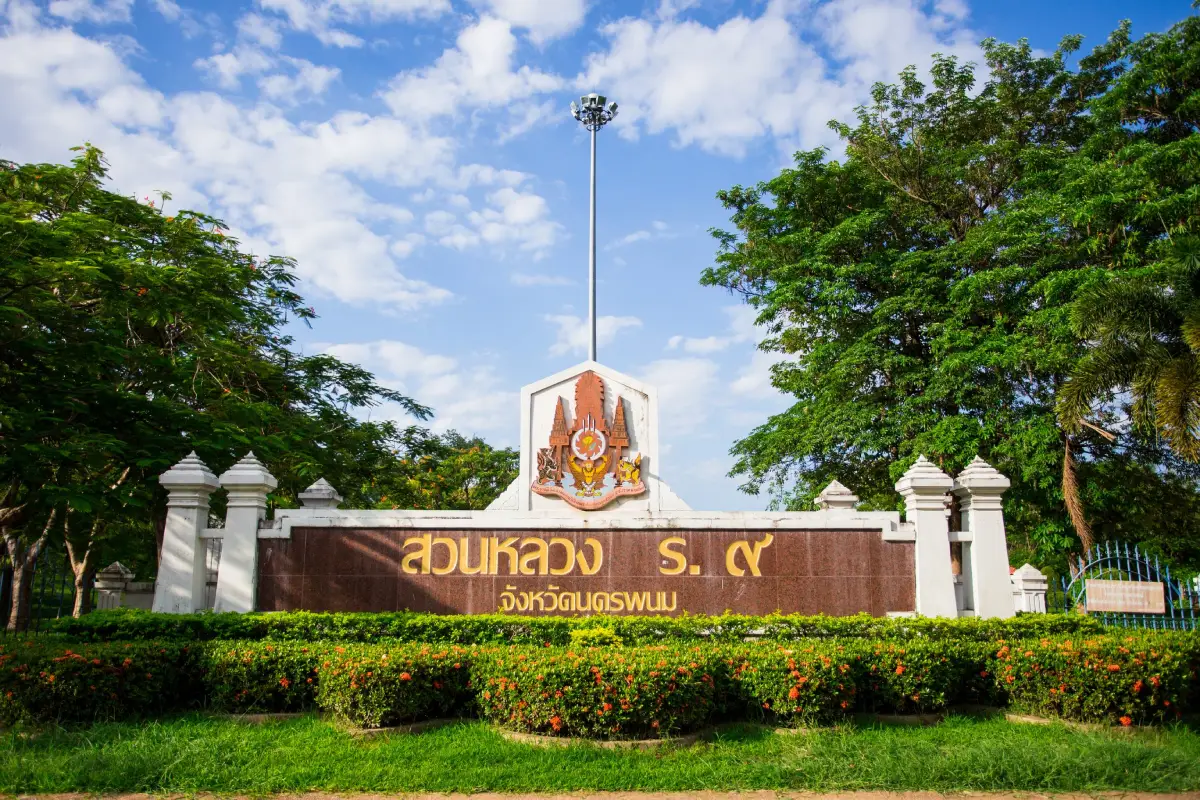
The entrance and park sign provide the first recognizable point for visitors. From this area, the principal paths lead toward the pond, bridges, islands, planted spaces, and shaded sections. First-time visitors may find it useful to pause near the entrance and observe the general layout before selecting a walking route. Beginning slowly also allows visitors to appreciate how the landscaped elements are arranged around the original body of water rather than following the pattern of a conventional formal garden.
The pond and its small islands remain the visual heart of the park. Water opens the landscape, reflects the trees and sky, and creates different moods throughout the day. In the morning, the surface often feels calm and cool, making the area suitable for walking and gentle exercise. During the late afternoon, softer light falls across the pond and produces attractive reflections for photography. Even a short visit can provide a welcome break from the built-up streets of the city.
The islands break the water into a series of layered views instead of presenting one large, featureless pond. Trees, vegetation, water, bridges, and pathways overlap visually, creating changing perspectives as visitors move around the site. The quieter island areas may also provide resting places for birds and small animals associated with the wetland. Although the park is located within the city, retaining water and vegetation allows it to continue functioning as a small ecological refuge.
Bridges and waterside paths are among the park’s most distinctive features. They connect different sections of the landscape and offer elevated views across the pond. Walking over a bridge provides a clearer view of reflections, islands, and vegetation, while the open water often brings a light breeze. Families with young children and older visitors should use caution, particularly after rain, when bridge surfaces and paved paths may become slippery.
Shaded areas and landscaped gardens provide places to rest between walks. Mature trees filter sunlight, reduce heat, and create comfortable spaces for reading, conversation, or a quiet pause during a day of sightseeing. Visitors do not need to follow a demanding activity program to enjoy the park. Sitting beneath the trees and looking across the water can be equally rewarding, especially for travelers seeking a slower and more local experience of Nakhon Phanom.
The main paths and open spaces are suitable for health walking, light jogging, stretching, and other low-impact activities that do not disturb other users. Early morning generally offers cooler temperatures and a quieter environment. Late afternoon is more social, when residents finish work or school and come to use the park. Joggers should reduce speed in narrow areas and around children, older people, or groups occupying the same path.
For families, the park offers children an opportunity to encounter trees, water, islands, and an outdoor environment without leaving the city. Parents can use the visit to discuss wetlands, public cleanliness, water conservation, and the value of shared urban spaces. However, the presence of water and bridges means young children require close supervision. They should not climb railings, approach the water’s edge without an adult, or feed wildlife unless the activity is specifically permitted.
Older visitors can use the park for slow walking, gentle movement, fresh air, and social contact. Early morning and late afternoon are preferable to the hottest part of the day. Carrying drinking water and taking regular breaks are advisable because the grounds cover a considerable area. Visitors with limited stamina do not need to complete a full circuit. The entrance area, nearby shaded paths, and the closest views of the pond can still provide a satisfying experience.
Photographers will find a variety of subjects, including the entrance sign, curved bridges, water reflections, small islands, trees, and everyday community activities. Morning light produces fresh colors and soft shadows, while late-afternoon light creates warmer tones and stronger reflections on the pond. A wide-angle lens is useful for capturing the relationship between the bridges, water, and vegetation, while a medium focal length works well for plants, reflections, and candid scenes. Visitors should request permission before photographing individuals at close range.
From an urban ecological perspective, Nong Saeng has value beyond its appearance. The water and vegetation help retain moisture, moderate temperatures, provide shade, and accommodate rainfall. The green area also filters dust and creates habitat for birds and small animals. Caring for the park therefore involves protecting its ecological functions as well as maintaining facilities for visitors. Rubbish should never be thrown into the pond, and plants along the water’s edge should not be removed or damaged.
The cool season, generally from November to February, is the most comfortable period for extended outdoor activity. Morning and evening temperatures are usually more pleasant than at other times of the year, while clearer skies make walking and photography easier. Travelers visiting Nakhon Phanom for festivals, cultural routes, or Mekong riverfront sightseeing can begin the day at the park before continuing to historical and religious sites in the old town.
From March to May, temperatures can become high, especially around midday. Visitors should come in the morning or after 16:00, wear breathable clothing, carry water, and use a hat and sun protection. Shaded trees offer relief, but prolonged walking in strong sunlight may still lead to dehydration. During the hot season, the park is best treated as an early-morning or late-afternoon stop rather than a long midday excursion.
The rainy season brings richer greenery and a fuller wetland landscape. The period immediately after rain can be attractive for plant photography and reflections on the water. Visitors should nevertheless check the weather, carry an umbrella or rain jacket, and watch for slippery surfaces. Mosquitoes may be more noticeable near the pond during humid evenings, making insect repellent useful. Remaining on the main routes is also advisable when surrounding ground is wet.
For general sightseeing, the most convenient visiting periods are approximately 08:30–10:00 and 15:30–16:30. Morning is suitable for health walking, gentle light, and a quieter atmosphere. Late afternoon is comfortable for resting and photography before continuing to the Mekong riverfront for sunset. Those planning a focused exercise session should allow at least 45–60 minutes. Visitors who wish to walk, photograph the bridges, and relax beside the pond should reserve approximately one to two hours.
A morning visit can begin at the entrance sign, continue along the path beside the water, cross or view the nearest bridges, and finish with a rest beneath the trees. This simple route reveals the most important landscape components without requiring a hurried circuit of the entire park. The journey can then continue to Saint Anna Nong Saeng Catholic Church, the Old Nakhon Phanom Governor’s Residence, the Vietnamese Memorial Clock Tower, and the Mekong riverfront.
In the afternoon, the park works well as a quiet stop before an evening itinerary. Visitors can take a gentle walk around the pond, sit in a shaded area, and photograph the bridges before traveling to the Phaya Si Sattanakharat Naga Monument or the riverside promenade. Nakhon Phanom has numerous restaurants and cafés near the river, making it easy to combine a late-afternoon park visit with dinner and an evening walk.
Getting There from central Nakhon Phanom or the Phaya Si Sattanakharat area is straightforward. Follow Sunthon Wichit Road or Highway 212 north toward Tha Uthen for approximately 3 kilometers. On reaching Nong Saeng Subdistrict, look for Wat Sawang Suwannaram. The park stands on the opposite side of the road and has a visible entrance sign. Private cars, rental cars, taxis, local three-wheeled vehicles, and bicycles can all be used for the short journey from the city center.
Travelers arriving at Nakhon Phanom Airport can take a rental car, taxi, or hotel transfer into the city and continue north along Highway 212. Travel time depends on traffic and the location of the accommodation. Guests staying near the Mekong riverfront may ask their hotel to arrange local transport and give the destination as “Nong Saeng Park” or “Suan Luang Rama IX opposite Wat Sawang Suwannaram,” names that local drivers can identify clearly.
Cycling from the central city is possible because the distance is relatively short. Cyclists should wear helmets, remain alert to road traffic, and avoid the hottest or busiest periods. Morning offers more comfortable conditions than midday. Bicycles should be left where they do not obstruct entrances or walking paths. Walking all the way from the central riverside area is possible for fit travelers but is longer than a typical sightseeing walk, so a bicycle or local vehicle is generally more practical.
Admission is free, and advance reservations are not required. Visitors should carry drinking water and any essential personal items because the site functions primarily as a community public park rather than a large commercial attraction. Casual, respectful clothing and sportswear are suitable. Shoes with reliable grip are recommended, particularly for those planning to walk around the wetland or visit during the rainy season.
Wheelchair users, older travelers, and people with limited mobility should prioritize level routes near the entrance and the main paths. Uneven surfaces, narrow sections, or bridges with slopes may require assistance. A companion can inspect a route before proceeding farther into the park. It is not necessary to circle the entire site to experience the wetland atmosphere, as several views of the pond and greenery are available within a shorter distance of the entrance.
Appropriate public-park etiquette helps all visitors share the space comfortably. Loud music, obstructive activities, unauthorized vehicles on walking paths, and littering should be avoided. Flowers, branches, and aquatic plants should not be removed. Food containers and waste should be taken to designated bins or carried out of the park. Pets should remain under control, and owners should follow current municipal rules and clean up after them.
The pond is visually attractive but requires basic safety precautions. Visitors should not enter the water, leave designated paths to approach unstable banks, or lean dangerously over bridge railings. Adults should hold young children’s hands when crossing bridges. Joggers should slow down on wet or narrow paths and whenever older people or families occupy the route. These simple measures protect both visitors and the shared environment.
Several nearby attractions can be combined with the park. Wat Sawang Suwannaram stands directly opposite. Saint Anna Nong Saeng Catholic Church reflects the history of Nakhon Phanom’s Christian community. The Old Nakhon Phanom Governor’s Residence presents aspects of the city’s political and architectural heritage. The Vietnamese Memorial Clock Tower represents the history of the Vietnamese community, while the Phaya Si Sattanakharat Naga Monument is one of the most prominent landmarks beside the Mekong River.
A half-day itinerary may begin at the park in the morning, continue to Saint Anna Nong Saeng Catholic Church and the Old Governor’s Residence, and finish at the Vietnamese Memorial Clock Tower and a restaurant in central Nakhon Phanom. A full-day journey can include additional destinations such as Ho Chi Minh’s former residence at Ban Na Chok or other attractions outside the municipal area. Beginning with the park provides a relaxed introduction before moving to sites requiring more time for historical and cultural interpretation.
Small local restaurants near the park serve grilled fish, som tam, larb, northeastern Thai dishes, snacks, and simple meals. Pla Phao Na Suan Luang Rama IX and Mae Joy’s koi, larb, soup, and som tam restaurant are among the closest options. Travelers looking for riverside dining can continue to Kitchen Khong The River Front or Ruen Rim Nam. Calling before arrival is advisable for large groups and during weekends or public holidays.
Accommodation is available both near the park along the Nakhon Phanom–Tha Uthen Road and in the central riverside area. Siam Grand Nakhon Phanom, The Room Hotel, and Blu Hotel are within a short drive of the park and may suit travelers with private transport. Hotels closer to the Mekong are convenient for evening restaurants, markets, and riverside landmarks. Accommodation should be selected according to the traveler’s complete itinerary rather than distance from the park alone.
Socially, Suan Luang Rama IX Park demonstrates how a shared urban asset can emerge from cooperation among public agencies, merchants, private organizations, and residents. Donations combined with municipal funding transformed an old wetland into a public space available to the entire community. This history gives the park significance beyond recreation. It represents the ability of local people to create a lasting public benefit while commemorating an important national occasion.
Within the history of Nakhon Phanom, the park also preserves the name and memory of Nong Saeng. Although the site’s function has changed from an unmanaged natural pond to an organized public park, the remaining water and islands continue to reveal the earlier geography. Understanding this background adds meaning to a walk through the site, as the landscape records the gradual transformation of the city over several decades.
The park connects different generations and daily routines. Older residents and health-conscious walkers commonly favor the morning. During the day, the grounds provide a resting place for local people and travelers. In the afternoon and evening, families, students, and groups of friends use the open areas. This varied activity prevents the park from functioning only as a ceremonial memorial and keeps it integrated into everyday urban life.
Continued maintenance is essential for water quality, path safety, cleanliness, and healthy vegetation. Provincial and municipal organizations have carried out cleaning and landscape-improvement activities to preserve the park as a community rest area. Visitors can support these efforts by reducing waste, respecting public property, and informing the municipality when they notice damaged facilities or potentially dangerous conditions.
Travelers seeking monumental architecture or a full-day commercial attraction may find the park modest. Its appeal lies instead in its authenticity as a place used by Nakhon Phanom residents. Visitors can observe everyday community life, walk beside a wetland with a long local history, and discover a quieter dimension of the city beyond its temples, stupas, and famous Mekong landmarks. The park is therefore especially suitable for travelers who prefer slow, locally grounded exploration.
Visitors with only 30 minutes should focus on the entrance, the nearest view of the pond, and one of the closest bridges before returning along the same route. With one hour, it is possible to follow a longer section of the main path and rest beneath the trees. Two hours allows for a slower walk, several photography stops, and a relaxed break before continuing elsewhere. Matching the route to the weather and personal fitness is more rewarding than rushing to cover every section.
Useful items include comfortable walking shoes, drinking water, a hat or umbrella, sun protection, and insect repellent during the rainy season. Photographers may wish to carry a lens cloth because humidity near the pond can be noticeable in the morning. A small bag for personal rubbish helps keep the grounds clean. Families traveling with children or older relatives should schedule regular rest periods and avoid the hottest part of the day.
Suan Luang Rama IX Park is simultaneously a public garden, an urban wetland, a royal commemorative site, and a record of community cooperation. From the original Nong Saeng pond, with its local trees and small islands, the area was restored and organized so that residents could use it without entirely losing its natural character. A visit offers a peaceful pause from busier sightseeing while revealing the history of Nakhon Phanom through a landscape that remains part of everyday community life.
Travelers can use the park as a morning starting point, a midday rest stop, or a light-exercise destination before visiting the Mekong riverfront in the evening. Its proximity to religious sites, historic buildings, restaurants, and several categories of accommodation makes it easy to include in a city itinerary without devoting an entire day. Visitors should use the grounds carefully, keep the area clean, respect other park users, and help preserve Nong Saeng as an important green space for Nakhon Phanom.
| Name | Suan Luang Rama IX Park, Nakhon Phanom, also known as Nong Saeng Park |
| Location | Northern Nakhon Phanom Municipality, Nong Saeng Subdistrict, Mueang Nakhon Phanom District, Nakhon Phanom Province |
| Address | Nakhon Phanom–Tha Uthen Road, Highway 212, between kilometer markers 0 and 1, opposite Wat Sawang Suwannaram, Nong Saeng Subdistrict, Mueang Nakhon Phanom District, Nakhon Phanom 48000, Thailand |
| Coordinates | 17.4181, 104.7756 |
| Area | Approximately 84 rai and 59 square wah |
| Highlights | A public park developed from a natural wetland, featuring small islands, bridges, waterside paths, shaded trees, and areas for relaxation and light exercise |
| History | Developed from Nong Saeng in 1987 as a royal tribute for the fifth-cycle birthday of King Bhumibol Adulyadej the Great. It officially opened on 5 December 1987 at 09:30. |
| Initial Project Funding | Approximately 400,000 baht in donations from agencies, merchants, and residents, plus 100,000 baht from Nakhon Phanom Municipality |
| Name Origin | The former name Nong Saeng is associated with local accounts that many saeng trees once grew around the natural pond. |
| Distinctive Features | The original pond and natural islands remain central to a landscaped urban green space designed for residents of all ages. |
| Recommended Activities | Health walking, light jogging, relaxing, reading, photography, wetland viewing, and family activities |
| Best Visiting Times | 08:30–10:00 and 15:30–16:30, with the cool season offering the most comfortable conditions |
| Recommended Duration | Approximately 1–2 hours |
| Travel Information | From central Nakhon Phanom, follow Sunthon Wichit Road or Highway 212 north toward Tha Uthen for approximately 3 km. The park is opposite Wat Sawang Suwannaram and is accessible by private car, rental car, taxi, local three-wheeled vehicle, or bicycle. |
| Current Status | Open as a municipal public park and community recreation area |
| Open Days | Daily |
| Opening Hours | 08:30–16:30 |
| Admission Fee | Free admission |
| Facilities | Walking paths, bridges, shaded areas, landscaped gardens, open activity areas, exercise space, and rest areas beside the wetland |
| Main Areas / Zones | 1. Entrance and park sign 2. Wetland and natural islands 3. Bridges and waterside paths 4. Shaded trees and landscaped gardens 5. Open activity and exercise areas |
| Caretaker | Nakhon Phanom Municipality |
| Main Contact Number | Nakhon Phanom Municipality: 042-512-005 |
| Nearby Tourist Attractions | 1. Wat Sawang Suwannaram, 0.2 km 2. Saint Anna Nong Saeng Catholic Church, 1.5 km 3. Old Nakhon Phanom Governor’s Residence, 2 km 4. Vietnamese Memorial Clock Tower, 3 km 5. Phaya Si Sattanakharat Naga Monument, 3.5 km |
| Nearby Restaurants | 1. Pla Phao Na Suan Luang Rama IX, 0.2 km, Tel. 093-364-3670 2. Mae Joy Koi, Larb, Soup and Som Tam, 0.3 km, Tel. 099-976-1508 3. Por Dee Kham Sandwich, 0.5 km, Tel. 094-384-6094 4. Kitchen Khong The River Front, 3 km, Tel. 085-924-7898 5. Ruen Rim Nam, 3.5 km, Tel. 082-107-7241 |
| Nearby Accommodations | 1. Siam Grand Hotel Nakhon Phanom, 0.6 km, Tel. 042-512-750 2. The Room Hotel Nakhon Phanom, 1 km, Tel. 042-512-144 3. Blu Hotel Nakhon Phanom, 1.2 km, Tel. 063-958-4403 4. Ban Pan Sukh Nakhon Phanom, 2.5 km, Tel. 042-511-035 5. Porpiang Hotel, 3 km, Tel. 042-515-444 |
Frequently Asked Questions (FAQ)
Q: Where is Suan Luang Rama IX Park in Nakhon Phanom?
A: The park is located along the Nakhon Phanom–Tha Uthen Road, between kilometer markers 0 and 1, in Nong Saeng Subdistrict. It is opposite Wat Sawang Suwannaram and approximately 3 km from central Nakhon Phanom.
Q: What are the opening hours of Suan Luang Rama IX Park?
A: The park is open daily from 08:30 to 16:30. Morning and late afternoon are the most comfortable times for walking, exercise, and photography.
Q: Is there an admission fee?
A: No. Admission is free because the site operates as a municipal public park.
Q: Why is the park also called Nong Saeng Park?
A: The site was originally a natural wetland named Nong Saeng. Local accounts explain that many saeng trees once grew around the pond, and residents continue to use the traditional name.
Q: When was Suan Luang Rama IX Park established?
A: Nong Saeng was developed as a commemorative park in 1987 for the fifth-cycle birthday of King Bhumibol Adulyadej the Great. The park officially opened on 5 December 1987.
Q: What activities can visitors enjoy in the park?
A: Visitors can walk, jog lightly, relax beneath the trees, read, photograph the bridges and wetland, observe the water and islands, or spend time with family.
Q: How much time should visitors allow?
A: Approximately 1–2 hours is suitable for a relaxed walk and photography. A shorter visit to the entrance, pond, and nearest bridge can be completed in 30–45 minutes.
Q: Which nearby attractions can be included in the same itinerary?
A: Nearby options include Wat Sawang Suwannaram, Saint Anna Nong Saeng Catholic Church, the Old Nakhon Phanom Governor’s Residence, the Vietnamese Memorial Clock Tower, and the Phaya Si Sattanakharat Naga Monument.
 Category: ●Entertainment and Agricultural
 Group: ●Farms, Parks and Ecotourism
Last Update : 2 MonthAgo
 Last Update : 2 MonthAgo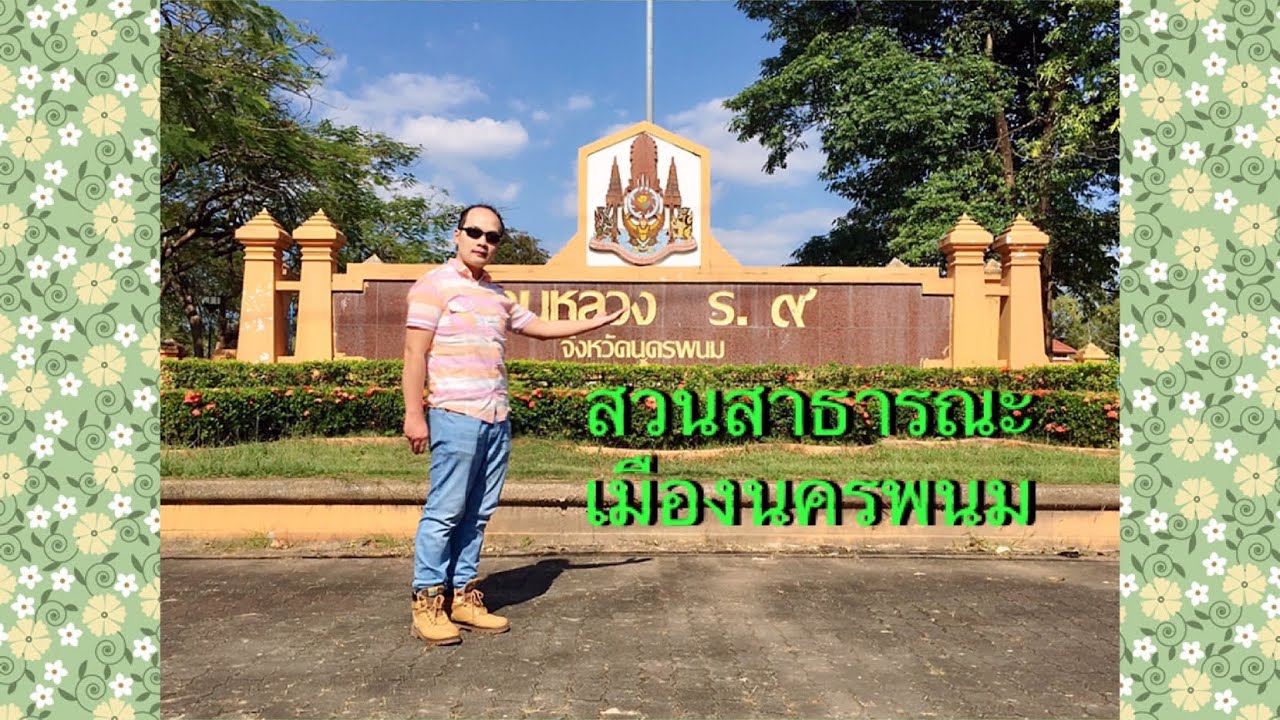
 Click to Access the Navigation Map GPS
Suan Luang Rama 9 (Nakhon Phanom) Map
Recommend

 Art, Culture and Heritage
 Historical Sites and Monuments(3)
 Landmarks and Memorials(2)
 Art, Craft Centres, Tradition(3)
 Museums(3)
 Educational Places
 Library(1)
 Places of Worship
 Temple(23)
 Church(1)
 Other Sacred Sites(11)
 Suburban Living
 Village, Community(5)
 Nature and Wildlife
 National Parks and Marine Reserves(1)
 Dam, Reservoir, Lake(5)
 Waterfalls(2)
 River, Canal(3)
 Bays and Beaches(3)
 Other natural attractions(2)
 Zoos and Aquariums(1)
Farms, Parks and Ecotourism(2)
Zoos and Aquariums(1)
Farms, Parks and Ecotourism(2)
 Shopping
 Shopping and Night Market(1)


