
lovethailand home >Northeastern Travel Attractions >Mukdahan Travel Attractions >Khamcha-i >Lao Sang Tho > Wat Si Sumang Wanaram
TL;DR: Wat Si Sumang Wanaram is located at Beside the Mekong River, Near the Indochina Market, Si Bun Rueang Subdistrict, Mueang Mukdahan District, Mukdahan Province, open Daily, hours 08:00 - 17:00.
Wat Si Sumang Wanaram
Open Days: Daily
Opening Hours: 08:00 - 17:00
Wat Si Sumang Wanaram in Mukdahan Province, commonly shortened to Wat Si Sumang, is a historic Buddhist temple on the bank of the Mekong River. Founded in 1786, the temple reaches approximately 240 years of age in 2026 and belongs to the formative period of Mukdahan’s development as a riverside town. Its most important features include an elegant applied-style sermon hall, an old sim or ordination hall influenced by Western masonry architecture, a Lao-style Buddha image protected by a naga, two distinctive stupas, and Ruea Nang Monthon, a historic racing boat more than a century old.
The temple stands on Samran Chai Khong Tai Road in Si Bun Rueang Subdistrict, Mueang Mukdahan District, close to the Indochina Market and the old riverside quarter. This location gives Wat Si Sumang Wanaram several overlapping roles. It remains an active community monastery, preserves architecture associated with different periods of local history, and forms part of an urban landscape shaped by the Mekong River, cross-border commerce, boat travel, and cultural exchange between the Thai and Lao sides of the river.
The history of the temple is closely connected with the early development of Mukdahan. The town was established in 1770 near the mouth of Huai Muk by Chao Chanthakinnari and settlers who crossed from the eastern bank of the Mekong. Wat Si Sumang Wanaram was founded in 1786, only 16 years later. It is therefore more precise to describe the temple as emerging during the founding generation of Mukdahan rather than claiming that the town and temple were established in exactly the same year.
From 1786 to 2026, the temple has witnessed approximately 240 years of political, economic, and social change. Mukdahan developed from a traditional Mekong town into a district under Nakhon Phanom and eventually became a separate province. Roads, markets, border administration, modern hotels, and the Thai–Lao Friendship Bridge transformed the surrounding region, yet the temple continued to function as a center of Buddhist worship and as a repository of local memory.
The Mekong River was fundamental to the development of both the town and the temple. Before modern roads and bridges, the river was the principal route for residents, merchants, monks, craftsmen, building materials, and artistic ideas. The Lao, Lan Xang, northeastern Thai, and Western-influenced elements visible at Wat Si Sumang Wanaram reflect the cultural mobility of the Mekong region rather than an isolated architectural tradition.
The temple’s official Thai name is Wat Si Sumang Wanaram, although local residents generally call it Wat Si Sumang. Historical accounts also preserve other community names, including Wat Chang and Wat Chao Khun Phraya. Such variations reflect associations with local patrons, events, and memories from different periods. Foreign travelers should use “Wat Si Sumang Wanaram, Mukdahan” when searching navigation applications because temples with similar names exist elsewhere in Thailand.
The temple received a royal grant of consecrated boundary, known in Thai as wisungkhamsima, in 1870. This boundary formally designates the area in which important acts of the Sangha, especially ordination, can be performed. Receiving the grant indicates that the monastery had become an established religious institution with a sufficiently stable community of monks and lay supporters.
The temple grounds cover approximately 5 rai, 1 ngan, and 25 square wah. Although the compound is not exceptionally large, it contains several important components: the sermon hall, old sim, viharn, principal Buddha image, two stupas, community ceremonial ground, and the shelter preserving Ruea Nang Monthon. Visitors should allow at least 45–60 minutes to appreciate the site rather than stopping only for a quick photograph.
The sermon hall, or sala kan parian, is admired for its applied architectural style. Such halls are used for sermons, chanting, meetings, educational activities, merit-making ceremonies, and community gatherings. It is naturally larger than the sim because the sim is designed primarily for formal monastic acts, while the sermon hall must accommodate monks and a much larger number of lay participants.
Historical descriptions record that the sermon hall measures approximately 13 metres wide and 24 metres long and was constructed in 1950. It is therefore more than 75 years old. Although considerably newer than the foundation of the temple, the hall represents an important phase of religious architecture in the mid-twentieth century, when traditional forms were increasingly combined with modern materials and structural methods.
The beauty of the hall results from the relationship between its proportions, columns, openings, roof, stairways, and decorative features. The overall silhouette clearly identifies it as a Thai Buddhist building, but several details have been simplified or adapted to suit the construction methods and materials available to a provincial community. Ornament emphasizes the roofline, gable, and entrance while allowing the building to remain practical for regular use.
In this context, “applied art” does not mean a random collection of unrelated styles. It refers to the careful adaptation of traditional architectural elements to climate, materials, function, and local taste. The hall needed broad internal space, ventilation, shelter from sun and rain, and the ability to host large ceremonies. Its designers retained recognizable Buddhist forms while modifying the structure to serve the community effectively.
Viewing the sermon hall together with the old sim reveals two architectural periods within the same monastery. The sim represents an earlier sacred building that incorporated Western-inspired arches and balustrades into a local Isan context. The sermon hall represents a later interpretation of traditional temple architecture during a period when Mukdahan had greater access to roads, manufactured materials, and modern construction techniques.
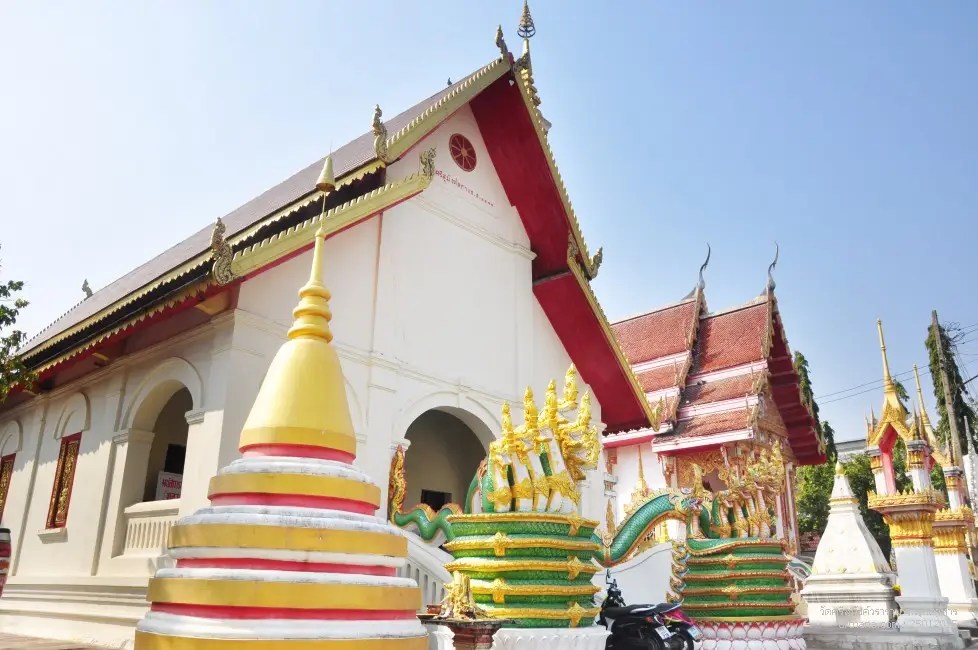
The old sim is one of the temple’s most architecturally significant structures. “Sim” is the northeastern Thai and Lao term for a consecrated ordination hall. Wat Si Sumang’s sim shows an unusually strong influence from Western-style masonry buildings, particularly in its arched entrance, arrangement of openings, stucco framing, and stair balustrades. These elements distinguish it from earlier rural Isan sims, which were often more enclosed and relied heavily on timber or restrained local stucco decoration.
The Thai expression “tuek farang,” literally “Western building,” traditionally refers to masonry architecture displaying features such as arches, symmetrically arranged windows, stucco mouldings, columns, and balustrades. Such forms spread through the Mekong region through commerce, colonial-era construction in neighboring Indochina, government architecture, and the circulation of skilled builders during the nineteenth and early twentieth centuries.
Local craftsmen did not reproduce a European church or civic building in its entirety. Instead, they selected individual forms that appeared attractive and suitable, then integrated them into a Buddhist ordination hall. The result is neither purely European nor a conventional vernacular sim. It is a local hybrid produced by a community familiar with several architectural languages.
The arched doorway gives the façade a more vertical and open appearance than a simple rectangular timber frame. Its curve softens the mass of the wall and marks the transition into the sacred interior. Stucco borders and surrounding ornament connect the imported geometric form with the visual vocabulary of a Thai–Lao temple. Visitors should observe the curve, wall thickness, framing, and relationship between the doorway and the gable above.
The stair balustrades provide another clear example of Western influence. Repeated balusters create a formal rhythm leading upward toward the entrance, while the ends of the stairway and the application of color remain consistent with local temple decoration. This combination gives the sim its distinctive character and demonstrates how imported forms were reshaped rather than copied without modification.
Western-influenced details do not reduce the religious identity of the building. The function of the sim, its consecrated space, principal image, orientation, and relationship with the Sangha all remain Buddhist. Only the formal language used to express beauty changed. The building is therefore a valuable example of cultural adaptation in the Mekong region, where new ideas could be absorbed without abandoning local religious foundations.
The front of the sim should be considered as a complete composition of gable, roofline, finials, arched doorway, and stairs. The upper decorative elements identify it as a sacred building, while the doorway and balustrade record a later or external architectural influence. Standing at a moderate distance provides a clearer understanding of the proportions than photographing isolated details at very close range.
The side and rear elevations reveal the actual mass of the building, the number and placement of windows, the thickness of the walls, and the relationship between the roof and supporting structure. Examining all sides can also help visitors distinguish early components from later repairs. Active religious buildings are regularly reroofed, repainted, replastered, and strengthened, and these changes form part of their continuing history.
The interior of the sim and viharn is relatively intimate. Worshippers stand much closer to the principal image than they would in a large royal temple. This creates a quiet and personal atmosphere but also requires careful behavior. Groups should enter gradually, avoid blocking the doorway, speak softly, and never touch old plaster, image bases, wall surfaces, or decorative details.
The temple’s principal sacred image is a Buddha protected by a naga, executed in a Lao artistic style. The posture represents the episode following the Buddha’s enlightenment when the naga king Mucalinda sheltered him from wind and rain. The image therefore symbolizes protection, stability, and a mind undisturbed by external hardship.
The naga-protected Buddha has particular resonance in the Mekong region. Nagas are central to the mythology, visual art, religious traditions, and riverine worldview shared by communities in northeastern Thailand and Laos. Naga imagery at Wat Si Sumang is consequently more than decoration. It connects Buddhist teaching with the cultural environment of people who have lived beside the Mekong for generations.
The Lao character of the Buddha image can be observed in facial proportions, body form, treatment of the naga hood, and details that differ from images created in Bangkok workshops. These differences demonstrate the regional diversity of Buddhist art. Mukdahan occupies a cultural area where Isan and Lao forms interact naturally, making strict classification according to modern national borders inadequate.
Two stupas stand beside the old sim and add another layer to the temple’s sacred landscape. The stupa positioned toward the front follows a Lan Xang form comparable to Phra That Si Song Rak in Loei Province. This family of architecture commonly features a stepped base, central relic chamber, and tall tapering upper section, creating a dignified vertical form.
The larger stupa is known as Phra That Si Sumongkhon and has been compared with the form of Phra That Phanom in Nakhon Phanom Province. Phra That Phanom has long served as a spiritual and architectural model for communities throughout the middle Mekong basin. The presence of a related form at Wat Si Sumang connects the temple with a wider network of pilgrimage, memory, and regional Buddhist identity.
Having two different stupa forms beside the sim allows visitors to compare architectural languages within a single temple. Attention should be given to the bases, central bodies, ornamental bands, and upper finials. Local builders did not necessarily reproduce famous stupas at full scale. They adapted proportion, decoration, and construction to suit the available space and resources.
The stupas and sim function together as the sacred core of the monastery. The sim is associated with formal monastic ceremonies and the principal Buddha image, while the stupas embody remembrance, merit, and religious continuity. Visitors should not lean against the bases, place bags on sacred structures, or climb raised areas for photographs.
Wat Si Sumang Wanaram also preserves Ruea Nang Monthon, a historic boat associated with the heritage of Mukdahan. More than 100 years old, the vessel was carved from a single large takhian tree. It measures approximately 20 metres long, about 1.20 metres across at the center, and could accommodate roughly 45 paddlers.
Local historical accounts state that Phraya Sasiwong Prawat, the last traditional ruler of Mukdahan, encouraged residents to locate a suitable takhian tree in the Dong Bang I forest. The tree was carved into a long racing boat completed around 1893. Originally known as Ruea Monthon, it later became widely remembered as Ruea Nang Monthon.
The long boat was celebrated for its appearance and racing record on the Mekong. Stories also associate it with distinguished visitors and important moments in the town’s history. Its cultural value lies not only in age and size but in the knowledge required to select the tree, carve a vessel from a single trunk, organize dozens of paddlers, and use the boat in river ceremonies and competitions.
Preserving the boat inside the temple demonstrates the monastery’s role as a guardian of community heritage. Temples in old towns often protected manuscripts, sacred images, ceremonial objects, and locally important artifacts because they were trusted communal institutions. Ruea Nang Monthon has therefore moved from an active vessel on the river to a historical object through which younger generations can understand earlier life in Mukdahan.
The boat also connects the temple with Mukdahan’s long-boat racing tradition during the end of Buddhist Lent. Although the historic vessel is no longer treated as an ordinary racing boat, its survival allows visitors to appreciate the actual scale of a traditional crew and the social organization needed to train paddlers. Boat racing was simultaneously a competition, religious celebration, expression of community unity, and demonstration of river knowledge.
The open area in front of the temple and the nearby Mekong riverfront continue to host civic and religious activities, particularly during festivals, kathin ceremonies, and events connected with the Indochina Market. The temple is therefore not separated from the life of the city. It links sacred space with commercial, social, and ceremonial space.
For planning purposes, the temple can be understood as several areas: the applied-style sermon hall, the old sim and viharn, the naga-protected Buddha image, the two stupas, the shelter containing Ruea Nang Monthon, and the communal ceremonial ground. These are interpretive areas rather than ticketed tourism zones, and access may change temporarily when ceremonies are taking place.
A useful sequence begins with an overall view of the sermon hall and sim from the temple courtyard. Visitors can then examine the arched entrance, stair balustrades, windows, gable, and roof of the sim before entering to pay respect to the principal image. After leaving the building, they can compare the two stupas and finish with the historic boat. This order moves naturally from architecture to sacred art and finally to the history of the city.
Architecture photographers should include sufficient surrounding space to communicate scale and context. Close-up photographs alone may obscure the relationship between the structures and the Mekong riverside setting. Morning light is generally softer, while late afternoon allows visitors to continue toward the market and riverfront. Drone use should never be attempted without explicit permission.
Before photographing inside any building, check signs or ask a monk or caretaker. Flash should not be used near old images or sacred objects. Offerings must not be moved to improve a composition, and worshippers should never be photographed without consent. Respectful photography ensures that tourism does not interfere with the temple’s primary religious function.
Visitors should wear clothing that covers the shoulders and knees, remove shoes before entering designated buildings, speak quietly, and avoid running or climbing. Parents should explain to children that several architectural elements are old and vulnerable. Plaster, walls, balustrades, relic bases, and sacred objects should not be touched.
The temple is open daily from 08:00 to 17:00. These hours provide access during the main daytime period while avoiding early monastic routines and evening activities. Individual buildings may occasionally be closed when no caretaker is present or when a ceremony is underway. Academic groups, film crews, and organized tours should arrange access in advance.
The period from 08:00 to 10:00 is comfortable for viewing architecture and exploring the nearby market. Late afternoon, approximately 15:30 to 17:00, is suitable for continuing along the Mekong riverfront, although visitors should enter the principal buildings before closing time. On Buddhist holy days and during kathin or major festivals, additional time should be allowed and religious participants should receive priority.
The cool season from November to February is the most comfortable period for walking between several riverside sites. During the hot season, bring water and sun protection and avoid extended exposure around midday. The rainy season creates a fresh atmosphere along the Mekong, but stairs and paved surfaces may become slippery.
Getting There from the provincial government area or the center of Mukdahan involves heading toward Samran Chai Khong Tai Road and the Indochina Market. The temple is beside the Mekong in Si Bun Rueang Subdistrict. Search for “Wat Si Sumang Wanaram Mukdahan” and confirm the approximate coordinates 16.53861, 104.73200.
Travelers staying near the Indochina Market or in a riverside hotel can walk to the temple. The distance from the main market area is generally between 300 and 500 metres, depending on the starting point. Walking provides an opportunity to observe shops, old urban buildings, local homes, and everyday riverside activity.
Drivers should use parking areas designated by the temple or community and must not block gates, residences, or ceremonial routes. During boat-racing festivals and major riverfront events, sections of the road may be closed. Parking farther away and walking to the temple is often more convenient at such times.
Wat Si Sumang can easily be included in a route linking several important Mukdahan temples. Wat Yot Kaeo Si Wichai lies approximately 300 metres away, while Wat Si Mongkhon Tai, Wat Si Bun Rueang, and Wat Si Mongkhon Nuea are located within the wider riverside and city area. Visiting them together reveals different sims, stupas, Buddha images, and relationships with Mukdahan’s former rulers.
The Indochina Market is one of the closest attractions and offers local products, packaged food, household goods, and items associated with cross-border trade. Visiting the temple before continuing through the market creates a compact walking itinerary. Mukdahan Square and the old governor’s residence can be added before traveling to Mukdahan Tower or Wat Roi Phra Phutthabat Phu Manorom.
Wat Yot Kaeo Si Wichai is another historic temple on Samran Chai Khong Road and is linked with the second ruler of Mukdahan. Visiting both temples demonstrates that riverside communities were served by several monasteries connected with different residential groups, patrons, and historical periods.
Wat Si Mongkhon Tai is an important royal temple housing Phra Chao Ong Luang, one of Mukdahan’s most revered Buddha images. Combining Wat Si Sumang and Wat Si Mongkhon Tai allows travelers to compare Western-influenced architecture, Lao Buddhist art, and the city’s principal sacred images without spending extensive time in transit.
Mukdahan Tower is approximately 3 kilometres from the temple and provides a broad view of the city and Mekong River. From the elevated viewpoint, visitors can understand how the old riverside quarter, market, temples, and modern road network relate spatially. The view helps explain why so many historic religious sites follow the river.
Wat Roi Phra Phutthabat Phu Manorom stands on elevated ground outside the old center and offers a monumental Buddha image and panoramic views. Visiting it after Wat Si Sumang creates a contrast between an intimate historic riverside monastery and a large contemporary hilltop pilgrimage site.
The market district offers a broad range of food, from inexpensive made-to-order dishes and Vietnamese specialties to Thai–Isan restaurants and riverside dining. Somkuan Phochana and Krua Saigon are convenient for breakfast or lunch, while Nut Pob Rim Khong, Baan Lao Yuan Na Rim Khong, and Zapp Rimkhong are suitable for travelers who want a longer meal near the river.
Vietnamese food is an important component of Mukdahan’s culinary identity because of the city’s multiethnic population and connections across Indochina. Nem nuong, Vietnamese steamed rice rolls, fresh spring rolls, and pork sausage are widely available. Eating regional Vietnamese dishes after visiting the temple provides another perspective on the same history of cultural movement visible in the architecture.
Nearby accommodation ranges from riverside hotels to budget properties in the city center. Riverfront Hotel is close enough for many guests to walk to the temple. Hotel de Ladda offers a more extensive riverside experience, while B2 Mukdahan, Ploy Palace Hotel, and HOTEL MUQ are accessible by a short drive or local transport.
Travelers staying beside the river can begin early and explore the market, Wat Si Sumang, Wat Yot Kaeo Si Wichai, and the old quarter on foot. Guests staying near Chayangkun Road or the bus terminal can take local transport to the riverside and then walk between several nearby attractions, reducing parking difficulties.
The current abbot is Phra Khru Sutthiphattharakhun, whose name appears in information published by the Mukdahan Provincial Office of Buddhism and in updated monastic activity records from 2025. The temple continues to have resident monks and regularly conducts Buddhist ceremonies. Organized study visits, filming, and special access should be coordinated with the monastery or provincial Buddhist office.
Wat Si Sumang Wanaram is a public community temple belonging to the Mahanikaya order. Activities include observances on Buddhist holy days, Makha Bucha, Visakha Bucha, Asalha Bucha, the beginning and end of Buddhist Lent, kathin, funerary rites, and community ceremonies. During major events, the sim or sermon hall may be reserved for worshippers.
The temple’s proximity to the Mekong event ground connects it with Mukdahan’s Thai–Lao long-boat racing and kathin traditions. This relationship gives Ruea Nang Monthon additional meaning. The historic boat is not merely a preserved object but evidence of a period when boats were central to transport, ceremony, competition, and community identity.
The architectural significance of the temple comes from the coexistence of buildings and objects from different periods. The sim records Western influence within an Isan sacred structure. The sermon hall represents applied architecture of the mid-twentieth century. The stupas reflect Lan Xang and Phra That Phanom traditions, while the historical boat links the compound directly to the social history of the Mekong.
Conserving an active historic monastery is complex. Structures must remain safe and usable while their early forms and materials are protected. Roofing, paint, plaster, and structural reinforcement may change during repairs. Visitors should therefore appreciate both the surviving original elements and the long process of community maintenance that has allowed the buildings to remain in use.
Tourists can support conservation by avoiding contact with old plaster, never writing on surfaces, not placing stickers or objects on structures, and not climbing balustrades or stupa bases. Donations should be made only through points officially arranged by the temple. Online posts should use the correct temple name and avoid unverified claims about age, miracles, or architectural history.
Architecture students can examine four major themes at the site: the planning of a riverside monastery, the functional relationship between sim and sermon hall, the adaptation of Western elements within Isan architecture, and the use of Lan Xang stupa forms in a Thai provincial town. A useful record should include the front, side, and rear elevations, openings, stair details, roof structure, and surrounding context.
For foreign travelers, Wat Si Sumang Wanaram provides a clear demonstration that northeastern Thai identity is culturally interconnected. Lao Buddhist art, Lan Xang architecture, Western-influenced masonry, and the institutional framework of a Thai monastery coexist within one compound. These influences should be understood as evidence of cultural exchange and local adaptation rather than rigid national categories.
A meaningful visit should move beyond the simple statements that the temple is 240 years old or that its sim resembles a Western building. More important questions concern how arches reached a Mekong town, why local builders adopted them, what the Lao-style Buddha reveals about community relationships, and why a historic racing boat came to be protected by a temple.
Wat Si Sumang Wanaram is suitable for travelers interested in history, Buddhist art, vernacular and hybrid architecture, Mekong culture, photography, and slow exploration of Mukdahan. Its location near the market and accommodation makes it accessible, yet it retains the atmosphere of an active community monastery. Visitors should therefore behave as guests of a religious institution rather than customers at a commercial attraction.
The temple’s greatest value lies in the many historical layers concentrated in one place: the founding period of Mukdahan, the establishment of the monastery in 1786, the consecrated boundary granted in 1870, Western influence on the old sim, the applied-style sermon hall built in 1950, continuing devotion to the naga-protected Buddha, and the preservation of Ruea Nang Monthon.
Walking from the temple toward the Mekong reveals that its location is not accidental. The river carried people, languages, beliefs, artistic forms, and commodities into Mukdahan. The sim, stupas, Buddha image, and historic boat all return the visitor’s attention to the Mekong. Wat Si Sumang Wanaram is not simply a temple located beside the river; its identity was directly formed by the riverine world.
A visit therefore offers much more than a single act of worship. Travelers encounter a 240-year-old monastery, architecture combining Isan and Western forms, Buddhist art connecting Thailand and Laos, an applied-style sermon hall, regional stupas, and a long boat preserving the memory of the town. Exploring slowly and respectfully makes Wat Si Sumang Wanaram one of the most informative places for understanding Mukdahan.
| Name | Wat Si Sumang Wanaram, Commonly Known as Wat Si Sumang |
| Location | Beside the Mekong River, Near the Indochina Market, Si Bun Rueang Subdistrict, Mueang Mukdahan District, Mukdahan Province |
| Address | Moo 1, Samran Chai Khong Tai Road, Si Bun Rueang Subdistrict, Mueang Mukdahan District, Mukdahan 49000, Thailand |
| Coordinates | 16.53861, 104.73200 |
| Highlights | Applied-Style Sermon Hall, Western-Influenced Old Sim, Lao-Style Naga-Protected Buddha, Lan Xang Stupas, and the Historic Ruea Nang Monthon Boat |
| Founded | 1786, Corresponding to 2329 BE |
| Age | Approximately 240 Years in 2026 |
| Consecrated Boundary | Royal Grant Received in 1870 |
| Monastic Affiliation | Mahanikaya Order; Public Community Temple |
| Temple Area | Approximately 5 Rai, 1 Ngan, and 25 Square Wah |
| Sermon Hall | Applied Architectural Style, Approximately 13 × 24 Metres, Built in 1950 for Sermons, Ceremonies, and Community Activities |
| Old Sim | A Hybrid Isan Ordination Hall with Western-Inspired Arched Doorways, Openings, and Balustraded Stairs |
| Principal Sacred Image | Lao-Style Buddha Protected by a Naga |
| Stupas | 1. Lan Xang-Style Stupa Comparable to Phra That Si Song Rak 2. Phra That Si Sumongkhon, Influenced by the Form of Phra That Phanom |
| Historic Boat | Ruea Nang Monthon, a Takhian-Wood Long Boat More Than 100 Years Old, Approximately 20 Metres Long and Designed for Around 45 Paddlers |
| Main Areas | 1. Sermon Hall 2. Old Sim and Viharn 3. Naga-Protected Buddha Worship Area 4. Two Stupas 5. Ruea Nang Monthon Preservation Area 6. Religious and Community Activity Ground |
| Abbot | Phra Khru Sutthiphattharakhun |
| Current Status | Active Buddhist Temple Conducting Regular Religious Activities and Open to Visitors |
| Open Days | Daily |
| Opening Hours | 08:00 - 17:00 |
| Travel Information | Travel to the Indochina Market on Samran Chai Khong Tai Road in Central Mukdahan. The Temple Stands Beside the Mekong and Is Within Walking Distance of the Main Market Area. |
| Official Information Contact | Mukdahan Provincial Office of Buddhism, Tel. 042-611089 or 042-614090 |
| Visitor Etiquette | Dress Modestly, Remove Shoes Before Entering Designated Buildings, Speak Quietly, Avoid Touching Old Plaster or Sacred Objects, and Request Permission Before Photographing Monks or Ceremonies. |
| Nearby Tourist Attractions | 1. Mukdahan Indochina Market, Approximately 0.3 km 2. Wat Yot Kaeo Si Wichai, Approximately 0.3 km 3. Mukdahan Square and the Former Governor’s Residence, Approximately 0.6 km 4. Wat Si Mongkhon Tai, Approximately 0.8 km 5. Mukdahan Tower, Approximately 3 km 6. Wat Roi Phra Phutthabat Phu Manorom, Approximately 7 km |
| Nearby Restaurants | 1. Somkuan Phochana, Approximately 0.4 km 2. Krua Saigon Mukdahan, Approximately 0.6 km, Tel. 042-615303 or 081-3201318 3. Nut Pob Rim Khong Restaurant, Approximately 0.9 km, Tel. 042-614499 4. Baan Lao Yuan Na Rim Khong, Approximately 2 km, Tel. 042-611111, 065-1423915, or 063-2479654 5. Zapp Rimkhong Mukdahan, Approximately 3 km, Tel. 097-0517988 |
| Nearby Accommodations | 1. Riverfront Hotel Mukdahan, Approximately 0.4 km, Tel. 042-612948-9 or 081-7031705 2. Hotel de Ladda, Approximately 1 km, Tel. 042-611499 or 042-632777 3. B2 Mukdahan Boutique & Budget Hotel, Approximately 1.3 km, Tel. 042-040123 or 1328 4. Ploy Palace Hotel, Approximately 1.8 km, Tel. 042-614988 5. HOTEL MUQ, Approximately 2.7 km, Tel. 063-7875555, 042-040888, or 042-040999 |
Frequently Asked Questions (FAQ)
Q: Where is Wat Si Sumang Wanaram located?
A: The temple is beside the Mekong River on Samran Chai Khong Tai Road, Si Bun Rueang Subdistrict, Mueang Mukdahan District, near the Indochina Market. Its approximate coordinates are 16.53861, 104.73200.
Q: How old is Wat Si Sumang Wanaram?
A: The temple was founded in 1786 and is approximately 240 years old in 2026. It belongs to the early period of Mukdahan’s development.
Q: What makes the old sim architecturally important?
A: The sim combines Isan Buddhist architecture with Western-inspired masonry features, particularly arched doorways, formal openings, and balustraded stairways.
Q: What are the most important objects and buildings at the temple?
A: Major features include the applied-style sermon hall, old sim, Lao-style naga-protected Buddha, two regional stupas, and Ruea Nang Monthon, a historic long boat more than 100 years old.
Q: What is Ruea Nang Monthon?
A: Ruea Nang Monthon is a historic long boat carved from a single takhian tree around 1893. It is approximately 20 metres long and was designed for a crew of about 45 paddlers.
Q: What are the opening hours?
A: The temple is open daily from 08:00 to 17:00. Individual buildings may close temporarily during ceremonies or when a caretaker is unavailable.
Q: Can visitors walk to the temple from the Indochina Market?
A: Yes. The temple is approximately 300–500 metres from the main market area, depending on the starting point.
Q: How much time should visitors allow?
A: Allow at least 45–60 minutes to see the sermon hall, old sim, principal Buddha image, stupas, and historic boat without rushing.
 Category: ●Places of Worship
 Group: ●Temple
Last Update : 2 MonthAgo
 Last Update : 2 MonthAgo
 Click to Access the Navigation Map GPS
Wat Si Sumang Wanaram Map
Recommend

 Art, Culture and Heritage
 Historical Sites and Monuments(2)
 Landmarks and Memorials(3)
 Art, Craft Centres, Tradition(2)
 Museums(1)
Temple(17)
Museums(1)
Temple(17)
 Other Sacred Sites(3)
 Suburban Living
 Village, Community(4)
 Local Market(2)
 Nature and Wildlife
 National Parks and Marine Reserves(4)
 Mountain (Doi)(5)
 Dam, Reservoir, Lake(3)
 Waterfalls(5)
 Caves(2)
 River, Canal(2)
 Bays and Beaches(1)
 Other natural attractions(1)
 Entertainment and Agricultural
 Farms, Parks and Ecotourism(1)


