
lovethailand home >Northeastern Travel Attractions >Mukdahan Travel Attractions >Khamcha-i >Phon Ngam > Phu Thong
TL;DR: Phu Thong is located at On the hill between Moo 8, Ban Na Dok Mai, and Moo 5, Ban Non Pa Daeng, Phon Ngam Subdistrict, Khamcha-i District, Mukdahan Province; the, open Daily, hours 08.00 – 17.00.
Phu Thong
Open Days: Daily
Opening Hours: 08.00 – 17.00
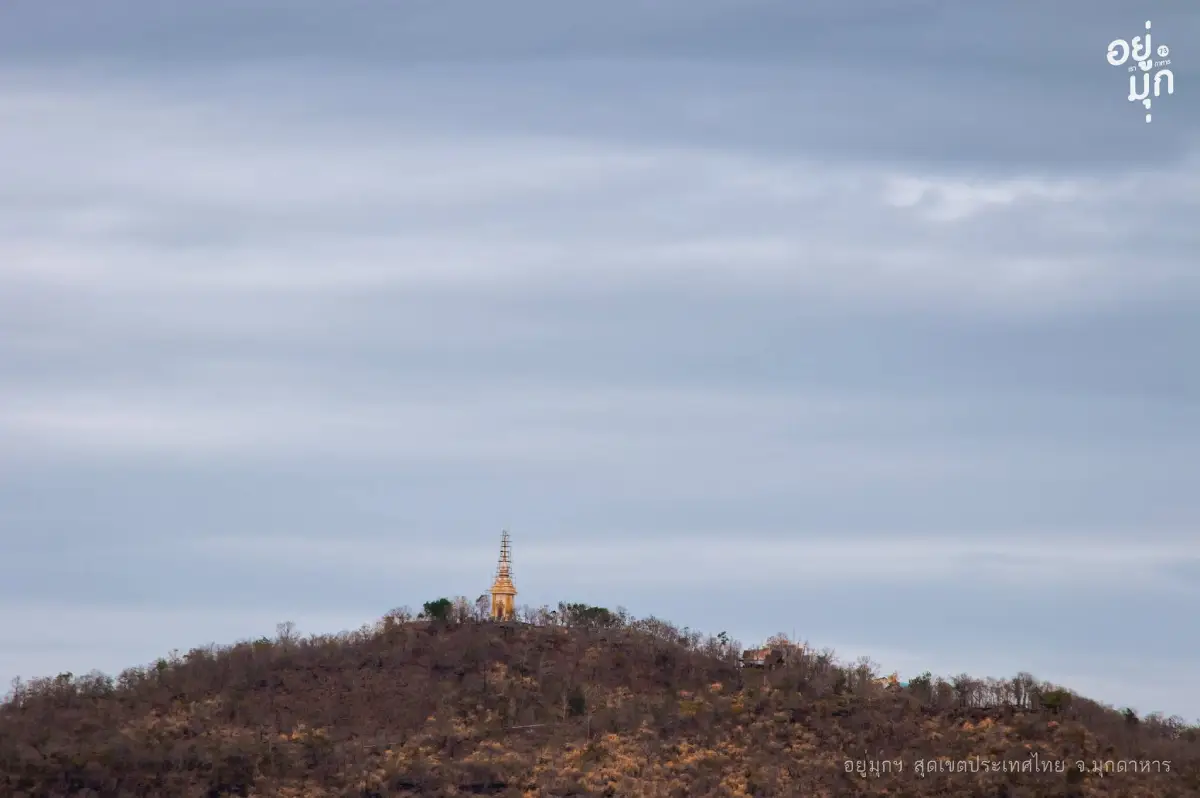
Phu Thong, or Wat Phra Phutthabat Phu Thong, in Mukdahan Province is a natural hill, community forest, Buddhist sanctuary, and panoramic viewpoint in Phon Ngam Subdistrict, Khamcha-i District. The hill stands between the areas administered as Moo 8, Ban Na Dok Mai, and Moo 5, Ban Non Pa Daeng, while its access route and the modern restoration of its religious structures are closely associated with Ban Tum Wan village. Located approximately 3 kilometres from Ban Tum Wan, Phu Thong rises above the surrounding farming communities and contains an upper area covering slightly more than 4 rai, a pavilion protecting a sacred Buddha footprint, a Buddhist ceremonial building, a Baby Buddha statue, community forest, and wide views over villages, fields, and distant mountain ridges.
The attraction of Phu Thong comes from the close relationship between nature and faith. Visitors can pay respect to the mark revered by the local community as a footprint of the Buddha, make merit, spend time in quiet contemplation, and view the landscape of Phon Ngam from an elevated position during the same visit. The summit receives a steady breeze for much of the day, particularly in the morning and late afternoon. From the pavilion and open upper area, the view extends across forest, agricultural land, houses, and surrounding hills. Phu Thong is therefore suitable for nature travelers, Buddhist pilgrims, cultural visitors, and anyone interested in the history of a locally restored sacred landscape.
Phu Thong is part of the Phu Pha Kham mountain range, which extends from Dong Luang District and connects with the broader Phu Phan range toward Na Kae District in Nakhon Phanom Province. The summit stands approximately 400 metres above sea level. Although it is not a high-altitude mountain requiring technical climbing, the elevation above the surrounding plains provides a clear view of the geography of Phon Ngam. The approach passes from village roads into forested and sloping terrain before reaching the quiet religious structures on the hilltop.
Its position between several communities has made Phu Thong a familiar landmark for local residents. One side is associated with Ban Na Dok Mai in Moo 8, another with Ban Non Pa Daeng in Moo 5, while Ban Tum Wan played an important role in developing access, restoring the forest, and constructing the Buddhist sanctuary. Phu Thong is consequently not regarded as belonging to only one village. It represents a shared religious and natural space supported by monks, local leaders, teachers, students, and residents across Phon Ngam Subdistrict.
The name “Phu Thong” has long been used locally for the hill. No single official explanation of the name has been preserved, but it became the recognised name of the mountain, the sacred site, and the Buddha footprint on the summit. When the sanctuary and pavilion were restored, the name Wat Phra Phutthabat Phu Thong was adopted to express both the location and the sacred object housed above. Today, “Phu Thong” generally refers to the natural hill and viewpoint, while “Wat Phra Phutthabat Phu Thong” emphasises its role as a Buddhist sanctuary and meditation site.
The central belief associated with Phu Thong concerns a mark on the summit revered as the Buddha’s footprint. This sacred feature inspired the construction of a protective pavilion where Buddhists could worship in an appropriate setting. In Thai Buddhist culture, reverence for a Buddha footprint is not limited to questions about physical age or archaeological origin. It represents remembrance of the Buddha, the intention to follow the Dhamma, and the idea of walking in the path of virtue. The physical journey up the hill can therefore become a symbolic journey away from everyday distraction and toward personal reflection.
Community records also describe the discovery of carved stone Buddha images, bronze bracelets, a bronze ceremonial drum, and various objects in a cave and across lower areas of the hill. These discoveries led villagers to believe that Phu Thong and its surroundings had once been an active Buddhist or community site. Travelers should understand these accounts as part of local history and collective memory. No object should be excavated, removed, or relocated. Any old or unusual item encountered in the area should be reported to the monks, community caretakers, or relevant authorities.
The modern restoration of Phu Thong became prominent in 1999, when Phra Khru Sangharak Kittima Kittimanantho, also known as Phra Kittima Chaiman, returned to spend the Buddhist rains retreat near the cemetery of his home village, Ban Tum Wan. He encouraged local residents to improve the community and restore the surrounding forest by planting teak among the existing mixed deciduous woodland. From the beginning, forest restoration and Buddhist development were treated as connected responsibilities. Protecting nature, strengthening cooperation, and cultivating the mind were understood as parts of the same community process.
Phra Khru Sangharak Kittima encouraged villagers, teachers, and students to participate in chanting, morning and evening prayers, Dhamma sermons, merit-making on important occasions, and meditation. As participation increased, the community expressed a desire for a peaceful place devoted to Buddhist practice. Phu Thong was close enough to the villages to remain accessible, yet sufficiently separated from everyday activity to provide quiet surroundings. It was therefore selected for the revival of a sacred site and the creation of a modern meditation destination.
In 2001, the Royal Forest Department designated approximately 825 rai on and around Phu Thong as community forest. This provided a framework for local participation in forest protection, restoration, and the prevention of encroachment. The importance of Phu Thong therefore extends beyond the buildings on the summit. The forest helps protect soil, moisture, small wildlife habitats, water systems, and the appearance of the wider landscape. Visitors should follow community-forest principles by avoiding fire, cutting vegetation, collecting plants, or leaving waste.
Construction of the hilltop sanctuary began formally with a foundation-stone ceremony on Saturday, 5 May 2001. Monks, novices, and local residents then worked together to clear and improve the route to the summit. Transporting materials to an elevated forest site was more difficult than building a temple on level ground, and much of the early work depended on community labour and religious commitment. The structures visible today are therefore the result of cooperation among many individuals rather than the work of a single patron.
The Buddha-footprint pavilion was designed with the assistance of Ko Kiat Thongphut, an architect specialising in traditional Thai architecture from the Fine Arts Department. The layout of the pavilion and its surroundings was planned to fit the limited summit area. Its artistic design combines elements associated with Central Thai Buddhist architecture and northeastern Thai traditions. This creates a religious structure that is formally elegant while remaining connected to the cultural environment of Isan and Mukdahan.
The first-pillar ceremony for the pavilion was held on Saturday, 8 March 2003. The structure is approximately 7 metres wide and 17 metres high. It was designed to protect and enshrine the sacred footprint on the summit. Its height makes the building visible above parts of the surrounding forest, while the interior remains suitable for quiet worship. The pavilion establishes the Buddha footprint as the spiritual centre of the site and has become the principal visual symbol of Phu Thong.
Religious development continued after work began on the pavilion. In 2007, a building intended for use as an ordination and ceremonial hall was constructed. It measures approximately 8 metres wide and 15 metres long. The hall supports monastic ceremonies, community merit-making, chanting, and Buddhist activities. With both a footprint pavilion and a ceremonial building, Phu Thong developed from a single hilltop shrine into a functioning religious area capable of serving the spiritual needs of the surrounding communities.
On 11 April 2022, Mukdahan Province organised a ceremony to install a Baby Buddha image on its pedestal and formally unveil the temple sign. The Baby Buddha represents Prince Siddhartha shortly after his birth and carries a message of birth, renewal, and the decision to begin a virtuous path. Its installation added both artistic and spiritual meaning to Phu Thong. Visitors can use this area to reflect on new beginnings, personal responsibility, and the intention to create positive change for themselves, their families, and society.
The symbolism of the Baby Buddha closely reflects the history of Phu Thong itself. Land once remembered as degraded forest and an abandoned sacred landscape was gradually restored as community forest and Buddhist sanctuary. Renewal took place both physically and spiritually. The woodland was strengthened, access was created, sacred buildings were constructed, and community activities returned to the hill. Phu Thong therefore demonstrates how religious commitment can support environmental restoration and collective development.
The religious structures have continued to be restored and maintained, improving both their appearance and their suitability for worship. The areas around the footprint pavilion, ceremonial hall, Baby Buddha, and other sacred points have been organised for visitors while retaining the simple character of a mountain temple. Phu Thong has not been transformed into a large commercial attraction. Its identity still depends on quiet surroundings, wind, forest, modest facilities, and the close relationship between the sanctuary and local communities.
Upon reaching the summit, the Buddha-footprint pavilion is the most prominent structure. Visitors should remove footwear where required, maintain cleanliness, and keep their voices low. Bags and personal items should not be placed on the footprint platform or sacred structures. When people are praying or meditating, photographers should keep a respectful distance and avoid flash, notification sounds, or unnecessary movement.
The ceremonial hall is another important area that should be entered respectfully. It was created for monks and residents to conduct Buddhist activities rather than simply to provide a photographic background. Before entering, travelers should check whether chanting, ceremonies, or meditation are taking place. Those wishing to join should sit in the designated area and follow the instructions of monks or caretakers. Quiet participation provides a deeper understanding of the active religious role of Phu Thong.
The Baby Buddha area invites reflection on renewal and the beginning of a good life. Although many visitors take photographs here, poses should remain respectful. Travelers should not climb the pedestal, touch the image, or stand in a manner inappropriate to a Buddhist statue. Photography should preserve memories and communicate the beauty of the sanctuary without diminishing the sacred meaning of the image.
The summit covers slightly more than 4 rai and provides views in several directions. Villages and agricultural land across Phon Ngam can be seen from parts of the upper area. Rice fields change in appearance throughout the year, from bright green during cultivation to gold before harvest and brown after the fields have been cleared. Together with forests and distant ridges, these seasonal changes give Phu Thong a different visual character throughout the year.
Morning is one of the best periods to visit. Temperatures remain comfortable, sunlight is soft, and the villages below gradually become active. On humid mornings, light mist may collect in lower areas, although Phu Thong is not a destination where dense fog can be expected every day. Even without mist, the morning light across forest and farmland creates a calm setting for photography, worship, and meditation. Access before the general opening period should be arranged with the local community or caretaker.
Late afternoon also offers attractive scenery. Lower sunlight brings out the shapes of the hills, forest, and religious structures, while the summit breeze reduces the heat. Visitors should nevertheless begin descending before the site closes. Sections of the route do not have continuous lighting, and sloping or uneven surfaces become more difficult to navigate after dark.
The cool season from approximately November to February is generally the most comfortable time to visit. The air is cooler, the summit breeze is pleasant, and the sky is often suitable for wide views. A light long-sleeved shirt or wind-resistant jacket is useful in the early morning. Although Mukdahan is not as cold as northern Thailand, the exposed summit can feel cooler than the villages below.
The rainy season brings the richest green colours to the community forest. Trees, ground plants, and moss become more vivid, but roads and walking surfaces may be slippery. Shoes with reliable grip are essential. Visitors should not remain on the open summit during thunderstorms. If heavy rain has continued for several days, road and trail conditions should be confirmed with the Phon Ngam Subdistrict Administrative Organization or residents of Ban Tum Wan before departure.
The hot season offers dry access and long-distance views, but direct sunlight on the open summit can cause fatigue. Travelers should arrive in the morning and carry sufficient drinking water, a hat, and sun protection. Children, older travelers, and people with medical conditions should rest regularly and avoid strenuous movement during the hottest hours.
The community forest is an essential part of Phu Thong’s atmosphere. The original woodland was mixed deciduous forest, later strengthened with teak and other trees during restoration efforts. Vegetation helps hold moisture, reduce erosion, and provide habitat for birds, insects, and small animals. Visitors should not break branches, remove bark, collect orchids, pick forest plants, or allow pets to roam uncontrolled.
Forest restoration benefits the community in ways that extend beyond visual beauty. Trees slow rainwater, protect the sloping soil, preserve moisture, and support water systems used in lower agricultural areas. Visiting Phu Thong can therefore reveal how a Buddhist sanctuary may contribute to environmental protection. Caring for the forest becomes a form of merit-making because it safeguards resources for present residents and future generations.
Portable speakers and loud music should not be used along the route or on the summit. Noise disturbs monks, meditators, wildlife, and other visitors. The value of Phu Thong lies partly in natural sounds and quiet surroundings. Phones should be placed on silent mode near chanting and meditation areas, and conversations should remain at a normal level.
All waste must be carried back down the hill, including bottles, plastic bags, tissues, food packaging, and fruit peel. Even biodegradable food waste attracts animals and changes their behaviour. Visitors should carry a small waste bag. Rubbish must never be burned, and open fires are inappropriate because dry deciduous leaves can ignite quickly during the dry season.
Travelers wishing to make merit may bring flowers, incense, candles, or donations, but these should be used only in designated areas. Incense and candles must not be lit in forested areas or near combustible material. Items for monks should be practical and offered through an appropriate person. Donations for maintaining the sanctuary or forest should be placed in official donation points or given to authorised caretakers.
Modest clothing is expected. Shirts should cover the shoulders, and trousers or skirts should be of appropriate length. Closed footwear or shoes with reliable grip are recommended. Even when vehicles can reach part of the upper area, visitors still need to walk across slopes, steps, and uneven surfaces. High heels, thin flip-flops, and smooth soles are unsuitable.
Children must be supervised closely. They should not run near slopes, stairs, retaining walls, or the edge of open areas. Parents should explain that children must not climb Buddha images, touch offerings, draw on buildings, or shout in religious spaces. A visit can become an educational experience in Buddhism, community history, and forest care when adults explain the meaning of the site rather than treating it only as a place for photographs.
Older travelers can visit according to their physical ability, but current road and walking conditions should be checked, particularly after rain. Anyone who needs to walk up sloping sections should travel with assistance and rest regularly. People with heart conditions, blood-pressure problems, or knee difficulties should not continue when experiencing unusual fatigue or pain. A slow visit is both safer and more rewarding.
Photography should respect safety and Buddhist etiquette. Some viewpoints contain slopes or vegetation that obscures the edge. Visitors should never walk backwards while looking at a screen or climb walls and building bases for a higher angle. Drone use requires permission because the noise can disturb monks, wildlife, and meditation. Permission should also be obtained before photographing monks or community ceremonies.
Landscape photographers can record more than the summit view. Morning light reveals layered ridges and agricultural colours, while late light creates shadows on the pavilion and surrounding trees. Images of the forest route, footprint pavilion, Baby Buddha, ceremonial hall, village landscape, and community activity together communicate the complete identity of Phu Thong as a place where nature, faith, and rural life remain connected.
Suitable activities include worshipping the Buddha footprint, making merit, chanting, meditation, studying the restoration history, observing Buddhist architecture, walking through the community forest, and photographing the landscape. Organised groups may contact local caretakers about volunteer work, litter collection, or tree planting at an appropriate time. Loud recreational events are not suitable for an active religious site.
Morning and evening chanting, Dhamma teaching, and meditation were central to the original development of Phu Thong. Visitors wishing to participate should ask for the current schedule because these are religious activities rather than fixed tourist programs. Buddhist holy days and major festivals may attract more local worshippers. Travelers visiting on such occasions should allow additional time and follow the arrangements made by the temple community.
Phu Thong is also a valuable community-history learning site. Accounts of old objects, forest restoration, architectural design, and cooperation between monks and villagers show how a community can create an important place through local resources and shared faith. Schools and educational institutions may use the hill for field learning, but groups should arrange their visit in advance, remain manageable in size, and provide appropriate supervision.
Phon Ngam Subdistrict contains 10 administrative villages, including communities known as Ban Phon Ngam, Ban Tum Wan, Ban Don Pa Khaen, Ban Non Pa Daeng, Ban Nong Sa Phang Thong, Ban Faek, and Ban Na Dok Mai. Agriculture, small-scale trade, and local employment remain important to the area. Phu Thong stands within a rural landscape where temple, forest, fields, and villages remain visibly connected. Using local restaurants, accommodation, and services helps distribute tourism income within Khamcha-i.
Khamcha-i District is closely associated with Phu Tai culture, expressed through language, textiles, food, clothing, and local traditions. A visit to Phu Thong can be combined with respectful learning about nearby Phu Tai communities. Permission should be requested before photographing residents, houses, or community activities. Visitors should avoid entering private areas and should purchase local products at fair prices.
Getting There from Mukdahan city involves traveling toward Khamcha-i District and continuing to Phon Ngam Subdistrict. Phon Ngam is approximately 38 kilometres from the provincial city and about 14 kilometres north of central Khamcha-i. From Ban Tum Wan, the route continues approximately 3 kilometres to Phu Thong. The final section follows local roads toward the hill. Vehicles should be in good condition, and drivers should use additional caution during the rainy season.
The coordinates 16.660733, 104.417284 can be used for navigation. An offline map should be saved before leaving the main road because mobile reception may be inconsistent. Some signs may use the name Wat Phra Phutthabat Phu Thong rather than Phu Thong. When uncertain, travelers should ask Ban Tum Wan residents or contact the Phon Ngam Subdistrict Administrative Organization rather than following an unclear track into farmland or forest.
A private vehicle is the most convenient option because regular public transport does not reach the hilltop sanctuary. Travelers without a vehicle can rent a car in Mukdahan city or arrange a vehicle with a driver. Return time, pickup location, and cost should be agreed in advance because taxis and local transport do not wait continuously at Phu Thong.
Parking consists of basic spaces designated by the temple or community. Vehicles should not block the access road, building entrances, or emergency routes. Large groups should share vehicles and avoid driving beyond recognised roads. Parking on soft soil or forest ground creates ruts and erosion.
Facilities are basic and intended primarily for the religious site and local community rather than for mass tourism. Visitors should bring drinking water, essential food, personal medication, and necessary supplies from Khamcha-i or nearby villages. Toilets and rest areas are limited, and there are no full-service restaurants, convenience stores, or large visitor facilities on the summit.
There is no general admission fee. Visitors may make a voluntary donation toward the maintenance of the sanctuary. Group activities, special ceremonies, meditation programs, and access outside normal hours should be arranged with the monks, Ban Tum Wan community, or Phon Ngam Subdistrict Administrative Organization.
Camping or overnight stays should not take place without permission. Phu Thong is both a religious site and a community forest. Night use involves concerns about fire, safety, wildlife, and monastic routines. Groups interested in meditation retreats or overnight activities must receive clear instructions regarding the permitted area, schedule, and conduct.
Before departure, travelers should check the weather forecast, vehicle condition, fuel level, and sunset time. Trips should be postponed during storms, thunderstorms, or prolonged heavy rain. Turning back when conditions are unsafe is a responsible decision, particularly when traveling with children, older visitors, or large groups.
Phu Thong can be visited as a half-day excursion. A practical schedule begins with a morning ascent, worship at the footprint pavilion, visits to the ceremonial hall and Baby Buddha, and time at the viewpoint before returning to Khamcha-i for lunch. A full-day route may continue to Wat Pa Wiwek Watthanaram, Khamcha-i Waterfall Park, or Phu Pha San, provided travel time is planned realistically.
Visitors interested in Buddhist practice may combine Phu Thong with Wat Pa Wiwek Watthanaram and Chedi Si Trairattanusorn, associated with Mae Chi Kaew Sianglam. Nature travelers may continue to Khamcha-i Waterfall Park, Phu Pha San, or Huai Ta Poe Reservoir. Choosing a small number of destinations allows enough time to appreciate each location.
Most restaurants and cafes are located in central Khamcha-i, Nam Thiang Subdistrict, and communities along the main roads. Food and water should be purchased before approaching the hill. Travelers starting early should prepare breakfast in advance. Local businesses may adjust their opening days and hours, so calling before travel is recommended.
Nearby accommodation mainly consists of small local resorts and daily rooms in Khamcha-i District. Staying locally is useful for travelers who want an early start without returning to Mukdahan city. Room availability, rates, check-in time, and the precise location should be confirmed by phone because some properties do not operate full online booking systems.
Responsible tourism at Phu Thong means protecting the quiet religious atmosphere, helping preserve the community forest, and supporting the local economy. Visitors can purchase food locally, stay in community businesses, and donate appropriately without demanding that the site be transformed into a commercial attraction. Its simplicity is an important part of its identity.
Travelers should take away memories, photographs, and an understanding of community cooperation rather than stones, plants, or old objects. Every piece of waste must be carried down, and no marks should be left on buildings or natural surfaces. Low-impact behavior will allow future generations to experience the same peaceful hill and sacred landscape.
For travelers seeking a Mukdahan destination that combines worship, views, local history, and nature, Phu Thong offers far more than the image of a temple on a hill. The Buddha footprint, 17-metre pavilion, Baby Buddha, ceremonial hall, 825-rai community forest, and history of collective restoration create a destination with natural, cultural, and spiritual depth.
The physical journey to the summit may be relatively short, but the story behind the sanctuary extends across several decades. It includes the return of Phra Khru Sangharak Kittima to his home community, forest restoration, path building, the foundation ceremony, architectural planning, construction of the ceremonial hall, and the installation of the Baby Buddha. Each stage represents the determination of people who wanted to transform a hill into a place of learning and spiritual refuge.
Phu Thong is therefore more than a natural viewpoint in Phon Ngam. It is a landscape of faith connecting the past with the present, forest with community, and physical travel with inner reflection. Visitors who arrive prepared, respect the religious environment, and take time to understand its history will encounter a quiet and meaningful side of Mukdahan that differs greatly from the province’s better-known Mekong River attractions.
| Name | Phu Thong, or Wat Phra Phutthabat Phu Thong |
| Location | On the hill between Moo 8, Ban Na Dok Mai, and Moo 5, Ban Non Pa Daeng, Phon Ngam Subdistrict, Khamcha-i District, Mukdahan Province; the access route and restoration history are closely associated with Ban Tum Wan. |
| Address | Wat Phra Phutthabat Phu Thong, Ban Tum Wan, Phon Ngam Subdistrict, Khamcha-i District, Mukdahan 49110, Thailand |
| Coordinates | 16.660733, 104.417284 |
| Elevation | Approximately 400 metres above sea level |
| Summit Area | Slightly more than 4 rai |
| Highlights | Sacred Buddha footprint, hilltop pavilion, Baby Buddha image, ceremonial hall, community forest, and panoramic views over the villages and agricultural landscape of Phon Ngam |
| Mountain Range | Part of the Phu Pha Kham range, connected to the wider Phu Phan mountain system |
| Principal Belief | The summit mark is revered by the community as a footprint of the Buddha and serves as the spiritual centre of the sanctuary. |
| Objects Mentioned in Community History | Carved stone Buddha images, bronze bracelets, a bronze ceremonial drum, and various objects formerly reported in the cave and lower hill area |
| Restoration History | Forest and religious restoration became prominent in 1999. The pavilion foundation stone was laid on 5 May 2001, and the first-pillar ceremony was held on 8 March 2003. |
| Restoration Initiator | Phra Khru Sangharak Kittima Kittimanantho, also known as Phra Kittima Chaiman, together with monks and Ban Tum Wan residents |
| Pavilion Architect | Ko Kiat Thongphut, a traditional Thai architecture specialist from the Fine Arts Department |
| Buddha Footprint Pavilion | Approximately 7 metres wide and 17 metres high, combining Central Thai and northeastern Buddhist artistic traditions |
| Ceremonial Hall | Constructed in 2007, approximately 8 metres wide and 15 metres long |
| Baby Buddha | Installed on 11 April 2022 as a symbol of renewal, new beginnings, and commitment to virtuous action |
| Community Forest | Approximately 825 rai, designated as community forest in 2001 |
| Caretakers | The monastic community of Wat Phra Phutthabat Phu Thong, Ban Tum Wan residents, local Phon Ngam leaders, and the Phon Ngam Subdistrict Administrative Organization |
| Main Areas / Zones | 1. Foothill access and parking area 2. Hill route and community forest 3. Summit viewpoint 4. Buddha footprint pavilion 5. Ceremonial hall and religious activity area 6. Baby Buddha area 7. Resting and panoramic viewing areas |
| Activities | Worship, merit-making, chanting, meditation, architecture appreciation, community-forest walks, and landscape photography |
| Travel Information | Travel from Mukdahan city toward Khamcha-i District, continue to Phon Ngam and Ban Tum Wan, then follow the local road approximately 3 km to Phu Thong. Phon Ngam is approximately 38 km from Mukdahan city. |
| Current Status | Open as a Buddhist sanctuary, meditation site, community forest, and natural attraction of Phon Ngam Subdistrict |
| Open Days | Daily |
| Opening Hours | 08.00 – 17.00 |
| Fees | No general admission fee; voluntary donations for maintenance are welcome. |
| Facilities | Basic parking, rest areas, toilets, and religious facilities. Visitors should bring drinking water and essential food from the lower communities. |
| Recommended Period | November to February, preferably in the morning or late afternoon before 17.00 |
| Visitor Guidelines | Dress modestly, keep noise low, do not light fires, do not remove objects or plants, do not mark religious structures, and carry out all waste. |
| Main Contact Number | Phon Ngam Subdistrict Administrative Organization, Tel. 042-664500 |
| Nearby Tourist Attractions | 1. Phu Pha San, approximately 14 km 2. Wat Pa Wiwek Watthanaram and Chedi Si Trairattanusorn, approximately 20 km 3. Khamcha-i Waterfall Park, approximately 24 km 4. Huai Ta Poe Royal Initiative Reservoir, approximately 28 km 5. Phu Mu Forest Park, approximately 33 km |
| Nearby Restaurants | 1. P & P Oasis Cafe, approximately 18 km, Tel. 092-763-1277 2. Tam Pak Taek Restaurant, approximately 19 km, Tel. 062-174-1104 3. Chao Doi Coffee Khamcha-i, approximately 19 km, Tel. 042-040-235 4. Jungle Cafe Khamcha-i, approximately 20 km, Tel. 080-192-8925 5. Cake Kru Kaeng, approximately 20 km, Tel. 081-380-1682 |
| Nearby Accommodations | 1. Ban Yai Nan Resort, approximately 17 km, Tel. 090-587-9966, 084-082-5832 2. Chonlathan Resort, approximately 20 km, Tel. 087-855-7564, 083-284-3088 3. Sap Sathian Resort, approximately 20 km, Tel. 088-375-2525 4. PT Resort Khamcha-i, approximately 21 km, Tel. 093-518-8327 5. Pha San Village, approximately 22 km, Tel. 089-947-0715 |
Frequently Asked Questions (FAQ)
Q: Where is Phu Thong located?
A: Phu Thong is located on the hill between Moo 8, Ban Na Dok Mai, and Moo 5, Ban Non Pa Daeng, Phon Ngam Subdistrict, Khamcha-i District, Mukdahan Province. Its access route and religious sanctuary are closely associated with Ban Tum Wan.
Q: What can visitors see at Phu Thong?
A: Major features include the sacred Buddha footprint, a 17-metre hilltop pavilion, the ceremonial hall, the Baby Buddha image, community forest, and viewpoints over surrounding villages and farmland.
Q: What are the opening hours and is there an admission fee?
A: Phu Thong is open daily from 08.00 to 17.00. There is no general admission fee, although voluntary donations for maintaining the sanctuary are welcome.
Q: Why is the Buddha footprint important?
A: The summit mark is revered by the local community as a footprint of the Buddha and forms the spiritual centre of the pavilion, merit-making activities, and Buddhist worship at Phu Thong.
Q: When was the Phu Thong sanctuary developed?
A: Modern restoration became prominent in 1999. The pavilion foundation stone was laid on 5 May 2001, the first-pillar ceremony was held on 8 March 2003, and the ceremonial hall was constructed in 2007.
Q: When is the best time to visit Phu Thong?
A: November to February is the most comfortable period. Morning and late afternoon provide pleasant temperatures and attractive light, but visitors should descend before the 17.00 closing time.
Q: Can visitors camp overnight at Phu Thong?
A: Camping or overnight group activities require advance permission from the monastic community, Ban Tum Wan representatives, or the Phon Ngam Subdistrict Administrative Organization.
Q: What should travelers bring?
A: Bring closed footwear with good grip, drinking water, a hat, sun protection, personal medication, an offline map, and a bag for carrying all waste back down.
 Category: ●Nature and Wildlife
 Group: ●Mountain (Doi)
Last Update : 3 MonthAgo
 Last Update : 3 MonthAgo
 Click to Access the Navigation Map GPS
 Art, Culture and Heritage
 Historical Sites and Monuments(2)
 Landmarks and Memorials(3)
 Art, Craft Centres, Tradition(2)
 Museums(1)
 Places of Worship
 Temple(17)
 Other Sacred Sites(3)
 Suburban Living
 Village, Community(4)
 Local Market(2)
 National Parks and Marine Reserves(4)
Mountain (Doi)(5)
National Parks and Marine Reserves(4)
Mountain (Doi)(5)
 Dam, Reservoir, Lake(3)
 Waterfalls(5)
 Caves(2)
 River, Canal(2)
 Bays and Beaches(1)
 Other natural attractions(1)
 Entertainment and Agricultural
 Farms, Parks and Ecotourism(1)
 Travel Articles, Recipes
 Travel Review, Food Review(1)


