
lovethailand home >Northeastern Travel Attractions >Mukdahan Travel Attractions >Khamcha-i >Nong Ian > Wat Srisatapaan
TL;DR: Wat Srisatapaan is located at Ban Hua Khua, Nong Ian Subdistrict, Kham Cha-i District, Mukdahan Province, open Daily, hours 08:00 - 17:00.
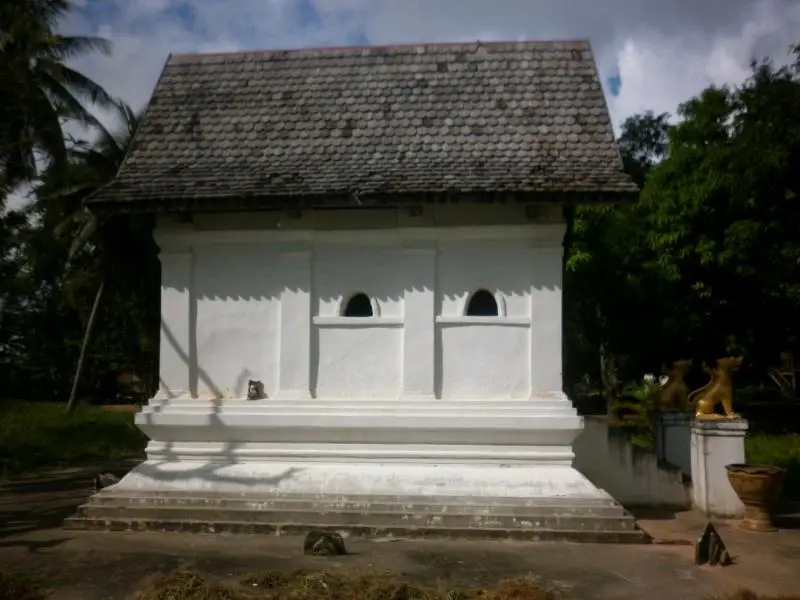
Wat Srisatapaan
Open Days: Daily
Opening Hours: 08:00 - 17:00
Wat Srisatapaan in Mukdahan Province, also written as Wat Sisa Taphan or Wat Srisa Taphan, is an old community temple in Ban Hua Khua, Nong Ian Subdistrict, Kham Cha-i District. It is best known for its exceptionally small Isan-style ordination hall, locally called a “sim.” Measuring approximately 4 metres wide, 5.30 metres long, and 6 metres high, the building is popularly promoted as the smallest ordination hall in Thailand and is officially described by local authorities as one of the smallest traditional sims in the country.
The attraction of Wat Srisatapaan goes far beyond the dimensions of the building. The small sim is an important surviving record of rural Buddhist life, local craftsmanship, community cooperation, and the practical way in which religious architecture was adapted to the needs of a modest village. Rather than being built to display wealth or monumental grandeur, the hall was designed to serve a small monastic community with limited resources while still fulfilling the requirements of Buddhist ceremonies.
From the outside, the sim appears far simpler than the large ordination halls found at major royal or urban temples. It does not have a multi-tiered roof, elaborate gable ornaments, or an extensive decorative programme. Its charm comes from the relationship between its compact walls, steep single-gable roof, hardwood structure, limited interior space, and restrained local stucco work. These elements reveal the knowledge of Isan craftsmen who understood how to create a complete sacred building without unnecessary scale or ornament.
The temple is located in Moo 7, Ban Hua Khua, Nong Ian Subdistrict, Kham Cha-i District, Mukdahan Province. It lies only a short distance from the Kuchinarai–Mukdahan road and the Nong Ian Subdistrict Administrative Organization. The surroundings retain the character of a working village temple rather than a commercial tourist complex. Visitors therefore encounter not only a historic building but also the continuing relationship between the monastery and the local community.
The temple’s principal landmark is the old sim widely referred to as “Thailand’s smallest ordination hall.” Some tourism descriptions round its dimensions to 4 metres by 5 metres. The more detailed local government record gives a width of 4 metres, a length of 5.30 metres, and a height of 6 metres. The two descriptions refer to the same building, with the difference resulting from the use of rounded and detailed measurements.
The main floor area is only about 21 square metres. This may be smaller than many modern meeting rooms, but the hall was never intended to accommodate a large congregation. Its purpose was to provide a consecrated space for formal acts of the Sangha in a rural temple where only around one to three monks normally resided. The interior could accommodate approximately five or six monks when a formal ceremony was required.
The size was therefore not an arbitrary reduction. It reflected the number of resident monks, the religious needs of the village, the materials available locally, and the amount of labour the community could provide. A larger structure would have required more bricks, timber, roofing materials, maintenance, and money without offering a practical benefit to the small monastic population. The building is a clear example of architecture based on sufficiency and functional proportion.
Information concerning the exact construction date survives in two forms. National tourism descriptions state that no definite year of construction is recorded and that the hall was believed to have existed before the village was formally established. The local history published by the Nong Ian Subdistrict Administrative Organization gives a more specific community account, stating that Wat Srisatapaan developed together with Ban Hua Khua and that around 2380 BE, or approximately 1837 CE, Phra Khru Kaeo Racha led the villagers in constructing the sim.
These accounts are not necessarily contradictory. The statement that the construction year is unknown indicates that no dated inscription or original building document has been identified. The year 2380 BE represents the period preserved in local historical records and oral memory. The most accurate interpretation is therefore that the sim dates from around the early nineteenth century, with 2380 BE serving as a local historical timeframe rather than an exact date carved into the building.
If the community chronology is followed, the sim is approaching 200 years of age. It has survived major changes in transportation, settlement patterns, materials, religious administration, and village life. When it was first constructed, building materials would have been prepared and transported largely by human and animal labour. Today, travelers can locate the temple through digital maps and reach the village by car, yet the small hall continues to represent the early religious foundation of the community.
One of the best-known stories associated with the building concerns its construction budget of only 110 baht. This figure appears in local oral history and in the account published by the subdistrict authority. It should not, however, be compared directly with 110 baht in modern currency. The economic system, cost of materials, value of labour, and methods of community construction were entirely different at the time.
Traditional village temples were not built with cash alone. Residents could contribute by making bricks, cutting and preparing timber, transporting earth, providing food for craftsmen, or working on the structure themselves. The recorded 110 baht may therefore have represented money used for items that could not be produced within the village rather than the full economic value of the project. The story is most meaningful as evidence of collective labour and shared faith.
The local term “sim” is widely used in northeastern Thailand and Laos for a consecrated ordination hall. Its religious function corresponds to that of an ubosot elsewhere in Thailand. The building is used for formal monastic acts, including ordination and meetings of the Sangha that must take place within a designated sacred boundary. Although the hall at Wat Srisatapaan is exceptionally small, its religious status and function are not diminished by its dimensions.
The capacity of approximately five or six monks was appropriate for a rural monastery with only one to three resident monks. When a larger quorum was required, monks could be invited from neighboring temples. The hall was consequently designed around the actual religious network of the area rather than an imagined need for a large resident community. Its compact plan represents an informed response to the way Buddhism was practiced in the village.
The local architectural description classifies the building as a pure rural Isan sim of the Maha Ut type, constructed with brick and plaster, locally described as “pathai.” The term Maha Ut is used in the local classification of the hall’s architectural character. Its important visual qualities include a relatively solid wall mass, limited openings, and a compact, enclosed appearance that gives the small building a sense of permanence.
Brick-and-plaster construction gave the structure sufficient strength to survive the hot, humid, and seasonally wet climate of northeastern Thailand. The use of locally available materials and familiar building methods also allowed the village to construct and repair the hall without relying entirely on outside specialists. Its value lies not in expensive materials but in the knowledge required to use ordinary materials effectively.
The roof has a single steep gable supported by a hardwood framework, with timber used to close the ceiling. Unlike many large central Thai ordination halls, the sim does not have chofa finials or hang hong ornaments along the roof edges. This restraint directs attention toward the proportions of the walls and roof rather than elaborate decorative features.
The original roof edges incorporated wooden corner tiles or boards known locally as paen mum. During later restoration, parts of the roof were replaced with corrugated metal, and stucco details were added to the column capitals. These changes have left the building with visible layers from different periods: the original structural concept, local traditional craftsmanship, and later materials introduced to keep the hall usable.
Restoration of an active village temple is often driven by the immediate need to prevent leaks or structural deterioration rather than by a formal archaeological conservation programme. Certain materials may therefore differ from the original construction. Visitors should understand the sim as a living religious building that has been maintained by successive generations, not as an abandoned monument separated from community life.
Inside the hall is a plaster Buddha image in a recognizably local Isan style. The principal image is modest in scale and proportionate to the confined interior. According to the local description, the original arrangement commonly used a long platform rather than a large formal chukchi pedestal. Later work added decorative stucco around the base.
The base includes regional mouldings such as inverted and upright lotus forms, horizontal panels, and rounded stucco bands. These details demonstrate the taste and workmanship of local Isan artisans. Although less elaborate than royal temple decoration, the motifs are carefully proportioned to the small room and create a complete visual composition without overwhelming the interior.
Because the room is so compact, visitors can observe the relationship between the Buddha image, walls, ceiling, floor, and decorative base at close range. This creates an intimate atmosphere that differs greatly from a vast urban ordination hall. The closeness also requires greater care. Visitors should not touch the walls, image base, stucco mouldings, or other historic surfaces.
The phrase “smallest ordination hall” can lead some travelers to expect a miniature or model-like building. In reality, this is a fully functional sacred structure with enough height and space for monks to conduct ceremonies. Its smallness becomes apparent when compared with conventional Thai ordination halls, not because it is a decorative miniature. The achievement lies in fitting every essential religious function into a very restricted area.
The claim that it is the smallest ordination hall in Thailand is firmly established in local tourism promotion and community memory. The Nong Ian Subdistrict Administrative Organization uses the more measured description that it is one of the smallest sims in Thailand. It is therefore appropriate to describe Wat Srisatapaan as the temple popularly known for Thailand’s smallest ordination hall and as the home of one of the country’s smallest surviving traditional Isan sims.
The cultural value of the building does not depend solely on an official record for size. Even if another hall elsewhere were found to have comparable dimensions, the Ban Hua Khua sim would remain important because of its age, architectural form, community history, construction story, and continuing religious role. It demonstrates how a village could create a complete sacred space through limited resources and collective work.
Wat Srisatapaan is closely connected with the development of Ban Hua Khua. As the settlement grew, the temple became a place for merit-making, religious education, communal ceremonies, and social gatherings. Constructing a consecrated sim signified that the village had developed a stable Buddhist community capable of organizing formal monastic activities.
In rural society, a temple was never merely a residence for monks. It served as a spiritual center, meeting place, ceremonial ground, and repository of shared memory. Buddhist holy days, merit-making traditions, ordinations, funerary rites, and community activities connected the temple to everyday life. The tiny hall therefore stood at the center of a social and religious network far larger than the building itself.
A close examination of the sim also challenges the idea that vernacular architecture is crude or unplanned. Its walls, roof angle, interior capacity, Buddha image, structural materials, and decoration were adjusted to one another with considerable care. Beauty comes from proportion, honesty of materials, practical knowledge, and the absence of unnecessary elements.
The temple retains the atmosphere of a community religious site rather than a ticketed attraction. Visitors enter an active sacred space where monks and residents may be carrying out daily duties. Appropriate temple etiquette is essential: wear clothing that covers the shoulders and knees, speak quietly, avoid disrupting ceremonies, and never treat the old hall as a photographic prop.
For photographs, it is useful to include some of the surrounding space so that the scale of the building can be understood. A close-up photograph alone may not communicate how small the sim is. A carefully positioned person or a wider view of the temple grounds can provide visual scale, but visitors should never lean against the walls, climb the base, move religious objects, or enter restricted areas to obtain a particular angle.
Morning and late-afternoon light usually reveals the texture of the plaster and roof more clearly than the harsh midday sun. Travelers seeking a peaceful visit should arrive shortly after opening or later in the afternoon. Entry should be avoided while monks are conducting ceremonies, and permission should be requested before photographing monks or community events.
The restricted interior can become crowded quickly. Tour groups should enter a few people at a time while others examine the roofline, wall proportions, and exterior details. This approach gives everyone sufficient time to appreciate the building and reduces the risk of accidental contact with historic surfaces.
Families can use the visit as an opportunity to teach children about local history, Buddhist architecture, and heritage conservation. Children should be reminded that the building is not a place for running or climbing. The sim demonstrates that cultural heritage does not have to be a palace or monumental ruin; a small village building can preserve a complex history of faith, labor, design, and community identity.
Wat Srisatapaan is particularly suitable for travelers interested in old temples, vernacular architecture, rural history, and less-commercialized destinations. Architecture enthusiasts can spend time examining the proportions and materials, while casual visitors can make a shorter stop as part of a broader journey through Kham Cha-i District.
The visit is best combined with other attractions rather than treated only as a quick photograph of a record-breaking structure. The surrounding district contains forest temples, natural sites, local restaurants, cafés, and small resorts. A half-day or full-day route can begin at Wat Srisatapaan, continue to Wat Pa Wiwek Watthanaram, and then extend toward natural attractions or Mukdahan city.
Travelers starting in Mukdahan city should allow sufficient time to reach Kham Cha-i District and Nong Ian Subdistrict. A private car or rental vehicle is the most convenient option because no regularly published public transport service stops directly at the temple. Travelers without a car should arrange local transport from Kham Cha-i and agree on the return journey in advance.
Getting There involves following the Kuchinarai–Mukdahan road. On reaching the Nong Ian Subdistrict Administrative Organization, turn toward Ban Hua Khua and continue for approximately 1 kilometre. Wat Srisatapaan will be on the left. The approximate navigation coordinates are 16.622945, 104.448055. When searching online, confirm that the destination is in Ban Hua Khua, Nong Ian Subdistrict, Kham Cha-i District, Mukdahan Province.
The final section of the route passes through a village area. Drivers should reduce speed and watch for pedestrians, motorcycles, and domestic animals. Daytime travel is preferable because local junctions and signs are easier to identify. During the rainy season, check weather conditions and avoid parking on soft or waterlogged ground.
The temple is not divided into formal commercial tourism zones. Its principal areas are the historic sim, the interior worship area containing the principal Buddha image, and the surrounding temple ground used for religious and community activities. Vehicles should be parked without blocking entrances, ceremonial routes, or access used by residents.
A meaningful visit requires looking beyond the label “smallest.” Consider why the hall was built at this scale, how many monks lived in the community, which materials were available, and how villagers organized the construction. With this context, the sim becomes more than an unusual small building; it becomes a record of social organization and religious architecture.
The famous budget of 110 baht should be understood in the same way. The number is remarkable, but the building was made possible by resources that were not recorded as cash: labor, craftsmanship, timber, bricks, food, transport, and time. The construction process created a strong sense of shared ownership and connected the religious building to the identity of the village.
The capacity of five or six monks reflects the regional religious network. A village might maintain only one to three resident monks, while additional monks could be invited from nearby temples for ceremonies requiring a larger quorum. Constructing a hall for this realistic number was an efficient and well-informed choice.
The absence of chofa and hang hong ornaments does not make the building less sacred. The gable form, walls, entrance, Buddha image, consecrated function, and spatial arrangement clearly establish its identity as an ordination hall. The structure allows foreign travelers to recognize that Thai Buddhist architecture is regionally diverse and not limited to the elaborate central Thai style commonly shown in guidebooks.
Many traditional Isan sims have been lost through deterioration, replacement by larger modern halls, or insensitive renovation. The survival of the Ban Hua Khua sim is therefore significant for the study of community-level architecture. Future care must balance structural safety, active religious use, and the preservation of surviving historic features.
Visitors can support conservation through simple behavior: do not write on surfaces, touch stucco details, move religious objects, light candles outside designated areas, or use flash when asked not to do so. When sharing photographs, use the correct temple name and location so that online information remains accurate.
The Thai name should be written as “วัดศรีษะตะพาน,” following the official place name. English sources may use Wat Srisatapaan, Wat Sisa Taphan, or Wat Srisa Taphan. These variations refer to the same temple in Ban Hua Khua and should not be confused with similarly named temples elsewhere in Thailand.
Early morning and late afternoon are generally the most comfortable times to visit. The cool season is suitable for combining several attractions in one day. During the hot season, carry drinking water and sun protection, while rainy-season visitors should bring an umbrella and take care on slippery ground.
Travelers staying overnight can choose small resorts in Kham Cha-i District to reduce morning travel time or remain in Mukdahan city for a wider selection of services. Local accommodations often take reservations directly by telephone or social media, so it is advisable to confirm availability, check-in times, and the precise location before departure.
The Nong Ian and Kham Cha-i areas offer Isan food, made-to-order dishes, grilled meat, cafés, and family restaurants. Some local businesses close on Buddhist holy days or on a fixed weekday. Calling ahead is recommended, particularly for weekday travel or larger groups.
Visitors interested in oral history may politely speak with monks or senior residents when an appropriate opportunity arises. Local memories can add valuable context concerning renovations, ceremonies, and the temple’s role in the village. The temple does not operate like a museum with a permanent guide, so personal time and ongoing religious duties must always be respected.
Phra Khru Kaeo Racha is remembered in local history as the religious leader who organized the construction around 2380 BE. His role illustrates the close cooperation between monastic and village leadership. Creating an ordination hall required collective agreement, faith, practical knowledge, and the contribution of many residents rather than the effort of a single patron.
A 2022 survey published by Thailand’s National Office of Buddhism listed Phra Athikan Khamla Thitasampanno as the abbot of Wat Srisatapaan. The year of the document is important because temple appointments can change. For current local directions and general area information, travelers may contact the Nong Ian Subdistrict Administrative Organization at 042-664000.
Wat Srisatapaan is a destination for travelers who want to understand Thailand through small but meaningful details. The sim shows that heritage may be preserved in a quiet village away from the main tourism circuit. Its importance is not determined by height, width, construction cost, or monumental appearance, but by the history and human relationships embodied in the building.
Careful observation reveals structural knowledge, efficient use of materials, an understanding of Buddhist ceremony, and a distinct local artistic taste within a single compact structure. The size is not a weakness. It is the defining quality that makes the building unique and provides a valuable lesson in architecture designed precisely for the needs of its community.
Wat Srisatapaan and the Ban Hua Khua sim deserve continued protection as part of Mukdahan’s local heritage. Respectful visits, support for nearby restaurants and accommodations, and the accurate sharing of information can benefit the community without transforming the temple into a large commercial attraction. Its true appeal lies in its simplicity, peaceful setting, and architecture created through the faith and cooperation of ordinary villagers.
| Name | Wat Srisatapaan and the Ban Hua Khua Sim |
| Location | Ban Hua Khua, Nong Ian Subdistrict, Kham Cha-i District, Mukdahan Province |
| Address | Moo 7, Ban Hua Khua, Nong Ian Subdistrict, Kham Cha-i District, Mukdahan 49110, Thailand |
| Coordinates | 16.622945, 104.448055 |
| Highlights | A traditional Isan sim popularly known as Thailand’s smallest ordination hall and officially described as one of the country’s smallest surviving sims |
| Sim Dimensions | Approximately 4 metres wide, 5.30 metres long, and 6 metres high, with capacity for about five or six monks |
| History | The temple developed together with Ban Hua Khua. Local history records that around 2380 BE, approximately 1837 CE, Phra Khru Kaeo Racha led villagers in building the sim for ordinations and formal acts of the Sangha. |
| Traditional Construction Budget | 110 baht according to local history, supplemented by community labor and locally supplied materials |
| Architectural Style | Rural Isan Maha Ut-type sim, built with brick and plaster, with a single steep gable, hardwood roof structure, and no chofa or hang hong ornaments |
| Important Interior Features | A plaster Buddha image in local Isan style and a base decorated with regional lotus mouldings, horizontal panels, and stucco bands |
| Main Areas | 1. Historic sim 2. Interior worship area and principal Buddha image 3. Temple ground used for religious and community activities |
| Travel Information | Follow the Kuchinarai–Mukdahan road. At the Nong Ian Subdistrict Administrative Organization, turn toward Ban Hua Khua and continue for approximately 1 kilometre. The temple is on the left. |
| Current Status | An active community temple and cultural attraction open to visitors, subject to ongoing religious activities |
| Open Days | Daily |
| Opening Hours | 08:00 - 17:00 |
| Abbot / Local Caretaker | Phra Athikan Khamla Thitasampanno, as listed in the National Office of Buddhism survey for 2022; local information is provided by the Nong Ian Subdistrict Administrative Organization |
| Local Information Contact | Nong Ian Subdistrict Administrative Organization, Tel. 042-664000 |
| Visitor Etiquette | Dress modestly, speak quietly, do not touch historic walls or stucco work, avoid disrupting ceremonies, and request permission before photographing monks or community activities. |
| Nearby Tourist Attractions | 1. Wat Pa Wiwek Watthanaram, approximately 12 km 2. Tat Ton Waterfall in Nong Sung District, approximately 28 km 3. Phu Pha Thoep National Park, approximately 39 km 4. Mukdahan Tower, approximately 43 km 5. Wat Roi Phra Phutthabat Phu Manorom, approximately 48 km |
| Nearby Restaurants | 1. Lan Khun Ta Mukda Café, approximately 4 km, Tel. 061-4478533 2. Lam Phrai Sin Haeng, Kham Cha-i Branch, approximately 6 km, Tel. 082-1486632 or 098-6510930 3. Pan Bai Restaurant, approximately 11 km, Tel. 042-642140 4. PunThai Coffee PTF Kham Cha-i, approximately 12 km, Tel. 085-0089112 5. Sit-Nee Bar Kham Cha-i, approximately 13 km, Tel. 093-4979499 |
| Nearby Accommodations | 1. Baan Yai Nan Resort, Kham Cha-i, approximately 11 km, Tel. 090-5879966 2. PT Resort Kham Cha-i, approximately 12 km, Tel. 093-5188327 3. Mayu Resort Kham Cha-i, approximately 13 km, Tel. 065-3174573 4. Suk Somboon Resort Kham Cha-i, approximately 14 km, Tel. 098-6261396 5. Chonlathan Resort Kham Cha-i, approximately 15 km, Tel. 083-2843088 |
Frequently Asked Questions (FAQ)
Q: Where is Wat Srisatapaan located?
A: The temple is located in Moo 7, Ban Hua Khua, Nong Ian Subdistrict, Kham Cha-i District, Mukdahan Province. Its approximate coordinates are 16.622945, 104.448055.
Q: How small is the ordination hall at Wat Srisatapaan?
A: The detailed local record gives dimensions of approximately 4 metres wide, 5.30 metres long, and 6 metres high. The interior can accommodate around five or six monks.
Q: Is it really the smallest ordination hall in Thailand?
A: It is popularly promoted as Thailand’s smallest ordination hall. The Nong Ian Subdistrict Administrative Organization describes it more precisely as one of the smallest traditional sims in the country.
Q: When was the Ban Hua Khua sim built?
A: No dated construction inscription has been identified. Local history records that Phra Khru Kaeo Racha led the villagers in building the sim around 2380 BE, approximately 1837 CE.
Q: What is the story behind the 110-baht construction budget?
A: Local oral history and the subdistrict record state that 110 baht was spent on construction. Villagers also contributed labor and local materials, so the figure should not be compared directly with modern construction costs.
Q: What are the opening hours of Wat Srisatapaan?
A: The temple is open daily from 08:00 to 17:00. Visitors should avoid disturbing monks or residents during religious ceremonies.
Q: How can travelers reach Wat Srisatapaan?
A: Follow the Kuchinarai–Mukdahan road. At the Nong Ian Subdistrict Administrative Organization, turn toward Ban Hua Khua and continue for approximately 1 kilometre. The temple will be on the left.
Q: What etiquette should visitors follow inside the old sim?
A: Wear modest clothing, speak quietly, do not touch the walls, Buddha image base, or stucco decoration, and request permission before photographing monks or ceremonies.
 Category: ●Places of Worship
 Group: ●Temple
Last Update : 2 MonthAgo
 Last Update : 2 MonthAgo
 Click to Access the Navigation Map GPS
 Art, Culture and Heritage
 Historical Sites and Monuments(2)
 Landmarks and Memorials(3)
 Art, Craft Centres, Tradition(2)
 Museums(1)
Temple(17)
Museums(1)
Temple(17)
 Other Sacred Sites(3)
 Suburban Living
 Village, Community(4)
 Local Market(2)
 Nature and Wildlife
 National Parks and Marine Reserves(4)
 Mountain (Doi)(5)
 Dam, Reservoir, Lake(3)
 Waterfalls(5)
 Caves(2)
 River, Canal(2)
 Bays and Beaches(1)
 Other natural attractions(1)
 Entertainment and Agricultural
 Farms, Parks and Ecotourism(1)


