
lovethailand home >Northeastern Travel Attractions >Mukdahan Travel Attractions >Khamcha-i >Khamcha-i > Wat Pa Suphattharam
TL;DR: Wat Pa Suphattharam is located at Kham Cha-i Subdistrict, Kham Cha-i District, Mukdahan Province, open Daily, hours 08.00 – 17.00.
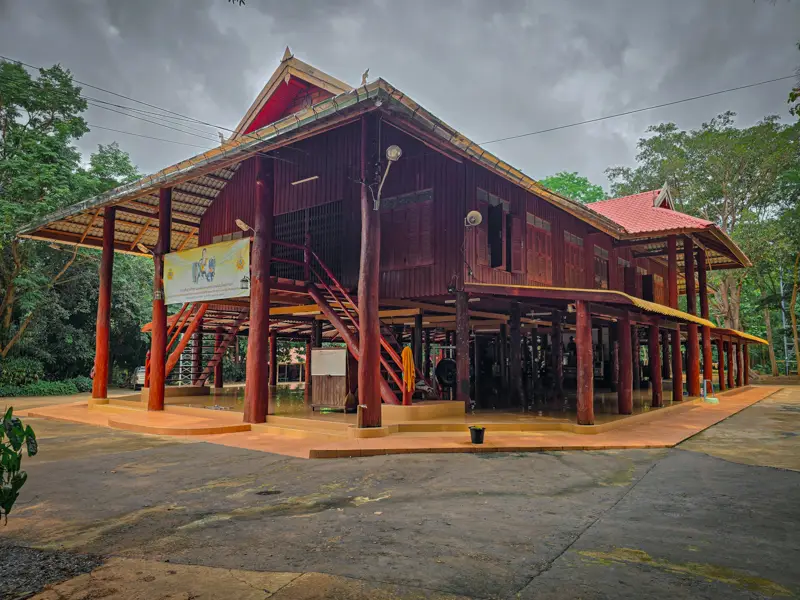
Wat Pa Suphattharam
Open Days: Daily
Opening Hours: 08.00 – 17.00
Wat Pa Suphattharam in Mukdahan Province is a Thai Forest Tradition monastery set on a wooded mountain in Kham Cha-i Subdistrict, Kham Cha-i District. Its defining features are the peaceful forest environment, a cliffside viewpoint overlooking the surrounding countryside, and Phra That Phothiyan, a half-scale architectural replica inspired by Phra That Phanom. The monastery is Branch No. 9 of Wat Nong Pah Pong and follows the monastic discipline and meditation tradition associated with Luang Por Chah Subhaddo. It remains an active monastery with resident monks, regular religious activities, and facilities used for meditation and Dhamma practice throughout the year.
From outside, Wat Pa Suphattharam may appear to be a modest rural forest monastery. Once visitors enter the grounds, however, the influence of the mountain landscape becomes immediately apparent. The monastery occupies elevated terrain shaded by mature trees and local vegetation. Paths rise gradually through different levels of the grounds, connecting the principal shrine hall, Phra That Phothiyan, forest practice areas, natural rock shelters, monastic quarters, and the viewpoint near the cliff. This setting allows visitors to experience both the contemplative atmosphere of a forest temple and broad views across Kham Cha-i’s villages, farmland, and wooded hills.
The monastery has not been developed as a commercial attraction filled with entertainment, souvenir stalls, or elaborate installations. Its appeal comes from simplicity and the close relationship between the religious buildings and the surrounding forest. In the morning, birds, wind moving through the trees, and the ordinary routines of the resident monks replace the sound of city traffic. In the late afternoon, sunlight passes through the forest and opens wider views over the landscape. These conditions allow a visit to become more than a sightseeing stop. They provide an opportunity to slow down, rest the mind, and observe one’s own thoughts.
The name “Suphattharam” conveys ideas of goodness, prosperity, and auspicious development. It also reflects the monastery’s connection with Luang Por Chah Subhaddo, the highly respected meditation master who founded Wat Nong Pah Pong in Ubon Ratchathani Province. Wat Pa Suphattharam is recognized as the ninth branch of Wat Nong Pah Pong. This relationship is not merely administrative or symbolic. It means that the monastery follows a shared approach to discipline, communal life, moderation, mindful daily activity, and strict respect for the Buddhist monastic code.
Wat Nong Pah Pong became the model for a large network of forest monasteries in Thailand and overseas. Luang Por Chah taught practitioners to learn directly from changing physical and mental conditions, to avoid escaping difficulty, and not to become so attached to outward forms that they forget to observe the mind. Wat Pa Suphattharam’s forested mountain setting supports this approach. The quiet environment reduces distraction, while heat, slopes, changing weather, and simple facilities provide practical opportunities to develop patience and awareness instead of reacting automatically to discomfort.
Local residents have known the monastery for many years and commonly describe it as an old forest temple. Its age is best understood through the continuity of religious use, community memory, and preserved practice rather than through the age of every building. Structures have been constructed, renovated, and adapted as the monastic community and the number of lay practitioners have changed. The chedi, halls, monks’ residences, and visitor facilities therefore represent different stages in the monastery’s development, while the essential emphasis on seclusion and meditation has remained consistent.
Wat Pa Suphattharam is also recognized as a provincial meditation center in Mukdahan. This role means that the monastery serves more than ceremonial functions on Buddhist holidays. It provides a place where laypeople can train in morality, mindfulness, walking meditation, sitting meditation, communal work, and a disciplined daily schedule. Such practice allows participants to see their habits and emotional reactions more clearly. The training depends less on complicated activities than on learning to perform ordinary actions with awareness and restraint.
The current abbot is Phra Khru Suphattharathipkhun, also known by his monastic name Thinakon Dipadhammo. He was ordained at Wat Nong Pah Pong on 24 June 1978 and was later entrusted with responsibilities at Wat Pa Suphattharam. He has served as abbot since 1999. His work includes supervising the monastic community, preserving the forest-practice tradition, maintaining religious buildings, supporting meditation activities, protecting the natural environment, and coordinating with surrounding communities.
Phra Khru Suphattharathipkhun has also received responsibilities in the regional monastic administration. After serving as an ecclesiastical chief at subdistrict level, he was appointed deputy ecclesiastical chief of Kham Cha-i District in 2025. This role extends beyond the boundaries of Wat Pa Suphattharam and includes coordination among temples, support for monastic education, guidance for monks and novices, and the promotion of responsible temple management in accordance with the Vinaya and Thailand’s Sangha regulations.
Resident monks follow a daily routine characteristic of forest monasteries. Mornings include chanting, alms rounds, the communal meal, and shared cleaning. The remainder of the day is divided among study, meditation, maintenance work, and other responsibilities. This ordered routine allows the monastery to retain a calm atmosphere even when visitors arrive to make merit or see the principal sites. Travelers should remember that not every part of the grounds is open for sightseeing. Monks’ residential areas and private practice spaces must not be entered without permission.
The most recognizable structure is Phra That Phothiyan, a chedi inspired by the architectural form of Phra That Phanom in Nakhon Phanom Province. It is approximately half the scale of the original monument. Phra That Phothiyan has become the visual and spiritual symbol of Wat Pa Suphattharam. Its form reflects the deep devotion that communities throughout the Mekong region have maintained toward Phra That Phanom, one of the most important sacred monuments in northeastern Thailand and neighboring areas.
The replica allows residents and travelers in Kham Cha-i to express this connection to Phra That Phanom without leaving the district. Approaching the chedi, visitors can observe its tall proportions and decorative elements influenced by the religious art of the Mekong basin. The surrounding area is used for worship, circumambulation, and Buddhist ceremonies. Visitors must walk respectfully, avoid climbing onto the base, and refrain from inappropriate poses because the monument is an active sacred site rather than a decorative background.
The name “Phothiyan” refers to awakening or liberating knowledge associated with the Bodhi tree. It encourages worshippers to understand the chedi as more than an object for requesting favors. Paying respect can become an occasion to recollect the Buddha, Dhamma, and Sangha and to make a practical commitment to more ethical conduct. Visitors may use the experience to strengthen a precept, speak more carefully, or practice awareness when difficult emotions arise. In this way, faith becomes connected with observable changes in daily life.
The elevated setting around Phra That Phothiyan provides open views and makes the chedi prominent within the monastery. Soft morning light reveals the form of the structure clearly, while late-afternoon sunlight produces a different atmosphere against the sky and surrounding hills. Photographers should avoid interrupting ceremonies or blocking worshippers. Space should always be left for older visitors and those who have come primarily to pay respect rather than to take photographs.
Another major attraction is the cliffside viewpoint. From the elevated area, visitors can see forest, farmland, villages, and the wider landscape of Kham Cha-i District. Moving air across the ridge often makes the viewpoint feel cooler than the lower areas of the monastery. Many visitors pause here after walking uphill. Despite the scenery, the cliff requires caution, especially during the rainy season or on days of strong wind.
Travelers should remain within established paths and safe viewing areas, never stepping beyond barriers or climbing rocks for photographs. Children must stay close to responsible adults, and older visitors or anyone with balance difficulties should be accompanied. Rock and soil surfaces can become slippery after rain. The view is valuable, but personal safety and respect for the contemplative atmosphere must take priority over photographs and videos.
The best periods for the viewpoint are shortly after the monastery opens and at approximately 16.00 in the late afternoon. Morning temperatures are lower, and light mist may sometimes appear during cooler seasons. Late-afternoon light gives greater depth to the hills and agricultural landscape. Visitors who remain later in the day should begin descending well before dark. The monastery closes at 17.00, and lighting is limited on some of the natural paths. Leaving on time also prevents disruption to the monks’ evening routine.
During the hot season, the higher areas are best visited in the morning. Although many sections are shaded, midday sunlight can be intense. Drinking water, a hat, and secure footwear are advisable. The rainy season brings dense green vegetation and fresh air, but moss, soft soil, and wet leaves increase the risk of slipping. During the cool season, the ridge and cliff can be noticeably windy, and a light outer layer may be useful in the morning or late afternoon.
The forest is not merely a scenic background. It is part of the monastery’s spiritual training environment. Forest monks use seclusion, natural sound, and the absence of unnecessary stimulation to observe the mind. Changes in light, temperature, seasons, plants, and animal activity offer direct lessons in impermanence. Falling leaves or rain changing the condition of a path demonstrate that circumstances cannot be controlled permanently. Practice involves accepting this reality while taking responsibility for one’s own actions.
Wat Pa Suphattharam has consistently worked to restore forest, expand green areas, and reduce the risk of wildfire. These efforts led to the monastery receiving the Green Dhammachakra Award in 2025 as a model temple for forest rehabilitation, environmental conservation, fire prevention, and sustainable cooperation between Buddhism and nature. The award reflects practical work rather than a ceremonial title alone. The monks and community protect trees, manage dry vegetation, maintain firebreaks, and promote environmental responsibility.
Wildfire prevention is particularly important for a monastery on a mountain. During the dry season, fallen leaves and branches become highly combustible. The monastic community and local partners must inspect vulnerable areas, maintain firebreaks, and communicate with people using the land surrounding the temple. Protecting the forest also reduces soil erosion, retains moisture, and preserves habitat for small wildlife. Visitors can help by never discarding cigarettes, lighting fires, or bringing flammable materials into forest zones.
Mature trees have environmental and contemplative value. Their shade keeps practice areas cooler, while dense vegetation reduces outside noise and creates natural boundaries between different zones. Visitors should not break branches, collect plants, or attach objects that damage bark. Cloth or devotional objects should be placed on trees only where the monastery explicitly permits the practice. Religious intention does not justify harming the living environment that the monastery works to protect.
In addition to the chedi and viewpoint, the monastery contains a main sermon and practice hall used for chanting, meditation, Dhamma talks, and ceremonies. The principal Buddha image forms the focus of the interior. Shoes must be removed, mobile phones silenced, and feet kept away from the Buddha image and monks. Visitors may sit quietly during chanting or a teaching even when unfamiliar with the language. Walking repeatedly through the hall or taking continuous photographs should be avoided.
The bell tower and gong area help regulate monastic time. Bells signal communal activities and remind practitioners to stop what they are doing and return to awareness. For tourists, the sound may seem like a characteristic feature of a temple. For residents and practitioners, it is a practical mindfulness cue. This illustrates an important principle of forest practice: awareness is not restricted to formal meditation but includes walking, cleaning, eating, working, and speaking.
Natural caves, rock shelters, and stone formations within the grounds contain Buddha images in several locations. These places reflect the traditional use of natural topography in forest monasteries. A rock shelter can create a sense of separation from ordinary activity and may be used for quiet practice when permitted. Visitors must not write on rock surfaces, light candles in fire-risk areas, move offerings, or touch Buddha images simply because no attendant is present nearby.
The monks’ residential zone includes individual huts, the abbot’s residence, and areas required for monastic routines. It is not a tourist route. Visitors should observe signs and should never enter a hut to obtain photographs. Anyone wishing to speak with the abbot or another monk should wait in a designated reception area or seek assistance from a temple attendant. Respecting these boundaries enables the monks to continue their study, rest, and meditation without unnecessary interruption.
Simple accommodation may be available for approved meditation participants and volunteers. It is not operated as a commercial lodging service. Anyone wishing to stay overnight must contact the monastery in advance, explain the purpose of the visit, and agree to follow the temple schedule. Guests should bring modest clothing, personal necessities, and required medication and should be prepared to help maintain cleanliness. Forest-monastery accommodation should not be expected to provide resort-style facilities.
Meditation practitioners should understand that quietness does not mean the complete absence of sound or thought. It means learning not to be carried away automatically by them. Walking meditation develops awareness of bodily movement, while sitting meditation reveals the changing quality of emotions and attention. Beginners do not need to sit for excessive periods. Practice should begin at a level appropriate to physical condition and follow the guidance of qualified teachers. Severe pain caused by force is not the objective.
Merit-making can include offering food, providing useful monastic supplies, contributing to maintenance, supporting forest-conservation work, or helping with communal activities. Offerings should be practical and delivered at an appropriate time. Food must arrive before the monks’ meal, while medicine and specialized equipment should be offered only after confirming a genuine need. Thoughtful giving reduces waste and avoids creating storage problems for the monastery.
The monastery does not charge an admission fee. Visitors may worship at the chedi, use the public viewpoint, and visit areas open to laypeople without purchasing a ticket. Voluntary donations may be made through official donation boxes or channels designated by the monastery. Money should not be handed to unauthorized individuals requesting contributions. Keeping the grounds clean, remaining quiet, and respecting temple rules are also meaningful forms of support.
Clothing must cover the shoulders and knees. Tight garments, sleeveless tops, short trousers, short skirts, and clothing displaying offensive material should be avoided. Footwear should be easy to remove for entering shrine buildings but secure enough for slopes and natural paths. Clean socks may be useful inside buildings. Appropriate preparation improves safety without compromising respect for the religious setting.
Women should not touch monks or hand objects directly to them. Offerings may be placed on a receiving cloth or passed through a male companion. Male visitors should also maintain respectful distance and should not enter a monk’s hut without permission. Conversations should be polite and should not press monks for private predictions, lucky numbers, or commercial sacred objects. The monastery’s central purpose is Dhamma study and meditation.
Exterior photography of Phra That Phothiyan, the halls, and the landscape is generally possible when it does not obstruct worshippers. Permission should be requested before photographing monks, meditation participants, or ceremonies. Flash should not be used inside religious buildings or close to people meditating. Drone operation requires prior approval because the sound can disturb monks, practitioners, wildlife, and the overall quietness of the forest.
Families should explain to children that running, shouting, and climbing on structures are inappropriate. The cliffside area requires constant adult supervision. Young children may become tired on the sloping paths, so additional rest time and drinking water are advisable. Older travelers may require a walking aid or companion. Anyone with heart, knee, or mobility conditions can choose the principal accessible areas rather than attempting every path.
Wheelchair users should travel with a companion who can check slopes, surface changes, and access to individual buildings. The main hall and flatter areas are more accessible than the cliff or natural rock zones. Contacting the monastery before traveling may clarify whether ceremonies or maintenance work will affect access. Although the temple is open daily, individual areas may be temporarily restricted during construction or religious activity.
Visitors with only one hour should begin at the main hall, pay respect to the principal Buddha image, and continue to Phra That Phothiyan before using the most accessible viewing area. Two to three hours allow time for the forest paths, cliff viewpoint, rock shelters, bell tower, and meditation areas without rushing. Those intending to practice formally should allow at least half a day or arrange an approved stay so that the experience is not reduced to a brief sightseeing activity.
Getting There from Mukdahan city, follow Highway 12 toward Kham Cha-i District. After reaching the district area, continue into Kham Cha-i Subdistrict and follow signs or digital navigation to Wat Pa Suphattharam. The address is 173 Moo 1, Kham Cha-i Subdistrict, Kham Cha-i District, Mukdahan 49110. The approximate coordinates are 16.55097, 104.36061. A private car or rental vehicle is the most convenient choice because public transportation to the temple and surrounding attractions is limited.
The journey from central Kham Cha-i is short. Digital maps can navigate directly to the monastery. Drivers should reduce speed near the mountain and watch for local junctions used by residents traveling to farms and villages. Ordinary cars can reach the temple in normal weather. During heavy rain, road conditions and unpaved parking surfaces should be checked carefully. Vehicles must be parked only in designated areas and should not block monastic or emergency access.
Travelers without private transport may first reach Kham Cha-i town and arrange a local vehicle. Fare, return time, and meeting point should be agreed upon before departure because finding transport from the monastery late in the day may be difficult. Groups can hire a vehicle with a driver and combine Wat Pa Suphattharam with Wat Pa Wiwek Watthanaram, the Mae Chi Kaew Sianglam Nunnery, and other sites in Kham Cha-i.
A religious heritage itinerary can begin at Wat Pa Suphattharam in the morning, with approximately two hours for Phra That Phothiyan, the forest, and the viewpoint. The next stop can be Wat Pa Wiwek Watthanaram, or Wat Luang Pu Jam, approximately 3 kilometers away, where visitors can study the history of Luang Pu Mun and Luang Pu Jam. The route may continue to the Mae Chi Kaew Sianglam Nunnery, followed by lunch in Kham Cha-i. Huai Khi Lek Yai Reservoir or Wat Tham Luang Pu Sao can be visited in the afternoon.
Nature-oriented travelers can combine Wat Pa Suphattharam with Huai Khi Lek Yai Reservoir. This route includes mountain forest, a cliff viewpoint, and a community water landscape. Starting at the monastery in the morning avoids the strongest heat. Travelers can have lunch in town and visit the reservoir in the afternoon. Littering, excessive noise, and intrusion into agricultural land should be avoided throughout the route.
Kham Cha-i District is known for Phu Thai cultural heritage, weaving, handicrafts, and regional food. A stop at a local product center or the Ban Song OTOP community group introduces travelers to textiles and goods reflecting local identity. Purchasing directly from community producers supports household income and occupational groups. A temple visit can therefore become a broader experience connecting faith, landscape, and living local culture.
Most nearby restaurants and cafés are located in communities and central Kham Cha-i. Some operate according to family schedules or close on selected days. Travelers, especially groups, should telephone before arrival. Typical choices include Isan food, made-to-order dishes, coffee, and snacks. Meals should be planned so that visitors do not carry strong-smelling food into halls or meditation areas.
Accommodation near the monastery consists mainly of small resorts and locally operated properties around Kham Cha-i. These are suitable for travelers staying overnight before visiting temples and natural attractions the next day. Facilities vary. Some properties provide parking and food, while others offer simple rooms only. Room type, check-in time, pet policy, and exact location should be confirmed before booking. Telephone numbers in the summary table are publicly listed business contacts, but service availability should be reconfirmed directly.
On Makha Bucha, Visakha Bucha, Asalha Bucha, and during the Buddhist Lent period, the monastery may organize chanting, candlelight circumambulation, Dhamma talks, and meditation activities beyond the ordinary schedule. Participants should arrive early and follow the directions of the monastic community. Travelers seeking a quieter visit should choose a weekday morning. Checking announcements from the monastery or the Mukdahan Provincial Office of Buddhism before major holidays will help confirm the current program.
Merit-making activities are also connected with forest and environmental care. Supporters may participate in tree planting, firebreak maintenance, water-source care, and waste management when the monastery organizes such work. These activities demonstrate that Buddhist practice is not separated from environmental responsibility. Forest protection reduces heat, preserves moisture, limits wildfire risk, and ensures that monks and lay practitioners continue to have a quiet place for spiritual training.
In 2025, the monastery was also progressing through the process of establishing a formal consecrated boundary for Sangha ceremonies. The proposed boundary measured 33 meters by 66 meters, covering approximately 2,178 square meters. This process reflects the monastery’s long-term institutional development. Visitors may occasionally encounter construction or restricted areas and should follow all signs rather than entering work zones.
Development must balance practical needs with the identity of a forest monastery. New buildings and access routes should support genuine use without reducing green space or disrupting seclusion. Parking, safer paths, and improved access for older people are beneficial, but commercial activity should not overwhelm monastic practice. The success of a forest temple is measured not only by visitor numbers or buildings but by its ability to preserve discipline, forest, and conditions suitable for training the mind.
Every visitor contributes to that balance. Remaining on established paths reduces damage to vegetation. Carrying bottles and waste out of the grounds reduces the burden on the monastery. Quiet behavior protects the practice environment. Names should never be carved into trees or rocks. Wildlife should not be captured, fed, or approached. Any animal in a location that may endanger visitors should be reported to a temple attendant.
The significance of Wat Pa Suphattharam extends beyond the half-scale chedi and the viewpoint. It is created by the relationship between Buddhism, mountain forest, and community. Phra That Phothiyan connects local devotion with Phra That Phanom. The monastery’s status as a branch of Wat Nong Pah Pong links Mukdahan with Luang Por Chah’s meditation tradition. The Green Dhammachakra Award reflects the practical conservation role of the monastic community. Together, these elements make the temple a place for learning about religion, history, ecology, and local life.
Even travelers who arrive primarily for the view can benefit from sitting quietly for a short period. The viewpoint opens the eye to the landscape outside, while meditation invites attention toward the inner landscape of thought and emotion. Seeing villages, fields, and hills from above can remind visitors that individual concerns are part of a wider system. This perspective gives the viewpoint meaning beyond producing photographs for social media.
Travelers interested in applied Buddhism can use the monastery as an introduction to Luang Por Chah’s teaching. A central theme is awareness of liking and disliking, because both can control human decisions. A forest environment reveals reactions to heat, tiredness, silence, and inconvenience. When a person notices these reactions without responding immediately, it becomes possible to understand that peace does not depend on arranging every external condition according to personal preference.
Wat Pa Suphattharam is suitable for faith-based travelers, students of forest Buddhism, visitors interested in chedi architecture, nature lovers, and anyone seeking a quiet destination in Mukdahan Province. It is readily reached by private vehicle and can be combined with Wat Pa Wiwek Watthanaram, reservoirs, nunneries, and community attractions in Kham Cha-i. Visitors must remember that it remains a working monastery where monks live and practice every day.
Before traveling, check the weather, wear footwear suitable for slopes, carry a reasonable amount of drinking water, and plan to leave before 17.00. Anyone attending a ceremony, joining a retreat, or requesting an overnight stay should contact the monastery in advance. A balanced visit begins with the main shrine hall, continues to Phra That Phothiyan and the natural areas, and concludes with quiet reflection or the viewpoint. This sequence helps visitors understand the monastery as a sacred place, a protected landscape, and an environment for mental training.
Wat Pa Suphattharam demonstrates how a forest monastery can preserve simplicity while responding to changing social needs. The half-scale Phra That Phanom replica, cliff viewpoint, shaded forest, Wat Nong Pah Pong lineage, and environmental work give the monastery a distinctive identity within Mukdahan. Respectful travelers gain more than photographs or a check-in location. The quiet mountain setting and disciplined rhythm of the monastery can create space to observe the mind and carry a greater sense of moderation into life after leaving.
| Name | Wat Pa Suphattharam, Mukdahan Province |
| Location | Kham Cha-i Subdistrict, Kham Cha-i District, Mukdahan Province |
| Address | 173 Moo 1, Kham Cha-i Subdistrict, Kham Cha-i District, Mukdahan 49110, Thailand |
| Coordinates | 16.55097, 104.36061 |
| Current Status | Active Thai Forest Tradition monastery with resident monks and a recognized provincial meditation center |
| Religious Affiliation | Mahanikaya monastery and Branch No. 9 of Wat Nong Pah Pong, following the forest tradition of Luang Por Chah Subhaddo |
| Current Abbot | Phra Khru Suphattharathipkhun, also known as Thinakon Dipadhammo |
| Abbot’s Role | Abbot since 1999 and deputy ecclesiastical chief of Kham Cha-i District since 2025 |
| Highlights | Phra That Phothiyan, half-scale Phra That Phanom replica, cliffside viewpoint, shaded forest, meditation areas, and Wat Nong Pah Pong forest-monastery tradition |
| Phra That Phothiyan | A chedi inspired by the architectural form of Phra That Phanom, approximately half the scale of the original monument, and an important focus of worship at the monastery |
| Viewpoint | Elevated cliffside viewpoint overlooking forest, villages, and farmland in Kham Cha-i District; additional caution is required during rain and strong wind |
| Main Areas / Zones | 1. Phra That Phothiyan 2. Cliffside viewpoint 3. Main sermon and shrine hall 4. Natural caves, rock shelters, and Buddha images 5. Bell and gong towers 6. Meditation areas and walking paths 7. Conservation forest 8. Monks’ residential zone 9. Accommodation area for approved practitioners |
| Meditation Role | Recognized provincial meditation center used for sitting meditation, walking meditation, moral training, Dhamma teaching, and Buddhist holiday activities |
| Environmental Recognition | Recipient of the 2025 Green Dhammachakra Award for forest restoration, environmental conservation, wildfire prevention, and expansion of green areas |
| Open Days | Daily |
| Opening Hours | 08.00 – 17.00 |
| Fees | No admission fee; voluntary donations are welcome |
| Recommended Visit Duration | Approximately 2–3 hours for the chedi, forest paths, and viewpoint without rushing |
| Travel Information | From Mukdahan city, follow Highway 12 toward Kham Cha-i District and continue to Kham Cha-i Subdistrict. Private car or rental vehicle is the most convenient option. |
| Visitor Etiquette | Dress modestly, speak quietly, remove shoes where required, do not enter monks’ residential areas without permission, take care near the cliff, and request permission before photographing monks or operating a drone |
| Nearby Tourist Attractions | 1. Wat Pa Wiwek Watthanaram, or Wat Luang Pu Jam, approximately 3 km 2. Mae Chi Kaew Sianglam Nunnery, approximately 4 km 3. Huai Khi Lek Yai Reservoir, approximately 4 km 4. Wat Tham Luang Pu Sao, approximately 9 km 5. Ban Song Community Product and OTOP Center, approximately 11 km |
| Nearby Restaurants | 1. Coffee House & Cafe, approximately 2 km 2. DNN Factory, approximately 4 km, Tel. 096-907-0793 3. Thidarat Fresh Seafood, approximately 4 km, Tel. 061-227-2274 4. Nong Khian Homestay Café, approximately 10 km, Tel. 096-828-7747 5. Lan Khun Ta Mukda Café, approximately 14 km, Tel. 061-447-8533 |
| Nearby Accommodations | 1. Chonthan Resort Kham Cha-i, approximately 5 km, Tel. 087-855-7564, 083-284-3088 2. PT Resort, approximately 8 km, Tel. 093-518-8327 3. Phasan Village Resort, approximately 10 km, Tel. 098-947-0714 4. Mayu Resort, approximately 14 km, Tel. 093-251-2699, 061-134-2924 5. Nong Ian Suan Pa Resort, approximately 15 km, Tel. 082-288-4464 |
Frequently Asked Questions (FAQ)
Q: Where is Wat Pa Suphattharam located?
A: The monastery is located at 173 Moo 1, Kham Cha-i Subdistrict, Kham Cha-i District, Mukdahan Province 49110, on a wooded mountain near central Kham Cha-i.
Q: How is Wat Pa Suphattharam connected with Wat Nong Pah Pong?
A: It is Branch No. 9 of Wat Nong Pah Pong and follows the forest-monastery discipline of Luang Por Chah Subhaddo, emphasizing simplicity, mindfulness, and strict observance of the Vinaya.
Q: What is distinctive about Phra That Phothiyan?
A: Phra That Phothiyan was inspired by the architectural form of Phra That Phanom and is approximately half the scale of the original monument.
Q: Who is the current abbot of Wat Pa Suphattharam?
A: The current abbot is Phra Khru Suphattharathipkhun, also known as Thinakon Dipadhammo. He has served as abbot since 1999 and is deputy ecclesiastical chief of Kham Cha-i District.
Q: What can visitors see inside the monastery?
A: Major areas include Phra That Phothiyan, the cliffside viewpoint, the main shrine hall, natural caves and rock shelters, Buddha images, the bell and gong towers, conservation forest, and meditation areas.
Q: When is the monastery open and is there an admission fee?
A: The monastery is open daily from 08.00 to 17.00. There is no admission fee, and visitors may make voluntary donations.
Q: What is the best time to visit the viewpoint?
A: Shortly after 08.00 and at approximately 16.00 are suitable periods because temperatures are lower and the light is favorable. Visitors should leave the cliff area before the monastery closes.
Q: What precautions and etiquette should visitors follow?
A: Visitors should dress modestly, remain quiet, avoid restricted monastic areas, wear secure footwear on slopes, take care on wet surfaces and near the cliff, and supervise children closely.
 Category: ●Places of Worship
 Group: ●Temple
Last Update : 2 MonthAgo
 Last Update : 2 MonthAgo
 Click to Access the Navigation Map GPS
Wat Pa Suphattharam Map
Recommend

 Art, Culture and Heritage
 Historical Sites and Monuments(2)
 Landmarks and Memorials(3)
 Art, Craft Centres, Tradition(2)
 Museums(1)
Temple(17)
Museums(1)
Temple(17)
 Other Sacred Sites(3)
 Suburban Living
 Village, Community(4)
 Local Market(2)
 Nature and Wildlife
 National Parks and Marine Reserves(4)
 Mountain (Doi)(5)
 Dam, Reservoir, Lake(3)
 Waterfalls(5)
 Caves(2)
 River, Canal(2)
 Bays and Beaches(1)
 Other natural attractions(1)
 Entertainment and Agricultural
 Farms, Parks and Ecotourism(1)


