
lovethailand home >Northeastern Travel Attractions >Mukdahan Travel Attractions >Don Tan >Pho Sai > Ban Nong Lom Ecotourism Village
TL;DR: Ban Nong Lom Ecotourism Village is located at Ban Nong Lom, Moo 3, Pho Sai Subdistrict, Don Tan District, Mukdahan Province, Thailand, open Daily, with advance reservations required, hours 08.00 – 17.00 for daytime visits and community activities. Overnight.
Ban Nong Lom Ecotourism Village
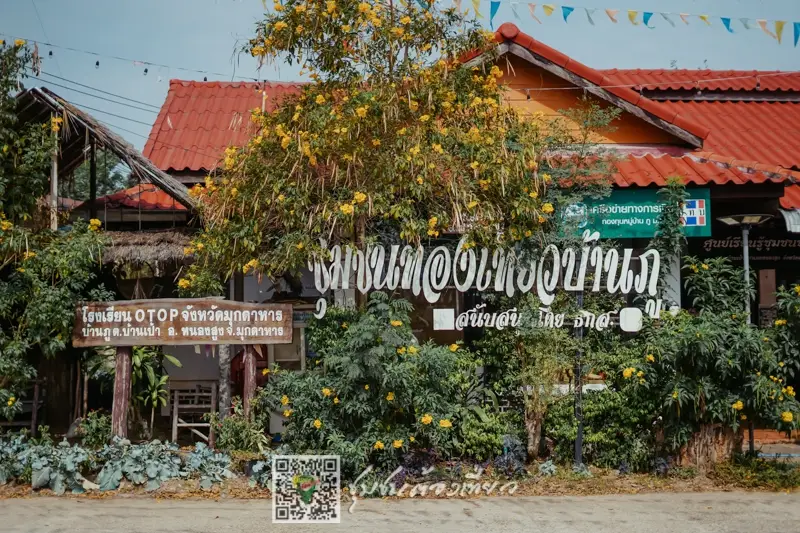
Open Days: Daily, with advance reservations required
Opening Hours: 08.00 – 17.00 for daytime visits and community activities. Overnight accommodation operates according to the confirmed booking schedule.
Ban Nong Lom Ecotourism Village in Mukdahan Province is a community-based destination beside the Mekong River in Ban Nong Lom, Moo 3, Pho Sai Subdistrict, Don Tan District. The village combines natural scenery, fishing traditions, Buddhist heritage, local performing arts, craft knowledge, food, and community accommodation in a program operated by local residents. Visitors can take a boat trip on the Mekong, observe riverside livelihoods, pay respect to the historic Phra Mutchalin Buddha image, attend cultural performances, learn about weaving and basketry, eat locally prepared food, and stay overnight in accommodation arranged by the community. The bamboo huts and the Nong Lom Phatthana floating raft are important features of the village’s original tourism program and operate according to advance arrangements, structural readiness, river conditions, and the selected itinerary.
Ban Nong Lom occupies a landscape closely connected to the Mekong. Village houses, farmland, religious spaces, natural water sources, and the community boat landing form a single living environment. The river is not merely a background for photographs. It supplies food, supports employment, influences agriculture, provides a transport route, and shapes the collective memory of local families. A visit therefore introduces travelers to the Mekong through the experience of people who live and work beside it rather than through a brief stop at a conventional viewpoint.
The name Ban Nong Lom is linked with a natural pond or wetland in the area. Community accounts describe ancestors who moved from settlements on the Lao side of the region and established a new home after finding land with dependable water and suitable natural resources. The pond supported farming, animal raising, fishing, and household life, while the nearby Mekong allowed contact with neighboring settlements and access to seasonal resources. The relationship between people, the wetland, and the river became the foundation of the village name and its cultural development.
Ban Nong Lom was developed as an ecotourism community and selected as an OTOP Village for Tourism. OTOP stands for One Tambon One Product, a national program that supports distinctive local products, knowledge, and community economies. In Ban Nong Lom, the tourism product is not limited to a single handicraft. It combines Mekong scenery, natural resources, traditional food, local performances, accommodation, religious heritage, fishing knowledge, and craft production into a complete village experience.
This model allows tourism income to reach different groups within the community. Host families receive accommodation income, cooks prepare meals, boat operators provide river trips, artisans teach weaving and basketry, performers present local arts, ritual leaders conduct welcoming ceremonies, and temple caretakers receive visitors at the religious site. A well-planned visit therefore supports a wider range of households than a journey in which travelers only stop to take photographs and leave.
The term ecotourism in Ban Nong Lom covers more than environmental conservation in isolation. It refers to a balance between the Mekong ecosystem, cultural continuity, and the local economy. Boat activities must respect water levels and safety. Visitors must avoid disturbing private households and working areas. Cultural performances must be presented by people who understand their meanings. Crafts should provide fair returns to their makers, while waste, noise, and excessive use of water or electricity should be minimized.
Ban Nong Lom is not a gated attraction with a ticket office and a fixed walking route. It is a functioning village where tourism spaces are distributed among participating houses, the temple, community activity areas, craft households, farmland, the boat landing, and the Mekong riverfront. Guests should begin by meeting the village coordinator or host family, who will explain the schedule, visitor guidelines, accessible areas, and locations that remain private.
The principal areas of the village include the community reception point, participating homestay houses, bamboo huts when available, the communal cultural activity area, weaving and basket-making households, Wat Mutchalin, the local learning area, the boat landing, and the Nong Lom Phatthana floating raft. These are not permanently staffed tourist zones. Each area is activated according to the confirmed program, the number of visitors, host availability, environmental conditions, and safety requirements.
A Mekong boat trip is one of the defining Ban Nong Lom experiences. Community boats leave from the local landing and travel through a riverscape shaped by seasonal water levels. Passengers can observe fishing boats, riverbank fields, temporary sandbars, cultivation areas, and views toward both the Thai and Lao sides of the river. The journey is especially valuable when accompanied by a local boat operator or community guide who can explain the meaning of what visitors see.
The boat operator may describe how fishing periods are selected, why particular equipment is used in different currents, how wind affects navigation, and how families adapt their work to changing water levels. These explanations transform the cruise from passive sightseeing into a lesson about a complex river environment. Fishing knowledge has been developed through years of observation and family experience and cannot be understood fully by looking at the water from a distance.
The appearance of the Mekong changes considerably through the year. During the dry season, falling water levels may reveal sandy banks, temporary islands, and land suitable for short-term cultivation. During the rainy season, the river becomes wider and stronger, while the surrounding countryside turns greener. A traveler returning in a different season will see a different river, different forms of work, and different limits on navigation.
Boat trips require advance booking and remain subject to the local operator’s safety assessment. Passengers must wear life jackets throughout the journey. Children require close adult supervision, and no one should stand, change seats, or lean outside the boat while it is moving. Heavy rain, strong wind, unsuitable currents, or poor visibility may require the community to delay, shorten, reroute, or cancel the trip. The operator’s decision must take priority over the original tourism schedule.
Travelers taking photographs from the boat should secure cameras and phones with straps or waterproof cases. Equipment should never be placed on the edge of the vessel, and visitors should not ask the operator to enter unsafe water merely to create a better photograph. Morning light is suitable for observing fishing activity, while late afternoon can provide attractive river views. The final timing must nevertheless follow navigation and weather conditions.
Fishing culture is a major part of the learning experience. Local fishers combine knowledge of currents, weather, fish behavior, seasons, and equipment when deciding where and when to work. Different fishing tools have different purposes and should not be treated as decorative objects. Learning directly from fishers helps visitors understand that a fish served at the table is connected to labor, risk, water quality, natural cycles, and community rules.
Riverside agriculture demonstrates another form of adaptation. When water levels fall, certain areas retain moisture and fertile sediment suitable for seasonal crops. Farmers must choose plants that can mature before the river rises again. This work requires knowledge of soil, rainfall, water cycles, and local weather. Visitors should treat these fields as productive working areas, remain on the recommended path, and never collect crops without permission.
The most important religious site in the village is Wat Mutchalin, home to the Phra Mutchalin Buddha image, which the community honors as being more than 700 years old. The image remains a focus of devotion for Ban Nong Lom and surrounding communities. Visiting the temple allows travelers to understand how Buddhism shapes merit-making, annual ceremonies, personal faith, community meetings, and the transfer of values between generations.
The name Mutchalin is associated with Mucalinda, the naga king in Buddhist tradition. After the Buddha attained enlightenment, severe rain and wind arose while he remained in meditation. Mucalinda sheltered him by spreading his hood overhead. Images of the Buddha protected by a naga therefore represent protection, concentration, stability, and spiritual calm in the midst of natural change. This meaning is especially relevant in a river community whose daily life requires respect for the power and seasonal transformation of water.
Visitors should approach Phra Mutchalin respectfully. Clothing should cover the shoulders and knees. Shoes must be removed before entering religious buildings. Feet should not be pointed toward the principal Buddha image, and visitors must not climb onto a sacred base or use a loud voice. Permission should be requested before photographing monks, people taking part in worship, or an active religious ceremony.
Wat Mutchalin is currently overseen by Phra Khru Mutchalin Phatthanakit, the abbot. The temple also serves as a place where village history, religious practice, and community memory meet. When circumstances allow, respectful conversation with monks or local elders can provide a deeper understanding of the temple than a short photographic visit. Donations are voluntary, and there is no compulsory fee for paying respect to the Buddha image.
Local cultural performances bring another dimension to an overnight stay. The exact presentation depends on group size, the date of the visit, and the availability of performers. A program may include dance, folk music, Lam Phaya oral performance, local clothing, or a welcoming ceremony. These activities are not performed on a fixed hourly schedule and must be requested when the booking is made.
Phu Thai cultural elements are prominent in the village tourism program, including language, dress, weaving, dance, music, and beliefs concerning the khwan or personal spirit. Don Tan District also has a diverse ethnic background that includes Kaleung communities and other Mekong cultural groups. Ban Nong Lom should therefore be understood within a broader social landscape rather than assuming that every household has an identical ethnic identity or migration history.
Lam Phaya is an oral art associated with northeastern Thai culture. The word phaya refers to poetic wisdom, philosophical sayings, riddles, moral observations, or sophisticated courtship language. A performer requires memory, verbal skill, musical control, humor, and sensitivity to the audience. Verses may concern love, gratitude, family relationships, work, or practical lessons for life. International visitors may not understand every word, but they can still appreciate the rhythm, interaction, and emotional tone.
A Bai Sri Su Khwan ceremony can be arranged to welcome visiting groups. In Phu Thai and wider northeastern Thai belief, the khwan is an emotional or spiritual essence that should remain with a person. Travel, major life changes, or important events may be occasions for calling and strengthening the khwan. A ritual leader recites blessings, after which community members tie white cotton threads around the wrists of the guests as a sign of goodwill, protection, and social connection.
Participants should sit respectfully, listen until the recitation has ended, and avoid distracting photography or conversation. The white thread is not merely a tourist decoration. It holds meaning for the people conducting the ceremony. Respectful behavior helps the ritual retain its cultural importance and prevents it from becoming a performance separated from the beliefs of its owners.
Textile weaving provides an opportunity to study a detailed production process. Weavers prepare thread, arrange the warp, select colors, form patterns, and control the tension of the loom. Products may include traditional cloth, pha khao ma multipurpose fabric, blankets, clothing material, and small household items. Watching a weaver at work reveals the time, concentration, and precision required to create a single piece.
Visitors may try a basic weaving stage under the guidance of an artisan. Even a brief attempt shows how difficult it is to maintain rhythm, align threads, and continue a pattern accurately. Buyers should ask about the material, washing method, and proper storage of a textile. Purchasing directly from the maker allows income to remain with the producing household and reinforces the economic value of traditional skills.
Plastic-strip basketry illustrates how local craft knowledge can be adapted to modern materials. Artisans create a base, arrange the strips, plan colors, control tension, shape the sides, and finish the rim securely. Finished baskets can be used for household storage, shopping, agricultural work, or souvenirs. A basic workshop is suitable for several age groups and allows visitors to understand that basketry requires planning and accuracy.
The use of plastic strips does not remove the traditional knowledge from the craft. The essential principles of interlacing, tension, form, strength, and pattern remain intact. What changes is the material, which is resistant to moisture and suited to contemporary household use. Visitors therefore see both cultural continuity and practical adaptation.
Bamboo huts are strongly associated with Ban Nong Lom’s original ecotourism identity. Staying in a hut introduces guests to natural materials, simple rural construction, and the sounds of the village environment. Current use depends on building condition, host availability, group size, and season. Guests must confirm the sleeping arrangement, bathroom location, electricity, bedding, and exact type of accommodation before traveling.
A bamboo-hut stay differs from a hotel stay. A fan may be used instead of air conditioning, a bathroom may be outside or shared, and natural sounds are clearly audible at night. Insect repellent, a small flashlight, easy-to-remove shoes, and limited luggage are practical. Older travelers or guests with mobility limitations should ask about steps, uneven surfaces, bathroom access, and walking distance before confirming the reservation.
The Nong Lom Phatthana floating raft was developed as part of the village tourism experience, connecting locally prepared meals with the atmosphere of the water and surrounding landscape. The raft operates only when included in a confirmed community program and when water, structure, and safety conditions permit. It should not be treated as a conventional restaurant that accepts unannounced customers every day.
Travelers requesting a meal on the raft must provide the group size, preferred time, meal requirements, and dietary restrictions in advance. A local meal may include sticky rice, fish, northeastern Thai dishes, seasonal vegetables, chili dips, and household recipes. The menu depends on ingredients, host availability, and the agreed budget. Allergies, vegetarian requirements, religious restrictions, and intolerance of spicy food must be communicated clearly.
The value of a community meal lies not only in the number of dishes but also in the ingredients, household recipes, and conversation with the cooks. Guests can ask about local plant names, fish preparation, preservation methods, and seasonal changes in food. Taking only a reasonable amount, reducing leftovers, and avoiding unnecessary packaging help keep the meal consistent with the principles of ecotourism.
Community products may include textiles, baskets, household items, crafts, and processed food according to the production cycle. Selection as an OTOP tourism village means that products are connected with the story of the destination. Visitors can meet producers, observe the process, and understand how an item is used before making a purchase. Direct buying returns a clearer share of the income to the artisan.
Aggressive bargaining is inappropriate in a community tourism setting. A craft price reflects materials, labor, time, and skills accumulated over many years. Buyers can compare sizes, designs, and uses rather than reducing the value of the maker’s work. Items should be handled carefully, and permission should be requested before using them as photography props.
Ban Nong Lom also maintains traditions connected with Buddhism, ancestors, and the Mekong. These include Bun Khao Pradap Din, a merit-making tradition in which food and offerings are dedicated to deceased relatives, and an ancient-style illuminated boat tradition associated with faith and the river. Such events follow the traditional calendar and cannot be arranged as daily entertainment for visitors.
Anyone planning a visit during a festival should confirm the annual date with the community. Lunar calendar dates and local schedules vary from year to year. Religious rites and community participation must take priority over tourist convenience. Visitors should avoid blocking a procession, entering a ritual area without permission, or using flash photography during an important moment.
Permission is required before photographing residents, children, elders, monks, artisans at work, ceremonies, kitchens, or private interiors. A welcoming host does not make every part of a home a public photography space. Social media captions should avoid portraying the community as exotic, backward, or helpless. When permission is granted, the correct name of an artisan, product, or tradition should be used.
Travelers should reduce single-use plastic, carry a refillable bottle, and follow the host’s waste-management instructions. Nothing should be discarded in the Mekong, at the boat landing, in fields, or beneath houses. Noise should be limited at night, and water and electricity should be used carefully. Ecotourism has real meaning only when visitor behavior supports conservation.
Families with children can use Ban Nong Lom as an outdoor learning environment. Children can see fishing tools, boats, looms, basketry, temples, crops, and food systems linked to local resources. Parents must nevertheless supervise children closely near the raft, riverbank, boat landing, and uneven ground. Children should not handle fishing equipment, enter fields, or disturb animals without permission.
Older travelers and people with mobility limitations can visit when their requirements are discussed in advance. Traditional houses, bamboo huts, floating structures, and river landings have practical limits involving steps, slopes, and uneven surfaces. The coordinator can select the most suitable available accommodation and activities. Information about wheelchairs, walking aids, medical conditions, and bathroom requirements should be provided before booking.
A day trip is suitable for travelers staying in Mukdahan city with private transport. A program may include a morning arrival, village introduction, temple visit, weaving and basketry, lunch, and a boat trip when conditions are suitable. The order must remain flexible because boat timing, artisan availability, cultural presenters, and weather can affect the schedule.
A 2-day, 1-night itinerary provides a deeper experience. The first day can include reception by the hosts, village orientation, crafts, Bai Sri Su Khwan, dinner, and a cultural performance. The following morning can focus on the Mekong, fishing culture, Phra Mutchalin, product purchasing, and conversation with the host family before departure.
A 3-day, 2-night stay is more suitable for travelers who want to participate rather than simply observe. Additional time can be used for weaving or basketry practice, agricultural walks, conversations with fishers, and viewing the Mekong at different times of day. The itinerary can also include attractions elsewhere in Don Tan District without forcing several activities into a short period.
November to February generally provides comfortable temperatures for outdoor activities. March to May is hotter but shows the dry-season river clearly. June to October brings rain, greener landscapes, and higher water levels, while boat programs require greater flexibility. Each season offers a different experience, and the best choice depends on what the traveler wants to learn.
Lightweight and modest clothing is suitable for village activities and the temple. Useful items include easy-to-remove shoes, a hat, sunscreen, insect repellent, personal medicine, a refillable bottle, and a light outer layer. A compact umbrella or rain jacket is useful in the rainy season. Guests staying in simple accommodation should bring personal toiletries and a small flashlight and avoid oversized luggage.
Ban Nong Lom does not use one fixed price for every group. Costs depend on group size, accommodation type, number of meals, raft use, boat trip, cultural performance, welcoming ceremony, and craft workshops. Historical promotional prices should not be used as current booking rates. A complete quotation should be requested before any payment is transferred.
A reservation request should include the group contact’s name and phone number, travel date, expected arrival time, number of adults and children, number of nights, dietary requirements, transport method, and requested activities. Bamboo huts, raft dining, and Mekong boat trips must be requested specifically so that availability and safety can be confirmed.
The main village coordinator is Mr. Sawaeng Yuenyong, telephone 081-075-9861. From outside Thailand, dial +66 81 075 9861. Contact should be made during daytime, and the itinerary should be sent in writing so that accommodation, meals, activity costs, and the meeting point can be confirmed accurately.
Getting There by private car is the most convenient option. From Mukdahan city, travel south toward Don Tan District and continue to Pho Sai Subdistrict and Ban Nong Lom. The road distance is approximately 50 km, depending on the selected route. Save the village name, Moo 3, Pho Sai Subdistrict, the coordinator’s telephone number, and the agreed meeting point because the final section passes through community roads.
Public transport travelers can take a bus from Bangkok to Mukdahan or a service that passes Don Tan District. From Mukdahan Bus Terminal, the remaining journey requires a local vehicle, hired transport, or a community-arranged transfer. Local transport is not frequent throughout the day, so the arrival time should be shared with the coordinator in advance.
Air travelers can use Ubon Ratchathani Airport or Nakhon Phanom Airport and continue by rental car or prearranged road transfer. Mukdahan Province does not have a commercial airport. Sufficient time should be allowed for baggage collection, vehicle pickup, and interprovincial travel before a community activity is scheduled.
Rail travelers can take a train to Ubon Ratchathani and continue by bus, rental car, or private transfer. Mukdahan has no direct railway connection. The road distance from Ubon Ratchathani to Mukdahan is approximately 160–170 km before the additional journey to Don Tan District and Ban Nong Lom.
Nearby destinations that can be added to the route include Wat Mutchalin, the Ban Nong Lom Mekong riverfront, Princess Mother Park at Than Woraphat, Wat Matchimawas, Phu Sa Dok Bua National Park, and Wat Roi Phra Phutthabat Phu Manorom. Travelers should plan according to road direction and check the operating conditions of each site on the travel date.
Restaurants and commercial hotels are less concentrated around Ban Nong Lom than in Mukdahan city. Overnight community guests should reserve meals together with their accommodation. Travelers preferring full hotel facilities can stay in Mukdahan city and visit the village on a day trip, but should allow for approximately 45–50 km of travel in each direction.
Tourism benefits the village most when travelers use several community services in a balanced way. Staying with a host, ordering local food, using a community boat, purchasing directly from artisans, and paying local knowledge holders allows income to circulate among different households. This distribution gives more members a practical reason to protect natural resources, cultural skills, and community spaces.
Ban Nong Lom Ecotourism Village is best suited to travelers who want to understand Mukdahan through the lives of Mekong residents. Its value does not depend on luxurious rooms or a long list of resort facilities. It lies in seeing the relationship between people and water, paying respect to Phra Mutchalin, listening to local language and performance, watching artisans work, and sharing food prepared by the host community. Advance preparation, respectful behavior, and willingness to follow the rhythm of village life create a meaningful experience for both visitors and residents.
| Name | Ban Nong Lom Ecotourism Village |
| Location | Ban Nong Lom, Moo 3, Pho Sai Subdistrict, Don Tan District, Mukdahan Province, Thailand |
| Postal Code | 49120 |
| Village Coordinates | 16.406360, 104.859670 |
| Attraction Type | Ecotourism village, OTOP Village for Tourism, and Mekong community learning destination |
| Highlights | Mekong boat trips, Phra Mutchalin, local performances, weaving, basketry, community accommodation, bamboo huts, and raft dining when included in a confirmed program |
| History and Name Origin | The settlement developed near a natural pond and the Mekong. The name Nong Lom is linked with the local water source that supported the ancestors’ livelihood. |
| Importance | A community that combines nature, fishing, crafts, food, cultural performance, and Buddhist heritage in locally managed tourism |
| Current Status | Listed in Thailand’s tourism directory and accepting visitors through advance arrangements |
| Open Days | Daily, with advance reservations required |
| Opening Hours | 08.00 – 17.00 for daytime activities; overnight services follow the confirmed booking schedule |
| Admission and Service Fees | No general individual entrance ticket. Accommodation, meals, raft use, boats, ceremonies, performances, and workshops are charged according to the confirmed program. |
| Main Areas / Zones | 1. Reception and coordination point 2. Participating homestay houses 3. Bamboo huts when available 4. Cultural performance and activity area 5. Weaving and basket-making households 6. Wat Mutchalin and Phra Mutchalin 7. Community learning area 8. Mekong boat landing and cruise route 9. Nong Lom Phatthana floating raft when included in the program |
| Main Activities | Mekong boat trips, fishing and riverside agriculture, Phra Mutchalin worship, dance and Lam Phaya, Bai Sri Su Khwan, weaving, basketry, and local meals |
| Facilities | Community accommodation, local meals, activity areas, village parking, bathrooms at host or service areas, and boats with life jackets when confirmed |
| Caretaker / Coordinator | Mr. Sawaeng Yuenyong and the Ban Nong Lom Community Tourism Group |
| Abbot of Wat Mutchalin | Phra Khru Mutchalin Phatthanakit |
| Main Contact Number | 081-075-9861; international format: +66 81 075 9861 |
| Travel Information | Drive approximately 50 km south from Mukdahan city toward Don Tan District, then continue to Pho Sai Subdistrict and Ban Nong Lom. Travelers without a car should arrange a transfer from Mukdahan or Don Tan. |
| Recommended Period | November–February for comfortable outdoor conditions; the dry and rainy seasons offer different Mekong landscapes, while boat trips depend on safety |
| Visitor Guidelines | Book in advance, dress modestly at the temple, wear a life jacket, request permission before photography, respect private areas, and never discard waste in the river or village |
| Nearby Tourist Attractions | 1. Wat Mutchalin and Phra Mutchalin, about 1 km 2. Ban Nong Lom Mekong Riverfront and Boat Landing, about 1 km 3. Princess Mother Park at Than Woraphat, about 18 km 4. Wat Matchimawas and the Ancient Mahoratuk Drum, about 18 km 5. Phu Sa Dok Bua National Park, about 35 km 6. Wat Roi Phra Phutthabat Phu Manorom, about 45 km |
| Nearby Restaurants | 1. Suan Ahan Hat Hin Rim Khong, about 12 km, Tel. 062-107-1255 or 097-049-3423 2. Krua Ton Kla Don Tan, about 18 km, Tel. 088-478-1764 3. Hainan Chicken Rice Restaurant, about 19 km, Tel. 085-004-2258 4. Nitaya Pla Phao, about 20 km, Tel. 087-864-8915 5. Yai Sang Lap Ped, about 22 km, Tel. 083-540-6490 |
| Nearby Accommodations | 1. Ploy Palace Hotel, about 45 km, Tel. 042-614-988 2. Hotel de Ladda, about 45 km, Tel. 042-611-499 3. Riverfront Hotel Mukdahan, about 45 km, Tel. 042-612-948-9 or 081-703-1705 4. Hotel Muq, about 46 km, Tel. 063-787-5555 or 042-040-888 5. Hop Inn Mukdahan, about 47 km, Tel. 02-080-2222 |
Frequently Asked Questions (FAQ)
Q: Where is Ban Nong Lom Ecotourism Village?
A: It is in Ban Nong Lom, Moo 3, Pho Sai Subdistrict, Don Tan District, Mukdahan Province, approximately 50 km from Mukdahan city.
Q: Is Ban Nong Lom open every day?
A: The village accepts visitors daily with advance reservations. Daytime activities normally operate from 08.00 to 17.00, while overnight services follow the confirmed schedule.
Q: Is there an admission fee?
A: There is no general individual village entrance ticket. Charges depend on accommodation, meals, boat trips, performances, ceremonies, and workshops included in the program.
Q: Can visitors stay in bamboo huts and eat on the floating raft?
A: Bamboo-hut accommodation and the Nong Lom Phatthana raft operate according to availability, program arrangements, structural readiness, and water conditions. Both must be confirmed before booking.
Q: Are Mekong boat trips available throughout the year?
A: Boat trips depend on water levels, currents, wind, rain, visibility, and the operator’s safety assessment. Advance confirmation is required.
Q: Why is Phra Mutchalin important?
A: The community honors Phra Mutchalin as a Buddha image more than 700 years old. It is enshrined at Wat Mutchalin and remains a central focus of local devotion.
Q: What is the best time to visit Ban Nong Lom?
A: November to February generally offers comfortable outdoor conditions. The dry and rainy seasons provide different Mekong scenery, while boat activities must follow natural and safety conditions.
Q: How can travelers book accommodation and activities?
A: Contact Mr. Sawaeng Yuenyong and the Ban Nong Lom Community Tourism Group at +66 81 075 9861 and provide the date, group size, accommodation, meal, and activity requirements.
 Category: ●Suburban Living
 Group: ●Village, Community
Last Update : 2 MonthAgo
 Last Update : 2 MonthAgo
 Click to Access the Navigation Map GPS
Ban Nong Lom Ecotourism Village Map
Recommend

 Art, Culture and Heritage
 Historical Sites and Monuments(2)
 Landmarks and Memorials(3)
 Art, Craft Centres, Tradition(2)
 Museums(1)
 Places of Worship
 Temple(17)
 Other Sacred Sites(3)
Village, Community(4)
Other Sacred Sites(3)
Village, Community(4)
 Local Market(2)
 Nature and Wildlife
 National Parks and Marine Reserves(4)
 Mountain (Doi)(5)
 Dam, Reservoir, Lake(3)
 Waterfalls(5)
 Caves(2)
 River, Canal(2)
 Bays and Beaches(1)
 Other natural attractions(1)
 Entertainment and Agricultural
 Farms, Parks and Ecotourism(1)


