
lovethailand home >Northeastern Travel Attractions >Mukdahan Travel Attractions >Wan Yai >Wan Yai > Wat Pa Wiwek
TL;DR: Wat Pa Wiwek is located at Ban Nong Saeng, Moo 8, Wan Yai Subdistrict, Wan Yai District, Mukdahan Province, Thailand, open Daily, hours 08:00 – 17:00.
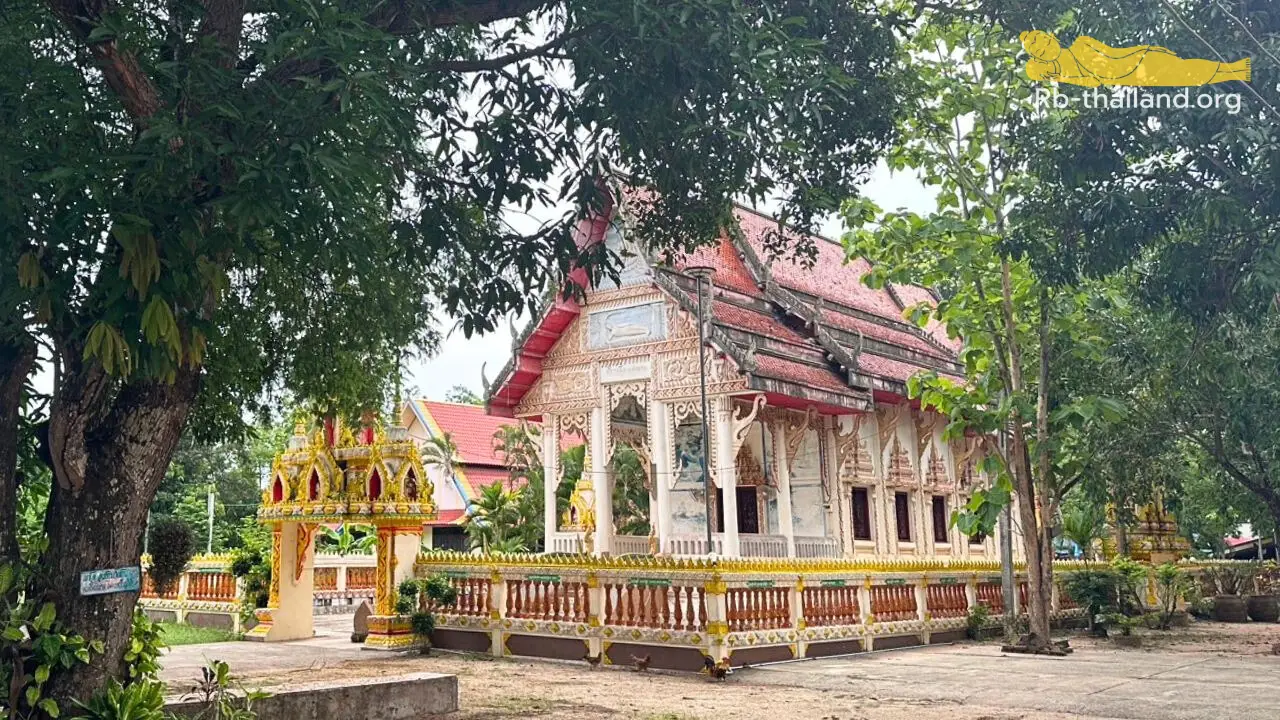
Wat Pa Wiwek
Open Days: Daily
Opening Hours: 08:00 – 17:00
Wat Pa Wiwek in Mukdahan Province, also widely known as the Reclining Buddha Temple of Wan Yai, is an important Buddhist monastery in Ban Nong Saeng, Moo 8, Wan Yai Subdistrict, Wan Yai District. It is located near Wan Yai Witthaya School, approximately 3 kilometres west of the district administrative centre. The temple’s defining landmark is a monumental reclining Buddha measuring 23 metres in length, housed inside a spacious protective viharn. The Buddha’s head points south and the face looks east. Twenty-nine smaller Buddha images representing different postures surround the main figure, while additional attractions include carved scenes from the Buddha’s life on the soles of the reclining image, a sandstone replica footprint, sculptures representing the Twin Miracle, a model of the Buddha’s parinirvana, a large Buddha sheltered by a naga and a group of 12 zodiac stupas. Wat Pa Wiwek is therefore both a place of worship, a centre for Buddhist education and meditation, and one of Wan Yai District’s most distinctive cultural attractions.
The temple stands in Ban Nong Saeng, an agricultural community within Wan Yai District. Although the district lies close to the Mekong River, Wat Pa Wiwek is set farther inland, west of the main community centre. This position gives the grounds a quieter atmosphere than many riverside attractions. The name “Pa Wiwek” refers to a forest or secluded place suitable for contemplation. In Buddhist usage, wiwek conveys withdrawal from distraction so that the body and mind can settle into mindfulness, concentration and reflection. The temple has expanded considerably and now contains several large structures, yet its location away from the busiest roads continues to support its role as a place for prayer and meditation.
Wat Pa Wiwek was formally established in 1939 and belongs to the Mahanikaya order of Thai Buddhism. The main monastic property covers approximately 11 rai and 38 square wah, with an additional plot of ecclesiastical land measuring about 6 rai and 93 square wah. The northern boundary adjoins Wan Yai Witthaya School, while public roads and community land surround the other sides. This proximity to a school creates a practical connection between home, temple and education. Students, parents, monks and local residents use the temple for religious ceremonies, ethical instruction and summer novice-ordination programs. The monastery consequently serves the community as an educational and social institution rather than functioning only as a tourist site.
Phra Athikan Kliang Chandiyo, also known as Phra Upatcha Kliang, was the earliest abbot named in the surviving administrative history. He served from 1945 to 1971 and led the construction of the reclining Buddha that later became the temple’s principal symbol. Building a large stucco image between 1962 and 1964 required technical knowledge, extensive labour, construction materials and donations. Monks, disciples and residents of Wan Yai Subdistrict worked together for more than 2 years. The reclining Buddha should therefore be understood as a collective achievement representing the faith and cooperation of an entire community.
Later abbots named in the temple record include Chao Athikan Thongchan Sirichanto, who served from 1984 to 1993, and Phra Athikan Tai Aggadhammo, who served from 1994 to 2002. In 2007, Phra Maha Kasemmani Tejapanno, a monk holding the highest ninth level of Pali studies, became abbot. He also serves as the ecclesiastical chief of Wan Yai District. These combined responsibilities have made Wat Pa Wiwek an administrative centre for the district monastic community. An office of the district ecclesiastical authority stands within the grounds and supports meetings, religious examinations, monk and novice training, and activities organised with government agencies and local communities.
Phra Maha Kasemmani Tejapanno, Pali Grade 9, remains the current abbot and ecclesiastical chief of Wan Yai District. His responsibilities include administration of the monastery, supervision of monks, Buddhist education and youth programs. Wat Pa Wiwek continues to host summer novice ordinations and ethical training. In 2026, it served as a Wan Yai District training centre for the annual summer novice-ordination project. Participants studied monastic discipline, chanting, meditation, communal living and the application of Buddhist principles in daily life. These continuing programs confirm that the temple remains an active religious institution rather than a static collection of sacred objects.
The temple provides formal Buddhist education in both Nak Tham studies and Pali. It has also served as an examination centre for the elementary level of the national Dhamma curriculum in Wan Yai District. Buddhist monastic education covers doctrine, discipline, Pali language and the responsibilities of monks and novices. Students do not study only to pass examinations; they use this knowledge when teaching laypeople, delivering sermons, performing ceremonies and governing their own conduct. Maintaining a study centre in Wan Yai allows monks from surrounding villages to receive instruction without travelling to central Mukdahan for every class or examination.
The reclining Buddha was begun on 5 December 1962, corresponding to the first waxing-moon day of the first lunar month in the Year of the Tiger. Construction was completed on 2 August 1964, the fourth waxing-moon day of the ninth lunar month in the Year of the Dragon. The total construction period was recorded as 2 years, 8 months and 7 days. Phra Upatcha Kliang Chandiyo directed the project with his disciples and the residents of Wan Yai. A monumental stucco Buddha had to be built in stages, beginning with its foundation and internal support, followed by the modelling of the body, adjustment of proportions and finishing of the outer surface. Uneven drying or an unstable core could have created serious cracking or settlement.
The image measures 23 metres in length. The distance from its lower base to the top of the head is approximately 4.36 metres, while the soles extend about 4.5 metres. These dimensions give the Buddha a commanding presence inside the viharn. Visitors must step back to appreciate the entire form, from the serene head and long body to the decorated feet. The scale is not intended merely to appear impressive. It changes the visitor’s physical and emotional relationship with the space, encouraging slower movement and reflection on impermanence, liberation from suffering and the limited scale of individual concerns.
The Buddha reclines with the head pointing south and the face turned east. This orientation relates to the layout of the temple and enables visitors entering the viharn to see the face clearly. Reclining Buddha images may represent mindful rest, one of the Buddha’s physical postures or the final passing into parinirvana. Interpretation depends on the hand position, facial expression and accompanying sculptures. At Wat Pa Wiwek, the model parinirvana setting and other narrative elements guide visitors toward contemplation of the Buddha’s final days and the universal principle that all conditioned things change and eventually cease.
The face has a peaceful expression, lowered eyes and a restrained smile. The head rests on one hand in the recognisable posture of a reclining Buddha. The surface is gilded or painted gold, reflecting daylight and interior lighting throughout the hall. Gold in Buddhist art is associated with purity, wisdom and spiritual value. The deeper purpose of the image, however, is not decorative splendour. Its calm expression encourages visitors to pause, consider the direction of their lives and recognise that time should be used with mindfulness rather than carelessness.
Twenty-nine Buddha images in different postures surround the reclining figure. These additional images expand the visual account beyond a single moment in the Buddha’s life. Each posture may refer to an important event or quality, such as meditation, victory over Mara, reconciliation, protection or blessing. Visitors can compare the hand gestures and bodily positions and relate them to the teaching represented by each image. The arrangement transforms the viharn into a learning environment as well as a devotional hall.
The soles of the reclining Buddha contain carved panels presenting episodes and symbols from the Buddha’s life. The feet attract particular attention because they measure approximately 4.5 metres and can be viewed more closely than much of the upper body. The panels function like pages in a visual book, communicating through figures, symbols and narrative scenes. Visitors should keep a respectful distance and avoid touching or leaning against the feet. Pressure, skin oils and moisture can gradually damage painted and carved surfaces.
Decorating the soles with Buddhist narratives is related to the wider tradition of creating Buddha footprints. A footprint symbolises the Buddha’s passage through the world and the path that followers are encouraged to practise. At many Buddhist sites, footprints contain cosmological diagrams, auspicious signs, animals, sacred objects and events from the Buddha’s life. The carvings at Wat Pa Wiwek therefore provide more than ornament. Adults can use them for reflection, while parents and teachers can use the images to introduce Buddhist history to children.
The temple also preserves a replica Buddha footprint carved from mountain sandstone. Sandstone is widely found in northeastern Thailand and has been used for religious sculpture for centuries. Although suitable for carving, it requires protection from standing water, moss, moisture and repeated handling. The footprint serves as a devotional object and a reminder of following the Buddhist path. Visitors should place offerings only where the temple permits and should never step, sit or place personal belongings on the footprint or its base.
A sculptural representation of the Twin Miracle is another important feature. In Buddhist narrative, the Twin Miracle involves simultaneous manifestations such as fire and water emerging from the Buddha’s body. The event demonstrates the overcoming of pride and the superiority of insight over empty claims. Artistically, the story allows sculptors to create a more dynamic composition than a motionless seated image. Visitors should understand the sculpture as a visual teaching about wisdom and the reduction of conceit, rather than treating it simply as an account of supernatural power.
The model parinirvana platform links the reclining Buddha with the Buddha’s final passing. Parinirvana is not presented in Buddhism as a hopeless death, but as the complete ending of defilement and the cycle of rebirth for a fully awakened being. The reclining image therefore reminds worshippers both of impermanence and of the possibility of liberation. Visitors may chant, sit quietly or remember deceased relatives in this area without requiring an elaborate ritual.
A widely repeated local account concerns attempts by thieves to break into the reclining Buddha in search of treasure believed to be hidden inside. According to community oral tradition, the intruders were repeatedly unable to complete their actions and encountered unusual events that caused them to stop. These stories became part of the sacred reputation of the image. They should be approached as local religious memory rather than as an invitation to test or investigate the damaged areas. The practical lesson is respect for communal heritage and recognition of the harm caused by illegal destruction.
Any holes or damaged areas created by attempted theft are also conservation concerns. Even a small opening can admit water, moisture, insects and dust into the internal structure. If repairs use material that is harder or softer than the original stucco, stress may produce further cracking. Conservation of a monumental Buddha requires compatible mortar, careful colour matching and continued monitoring. Barriers, lighting controls and requests not to touch the image are therefore part of long-term preservation rather than unnecessary restrictions.
The reclining Buddha was originally exposed to a less complete protective environment. A large viharn measuring approximately 30 by 36 metres was later built around it. Construction began in 2004 and was completed in 2011. The building shields the statue from direct sun, rain, wind and rapid weather changes while accommodating large groups of worshippers. Its high roof and wide structural spans preserve views of the entire Buddha, and its openings allow heat and humidity to escape.
The generous floor area creates space for worship, circumambulation and organised visitor movement. A useful viewing sequence begins at the face, continues along the body and ends at the decorated feet. The 29 surrounding images and other sculptures can be examined along the way without repeated backtracking. Moving slowly and studying individual details gives a fuller understanding than taking a few photographs and leaving immediately.
The first ordination hall was constructed entirely from timber in 1962. It measured approximately 6 metres wide and 18 metres long and received a royal grant of consecrated boundary in 1965. A consecrated boundary permits major monastic acts, especially ordination, to be performed in accordance with Buddhist discipline and Thai ecclesiastical law. After decades of use, the timber building deteriorated because of humidity, termites, sun and rain. The monastic committee eventually dismantled it and constructed a more durable replacement.
The present ordination hall was built in 1984 in a traditional Thai form using brick and stucco. Its dimensions remain close to the earlier building, approximately 6 by 18 metres. It is used for ordination, recitation of the monastic code and other formal acts of the Sangha. Visitors may admire the exterior and enter when no ceremony is taking place, but should avoid crossing restricted areas, walking directly in front of monks or disrupting formal proceedings.
Phra Phuttha Rattana Maha Muni, the large Buddha sheltered by a naga, was constructed on 26 February 2015. The seated image has a lap width of approximately 6 metres, a total height of 9 metres and a raised base about 2.5 metres high. Four naga figures surround the second level of the base. The posture recalls the episode in which Mucalinda protected the meditating Buddha from a storm after enlightenment, symbolising protection, stability and concentration that remains undisturbed by external difficulty.
Naga imagery has particular resonance within the Mekong cultural region. Communities in Mukdahan and Wan Yai have long depended on the Mekong for travel, farming, trade and identity. The naga connects Buddhist narrative with this local river landscape. The large naga-protected Buddha represents a modern phase of temple development, while the reclining Buddha reflects the community’s religious ambitions during the early 1960s. Together, the two monuments show how the temple’s artistic language has evolved over time.
The group of 12 zodiac stupas was built in 2016. These structures connect Buddhist devotion with familiar beliefs concerning birth years and zodiac signs. Visitors may worship at the stupa associated with their year or sign, but the central purpose of merit-making is not simply the pursuit of good fortune. Respect for the Triple Gem, ethical conduct, generosity and assistance to others remain more important. The zodiac stupas provide an approachable entry point that can lead visitors toward broader Buddhist practice.
The monastic residential zone contains a large two-storey residence, 3 smaller monk residences, an office for the Wan Yai district ecclesiastical authority and 2 guest residences. These are private areas used for study, rest and monastic duties rather than general tourism. Visitors should observe signs and avoid entering without permission. Anyone wishing to meet the abbot, make a formal offering or contact the district monastic office should first inquire at the designated office.
Wat Pa Wiwek is a meditation centre where chanting, sitting meditation, Dhamma instruction and group training may be organised. Groups planning an extended practice visit should contact the monastery in advance regarding schedules, accommodation, food, clothing and required supplies. Meditation in a monastery differs from an ordinary leisure stay. Participants are expected to follow a timetable, reduce phone use, dress respectfully, eat at designated times and assist with cleanliness.
The teaching of Dhamma and Pali gives the temple the atmosphere of a religious school. Monks and novices may be memorising texts, translating Pali, preparing for examinations or attending district activities. Visitors should keep their voices low near teaching areas and avoid photographing classes without consent. Respecting the educational environment supports one of the monastery’s most important functions: preserving Buddhist knowledge through teachers, students and community support.
Summer novice ordination is a visible part of the temple’s current community role. Young participants learn discipline, the 10 novice precepts, chanting, meditation, communal responsibilities and basic Buddhist teachings. The program is not designed only for those intending to remain in monastic life. It provides temporary training that can influence study habits, emotional control and personal responsibility. During a training period, certain zones may be reserved for participants, and visitors should follow all posted instructions.
Buddhist holy days and festivals bring larger congregations to the temple. Makha Bucha, Visakha Bucha, Asalha Bucha, the beginning and end of the rains retreat, and the annual Kathin ceremony may involve almsgiving, sermons, candlelight processions and community service. These occasions reveal the monastery’s active relationship with local residents, although travelers should allow extra time for parking and avoid obstructing processions or worship areas.
Worship at the reclining Buddha may begin with flowers, incense or candles in the area designated by the temple. Visitors may then bow 3 times while recollecting the Buddha, Dhamma and Sangha. Those who prefer not to light incense can simply bow or place their palms together. Offerings should never be attached directly to the image unless a specific area has been provided. Following temple arrangements reduces smoke, waste and damage.
Respectful clothing is required. Shoulders should be covered, trousers or skirts should be of an appropriate length, and hats should be removed inside sacred buildings. Shoes must be removed where indicated. Visitors should not point their feet toward Buddha images, climb bases or use the sacred figures as backgrounds for inappropriate poses. Children should remain under adult supervision, especially near sculptures, carved feet and smaller Buddha images.
Photography is possible when it is conducted quietly and without flash. Worshippers should not be disturbed or photographed closely without permission. Large tripods, lighting systems and commercial filming equipment require prior approval. Objects, offerings and sculptures must never be moved for a better composition. Responsible photography records the image, viharn and atmosphere without treating people at prayer as scenery.
The temple is generally open daily from 08:00 to 17:00 and does not charge an admission fee. Voluntary donations can support electricity, water, maintenance, Buddhist education and community programs. Donations should be placed in official boxes or made through channels announced by the monastery. Travelers visiting during a major ceremony, novice program or restoration project should telephone ahead to confirm access to the reclining Buddha hall.
Facilities include parking, toilets, rest pavilions and areas for merit-making and meditation activities. The main buildings are within walking distance of one another, although surfaces and changes in level may not be completely accessible. Older visitors should wear suitable footwear and may benefit from assistance. Wheelchair users should ask about the easiest approach to the viharn because thresholds, steps or temporary offering arrangements can affect access.
The most comfortable visiting periods are approximately 08:00–10:30 and 15:00–17:00. Morning temperatures are cooler and the viharn is often quieter. In the later afternoon, angled light reveals the modelling of the face, body and carved feet. November through February offers the most comfortable weather. March through May is hot, requiring drinking water and sun protection, while the rainy season can produce slippery surfaces around entrances.
Getting There from central Mukdahan requires following Highway 212 toward Wan Yai District and Nakhon Phanom. After reaching Wan Yai, turn toward Ban Nong Saeng and Wan Yai Witthaya School, then continue approximately 3 kilometres west. The total road distance from central Mukdahan is around 21–23 kilometres, normally requiring 30–35 minutes. Approximate coordinates are 16.714912, 104.744577. Travelers should specify “Wat Pa Wiwek Reclining Buddha, Ban Nong Saeng, Wan Yai” to avoid confusion with Wat Pa Wiwek Watthanaram, the Luang Pu Cham temple in Kham Cha-i District.
Travelers approaching from That Phanom or Nakhon Phanom can follow Highway 212 south to Wan Yai and then turn west through the district centre toward Ban Nong Saeng. This route can combine Phra That Phanom, Wat Song Khon, Kaeng Kabao, Wat Phra Si Maha Pho and Wat Pa Wiwek. A private car or rental vehicle is the most practical option because public transport to the temple is limited and return services may not operate late in the day.
Anyone hiring a driver from Mukdahan should agree on the fare, waiting time and return journey in advance, particularly when combining several Wan Yai attractions. A half-day hire makes it possible to visit Wat Phra Si Maha Pho, Wat Latthikawan, Wat Manophirom and the Nuhak Phoumsavan Birthplace Museum without arranging a new vehicle at each stop. Self-driving visitors should save the map in advance because mobile reception may vary on smaller rural roads.
A half-day route can begin at Wat Pa Wiwek in the morning. Allow 1.5–2 hours for the reclining Buddha, the 29 accompanying images, the footprint, the Twin Miracle, the naga-protected Buddha and the zodiac stupas. Continue to Wat Phra Si Maha Pho for its historic sim and murals, followed by Wat Latthikawan and Wat Manophirom in Ban Chanot. The route presents a broad range of Buddhist art, from Isan folk architecture and Vientiane influence to monumental modern sculpture.
A full-day itinerary can add Wat Song Khon and Kaeng Kabao. Wat Song Khon is a Roman Catholic shrine associated with the 7 Blessed Martyrs of Thailand and internationally recognised modern architecture. Kaeng Kabao offers Mekong scenery, the Phaya Si Phuchong Mukda Nakarat sculpture and well-known roasted-pork restaurants. The road distance from Wat Pa Wiwek to Kaeng Kabao is approximately 16 kilometres, making the riverside area a practical afternoon and lunch destination.
Wat Phra Si Maha Pho is approximately 2 kilometres away by road. Its historic sim was built by Vietnamese craftsmen and contains murals of the Vessantara Jataka and local historical scenes. Visiting both temples demonstrates the contrast between a small mural-filled ordination hall and a monumental reclining Buddha housed in a modern protective structure.
Wat Latthikawan and Wat Manophirom are in the Ban Chanot area, approximately 5–6 kilometres from Wat Pa Wiwek. Wat Latthikawan contains an open Isan sim, bottle balustrades, folk murals and Vientiane-influenced brackets. Wat Manophirom is known for its Lan Xang viharn and important Buddha images. Together, they reveal the artistic networks that once connected communities throughout the Mekong region.
The Nuhak Phoumsavan Birthplace Museum is approximately 7 kilometres away and introduces visitors to Thai–Lao relations and an important figure in modern Lao history. Wat Song Khon is approximately 8 kilometres away and presents the history of Roman Catholicism in Thailand. Combining a museum, Buddhist monasteries and a Catholic shrine reveals the ethnic, religious and historical diversity of Wan Yai District.
Restaurants are concentrated around central Wan Yai, Pong Kham, Bang Sai Noi and Kaeng Kabao. Khrour Wan Yai Cafe serves cooked-to-order meals, Isan food and drinks near the district centre. 62 Garden Cafe offers Thai and Vietnamese dishes, while Ben Ben Coffee and Restaurant is located on the Pong Kham route. Travelers continuing to Kaeng Kabao can choose Sirichai Moo Han, Chitra Moo Han or Nong Bow Moo Han. Whole roasted pork should normally be ordered by telephone in advance.
Accommodation immediately beside the temple is limited. Baan Oun Ai Din Homestay offers a Mekong riverside setting on the Song Khon and Kaeng Kabao route. Travelers wanting full hotel facilities can stay in Mukdahan city at Hotel de Ladda, Riverfront Hotel Mukdahan, Ploy Palace Hotel, Mukdahan Grand Hotel or Bird Day Boutique Hotel. The city hotels are approximately 23–25 kilometres from the temple and are convenient for an early-morning drive to Wan Yai.
For families, Wat Pa Wiwek offers a practical introduction to Buddhist history. Children can see a monumental reclining Buddha, 29 images representing different postures, carved panels on the feet, a sandstone footprint and a model of the Twin Miracle. Adults should explain the meanings simply and prevent climbing or touching. Encouraging children to observe one feature at a time creates a more meaningful educational visit.
For art and architecture enthusiasts, the reclining Buddha demonstrates the ability of local craftsmen to model a monumental stucco sculpture around an internal structure. Proportions of the head, hands, feet and body had to be adjusted for viewing from ground level. The later viharn is also an example of designing a protective building around a large sacred object while maintaining ventilation, roof stability and clear sightlines.
For meditation practitioners, the reclining posture provides a direct image of impermanence. Even the physical body of the Buddha remained subject to arising, change and dissolution. Recognising this truth does not make life meaningless. It encourages careful use of time, reduced harm and beneficial action before opportunities disappear.
The account of thieves attempting to break into the image should be preserved as community religious heritage while being explained responsibly. Its value does not depend on proving a particular supernatural event. It warns that greed can lead individuals to damage what generations of people created together. Refusing theft, protecting sacred property and reporting vandalism are the most appropriate responses to the story.
Conservation at Wat Pa Wiwek includes the reclining Buddha, viharn, surrounding images, footprint, sculptures and historical records. Repairs should document existing conditions, use compatible material and avoid unnecessary alteration. Visitors contribute to preservation by donating through official channels, avoiding physical contact and sharing accurate information concerning the construction dates, dimensions, orientation and number of accompanying images.
Wat Pa Wiwek is therefore more than a temple containing a large reclining Buddha. Its history extends from its establishment in 1939 and the leadership of Phra Upatcha Kliang to its current role in Pali education, meditation, district monastic administration and youth training. The ordination hall, naga-protected Buddha, zodiac stupas and continuing community activities complete the experience. Allowing at least 1.5–2 hours enables visitors to understand its art, teachings and living social role rather than treating it as a brief photographic stop.
| Name | Wat Pa Wiwek / Wan Yai Reclining Buddha Temple |
| Type | Community Buddhist temple of the Mahanikaya order, meditation centre and Buddhist education centre |
| Location | Ban Nong Saeng, Moo 8, Wan Yai Subdistrict, Wan Yai District, Mukdahan Province, Thailand |
| Address | Ban Nong Saeng, Moo 8, Wan Yai, Mukdahan 49150, Thailand |
| Coordinates | 16.714912, 104.744577 |
| Established | 1939 |
| Temple Area | Approximately 11 rai 38 square wah, with an additional ecclesiastical plot of about 6 rai 93 square wah |
| Highlights | A 23-metre reclining Buddha, 29 accompanying Buddha images, carved Buddhist narratives on the feet, sandstone footprint, Twin Miracle sculpture, parinirvana model, naga-protected Buddha and 12 zodiac stupas |
| Reclining Buddha Founder | Phra Upatcha Kliang Chandiyo, his disciples and the residents of Wan Yai Subdistrict |
| Construction Period | 5 December 1962 to 2 August 1964, a total of 2 years, 8 months and 7 days |
| Reclining Buddha Dimensions | 23 metres long, approximately 4.36 metres from the lower base to the head, with feet about 4.5 metres long |
| Orientation | Head pointing south and face looking east |
| Reclining Buddha Viharn | Approximately 30 by 36 metres, constructed between 2004 and 2011 |
| Ordination Hall | Present brick-and-stucco Thai-style hall measuring approximately 6 by 18 metres, constructed in 1984 to replace the earlier timber hall |
| Consecrated Boundary | Royal grant received in 1965 |
| Phra Phuttha Rattana Maha Muni | Naga-protected Buddha with a 6-metre lap width and 9-metre height, raised on a 2.5-metre base with 4 naga figures, constructed on 26 February 2015 |
| Zodiac Stupas | Group of 12 zodiac stupas constructed in 2016 |
| Abbot | Phra Maha Kasemmani Tejapanno, Pali Grade 9, Ecclesiastical Chief of Wan Yai District |
| Temple Contact | 089-617-5933 |
| Main Areas / Zones | 1. Reclining Buddha viharn 2. Group of 29 Buddha images 3. Carved narratives on the soles 4. Sandstone Buddha footprint 5. Twin Miracle sculpture 6. Parinirvana model 7. Ordination hall 8. Naga-protected Buddha 9. Twelve zodiac stupas 10. Meditation and Buddhist education areas |
| Open Days | Daily |
| Opening Hours | 08:00 – 17:00 |
| Admission Fee | Free admission; voluntary donations for temple maintenance and Buddhist education are welcome |
| Facilities | Parking, toilets, rest pavilions, merit-making areas and facilities for meditation activities |
| Getting There | Follow Highway 212 from Mukdahan toward Wan Yai, turn toward Ban Nong Saeng near Wan Yai Witthaya School and continue approximately 3 kilometres west. The total distance from central Mukdahan is approximately 21–23 kilometres |
| Recommended Visit Duration | Approximately 1.5–2 hours |
| Visitor Etiquette | Dress respectfully, remove shoes where required, avoid flash, never touch or climb the images and sculptures, silence phones and do not disturb monastic activities |
| Nearby Tourist Attractions | 1. Wat Phra Si Maha Pho, 2 km 2. Wat Latthikawan, 5 km 3. Wat Manophirom, 6 km 4. Nuhak Phoumsavan Birthplace Museum, 7 km 5. Wat Song Khon, 8 km 6. Kaeng Kabao and Phaya Si Phuchong Mukda Nakarat, 16 km |
| Nearby Restaurants | 1. Khrour Wan Yai Cafe, 3 km, Tel. 094-291-5979, 093-514-9569, 095-415-7822 2. 62 Garden Cafe, 7 km, Tel. 099-795-1962 3. Ben Ben Coffee and Restaurant, 8 km, Tel. 088-357-2123, 095-659-9076 4. Sirichai Moo Han, Kaeng Kabao, 16 km, Tel. 081-260-7358, 042-643-552 5. Chitra Moo Han, Kaeng Kabao, 16 km, Tel. 093-101-4756 6. Nong Bow Moo Han, Kaeng Kabao, 16 km, Tel. 061-318-9377 |
| Nearby Accommodations | 1. Baan Oun Ai Din Homestay, 13 km, Tel. 098-274-6949, 081-112-6243 2. Hotel de Ladda, 23 km, Tel. 042-611-499, 042-611-497 3. Riverfront Hotel Mukdahan, 23 km, Tel. 042-612-948-9, 081-703-1705 4. Ploy Palace Hotel, 24 km, Tel. 042-614-988 5. Mukdahan Grand Hotel, 24 km, Tel. 042-612-020 6. Bird Day Boutique Hotel, 25 km, Tel. 093-469-5588, 042-615-007 |
Frequently Asked Questions (FAQ)
Q: Where is Wat Pa Wiwek in Mukdahan located?
A: The temple is in Ban Nong Saeng, Moo 8, Wan Yai Subdistrict, Wan Yai District, Mukdahan Province, close to Wan Yai Witthaya School and approximately 3 kilometres west of the district centre.
Q: What are the opening hours and admission fee?
A: Wat Pa Wiwek is open daily from 08:00 to 17:00. Admission is free, and voluntary donations for maintenance and Buddhist education are welcome.
Q: How large is the reclining Buddha?
A: The reclining Buddha is 23 metres long, approximately 4.36 metres high from its lower base to the head, and has feet measuring about 4.5 metres. The head points south and the face looks east.
Q: When was the reclining Buddha constructed?
A: Construction began on 5 December 1962 and was completed on 2 August 1964 under the leadership of Phra Upatcha Kliang Chandiyo, his disciples and the residents of Wan Yai.
Q: What else can visitors see besides the reclining Buddha?
A: The temple contains 29 Buddha images, carved narratives on the soles, a sandstone footprint, a Twin Miracle sculpture, a parinirvana model, an ordination hall, a large naga-protected Buddha and 12 zodiac stupas.
Q: What is the story about thieves attempting to break into the Buddha?
A: Local oral tradition states that several attempts were made to break into the image in search of treasure, but the intruders stopped after experiencing unusual events. The story is preserved as a warning against greed and the destruction of sacred community property.
Q: Who is the current abbot of Wat Pa Wiwek?
A: The abbot is Phra Maha Kasemmani Tejapanno, Pali Grade 9, who also serves as the Ecclesiastical Chief of Wan Yai District. The temple contact number is 089-617-5933.
Q: How much time should travelers allow for a visit?
A: Allow approximately 1.5–2 hours to see the reclining Buddha, surrounding images, carved feet, footprint, naga-protected Buddha, zodiac stupas and the principal areas of the monastery.
 Category: ●Places of Worship
 Group: ●Temple
Last Update : 2 MonthAgo
 Last Update : 2 MonthAgo
 Click to Access the Navigation Map GPS
 Art, Culture and Heritage
 Historical Sites and Monuments(2)
 Landmarks and Memorials(3)
 Art, Craft Centres, Tradition(2)
 Museums(1)
Temple(17)
Museums(1)
Temple(17)
 Other Sacred Sites(3)
 Suburban Living
 Village, Community(4)
 Local Market(2)
 Nature and Wildlife
 National Parks and Marine Reserves(4)
 Mountain (Doi)(5)
 Dam, Reservoir, Lake(3)
 Waterfalls(5)
 Caves(2)
 River, Canal(2)
 Bays and Beaches(1)
 Other natural attractions(1)
 Entertainment and Agricultural
 Farms, Parks and Ecotourism(1)


