
lovethailand home >Northeastern Travel Attractions >Mukdahan Travel Attractions >Wan Yai >Cha Not > Wat Latthikawan
TL;DR: Wat Latthikawan is located at Ban Chanot, Moo 2, Chanot Subdistrict, Wan Yai District, Mukdahan Province, Thailand, open Daily, hours 08:00 – 17:00.
Wat Latthikawan
Open Days: Daily
Opening Hours: 08:00 – 17:00
Wat Latthikawan in Mukdahan Province is a historic Buddhist temple in Ban Chanot, Chanot Subdistrict, Wan Yai District. It stands beside the Mukdahan–Wan Yai road near Huai Chanot and within the cultural landscape of the Mekong River. The temple is especially important for its group of protected monuments combining vernacular Isan art with artistic connections to Vientiane. Its most remarkable structure is a small open-sided sim, or ordination hall, containing a gilded stucco Buddha in the Mara-vijaya posture, 5 kneeling disciples representing the Pañcavaggiya monks, folk murals illustrating Buddhist cosmology and the Ten Great Birth Stories, green-glass bottle balustrades, carved wooden brackets, and exterior stucco showing Vishnu riding Garuda. Other important areas include an old Buddha-footprint pavilion, a reclining Buddha pavilion, a model of the Buddha’s cremation ceremony and a Dhamma stupa related in form to historic Phra That Phanom. The temple is open daily without an admission fee and is particularly valuable for travelers interested in Isan ordination halls, folk painting, Mekong architecture and the history of Ban Chanot.
Wat Latthikawan belongs to Ban Chanot, a centuries-old community on the Thai bank of the Mekong. A local cultural record prepared in 1990 described the community as nearly 300 years old at that time, showing that the settlement existed long before the foundation of the present temple. Residents traditionally relied on farming, fishing, river transport and contact between communities on both banks. The name Chanot comes from a palm-family tree with a trunk resembling a coconut palm and leaves similar to a palmyra palm, although its leaf segments are finer. The edible-fruited plant is also known in parts of northeastern Thailand as kho khiao. The plant gave its name to the settlement, local waterways and the surrounding cultural landscape.
Before Wat Latthikawan was established, the area known as Pa Non Rang was a wooded rise covered with local vegetation. Broken brickwork, fragments of stucco, damaged Buddha images and traces of earlier construction were found within the forest. Villagers believed that an abandoned temple or an old water-bound ordination area had once occupied the site, but no inscription or documentary record identifies its founder or construction period. These unidentified remains must be distinguished from the documented foundation of Wat Latthikawan in 1915. The earlier ruins demonstrate that the forest had religious associations before the creation of the modern monastic institution, but their exact age remains outside the surviving historical record.
The forest was also used for meditation by a monk remembered locally as Anyatha Ho. Its quiet position, natural shade and moderate distance from Ban Chanot made it suitable for contemplative practice. When Phra Nantawiro, better known locally as Phra Ajarn Bu, examined the area, he recognised its potential as a permanent monastery. The choice was therefore influenced not only by convenient geography but by the site’s earlier history of meditation and its surviving traces of Buddhist activity.
Wat Latthikawan was founded on Thursday, the fourth waxing-moon day of the eighth lunar month in the Year of the Rabbit, corresponding to 15 July 1915. Phra Nantawiro led the establishment of the new temple approximately 231 wa, or about 460 metres, north of Wat Manophirom. He had previously played an important role in restoring Wat Manophirom after a destructive fire. Once the older temple had regained stability, he entrusted part of its daily administration to a senior monk and concentrated on developing Pa Non Rang. Wat Latthikawan is consequently closely connected with Wat Manophirom and with the expansion of Buddhist institutions in Ban Chanot during the early 20th century.
The name Latthikawan means “grove of young palms.” Phra Nantawiro planted numerous palm trees around the monastery, giving the grounds a distinctive appearance. Local residents therefore also call the temple Wat Pa Tan, meaning the Palm-Forest Temple, or simply Wat Pa. The name also recalls a palm grove associated with King Bimbisara and the Buddha in Buddhist tradition. It refers simultaneously to the actual landscape created around the monastery and to a sacred memory drawn from Buddhist history. The palms offered shade, established a natural inner boundary and created a visual identity that distinguished the monastery from the surrounding village.
In 1920, only a few years after establishing the temple, Phra Nantawiro was appointed an upajjhāya, a monk authorised to preside over ordinations. The following year he received the ecclesiastical title Phra Khru Nantawiro and was appointed to oversee the monastic administration of the Mukdahan district. Despite these wider responsibilities, he remained based at Wat Latthikawan and continued developing its religious landscape. His work included monastic administration, ordination, Buddhist education and the creation of buildings and sculptures presenting key episodes from the life of the Buddha.
Wat Latthikawan was formally recognised as a temple in 1923 and received its royal grant of consecrated boundary, or wisungkhamsima, in 1925. This grant authorised the temple to maintain an ordination area for major monastic ceremonies. The old sim therefore became the religious and architectural heart of the complex. Although small and modest compared with many modern ordination halls, it brings together Buddhist disciplinary requirements, local climate, masonry, timber construction, stucco sculpture, mural painting and materials linked to trade along the Mekong.
Phra Khru Nantawiro arranged the temple so that visitors could encounter the life of the Buddha through movement across the grounds. Representations included the Buddha’s birth beneath paired trees, enlightenment and victory over Mara beneath the Bodhi tree, the First Sermon to the 5 disciples, the passing into parinirvana between paired trees and the subsequent cremation ceremony. A model pond, Dhamma stupa, Buddha footprint, sermon hall, monastic residences and other structures completed the educational landscape. The temple functioned as a three-dimensional account of Buddhist history long before modern museums and interpretation centres became common in rural Thailand.
The old sim is a low, relatively small masonry building with a rectangular interior measuring approximately 5.40 by 5.10 metres. Its brick-and-stucco base rises in an inverted lotus moulding, while substantial brick columns approximately 0.40 metres wide are arranged along the sides. The structure is divided into 3 bays and faces west, unlike the east-facing orientation common at many Buddhist temples. Its orientation relates to the arrangement of the monastery, Huai Chanot and the community approach from the surrounding grounds.
The sim is enclosed by a solid wall only behind the principal Buddha image. Its other 3 sides remain open above low veranda walls, making it an example of the open Isan sim. This design admits air and daylight and responds effectively to the hot, humid climate. People outside can still see the principal image and recognise ceremonies taking place within. The open plan creates a close visual relationship between sacred space and community while maintaining the consecrated boundary through the raised base, structural arrangement and ritual use of the building.
The veranda is famous for balustrades constructed from dark-green glass bottles resembling French wine or liquor bottles. They record the circulation of imported goods and materials through the Mekong region during the period of contact between Thai, Lao and French Indochinese territories. Local craftsmen transformed discarded containers into an architectural feature. The green glass filters sunlight, produces a repeated visual rhythm and demonstrates a practical form of material reuse long before sustainable design became a modern concern.
Visitors should observe the bottle balustrades without touching, twisting or placing objects on them. Old glass may be brittle, and the mortar securing it can weaken over time. The balustrade is important not simply because it looks unusual. It preserves information about regional trade, local resourcefulness and the ability of craftsmen to incorporate available materials into a sacred building. Replacing broken bottles without documentation would gradually remove part of the historical evidence contained in the sim.
The principal image is a gilded stucco Buddha seated in the Mara-vijaya, or Earth-touching, posture. The right hand reaches toward the earth, recalling the Buddha’s victory over Mara and the calling of the earth goddess as witness. Five kneeling figures with hands joined in respect sit before the image. They represent the Pañcavaggiya monks, the 5 ascetics who received the Buddha’s First Sermon. The unusual composition links the moment of enlightenment with the beginning of Buddhist teaching and makes the sim an educational setting as well as a ritual space.
The Pañcavaggiya monks were Kondañña, Vappa, Bhaddiya, Mahānāma and Assaji. Their representation around the principal Buddha shows the transmission of the Dhamma from the Buddha to his first disciples and eventually to the wider community. The figures have vernacular proportions and do not follow the naturalistic conventions of modern academic sculpture. Their devotional poses and orientation toward the Buddha communicate the scene clearly and directly.
Behind the principal Buddha, raised stucco foliage projects from the wall and curves around the upper part of the image. The ornament acts like a halo or sacred canopy above the ushnisha. It creates depth and shadow on the otherwise solid rear wall and distinguishes the Buddha from the background. The craftsmen used inexpensive lime-based material, modelling and careful composition to create dignity within a very small interior.
Folk murals, known in Isan as hup taem, decorate the walls and columns. Their subjects include the Traiphum cosmology, the Ten Great Birth Stories, the final lives of the Bodhisattva, kinnari, yaksha figures, Thao Suwan and other Buddhist narratives. The painters used direct lines, a limited range of colours and spatial arrangements based on local visual understanding rather than Western perspective. The value of these paintings lies in their distinctive community language and narrative effectiveness, not in comparison with court painting from Bangkok.
The Traiphum presents the Buddhist universe through hells, the human world, heavenly realms and different forms of rebirth. The Ten Great Birth Stories illustrate virtues developed by the Bodhisattva, including generosity, morality, perseverance, patience and renunciation. Before books and formal schooling became widely accessible, monks could use the paintings while preaching, and villagers could learn through familiar figures and visual sequences. The murals therefore operated as a public educational system as well as sacred decoration.
The outer surface of the rear wall carries low-relief stucco showing Vishnu riding Garuda, accompanied by guardian figures interpreted as yaksha or deities. The presence of Hindu imagery on a Buddhist building is consistent with Thai and Lao artistic traditions, which often combine several symbolic systems. Vishnu on Garuda expresses protective authority and cosmic order, while the guardians defend the sacred interior against harmful forces.
Timber blocks project from the sim to support the eaves, while carved brackets strengthen the roof around the building. Their form shows clear Vientiane influence and has been compared with brackets in the cloister of Pha That Luang in Vientiane. This connection accords with the long history of craftsmen and artistic ideas moving along the Mekong. The brackets are therefore both structural devices and physical evidence of cultural relationships extending beyond the modern provincial border.
The base and columns employ local brick-and-stucco construction. The upper structure uses hardwood, including large square-section tie beams measuring approximately 30 centimetres. The original roof was covered with small clay tiles and decorated with carved timber at the gable ends. Corrugated metal replaced parts of the clay roof in a later period to prevent leakage. The roof combines a reduced gable with broad projecting wings, protecting the murals, columns and worshippers from intense sun and seasonal rain.
Roof conservation must balance structural safety with historical accuracy. Clay tiles have a different weight, surface and drainage behaviour from metal sheets. Replacing one material with another without assessing the timber can alter load distribution, heat and interior humidity. Returning to an earlier material also requires reliable evidence concerning dimensions, colour and installation. Conservation should therefore preserve original fabric wherever possible and repair only what is necessary rather than making the building appear entirely new.
The old Buddha-footprint pavilion is a square building enclosed by a wall only on its eastern side. Stucco ornament decorates the wall and columns, while a hipped roof with a pointed finial is covered with clay tiles. The footprint rests on a brick-and-stucco lotus base and contains 108 auspicious symbols representing the qualities of the Buddha. These symbols refer to cosmology, sacred animals, royal emblems, flowers and signs of complete spiritual perfection.
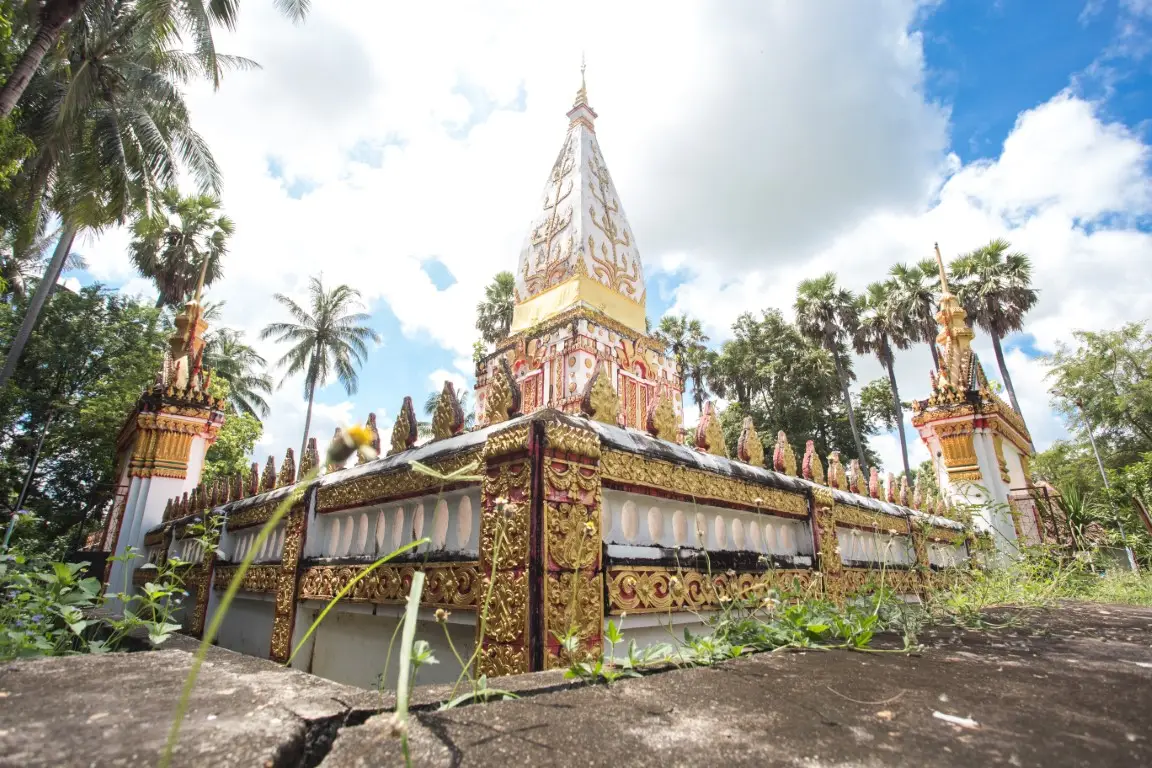
The Dhamma stupa follows the form of the earlier Phra That Phanom and expresses the community’s devotion to the major Mekong pilgrimage monument. Its base was recorded as approximately 2 wa and 2 sok on each side, with a height of around 6 wa and 2 sok. The Tripitaka was placed within it, giving the monument its identity as a stupa of the Dhamma. Restoration and repainting of the structure continued during 2025–2026 through contributions from monks, villagers and supporters.
A rectangular pavilion contains a reclining Buddha lying on the right side in the lion posture, representing the Buddha’s passing into parinirvana. Supporting figures create an atmosphere of grief and remembrance. The pavilion communicates the Buddhist teaching of impermanence and the inevitable dissolution of conditioned existence. Its position within the wider narrative plan allows visitors to proceed from enlightenment and teaching toward the final stage of the Buddha’s life.
The cremation pavilion is an open, four-gabled masonry structure with a clay-tiled roof. Inside, sculpted figures recreate the cremation of the Buddha, including disciples, Buddhist devotees, rulers and a traditional musical ensemble. The eastern gable bears the year 1936, providing evidence for the building’s construction. The pavilion demonstrates Phra Khru Nantawiro’s intention to teach Buddhist history through physical scenes rather than relying only on sermons and written texts.
The temple’s viharn is a brick-and-stucco building standing on a low base beneath a single roof. A relief on the front gable represents the First Sermon. Other facilities include the sermon hall, Dhamma hall, monastic residences, a model lotus pond, Bodhi trees and the planted palm grove. These features create a complex containing protected monuments, active monastic areas, ceremonial space and a landscape designed for Buddhist education.
Wat Latthikawan was registered as an ancient monument in the Royal Gazette, Volume 115, Special Part 4 Ngor, dated 14 January 1998. The protected group includes the old sim, the Buddha-footprint pavilion, the reclining Buddha pavilion, the cremation pavilion and associated elements. Registration requires major repairs, alterations and nearby development to follow conservation principles and relevant law. The temple is therefore both a living religious institution and nationally protected cultural heritage.
In 2021, the Mukdahan Provincial Office of Buddhism and a provincial committee inspected restoration and development work at the temple. Funding supported improvement of the toilet facilities, showing that the monastery remained active and continued receiving maintenance assistance. New visitor facilities should be positioned so that they do not dominate the old buildings, while service routes should avoid fragile areas around the murals, stucco and historic timber.
The Mukdahan Provincial Office of Buddhism identified Phra Athikan Solot Sanyamo as the abbot of Wat Latthikawan and secretary to the Wan Yai district monastic authority during the official inspection in 2021. The abbot’s responsibilities include administration of the monastic community, care of religious property, coordination with conservation agencies and leadership of community restoration. The temple’s current public channel continues to share restoration activities, merit-making and the history of Phra Khru Nantawiro, confirming its continuing role within Ban Chanot.
A visit should begin by walking around the old sim before entering the veranda. This reveals the masonry base, columns, brackets, eaves, bottle balustrades and solid rear wall in sequence. Visitors can then pay respect to the principal Buddha and study the murals. Looking from the exterior toward the interior demonstrates how an open sim creates sacred boundaries with only a few structural components while maintaining airflow, daylight and a close relationship with the community.
After the sim, visitors can proceed to the Buddha-footprint pavilion, Dhamma stupa, reclining Buddha and cremation pavilion. Following the episodes of the Buddha’s life helps explain Phra Khru Nantawiro’s overall concept. Each building should not be treated as an isolated attraction. Together they form a continuous account from birth and the search for truth to enlightenment, teaching, parinirvana and cremation. The entire monastery functions as an open-air museum of Buddhist art while remaining in active religious use.
The best periods for examining the murals and structures are approximately 08:00–10:30 and 14:30–16:30. Morning temperatures are cooler, while angled afternoon light reveals the surfaces of stucco, brackets and green glass. Flash photography should be avoided because it disturbs worshippers and is unsuitable around old pigments. The cool season from November through February is generally the most comfortable for walking around the outdoor complex.
Visitors should dress respectfully, covering shoulders and wearing trousers or skirts of an appropriate length. Shoes must be removed before entering the sim or other buildings containing Buddha images. Feet should not be pointed toward the principal image, and conversation should remain quiet during monastic or community ceremonies. Murals, stucco, Buddha images, timber brackets and bottles must not be touched. Oils and moisture from repeated handling gradually damage historic surfaces.
Exterior photography is possible when visitors maintain a safe distance, avoid climbing historic bases and never place bags or tripods against old columns. Phones should be silenced inside the sim, and objects must not be moved for photographs. Temporary barriers, scaffolding and restoration notices must be respected because structural examination or conservation work may be in progress.
The temple is open daily from 08:00 to 17:00 and charges no admission fee. Voluntary donations may be made through authorised temple channels. Facilities include parking, toilets, rest pavilions and merit-making areas. Some historic buildings contain steps and changes in level, making the exterior grounds more accessible than certain interiors for wheelchair users. Families should prevent children from running near old glass, stucco and timber components.
Getting There from central Mukdahan is straightforward by following Highway 212 toward Wan Yai District and Nakhon Phanom, then entering Ban Chanot. The temple is approximately 18 kilometres from the city and normally requires a 25–30-minute drive. It stands near the Mukdahan–Wan Yai road with convenient connections to Wat Manophirom, Hat Manophirom and the Ban Chanot community. A private car, rental vehicle or prearranged round-trip taxi is the most practical option because local public transport is limited.
Travelers approaching from That Phanom or Nakhon Phanom can follow Highway 212 south along the Mekong. The temple is approximately 33 kilometres from Phra That Phanom. This route can combine Phra That Phanom, Wat Song Khon, Kaeng Kabao, Wat Latthikawan and Wat Manophirom in one day. Drivers should reduce speed in Ban Chanot, where village roads are shared by pedestrians, motorcycles and agricultural vehicles.
A morning itinerary can begin at Wat Latthikawan, allowing approximately 1.5–2 hours for the sim, murals, footprint pavilion, Dhamma stupa and narrative structures. Continue to Wat Manophirom, only about 0.5 kilometre away, to see its Lan Xang viharn and sacred Buddha images. The Nuhak Phoumsavan Birthplace Museum and Hat Manophirom can then be added. This route presents Isan folk art, Vientiane-influenced architecture and the riverside history of Ban Chanot within a compact area.
A full-day journey can continue to Wat Phra Si Maha Pho, Wat Song Khon and Kaeng Kabao. Wat Song Khon introduces modern Catholic architecture and the history of the Blessed Martyrs of Thailand, while Kaeng Kabao provides Mekong scenery, the Phaya Si Phuchong Mukda Nakarat sculpture and local restaurants. Combining different religions and periods reveals the cultural diversity of Wan Yai District.
Restaurants along the Wan Yai and Kaeng Kabao route serve Isan food, Thai and Vietnamese dishes, Mekong fish, coffee and roasted pork. Suitable options include 62 Garden Cafe, Khrour Wan Yai Cafe, Ben Ben Coffee, Sirichai Moo Han and Nong Bow Moo Han. Groups should telephone ahead, particularly when ordering roasted pork, which requires preparation and may be limited on busy holidays.
Accommodation immediately beside the temple is limited. Baan Kieng Sawan in Chanot Subdistrict offers a community riverside setting, while Baan Oun Ai Din Homestay is convenient for the Wat Song Khon and Kaeng Kabao route. Travelers seeking full hotel facilities can stay in Mukdahan city at Hotel de Ladda, Ploy Palace Hotel or Mukdahan Grand Hotel, approximately 20–23 kilometres away and accessible through Highway 212.
The significance of Wat Latthikawan extends beyond the age of its monuments. It demonstrates how an Isan community created religious architecture from locally available knowledge and materials. Brick, lime, hardwood, clay tiles and glass bottles form a sim responding to monastic discipline, climate and local taste. Murals and sculptures transmitted teachings to people without books, while Vientiane-style brackets and the Phra That Phanom-inspired stupa reveal cultural networks extending beyond provincial boundaries.
The temple also preserves the legacy of Phra Khru Nantawiro as monk, administrator and artistic planner. He created more than a collection of monastic buildings. He arranged a religious landscape that presents the Buddha’s life from birth through cremation. This made the monastery a community learning centre before modern museums and cultural centres existed. Its structures should therefore be understood together rather than focusing exclusively on the sim or Dhamma stupa.
Wat Latthikawan remains an active monastery where monks reside, villagers make merit and historic structures continue to be restored. Tourism must coexist with monastic duties and daily community life. Prayer, festivals or conservation work may temporarily limit access to some areas. Adjusting the route and following temple instructions are essential parts of responsible heritage travel.
The temple rewards visitors who examine Isan art in detail rather than stopping only for photographs. The bottle balustrades, folk murals, kneeling disciples, Vishnu-on-Garuda relief, Vientiane-influenced brackets and Buddhist narrative pavilions reveal the ideas of the monks and craftsmen responsible for the site. Each element explains how a Mekong community learned Buddhism, created art and preserved memory through physical space.
A visit therefore moves through several historical layers: the unidentified ruins in Pa Non Rang, the foundation of the temple in 1915, formal recognition in 1923, the consecrated boundary granted in 1925, construction of the cremation pavilion in 1936, ancient-monument registration in 1998 and continuing restoration today. Wat Latthikawan is not frozen in the past. It remains alive through worship, maintenance and the faith of Ban Chanot.
| Name | Wat Latthikawan |
| Local Names | Wat Pa Tan or Wat Pa |
| Type | Community Buddhist temple of the Mahanikaya order and the location of a protected ancient-monument group |
| Location | Ban Chanot, Moo 2, Chanot Subdistrict, Wan Yai District, Mukdahan Province, Thailand |
| Address | Ban Chanot, Chanot Subdistrict, Wan Yai District, Mukdahan 49150, Thailand |
| Coordinates | Approximately 16.68000, 104.75000 |
| Foundation Date | Thursday, the fourth waxing-moon day of the eighth lunar month in the Year of the Rabbit, corresponding to 15 July 1915 |
| Founder | Phra Nantawiro, later known as Phra Khru Nantawiro (Bu) |
| Official Temple Status | Formally established in 1923 and granted a royal consecrated boundary in 1925 |
| Name Origin | Latthikawan means “grove of young palms,” referring to the palms planted around the temple and to a palm grove in Buddhist tradition |
| Highlights | Open Isan sim, green-bottle balustrades, principal Buddha with the 5 disciples, folk murals, Vientiane-influenced brackets, Buddha footprint and narrative Buddhist structures |
| Sim Architecture | Small 3-bay rectangular brick-and-stucco sim facing west, enclosed only behind the principal Buddha and open on the other 3 sides |
| Interior Dimensions | Approximately 5.40 by 5.10 metres, with brick columns about 0.40 metre wide arranged along each side |
| Principal Buddha | Gilded stucco Buddha in the Mara-vijaya posture, accompanied by 5 kneeling figures representing the Pañcavaggiya disciples |
| Murals and Stucco | Folk murals of the Traiphum, Ten Great Birth Stories, kinnari, yaksha and Thao Suwan; exterior relief of Vishnu riding Garuda with guardian figures |
| Important Materials | Brick, stucco, hardwood, clay tiles and recycled green glass bottles used as veranda balustrades |
| Artistic Influence | Isan vernacular art combined with Vientiane craftsmanship, especially in brackets comparable to those at Pha That Luang in Vientiane |
| Ancient Monument Status | Registered in the Royal Gazette, Volume 115, Special Part 4 Ngor, dated 14 January 1998 |
| Main Areas / Zones | 1. Old sim and folk murals 2. Buddha-footprint pavilion 3. Dhamma stupa 4. Birth and enlightenment representations 5. Reclining Buddha and parinirvana pavilion 6. Cremation-ceremony pavilion 7. Viharn, sermon hall and Dhamma hall 8. Monastic area, model pond and palm grove |
| Abbot Named in the Latest Published Government Record | Phra Athikan Solot Sanyamo, identified by the Mukdahan Provincial Office of Buddhism during its 2021 inspection |
| Current Status | Active Buddhist monastery with resident monks, public worship and continuing restoration of the Dhamma stupa and religious structures |
| Open Days | Daily |
| Opening Hours | 08:00 – 17:00 |
| Fees | Free admission; voluntary donations for temple maintenance and conservation are welcome |
| Facilities | Parking area, toilets, rest pavilions, merit-making areas and outdoor paths around the historic structures |
| Travel Information | From central Mukdahan, follow Highway 212 toward Wan Yai District and enter Ban Chanot. The temple is approximately 18 kilometres away and the drive takes about 25–30 minutes |
| Recommended Visiting Time | 08:00–10:30 or 14:30–16:30 for suitable light on the murals, stucco, brackets and glass balustrades |
| Visitor Etiquette | Dress respectfully, remove shoes before entering the sim, avoid flash photography, never touch murals, stucco, glass or timber, and do not disturb monastic activities |
| Nearby Tourist Attractions | 1. Wat Manophirom, 0.5 km 2. Hat Manophirom or Chanot Beach, 1 km 3. Nuhak Phoumsavan Birthplace Museum, 2 km 4. Wat Phra Si Maha Pho, 3 km 5. Wat Pa Wiwek, 3 km 6. Kaeng Kabao and Phaya Si Phuchong Mukda Nakarat, 10 km |
| Nearby Restaurants | 1. 62 Garden Cafe, 8 km, Tel. 099-795-1962 2. Sirichai Moo Han at Kaeng Kabao, 9 km, Tel. 081-260-7358, 042-643-552 3. Nong Bow Moo Han at Kaeng Kabao, 9 km, Tel. 061-318-9377 4. Khrour Wan Yai Cafe, 10 km, Tel. 094-291-5979, 093-514-9569, 095-415-7822 5. Ben Ben Coffee and Restaurant, 11 km, Tel. 088-357-2123, 095-659-9076 |
| Nearby Accommodations | 1. Baan Kieng Sawan, 4 km, Tel. 088-855-5464 2. Baan Oun Ai Din Homestay, 12 km, Tel. 088-563-9325 3. Hotel de Ladda, 20 km, Tel. 042-611-499, 042-611-497 4. Ploy Palace Hotel, 21 km, Tel. 042-614-988 5. Mukdahan Grand Hotel, 22 km, Tel. 042-612-020 |
Frequently Asked Questions (FAQ)
Q: Where is Wat Latthikawan located?
A: Wat Latthikawan is in Ban Chanot, Moo 2, Chanot Subdistrict, Wan Yai District, Mukdahan Province, approximately 18 kilometres north of central Mukdahan.
Q: What are the opening hours and admission fee?
A: The temple is open daily from 08:00 to 17:00. Admission is free, and visitors may make a voluntary donation toward maintenance and conservation.
Q: What is the main highlight of Wat Latthikawan?
A: The principal highlight is the open Isan sim with green-bottle balustrades, a Buddha surrounded by the 5 disciples, folk murals, a Vishnu-on-Garuda relief and Vientiane-influenced timber brackets.
Q: When was Wat Latthikawan founded and who built it?
A: The temple was founded on 15 July 1915 by Phra Nantawiro, later known as Phra Khru Nantawiro or Ajarn Bu.
Q: What does the name Latthikawan mean?
A: Latthikawan means “grove of young palms.” Phra Nantawiro planted palms around the temple, leading local residents to call it Wat Pa Tan, the Palm-Forest Temple.
Q: Why are green bottles used in the sim?
A: Dark-green bottles resembling French wine or liquor bottles were reused as veranda balustrades, preserving evidence of Mekong trade and local architectural resourcefulness.
Q: Is photography allowed inside the historic sim?
A: Photography is permitted when flash is avoided and visitors do not touch the murals, stucco, bottles, Buddha images or timber elements. Worshippers and ceremonies must not be disturbed.
Q: Which nearby places can be combined with Wat Latthikawan?
A: The temple can be combined with Wat Manophirom, Hat Manophirom, the Nuhak Phoumsavan Birthplace Museum, Wat Song Khon and Kaeng Kabao on the same Mekong cultural route.
 Category: ●Places of Worship
 Group: ●Temple
Last Update : 2 MonthAgo
 Last Update : 2 MonthAgo
 Click to Access the Navigation Map GPS
Wat Latthikawan Map
Recommend

 Art, Culture and Heritage
 Historical Sites and Monuments(2)
 Landmarks and Memorials(3)
 Art, Craft Centres, Tradition(2)
 Museums(1)
Temple(17)
Museums(1)
Temple(17)
 Other Sacred Sites(3)
 Suburban Living
 Village, Community(4)
 Local Market(2)
 Nature and Wildlife
 National Parks and Marine Reserves(4)
 Mountain (Doi)(5)
 Dam, Reservoir, Lake(3)
 Waterfalls(5)
 Caves(2)
 River, Canal(2)
 Bays and Beaches(1)
 Other natural attractions(1)
 Entertainment and Agricultural
 Farms, Parks and Ecotourism(1)


