
lovethailand home >Northeastern Travel Attractions >Mukdahan Travel Attractions >Muang Mukdahan >Mukdahan > Vietnamese Five-Way Junction
TL;DR: Vietnamese Five-Way Junction, Mukdahan attractions : Suburban Living, Village, Community.
Vietnamese Five-Way Junction
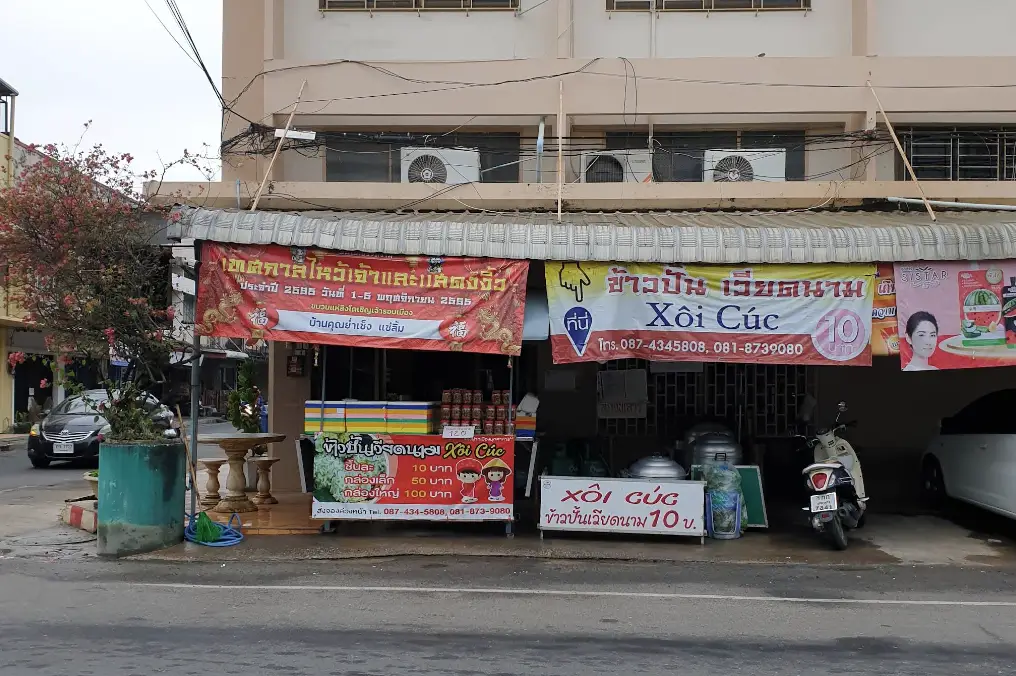
Open Days: Daily
Opening Hours: The main breakfast-market period is approximately 05:30 – 10:00; some vendors continue until around 12:30.
The Vietnamese Five-Way Junction in Mukdahan Province, known in Thai as Ha Yaek Chumchon Vietnam, is an old urban neighborhood and one of Mukdahan’s best-known breakfast destinations. It is situated near the end of Pitak Santirat Road, where Thaiyanon Road and several community lanes meet. Rather than occupying a purpose-built market hall with a single entrance and fixed closing time, the market consists of family restaurants, street-side food stalls, shops, residences and small commercial buildings distributed around a five-way intersection. Before sunrise, the area begins to fill with the aromas of simmering broth, fresh rice noodles, Vietnamese-style noodle soup, rice porridge, pork sausage, steamed rice rolls, baguettes, pork offal and traditional coffee.
The physical layout explains the name “Five-Way Junction.” Roads and lanes radiate from one central point toward residential neighborhoods, commercial areas, government offices and routes leading to the Mekong riverfront. Before motor traffic became dominant, these streets accommodated pedestrians, bicycles, pushcarts and small delivery vehicles. The intersection served as a practical meeting place where residents exchanged news, bought ingredients and ate before work. Urban development has changed the buildings and traffic pattern, but the junction continues to function as a morning gathering place.
The term “Vietnamese Community” reflects the settlement of families of Vietnamese heritage in central Mukdahan. Different families followed different routes into northeastern Thailand during periods of warfare, insecurity and political change in Indochina. Some came through Laos, while others followed relatives or commercial networks along the Mekong. After establishing themselves, they built homes, opened shops and formed relationships with Thai, Lao-Isan, Phu Thai, Chinese and other local communities.
Today, the neighborhood should not be understood as a foreign enclave separated from Mukdahan. Most residents are Thai citizens of Vietnamese ancestry who speak Thai and the local Isan language in daily life and participate fully in the economy and civic life of the province. Vietnamese heritage remains especially visible through family food traditions, kinship networks and methods of running small businesses. Many recipes have been adjusted to local ingredients and preferences. The food is therefore not identical to contemporary food served in every region of Vietnam; it is the distinctive cuisine of a Thai-Vietnamese Mekong community shaped over several generations.
Mukdahan lies on the western bank of the Mekong opposite Savannakhet in Laos and connects by road toward Vietnam through the Second Thai–Lao Friendship Bridge. The province functions as an important gateway within the Greater Mekong region. Its cultural diversity results from long-term trade, migration, intermarriage and relationships across the river rather than from modern tourism alone. The Five-Way Junction provides a compact example of the multicultural character visible throughout Mukdahan.
Breakfast at the junction functions as an edible historical archive. Broth recipes, noodle preparation, pork-sausage making, offal cleaning, rice-batter steaming and condiment mixtures have been transmitted within families. Each household may use a different proportion of ingredients or a particular technique. One vendor may simmer pork bones for many hours, another may emphasise pepper, while another makes fresh noodles or receives ingredients from relatives. Dishes carrying the same name can therefore taste and feel noticeably different from stall to stall.
The market begins operating before sunrise. Some vendors prepare broth, wash herbs, cut pork, steam batter and arrange tables from approximately 04:00 or 05:00. By around 05:30, the first customers begin arriving. These early diners often include workers, merchants, government employees, older residents and people with long-standing loyalty to a particular shop. The busiest period is generally between 06:30 and 08:30, particularly on weekends and public holidays.
There is no universal opening schedule because the market is made up of independent family businesses. Many traditional breakfast stalls close when their prepared ingredients sell out, and particular dishes may disappear before 10:00. Several noodle and rice-porridge restaurants remain open until midday or approximately 12:30. Travelers seeking a specific traditional dish should arrive before 08:30. Individual vendors may also take different days off according to family responsibilities, health or ingredient availability.
The best-known dish is khao piak sen, a bowl of fresh rice-flour noodles with a soft, pleasantly chewy texture. The noodles are cooked in hot broth, releasing enough starch to give the liquid a slightly thick consistency. Depending on the vendor, the bowl may contain pork, moo yor sausage, pork bones, offal or egg, and is finished with spring onion, coriander, fried shallot and pepper. Good khao piak should be tender without becoming mushy, while the broth should remain aromatic and balanced. Diners may add chili, fish sauce, vinegar or lime, but tasting the original broth first reveals the character of each family recipe.
The names khao piak and Vietnamese-style guay jub are sometimes used interchangeably in northeastern Thailand, although local residents and vendors may distinguish them according to noodle shape, texture or preparation. Some use khao piak for thick fresh noodles and guay jub yuan for a related but slightly different noodle soup. Visitors do not need to insist on one universal definition. Asking about the type of noodle and toppings available is more useful than relying solely on the written name.
Broth is the foundation of these dishes. Vendors may begin simmering pork bones during the night or in the very early morning, adding daikon, onion, coriander root, garlic or pepper. Foam is removed to keep the broth clear before it is seasoned with salt, fish sauce or a proprietary family mixture. A bowl served within minutes therefore represents several hours of preparation that occurred before customers arrived.
Moo yor, a firm Vietnamese-influenced pork sausage, is another defining ingredient. Pork is finely ground, seasoned with pepper and other ingredients, wrapped and cooked until the texture becomes dense and springy. Moo yor may be sliced into noodle soup, steamed, fried or purchased as a takeaway product. Recipes differ in fat content, pepper level and grinding technique. Travelers buying sausage for a long journey should ask how it must be stored because cooked meat products require appropriate temperature control.
Rice porridge and pork-offal soup are equally important morning foods. Rice may be cooked until soft while retaining individual grains, then served with minced pork, ribs, bones, offal or egg. Clear peppery broth makes the dish comforting in the early morning. Vendors specialising in intestines devote significant work to cleaning, boiling and controlling aroma. A separate plate of boiled pork intestine may be accompanied by a sour, salty and spicy dipping sauce. Diners who do not eat offal can request ordinary pork, moo yor or egg.
Vietnamese steamed rice rolls, commonly called pak mor yuan, display the skill of the cook. A thin layer of liquid rice batter is spread over cloth stretched above a pot of steam. Once set, it is filled with seasoned minced pork, mushrooms or other ingredients and folded with a narrow utensil. Freshly made rolls are warm and delicate and may be served with moo yor, fried shallot, vegetables and dipping sauce. Their texture changes as they cool, making immediate consumption preferable.
Khao jee pâté and filled baguettes reflect the influence of French bread on Vietnamese food and its later adaptation in northeastern Thailand. A small baguette is split and filled with pâté, moo yor, minced pork, Chinese sausage, egg, pickled vegetables or house sauce. Some shops warm the bread until the exterior becomes crisp. The appeal lies in the contrast between crunchy bread, savory filling, fresh or pickled vegetables and sauce used in sufficient quantity without making the loaf soggy.
Traditional coffee, hot tea, soft-boiled eggs and khai kratha complete the morning atmosphere. Local coffee may be strong and sweetened with condensed milk. Khai kratha is served in a small heated pan with moo yor, Chinese sausage, minced pork and spring onion. These dishes combine Vietnamese, Chinese and northeastern Thai influences. Travelers who do not want a full meal can begin with coffee, bread or eggs before tasting smaller portions from several vendors.
A historically distinctive dish is lueat plaeng, related to raw-blood preparations found in some Vietnamese culinary traditions. Recipes vary, but the dish generally combines blood with prepared meat or offal, seasonings, herbs, lime and chili. Because it is raw or only partially cooked, it is not appropriate for everyone. Pregnant travelers, children, older adults, people with weakened immune systems and anyone who avoids raw food should select fully cooked alternatives. Understanding a food tradition does not require eating every dish.
Snacks and sweets expand the range of the market. Khanom kot kan is a fried preparation in which chewy dough encloses a seasoned minced-pork filling. Its Thai name evokes 2 portions of dough “embracing” the filling. Other sticky Vietnamese-influenced sweets are occasionally sold by small community vendors. Availability changes from day to day, so looking beyond the largest restaurants and asking what has been prepared that morning often produces unexpected discoveries.
Fresh herbs are central to the cuisine. Coriander, spring onion, mint, Vietnamese coriander, basil, lettuce, cucumber and pickled vegetables contribute aroma, freshness and texture. Some accompany steamed rolls and fried food, while others are placed directly in soup. Their extensive use reflects both Vietnamese dining practices and the availability of local northeastern plants. Travelers with allergies or strong dislikes should ask about herbs before a dish is completed.
Table condiments commonly include chili powder, fish sauce, vinegar, fresh chili, fried garlic, sugar and house-made sauces. Food should be tasted before everything is added because the broth or dipping sauce has already been balanced. Gradual seasoning also reduces waste and prevents the original character of the recipe from being overwhelmed.
The alternative name “Five-Way Pork Market” is associated with the historical sale of pork, offal, moo yor and pork-based breakfast dishes in this district. Ingredient traders and food vendors could work close to one another, allowing fresh pork to be prepared promptly. Commercial patterns have changed and new businesses have appeared, but Ha Yaek Talat Mu remains a familiar local landmark and continues to appear in restaurant addresses.
The area is sometimes promoted as a century-old market. This phrase is best understood as a reference to the long continuity of the neighborhood rather than proof that every shop or building is exactly 100 years old. Roads have been improved, concrete commercial buildings have replaced earlier structures and businesses have changed ownership. The heritage of the market lies primarily in continuing food knowledge, family relationships and daily routines.
The atmosphere differs from a tourist market constructed mainly for visitors. Local residents genuinely use the junction for breakfast. Tables can be small, customers may share limited space and seats turn over quickly. Vendors often recognise regular customers and begin preparing an order without lengthy discussion. New visitors should wait their turn, keep clear of cooking stations and avoid expecting priority over local diners.
Ordering is straightforward when diners first ask what is currently available and what ingredients are included. Anyone avoiding offal, blood, raw food or a particular meat should state this clearly. Food allergies require questions about broth, sauces and fillings, which may contain soy, wheat, egg, seafood or fermented ingredients. Short requests such as “no offal,” “not spicy” or “moo yor only” are useful during busy periods.
Cash remains widely used, although several businesses accept Thai QR payment. Small banknotes are useful because not every stall offers the same payment options. Where prices are not displayed, customers should ask before ordering and confirm the number of dishes when paying. Prices may vary according to bowl size, quantity of meat and premium ingredients.
Seating ranges from indoor restaurant tables to street-side arrangements and small shared areas. Large groups should divide across tables or order takeaway rather than moving furniture into the roadway. After finishing, dishes should be left where the vendor requests and seats released for the next customers. Efficient turnover is part of a morning market in which many local diners must continue to work.
Travelers wishing to compare several shops should order modest portions, share food and avoid purchasing every dish at the first stall. Noodles, pork and bread are filling, and excessive ordering produces waste. A gradual tasting route allows visitors to compare broth, noodle texture, moo yor and dipping sauces more effectively.
Cleanliness depends on cooperation among businesses, municipal services, customers and residents. Vendors must manage washing water, utensils, food scraps and raw ingredients, while customers should use waste bins and avoid leaving cups or bags outside private homes. Reusable bags or clean personal containers may reduce packaging, although vendors should first confirm whether a container is suitable for hot or liquid food.
Photography is acceptable when it does not obstruct cooking or traffic. Visitors should not stand in the road, move close to boiling pots or extend cameras into food-preparation areas. Permission should be requested before photographing vendors, diners, older residents or the interior of private homes. This remains a living residential community rather than a public film set.
Lanes around the junction contain homes, commercial buildings, small shops, community facilities and a local foundation. Architecture ranges from older timber-influenced houses to renovated concrete shophouses. Visitors should remain on public roads and avoid entering courtyards, residences or organizational buildings without permission. Noise should be limited in the early morning because not every resident operates a food business.
The functional areas can be understood without treating them as officially numbered zones. The intersection itself is the principal landmark. Nearby are concentrations of khao piak, noodle and rice-porridge shops, followed by pork, moo yor and offal vendors. Steamed-roll, baguette, coffee and dessert stalls are distributed among surrounding buildings. Residential lanes connect the food businesses to the wider Thai-Vietnamese neighborhood.
Arriving between 05:30 and 06:30 provides a quieter view of the market’s beginning, although several stalls may still be preparing. From 06:30 to 08:30, the widest range of food is normally available. After 09:00, the market begins to slow, and some traditional stalls close or sell out. Later visitors may still find noodles and rice porridge, but the characteristic early-breakfast selection will be smaller.
Weekends, long holidays and provincial events bring heavier traffic. Streets around the market are narrow and shared by homes, delivery vehicles and through traffic. Cars must not double-park, block a house entrance or stop too close to the junction. When nearby parking is unavailable, visitors should use an authorised public space and walk.
Motorcycles and local samlor tricycles are often more practical than large vehicles. Tour groups using vans or buses should arrange a drop-off point outside the central intersection and enter in small groups. A short walk also reveals small businesses and older buildings that would be missed from inside a vehicle.
The district is on generally level ground and is easier for older travelers than a hill attraction, but pavements may be narrow or uneven. Tables, motorcycles and carts can reduce available space. Wheelchair users may benefit from assistance and from visiting before the busiest period. Individual restaurants may have thresholds or limited seating.
Children must be supervised near traffic, boiling broth, gas stoves and hot oil. They should not run between tables or enter preparation areas. A family visit can become an educational experience by observing noodles, herbs and steamed-roll making from a safe distance.
The cool season from November through February provides the most comfortable walking conditions. March through May is hot even in the morning, making water useful. During the rainy season, visitors should carry an umbrella and wear secure footwear because street edges may become wet or slippery.
No religious dress code applies, but lightweight, practical clothing and comfortable footwear are recommended. Travelers continuing to temples or guardian shrines should dress modestly from the beginning. Umbrellas and hats are useful after breakfast but should be stored carefully in small restaurants.
Getting There from Mukdahan Bus Terminal involves following Chayangkun Road into the city and turning toward Pitak Santirat Road or Thaiyanon Road. Travel normally takes approximately 8–15 minutes depending on traffic. Navigation searches may use “Vietnamese Five-Way Junction Mukdahan,” “Ha Yaek Talat Mu” or the name of a restaurant located inside the market.
From Indochina Market or Samran Chai Khong Road, the junction is only about 1–2 kilometres away and can be reached by samlor, motorcycle taxi, car or a careful walk. The route passes shops, temples and old-city streets, allowing the market to be included within a cultural walking itinerary.
From the Second Thai–Lao Friendship Bridge, follow Chayangkun Road into central Mukdahan for approximately 7–8 kilometres and turn toward Pitak Santirat Road. International travelers should allow sufficient time for immigration formalities. Staying overnight in Mukdahan is more reliable than attempting to cross the border and reach the market during its short peak period on the same morning.
A half-day itinerary can begin with breakfast between 06:30 and 08:00, followed by Mukdahan City Pillar Shrine, Chao Pho Chao Fa Mung Mueang Shrine, Wat Si Mongkhon Tai, Indochina Market, the Mekong promenade and Chao Mae Song Nang Phi Nong Shrine. Together, these places introduce Vietnamese community life, civic guardian belief, Buddhism and Mekong trade.
A full-day itinerary may add Mukdahan Tower and the sacred sites of Phu Manorom. The morning focuses on food and the historic urban district, while the afternoon provides elevated views of Mukdahan and the Mekong. This route can be completed without traveling far beyond Mueang Mukdahan District.
Mukdahan City Pillar Shrine and Chao Pho Chao Fa Mung Mueang Shrine are less than 1 kilometre away by urban roads. The first represents official civic identity, while the second honours the traditional guardian of the city. Visiting them after breakfast demonstrates how everyday community life and public spirituality coexist within central Mukdahan.
Wat Si Mongkhon Tai is a royal temple containing Phra Chao Ong Luang, a principal Buddha image of Mukdahan. Its history is connected with the establishment of the city under Chao Kinnari. From the temple, travelers can continue easily toward Indochina Market and the Mekong riverfront.
Indochina Market and the promenade illustrate Mukdahan’s border-trading identity through goods and food associated with Thailand, Laos, Vietnam and China. Although trade patterns have changed following the opening of the bridge and the growth of online commerce, the riverfront remains an important place to view Savannakhet and understand the geography of the city.
Chao Mae Song Nang Phi Nong Shrine commemorates 2 legendary Lao royal sisters said to have died in a boat accident on the Mekong. Residents worship the Two Sisters together with Chao Pho Chao Fa Mung Mueang. Combining the shrine with the Vietnamese community reveals how river travel shaped migration, food, spiritual belief and local memory.
Mukdahan Tower lies approximately 2.8 kilometres from the market and provides a broad view over the city, river and Lao bank. Beginning the day at a small neighborhood market and later viewing the city from above helps travelers understand how the junction connects with commercial roads, government areas and the Mekong waterfront.
Several breakfast businesses operate within the junction. Nong An An Noodle Shop is located directly in the Ha Yaek Talat Mu area. Mang Mee–Nong Mam serves rice porridge, pork intestine and other morning dishes. Vietnamese Kitchen Mae Yor is situated close to the local foundation and offers a wider selection of Vietnamese-influenced food. These businesses show how traditional street food has adapted to telephone ordering and modern takeaway services.
For later meals, Virin Jaew Hon is approximately 0.6 kilometres away and serves Isan hotpot, northeastern dishes and Vietnamese food. Baan Lao Yuan Na Rim Khong is approximately 0.9 kilometres away and provides Vietnamese and Isan dishes in a riverside setting. Such restaurants allow late-arriving visitors to explore Thai-Vietnamese cuisine even after the traditional breakfast stalls have closed.
Nearby accommodation includes Mukdahan Grand Hotel, Ploy Palace Hotel and B2 Mukdahan Hotel in the central urban area. Riverfront Hotel Mukdahan and Hotel de Ladda are convenient for guests seeking a Mekong location. Staying in central Mukdahan allows travelers to reach the market before food sells out.
Spending at least one night in the city is practical for serious food travelers. Arriving the previous afternoon provides time to rest and begin breakfast early without a long pre-dawn drive. After the market, visitors can return to the hotel or continue through the nearby historic district.
The junction has no abbot or single private manager because it is neither a temple nor an enclosed market owned by one operator. Mukdahan Town Municipality, the Thai-Vietnamese community, individual vendors, property owners and agencies responsible for roads and public health all contribute to management. The municipality oversees public space, sanitation and traffic, while residents preserve recipes and daily social relationships.
Tourism development should not prevent the market from serving local residents. Excessive rent, event closures or traffic restrictions could push family vendors away and cause regular customers to use other markets. Conservation therefore involves maintaining affordable and practical conditions for existing businesses rather than merely decorating buildings to appear old.
Recipe transmission is another challenge. Younger family members may choose different occupations because market work requires very early hours and substantial physical labor. Recording recipes, Vietnamese names, family histories and preparation methods can preserve knowledge, but written records cannot replace practical training. Supporting skilled traditional vendors remains essential.
Changing preferences require adaptation. Some businesses reduce fat or salt, offer dishes without offal or redesign packaging for takeaway orders. Adaptation does not automatically destroy tradition when the principal techniques remain clear and customers are told how a version differs. A living cuisine survives by serving new generations while preserving reference points to older flavors.
Takeaway service also increases plastic and disposable waste. Customers can decline unnecessary cutlery, avoid multiple bags and combine purchases where practical. Vendors can use secure containers and separate organic waste. Street cleanliness directly affects the quality of life of residents and public confidence in the market.
The junction is a valuable outdoor classroom. Students can examine migration, Thai–Vietnamese relations, morning-market economics and culinary change by interviewing vendors and comparing ingredients. Educational groups should seek permission, avoid the busiest selling period and return useful records or photographs to the community.
For local-history researchers, the market adds stories often absent from official accounts focused on governors, temples and government buildings. Cities are also built by refugee families, merchants, cooks and workers who create new lives in border regions. A bowl of noodles can preserve memories of an earlier homeland, adaptation to new ingredients and the effort required to support a family.
For students of multicultural society, the junction demonstrates that cultural integration neither erases the past nor leaves it unchanged. Vietnamese food in Mukdahan has adopted northeastern herbs, chili preferences and dining habits, while fresh noodles, moo yor, steamed rolls and baguettes retain Vietnamese lineages. The resulting cuisine belongs specifically to Mukdahan.
International visitors should recognise that Vietnamese food in northeastern Thailand has a different history from modern Vietnamese restaurants in major global cities. Names and pronunciations may differ from standard Vietnamese. Pointing to a menu and asking politely about ingredients is usually sufficient, even when English is limited.
Offal, blood, fermented ingredients and strong herbs may be unfamiliar. Visitors are never required to try every traditional food. Accessible starting choices include cooked khao piak with moo yor, steamed rice rolls, filled baguettes, khai kratha and coffee. Vegetarians must ask about broth because a dish without visible meat may still use pork bones.
The community should not be described as foreign or separate from Thailand. Many residents were born and raised in Mukdahan and are Thai citizens whose families retain Vietnamese heritage. The description “Thai of Vietnamese ancestry” acknowledges both civic belonging and family history.
The most meaningful experience does not depend on identifying a single supposedly best restaurant. It comes from arriving while the neighborhood is waking, observing preparation, waiting beside local diners and comparing several dishes. Personal preference varies: one traveler may prefer a clear broth, another a peppery soup, while others focus on steamed rolls, coffee or bread.
Allow at least 1–2 hours for exploring and eating, or 2–3 hours when comparing several businesses and walking through the public community lanes. Visitors should avoid rushing through photographs, but they should also release limited seating during the busy period once a meal is complete.
There is no admission fee. Expenses are limited to food, beverages and products purchased from vendors. Buying responsibly, asking questions respectfully and avoiding aggressive bargaining support family enterprises and help culinary knowledge remain economically viable.
The heritage of the Five-Way Junction lies in activities repeated every morning: simmering broth, steaming batter, slicing moo yor, arranging herbs, greeting regular customers and transferring businesses between generations. If these practices disappear, buildings alone will not preserve the essential meaning of the place.
The Vietnamese Five-Way Junction is appropriate for culinary travelers, students of migration, early-market enthusiasts and anyone interested in the multicultural character of the Mekong borderlands. Arriving before 08:30, choosing food according to personal health, respecting private community space and observing the market at an unhurried pace reveal a story of migration, adaptation, work and coexistence contained within an ordinary morning meal.
| Name | Vietnamese Five-Way Junction |
| Alternative Names | Ha Yaek Chumchon Vietnam, Ha Yaek Vietnam, Ha Yaek Talat Mu and the Old Vietnamese Market |
| Type | Thai-Vietnamese community, traditional breakfast market and urban food-heritage district |
| Location | Near the end of Pitak Santirat Road, where Thaiyanon Road and lanes beside the local foundation meet in Mukdahan Municipality |
| Address | Pitak Santirat Road, Mukdahan Subdistrict, Mueang Mukdahan District, Mukdahan 49000, Thailand |
| Physical Setting | A five-way street junction surrounded by breakfast shops, food stalls, small businesses, residences and community buildings |
| Community Background | A long-established community of Thai residents of Vietnamese ancestry whose families developed food businesses after migration and resettlement in northeastern Thailand |
| Highlights | Khao piak noodles, Vietnamese-style guay jub, rice porridge, moo yor, boiled pork intestine, steamed rice rolls, lueat plaeng, pâté baguettes, traditional coffee and community sweets |
| Site Management | Mukdahan Town Municipality working with the Thai-Vietnamese Ha Yaek Talat Mu community, vendors, property owners and relevant public-health and road agencies |
| Public Contact | Mukdahan Town Municipality, Tel. 042-611-227 |
| Main Functional Areas | 1. Five-way intersection and meeting point 2. Khao piak, noodle and rice-porridge shops 3. Pork-market, moo yor and offal area 4. Vietnamese steamed-roll vendors 5. Pâté baguette and takeaway-food stalls 6. Coffee, khai kratha and morning-drink shops 7. Community sweets and local products 8. Residential lanes, shops and Thai-Vietnamese community route |
| Open Days | Daily; individual businesses determine their own closing days |
| Opening Hours | Main breakfast-market period approximately 05:30 – 10:00; some vendors continue until around 12:30 |
| Busiest Period | Approximately 06:30–08:30; several traditional foods may sell out before 10:00 |
| Admission Fee | No admission fee; visitors pay only for food, drinks and products purchased |
| Facilities | Restaurant and street-side seating, takeaway service, cash and QR payment at some shops, community stores and limited roadside parking |
| Recommended Visit Duration | Approximately 1–2 hours, or 2–3 hours for tasting several shops and exploring the public community lanes |
| Recommended Visiting Time | Arrive between approximately 06:00 and 08:30 for the widest food selection |
| Getting There | From Mukdahan Bus Terminal, follow Chayangkun Road into the city and continue toward Pitak Santirat Road or Thaiyanon Road. The journey normally takes approximately 8–15 minutes |
| Visitor Etiquette | Wait in line, keep clear of cooking areas and traffic, request permission before photographing people or homes, dispose of waste correctly, park responsibly and explain allergies or dietary restrictions before ordering |
| Nearby Tourist Attractions | 1. Mukdahan City Pillar Shrine, approximately 0.8 km by urban road 2. Chao Pho Chao Fa Mung Mueang Shrine, approximately 0.9 km by urban road 3. Wat Si Mongkhon Tai, approximately 1.2 km by urban road 4. Indochina Market and Mekong Promenade, approximately 1.3 km by urban road 5. Chao Mae Song Nang Phi Nong Shrine, approximately 1.7 km by urban road 6. Mukdahan Tower, approximately 2.8 km by urban road |
| Nearby Restaurants | 1. Nong An An Noodle Shop, inside the junction, Tel. 093-529-6674 2. Mang Mee–Nong Mam Five-Way Shop, approximately 0.1 km, Tel. 093-928-8566, 095-623-4165 3. Vietnamese Kitchen Mae Yor, approximately 0.1 km, Tel. 096-328-9626, 042-614-120 4. Virin Jaew Hon, approximately 0.6 km, Tel. 082-659-6624, 042-612-487 5. Baan Lao Yuan Na Rim Khong, approximately 0.9 km, Tel. 042-611-111, 065-142-3915, 063-247-9654 |
| Nearby Accommodations | 1. Mukdahan Grand Hotel, approximately 0.8 km, Tel. 042-612-020 2. Ploy Palace Hotel, approximately 1.2 km, Tel. 042-614-988 3. B2 Mukdahan Hotel, approximately 1.4 km, Tel. 042-040-123 4. Riverfront Hotel Mukdahan, approximately 1.5 km, Tel. 042-612-949 5. Hotel de Ladda, approximately 2.2 km, Tel. 042-611-499, 042-611-497 6. Hotel Muq, approximately 2.8 km, Tel. 063-787-5555, 042-040-888 |
Frequently Asked Questions (FAQ)
Q: Where is the Vietnamese Five-Way Junction located?
A: It is near the end of Pitak Santirat Road, where Thaiyanon Road and several community lanes meet in Mukdahan Municipality, Mueang Mukdahan District.
Q: What time does the breakfast market open?
A: Most vendors begin operating at approximately 05:30. The busiest period is generally 06:30–08:30, and many traditional breakfast stalls close or sell out between 09:00 and 10:00. Some businesses continue until approximately 12:30.
Q: Is there an admission fee?
A: No. The area is a public community and roadside food market. Visitors pay only for the food, beverages and products they purchase.
Q: Which foods should visitors try?
A: Popular choices include khao piak, Vietnamese-style guay jub, rice porridge, moo yor, boiled pork intestine, Vietnamese steamed rice rolls, pâté baguettes, khai kratha, traditional coffee and community sweets. Lueat plaeng is a raw traditional dish, so travelers avoiding raw food should choose fully cooked alternatives.
Q: Are Ha Yaek Vietnam and Ha Yaek Talat Mu the same place?
A: Yes. Ha Yaek Talat Mu, or the Five-Way Pork Market, refers to the district’s historical connection with pork, offal, moo yor and pork-based breakfast food. Ha Yaek Vietnam emphasises the history of the Thai-Vietnamese community.
Q: How long should travelers allow for a visit?
A: Allow approximately 1–2 hours for exploring and eating, or 2–3 hours when comparing several vendors and walking through the public community lanes.
Q: Is parking available?
A: Limited roadside and public parking is available nearby. Vehicles must not double-park or block homes, intersections and emergency access. Large vehicles should drop passengers outside the central market area.
Q: Which attractions can be visited after breakfast?
A: Nearby options include Mukdahan City Pillar Shrine, Chao Pho Chao Fa Mung Mueang Shrine, Wat Si Mongkhon Tai, Indochina Market, the Mekong promenade, Chao Mae Song Nang Phi Nong Shrine and Mukdahan Tower.
 Category: ●Suburban Living
 Group: ●Village, Community
Last Update : 3 MonthAgo
 Last Update : 3 MonthAgo
 Click to Access the Navigation Map GPS
Vietnamese Five-Way Junction Map
Recommend

 Art, Culture and Heritage
 Historical Sites and Monuments(2)
 Landmarks and Memorials(3)
 Art, Craft Centres, Tradition(2)
 Museums(1)
 Places of Worship
 Temple(17)
 Other Sacred Sites(3)
Village, Community(4)
Other Sacred Sites(3)
Village, Community(4)
 Local Market(2)
 Nature and Wildlife
 National Parks and Marine Reserves(4)
 Mountain (Doi)(5)
 Dam, Reservoir, Lake(3)
 Waterfalls(5)
 Caves(2)
 River, Canal(2)
 Bays and Beaches(1)
 Other natural attractions(1)
 Entertainment and Agricultural
 Farms, Parks and Ecotourism(1)
 Travel Articles, Recipes
 Travel Review, Food Review(1)


