
lovethailand home >Northeastern Travel Attractions >Mukdahan Travel Attractions >Wan Yai >Pong Kham > Wat Song Khon
TL;DR: Wat Song Khon is located at Ban Song Khon, Pong Kham Subdistrict, Wan Yai District, Mukdahan Province, Thailand, open Daily, hours Shrine grounds 06:00–17:00; main shrine building 09:00–12:00 and 13:00–17:00.
Wat Song Khon
Open Days: Daily
Opening Hours: Shrine grounds 06:00–17:00; main shrine building 09:00–12:00 and 13:00–17:00
Wat Song Khon, officially known as the Our Lady of the Martyrs of Thailand Shrine, is one of Thailand’s most important Roman Catholic pilgrimage sites. It stands beside the Mekong River in Ban Song Khon, Pong Kham Subdistrict, Wan Yai District, Mukdahan Province. The shrine is distinguished by a large modern building, a sweeping curved sandstone wall, restrained geometric lines and a sacred interior containing representations and relics of the 7 Blessed Martyrs of Song Khon. The grounds welcome Catholic pilgrims, travelers, students of history and visitors of every faith on a daily basis without an admission charge. Sunday Mass is celebrated at 07:00. The site is therefore an active church, a memorial to freedom of conscience, an award-winning work of modern architecture and a peaceful riverside cultural attraction.
Although Thai travelers commonly call the site Wat Song Khon, its formal ecclesiastical name is the Our Lady of the Martyrs of Thailand Shrine. It belongs to the Roman Catholic Metropolitan Archdiocese of Thare and Nonseng. The title refers both to the Virgin Mary, mother of Jesus Christ, and to the memory of 7 Thai Catholics who remained faithful until death during the closing weeks of 1940. Pope John Paul II formally beatified the group on 22 October 1989 at Saint Peter’s Basilica in Rome. This recognition transformed a small Mekong village into a major pilgrimage destination known to Catholics throughout Thailand and beyond.
In Catholic terminology, “Blessed” is a formal title granted to a person whose life and holiness have been officially recognised and who may be publicly venerated within the scope established by the Church. A “martyr” is a witness who accepts death rather than renounce the faith. The 7 people commemorated at Song Khon are therefore properly known as the Blessed Martyrs rather than canonised saints. This distinction is important because it respects the current stage of their cause within the Catholic Church. The shrine does not glorify the violence inflicted upon them; it honours their courage, fidelity, forgiveness and defence of freedom of conscience.
Ban Song Khon is an old Mekong riverside community whose life developed around farming, fishing, river travel and interaction between settlements on both banks. Catholic missionaries, religious sisters and local catechists served the community before the martyrdoms. For many years, Christians lived within the wider cultural landscape of northeastern Thailand in the same manner as other local residents. The situation changed during the Franco-Thai conflict, when political suspicion toward France affected communities associated with French missionaries. Foreign priests were pressured to leave certain districts, while local Catholics faced restrictions and demands to abandon their religion.
The events must be understood within the tense political environment of 1940. Thailand and French Indochina were involved in a territorial and military confrontation, and the Mekong borderlands became an area of heightened state concern. Catholic identity was sometimes unfairly confused with support for French political interests, even though most members of the congregations were local Thai residents with deep ties to their communities. Political fear, nationalism and religious prejudice became entangled. The resulting persecution at Song Khon shows how quickly suspicion can transform ordinary differences into a violation of human dignity.
The first member of the group to die was Blessed Philip Siphong Onphitak, a 33-year-old catechist who supported the Catholic community after its priests had been forced away. He was a respected lay leader with knowledge of Christian teaching and a strong sense of responsibility toward local families. On 16 December 1940, Philip was taken away from the village and killed after refusing to renounce his faith. His death did not end the community’s religious life. Instead, it made the remaining sisters and laypeople fully aware of the danger while strengthening their decision to remain faithful.
The other 6 martyrs continued praying, teaching children and supporting the community. They were Sister Agnes Phila Thipsuk, aged 31, and Sister Lucia Khambang Sikhamphong, aged 23, members of the Lovers of the Cross; Agatha Phutta Wongwai, aged 59; Cecilia Butsi Wongwai, aged 16; Bibiana Khamphai Wongwai, aged 15; and Maria Phon Wongwai, aged 14. These women and girls were neither armed combatants nor political leaders. Their actions consisted of continuing their religious practice and refusing to deny what they believed.
On 26 December 1940, the 6 were taken to the area now remembered as the Sacred Forest and cemetery. They were offered the possibility of saving their lives by abandoning Christianity but chose to remain faithful. They prayed and entrusted themselves to God before their deaths. Together with Philip, who had died 10 days earlier, they became known as the 7 Martyrs of Song Khon. Their history is not relevant only to Catholics. It is also the story of ordinary Thai citizens subjected to coercion of conscience who defended their right to religious belief without using violence against others.
After the period of persecution ended, the community preserved the memory of the victims and cared for the places associated with them. Testimonies, documents and historical evidence were collected for investigation by the Catholic Church. The process examined whether they had died because of hatred toward the faith and whether they had freely accepted death rather than renounce their beliefs. The inquiry continued for decades. On 22 October 1989, Pope John Paul II beatified all 7 at Saint Peter’s Basilica, making them the best-known group of Thai Catholic martyrs honoured internationally.
For this reason, 22 October is an important annual date at Song Khon, commemorating their beatification in 1989. The shrine generally holds a thanksgiving Mass, veneration of the relics and activities presenting the lives of the Blesseds. The annual liturgical commemoration at Song Khon is also observed on 16 December, the anniversary of Philip’s death and a date associated with the ministry of Thai catechists. Major celebrations may be moved to a nearby weekend to accommodate pilgrims, so travelers planning to attend should consult the current annual announcement rather than relying on a previous year’s timetable.
The present shrine was developed to accommodate the increasing number of pilgrims and to provide an appropriate setting for the relics of the 7 Blesseds. The current building was completed and dedicated during the mid-1990s. Its design was prepared by Atchapol Dusitnanond and Associates, who chose a modern architectural language rather than directly imitating a European Gothic or Romanesque church. The result communicates the history of Thai Catholics through materials, forms and a landscape closely connected to the Mekong borderlands.
The building received a Gold Medal Award for Outstanding Architecture from the Association of Siamese Architects under Royal Patronage in 1996. It later received recognition from the Architects Regional Council Asia, or ARCASIA, in 2002. These awards acknowledge the way the project combines the functions of a church, memorial, pilgrimage centre and public gathering space. The shrine was also promoted through Thailand’s Unseen in Thailand II tourism campaign and is frequently described as one of Southeast Asia’s largest and most distinctive modern Catholic shrines.
The main building uses a plan close to a square rather than the elongated nave or cross-shaped plan found in many traditional European churches. A centralised arrangement allows worshippers to see the altar and relic area from several positions while reducing the distance between the celebrating priest and congregation. Columns and structural lines establish a regular rhythm, creating order without unnecessary decoration. Openings around the building prevent the large interior from becoming visually enclosed.
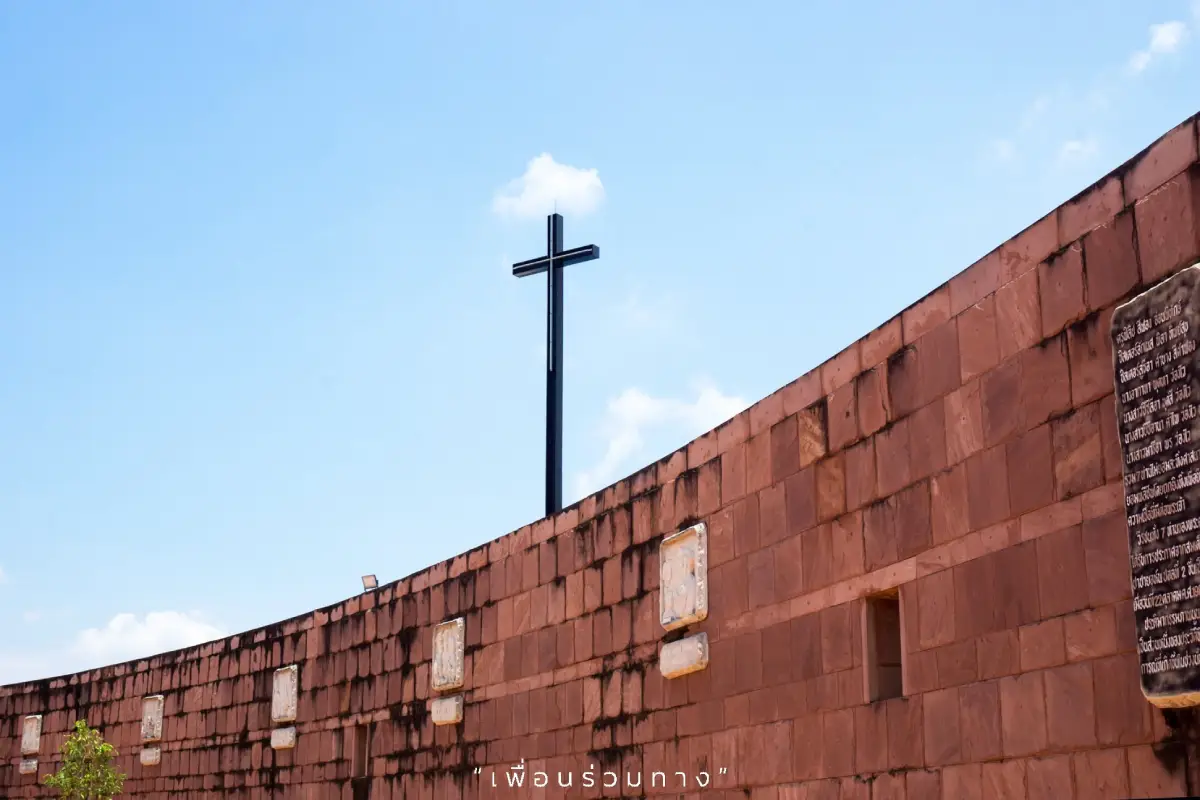
The most recognisable exterior element is a broad wall of natural sandstone curving around one side of the shrine. It defines the memorial space, creates a powerful silhouette and connects the architecture with the geology and earthen colors of northeastern Thailand. The stone surface changes character as sunlight moves across it during the day. Shadows deepen in the morning and late afternoon, making the wall appear more sculptural while directing attention toward the altar and memorial zone.
Glass walls and openings admit natural light and maintain a visual relationship between the church, gardens and sky. Worshippers can remain aware of the external landscape, while visitors outside can recognise the activity within without approaching the altar. Glass balances the visual weight of sandstone and concrete, allowing the building to feel both secure and open. Within Christian symbolism, light also conveys hope, truth and life overcoming darkness, making daylight an integral element of the religious atmosphere.
The floor uses marble and other smooth, light-colored surfaces that reflect daylight gently. The restrained material palette prevents the architecture from competing with the altar and relics. The interior can receive large congregations during the celebrations of 22 October, 16 December and Christmas. Despite its considerable size, the simplicity of the layout preserves a sense of quietness and keeps the human stories of the martyrs at the centre of the visitor’s attention.
The most sacred zone is located behind and around the altar, where relics of the 7 Blessed Martyrs are preserved. Glass coffins contain sculpted representations of their bodies, often described by visitors as wax figures, while the relics connect the memorial directly with the historical individuals. The presentation helps visitors understand that the Blesseds were real people of different ages and responsibilities: a catechist, religious sisters, an older laywoman and teenage girls. Silence is particularly important in this area because pilgrims frequently spend time in personal prayer.
The glass enclosures allow the figures and memorial objects to be viewed without direct handling. Preserving relics requires protection from dust, impact, humidity and excessive light. Visitors should not touch the glass, place belongings on the bases or use flash photography at close range. People of all religions may enter, provided that they respect the sacred character of the space and follow instructions from shrine staff.
Outside the curved wall stand 7 steel crosses representing the 7 martyrs. Their forms are intentionally simple and strong, consistent with the modern architectural vocabulary of the main building. From a distance, the repeated crosses communicate the subject of the memorial before visitors read an interpretive panel or enter the shrine. Their number emphasises that the history belongs to a group of witnesses from different ages and roles, not to a single heroic figure.
Relief sculpture and memorial artwork on portions of the walls present episodes from the martyrs’ lives. Visual narration helps visitors unfamiliar with Catholic history understand the sequence from ordinary community life and religious instruction to pressure, refusal and death. These images should be considered together with the historical information provided at the site. The central message is not tragedy alone, but service, love, forgiveness and hope.
The Sacred Forest and cemetery are directly associated with the deaths of the 6 female martyrs on 26 December 1940. This zone has a more contemplative atmosphere than the main forecourt. Visitors should walk quietly, avoid loud conversation and refrain from treating the area merely as a photographic backdrop. Reading the names and ages of the women and girls reveals that the event involved actual members of local families ranging from 14 to 59 years old.
The house associated with Sisters Agnes and Lucia provides a more personal perspective on the story. Displays and interpretation explain their daily lives, teaching and service to the community. The house demonstrates that holiness in the Christian tradition is expressed not only through formal worship but through education, care for children, service to neighbors and fidelity in ordinary responsibilities. This domestic setting makes the martyrs’ history more accessible and human.
The bell tower calls the community to worship and announces important liturgical moments. Its sound has both a practical and symbolic role, inviting people to pause and turn their attention toward prayer. The Blessed Well is another locally significant area visited by pilgrims. It should be approached according to shrine guidance and should not be promoted with unverified medical or miraculous claims. Its value lies in its relationship with community memory and devotional practice.
Spacious lawns and open courtyards allow pilgrims to gather and give visitors room to study the architecture from several angles. Walking around the building reveals how the curved wall, columns, glass surfaces and crosses change in relation to one another. Visitors should not climb memorial bases or lean against architectural components for photographs. The entire complex combines religious, historical and architectural significance.
The shrine grounds extend toward the Mekong River. From the riverside, visitors can see the water, the Lao bank and the daily environment of the border community. The river is more than scenery. It shaped settlement patterns, missionary journeys, trade and communication in the region. Viewing the Mekong after studying the history inside helps place the martyrs within the real landscape in which the Catholic community developed.
Morning is suitable for travelers seeking cooler temperatures and a quiet atmosphere. Soft light reveals the color and texture of the sandstone without harsh contrast. The later afternoon, particularly between 15:00 and 17:00, is useful for exterior photography and riverside walks. Visitors should distinguish between the general opening of the grounds and access to the main building. The grounds are open approximately 06:00–17:00, while tourism information lists interior access as 09:00–12:00 and 13:00–17:00.
Sunday Mass is celebrated at 07:00. Catholics may participate according to the practice of the Church, while visitors of other faiths are welcome to observe respectfully. Phones should be silenced, movement should be limited and worshippers should not be obstructed. During Holy Communion, non-Catholics or those not prepared to receive according to Catholic discipline may remain seated in prayer or follow the guidance of the celebrant rather than joining the Communion line.
The current parish priest identified in recent archdiocesan announcements is Father Suriya Phanphli. The responsibilities of the parish priest include regular worship, care for pilgrims, protection of the relics, coordination of archdiocesan events and maintenance of the large complex. During major celebrations, an archbishop or visiting priest may preside, so the name of the celebrant for a particular event may differ from that of the resident parish priest.
The 22 October celebration remembers the beatification of the 7 Martyrs in 1989. Activities normally include a thanksgiving Mass, veneration of the relics and presentations of their lives. The 16 December feast commemorates the Blessed Martyrs of Song Khon and has a particular connection with the vocation of catechists in Thailand. Pilgrims often arrive in organised groups, making parking and seating more crowded than on ordinary days. Arriving early and checking the annual program is recommended.
During the Christmas season, the Song Khon community also organises a star procession and related celebrations. Illuminated stars refer to the Star of Bethlehem that guided the Magi to the infant Jesus. Processions, lights, dramatic presentations and community performances create a different atmosphere along the Mekong. Dates and programs change from year to year, so travelers should consult the latest official announcement rather than assuming that a previous schedule is permanent.
An ordinary weekday provides a different experience from a festival. Fewer visitors make it easier to read the displays, examine the building and spend time in silence. Sundays and feast days reveal the shrine’s role as a living community centre through music, worship, families and groups of pilgrims. Architecture enthusiasts may prefer a weekday, while travelers interested in religious tradition and community life may choose a Sunday or annual celebration.
Clothing should be respectful. Shoulders should be covered, trousers or skirts should be of an appropriate length, and hats should be removed inside the church. Clothing displaying offensive images or messages is unsuitable. Travelers arriving from Kaeng Kabao or riverside recreation should change out of wet clothing or swimwear before entering the worship area.
Exterior photography is generally possible as long as pathways and religious activities remain unobstructed. Flash should not be used near the relics, glass coffins or altar. Worshippers should not be photographed closely without permission, and playful poses are inappropriate near the memorial figures, cemetery and Sacred Forest. Commercial filming, large lighting equipment and tripods should be discussed with the shrine in advance.
The large complex is mostly level and suitable for families, older visitors and organised groups. Facilities include parking, toilets, waiting areas, lawns, seating and a Mekong viewpoint. Wheelchair users can reach many parts of the main grounds, although it is advisable to ask staff about the most suitable access route during festivals or temporary closures. Large tour buses should coordinate parking ahead of major events.
Admission is free. Visitors may make a voluntary donation to support maintenance of the building, relic displays, public areas and community activities. Donations should be placed in official boxes or made through channels authorised by the shrine. Purchasing food or community products during festivals is another way to support local households.
Getting There from central Mukdahan requires following Highway 212 toward Nakhon Phanom and Wan Yai District, then turning onto the local route to Ban Song Khon and continuing to the Mekong River. Depending on the starting point and selected road, the journey is approximately 35–40 kilometres and normally takes 45–55 minutes. The main road is suitable for cars, vans and buses, but drivers should reduce speed inside the village because pedestrians, motorcycles and local traffic share the route.
Travelers coming from That Phanom or Nakhon Phanom can follow Highway 212 south and turn toward Ban Song Khon. This approach makes it practical to combine Phra That Phanom, Kaeng Kabao, Wat Song Khon and Wat Manophirom. Staying in That Phanom places travelers closer to the shrine than staying in central Mukdahan and may be convenient for those attending the 07:00 Sunday Mass.
Public transportation directly into Ban Song Khon is limited. A rental car, hired vehicle or round-trip taxi from Mukdahan is usually more convenient. Travelers should agree on the fare, waiting time and return journey in advance because finding a vehicle from the village late in the afternoon may be difficult. The destination should be specified as the Our Lady of the Martyrs of Thailand Shrine, Ban Song Khon, Pong Kham, Wan Yai District.
A half-day itinerary can begin at the shrine in the morning. Allow approximately 1.5–2 hours for the church, relics, Sacred Forest, sisters’ house and Mekong riverfront. Continue to Kaeng Kabao to see the Phaya Si Phuchong Mukda Nakarat sculpture and have lunch. Travelers with additional time can visit Wat Manophirom in Ban Chanot, comparing modern Catholic memorial architecture with historic Lan Xang Buddhist art along the same river.
A full-day route can include the Nuhak Phoumsavan Birthplace Museum, Hat Manophirom and other attractions in Wan Yai District. Organising the route consistently from north to south or south to north reduces unnecessary driving. Because the shrine building closes between 12:00 and 13:00, travelers arriving at midday can begin with the exterior, garden and riverfront before entering when the interior reopens.
Most restaurants close to the shrine are around Kaeng Kabao, an area known for roasted pork, northeastern Thai dishes, Mekong fish and family restaurants. Sirichai Moo Han, Chitra Moo Han and Nong Bow Moo Han are approximately 3 kilometres away. Groups should telephone ahead on weekends and annual feast days because popular restaurants may be busy and rural opening hours can change.
Accommodation includes community homestays and hotels in That Phanom. Baan Oun Ai Din Homestay is suitable for travelers seeking a local setting near Kaeng Kabao, while Baan Kieng Sawan is useful for an itinerary connecting Song Khon and Wat Manophirom. Travelers wanting hotel facilities can stay at Phonnaruemit Hotel, That Phanom River View Hotel, Sangthong Heritage or Na That Phanom Place, approximately 18–20 kilometres from the shrine.
The cool season from November through February is generally the most comfortable period for walking around the extensive grounds. Morning winds from the Mekong can be cool, so a light jacket may be useful. March through May is hot and sunny, requiring water, a hat and sun protection. The rainy season produces greener surroundings and a fuller river but makes weather and road conditions more important when planning outdoor photography or riverside activities.
The celebrations of 22 October, 16 December and Christmas attract larger crowds. They are suitable for travelers who want to experience religious and community traditions, while ordinary weekdays are better for quiet contemplation. On major event days, visitors should allow extra time for traffic, parking and walking from designated parking areas. Roads reserved for processions or pilgrims must remain clear.
For families with children, the shrine offers a valuable introduction to religious diversity, human rights, architecture and local history. Adults should explain that the memorial figures, relics and cemetery are connected to real people and are not play areas. Children can learn the names and ages of the martyrs and consider why people of different religions should respect one another. The visit can therefore become a practical lesson in peaceful coexistence.
Architecture enthusiasts should walk completely around the building before entering. This reveals how the curved wall, structural rhythm, glass surfaces, crosses and river landscape interact. Looking outward from inside then reverses the perspective and clarifies how the designers organised the sequence of approach, gathering, worship and encounter with the relics. The architectural achievement lies not only in appearance but in the way space guides understanding.
History enthusiasts should examine the wider context of the Franco-Thai conflict and distinguish historical analysis from collective blame. The events at Song Khon should encourage understanding of the dangers of prejudice rather than create new hostility. The shrine emphasises love, forgiveness and respect for conscience, values that remain relevant to visitors of every faith.
Pilgrims commonly pray before the relics for strength, family stability and people facing pressure because of their beliefs. Catholic veneration does not treat relics or memorial figures as gods. The Blesseds are honoured as examples of faith and are asked to intercede with God. Non-Christian visitors may sit or stand quietly and reflect on courage and freedom of conscience without participating in every religious practice.
Preservation includes maintaining accurate history as well as caring for the physical building. Referring to the 7 Blesseds as fully canonised saints or stating that all died on the same day creates confusion. Philip died on 16 December 1940, while the 6 women and girls died on 26 December. Presenting these details correctly is itself a form of respect for the deceased and their community.
Wat Song Khon demonstrates that religious tourism need not be limited to members of a particular faith. Visitors can appreciate architecture, study history and enjoy the Mekong landscape without changing their own beliefs. Respectful tourism benefits the community through restaurants, accommodation and transport services while creating broader support for conservation.
The shrine’s national importance comes from the combination of several elements: the history of Thailand’s 7 beatified martyrs, award-winning modern architecture, continuing worship, the distinctive Catholic culture of northeastern Thailand and the Mekong landscape. It should therefore be understood as more than a large church or photographic landmark. It is living heritage whose character changes with ceremonies, seasons and the people who gather there.
Viewed from the riverfront, the modern architecture demonstrates that a sacred building does not have to imitate an ancient style. Sandstone, glass, columns and crosses create a place of memory without excessive decoration. Simplicity directs attention toward the lives of the martyrs and the community, while the width of the Mekong recalls that belief, culture and memory have always moved beyond political boundaries.
Wat Song Khon is therefore suitable for travelers seeking more than a beautiful attraction. In one complex, visitors can learn about the 7 Blesseds, view their memorials and relics, study an internationally recognised modern building, walk through the Sacred Forest, explore community history and see the Mekong. Allowing at least 1.5–2 hours provides a far more complete experience than a brief photographic stop.
The most important lesson of Song Khon is not fixation on loss. It is the need to respect the right of every person to think and believe differently. The 7 Blesseds are remembered not only because violence was inflicted upon them, but because they responded with fidelity, love and forgiveness. The great shrine beside the Mekong is therefore both a memorial to the past and a reminder that a peaceful future must be built on respect for conscience and human dignity.
| Name | Our Lady of the Martyrs of Thailand Shrine / Wat Song Khon |
| Type | Roman Catholic shrine and church under the Metropolitan Archdiocese of Thare and Nonseng |
| Location | Ban Song Khon, Pong Kham Subdistrict, Wan Yai District, Mukdahan Province, Thailand |
| Address | Ban Song Khon, Pong Kham Subdistrict, Wan Yai District, Mukdahan 49150, Thailand |
| Coordinates | 16.77501, 104.73821 |
| Highlights | Award-winning modern architecture beside the Mekong, curved sandstone wall, glass coffins and relics of the 7 Blessed Martyrs, 7 steel crosses, Sacred Forest and extensive pilgrimage grounds |
| The 7 Blessed Martyrs | 1. Blessed Philip Siphong Onphitak 2. Blessed Agnes Phila Thipsuk 3. Blessed Lucia Khambang Sikhamphong 4. Blessed Agatha Phutta Wongwai 5. Blessed Cecilia Butsi Wongwai 6. Blessed Bibiana Khamphai Wongwai 7. Blessed Maria Phon Wongwai |
| Historical Event | Philip died on 16 December 1940. The 2 sisters and 4 laywomen and girls died in the Sacred Forest on 26 December 1940 after refusing to renounce their faith |
| Beatification | Pope John Paul II beatified the 7 Martyrs on 22 October 1989 at Saint Peter’s Basilica in Rome |
| Architectural Style | Modern Catholic architecture using a near-square plan, natural sandstone, glass, concrete, marble and restrained geometric forms connected to the Mekong landscape |
| Architect | Atchapol Dusitnanond and Associates |
| Awards | Gold Medal Award for Outstanding Architecture from the Association of Siamese Architects under Royal Patronage in 1996 and an ARCASIA award in 2002 |
| Tourism Recognition | Previously promoted through Unseen in Thailand II and recognised as a major Catholic pilgrimage destination in Thailand |
| Main Areas / Zones | 1. Main shrine and worship hall 2. Altar and relic area of the 7 Blesseds 3. Curved sandstone memorial wall and 7 steel crosses 4. Sacred Forest and martyrs’ cemetery 5. House of Sisters Agnes and Lucia 6. Bell tower 7. Blessed Well 8. Event courtyard, gardens and Mekong riverfront |
| Parish Priest | Father Suriya Phanphli |
| Current Status | Active Roman Catholic shrine, church and pilgrimage centre of the Metropolitan Archdiocese of Thare and Nonseng |
| Open Days | Daily |
| Shrine Grounds Hours | 06:00–17:00 |
| Main Building Hours | 09:00–12:00 and 13:00–17:00 |
| Sunday Mass | 07:00 |
| Annual Celebrations | 22 October commemorates the beatification of the 7 Martyrs; 16 December is the feast of the Blessed Martyrs of Song Khon. The Christmas star procession follows the program announced for each year |
| Fees | Free admission; voluntary donations are welcome |
| Facilities | Parking, toilets, waiting areas, lawns, seating, group-pilgrimage areas and a Mekong River viewpoint |
| Travel Information | From central Mukdahan, follow Highway 212 toward Nakhon Phanom and Wan Yai District, then turn toward Ban Song Khon and continue to the Mekong. The distance is approximately 35–40 kilometres and the drive takes about 45–55 minutes |
| Main Contact Number | 090-237-7648 |
| Visitor Etiquette | Dress respectfully, silence mobile phones, avoid flash near the relics, do not touch the glass coffins or memorials and do not obstruct worshippers or Mass |
| Nearby Tourist Attractions | 1. Kaeng Kabao and Phaya Si Phuchong Mukda Nakarat, 3 km 2. Wat Manophirom, 11 km 3. Nuhak Phoumsavan Birthplace Museum, 12 km 4. Hat Manophirom or Chanot Beach, 12 km 5. Wat Phra Si Maha Pho, 15 km 6. Phra That Phanom, 20 km |
| Nearby Restaurants | 1. Sirichai Moo Han, Kaeng Kabao, 3 km, Tel. 081-260-7358, 042-643-552 2. Chitra Moo Han, Kaeng Kabao, 3 km, Tel. 085-010-4756 3. Nong Bow Moo Han, Kaeng Kabao, 3 km, Tel. 061-318-9377 4. Nong Benz Moo Han Restaurant, 4 km, Tel. 097-951-4353 5. 62 Garden Cafe, 8 km, Tel. 099-795-1962 |
| Nearby Accommodations | 1. Baan Oun Ai Din Homestay, 4 km, Tel. 088-563-9325 2. Baan Kieng Sawan, 12 km, Tel. 088-855-5464 3. Phonnaruemit Hotel, That Phanom, 18 km, Tel. 081-623-0907 4. That Phanom River View Hotel, 19 km, Tel. 042-541-555 5. Sangthong Heritage, 19 km, Tel. 081-578-7960 6. Na That Phanom Place, 19 km, Tel. 081-504-7899, 042-532-149 |
Frequently Asked Questions (FAQ)
Q: Where is Wat Song Khon located?
A: Wat Song Khon, officially the Our Lady of the Martyrs of Thailand Shrine, is in Ban Song Khon, Pong Kham Subdistrict, Wan Yai District, Mukdahan Province, beside the Mekong River and approximately 35–40 kilometres from central Mukdahan.
Q: What time does Wat Song Khon open?
A: The shrine grounds are open daily from 06:00 to 17:00. The main shrine building is open from 09:00 to 12:00 and from 13:00 to 17:00.
Q: Is there an admission fee?
A: Admission is free. Visitors may make a voluntary donation to support maintenance of the shrine, relic displays and public areas.
Q: What time is Sunday Mass?
A: Sunday Mass begins at 07:00. Visitors should arrive early, dress respectfully and avoid disturbing the congregation.
Q: Who are the 7 Blessed Martyrs of Song Khon?
A: They are Philip Siphong Onphitak, Sister Agnes Phila Thipsuk, Sister Lucia Khambang Sikhamphong, Agatha Phutta Wongwai, Cecilia Butsi Wongwai, Bibiana Khamphai Wongwai and Maria Phon Wongwai.
Q: When are the annual Song Khon martyr celebrations?
A: The beatification is commemorated on 22 October, while the feast of the Blessed Martyrs of Song Khon is observed on 16 December. The exact program for major ceremonies should be checked each year.
Q: Can non-Christians visit the shrine?
A: Yes. Visitors of every faith are welcome. They should dress respectfully, remain quiet, avoid flash photography near the relics and not obstruct prayer or Mass.
Q: How long should travelers spend at Wat Song Khon?
A: Allow approximately 1.5–2 hours to see the shrine, relics of the 7 Blesseds, Sacred Forest, sisters’ house, bell tower, memorial areas and Mekong riverfront.
 Category: ●Places of Worship
 Group: ●Temple
Last Update : 2 MonthAgo
 Last Update : 2 MonthAgo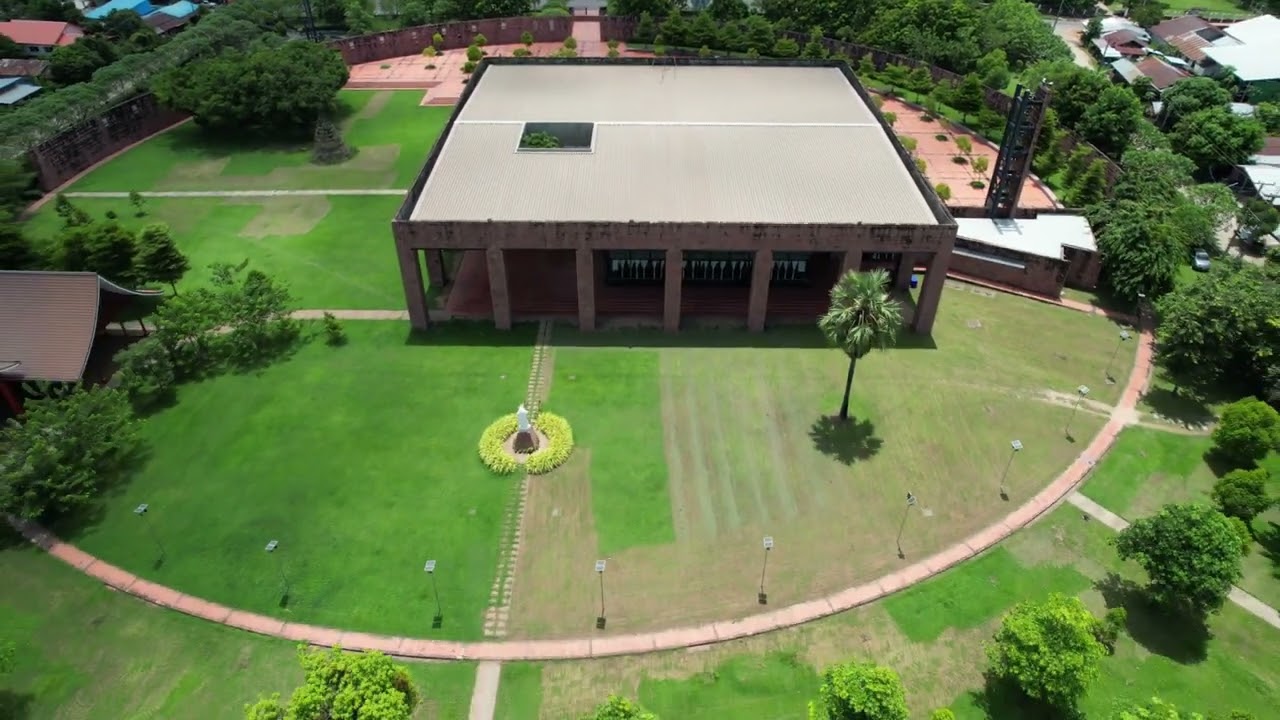
 Click to Access the Navigation Map GPS
Wat Song Khon Map
Recommend

 Art, Culture and Heritage
 Historical Sites and Monuments(2)
 Landmarks and Memorials(3)
 Art, Craft Centres, Tradition(2)
 Museums(1)
Temple(17)
Museums(1)
Temple(17)
 Other Sacred Sites(3)
 Suburban Living
 Village, Community(4)
 Local Market(2)
 Nature and Wildlife
 National Parks and Marine Reserves(4)
 Mountain (Doi)(5)
 Dam, Reservoir, Lake(3)
 Waterfalls(5)
 Caves(2)
 River, Canal(2)
 Bays and Beaches(1)
 Other natural attractions(1)
 Entertainment and Agricultural
 Farms, Parks and Ecotourism(1)


