
lovethailand home >Northeastern Travel Attractions >Mukdahan Travel Attractions >Muang Mukdahan >Mukdahan > Isan Folk Museum Baan Kwian Muk
TL;DR: Isan Folk Museum Baan Kwian Muk, Mukdahan attractions : Art, Culture and Heritage, Museums.

Isan Folk Museum Baan Kwian Muk
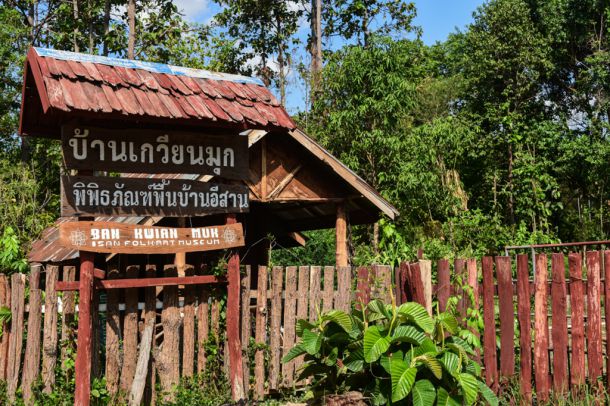
Open Days: Temporarily closed for renovation, with no reopening date announced
Opening Hours: No regular visiting hours while the museum is closed. Travelers should contact the caretaker directly before making the journey.
Ban Kwian Muk Folk Museum of Isan and the Two Mekong Banks is an extensive privately founded museum in Mukdahan whose story began with family memory, personal dedication, and a desire to preserve the practical wisdom of northeastern Thailand. Set across more than 10 rai of land, the collection includes traditional ox carts, agricultural tools, household utensils, pottery, weaving equipment, animal traps, musical instruments, old currency, glassware, silverware, metal objects, rice-processing machinery, and cultural items from northeastern Thailand, Laos, Cambodia, Vietnam, and China. The museum therefore tells a story extending beyond Mukdahan itself, presenting the everyday life, trade, transportation, and cultural relationships of communities throughout the Mekong region.
The museum is located at 10 Tad Khaen Road, Soi 18, Mukdahan Subdistrict, Mueang Mukdahan District. It is not housed inside a conventional modern museum building constructed from steel, glass, and concrete. Instead, visitors encounter a group of wooden houses, barn-like structures, cart sheds, working spaces, and open areas arranged to resemble the environment in which the objects were originally used. Carts remain inside the cart sheds, rice equipment stands within the rice-mill area, household objects are displayed inside a vernacular house, and agricultural implements remain connected to the physical world of rural labor.
The central figure behind Ban Kwian Muk is its founder and collector, Mr. Somsak Siboonruang. His inspiration came from his grandfather, an Isan man who had once been a nai hoi. A nai hoi was more than a livestock trader. He was a leader of overland trading caravans who required detailed knowledge of routes, water sources, geography, negotiation, animal care, security, and the organization of people traveling across long distances. Memories of his grandfather consequently connected Mr. Somsak with the world of ox carts, self-reliance, and practical knowledge acquired outside formal education.
As a child, Mr. Somsak observed that his grandfather had received little formal schooling yet remained remarkably capable of supporting himself. He cultivated rice, caught fish, repaired tools, used materials available in the local environment, and organized daily life without requiring cash for every activity. This experience demonstrated that knowledge did not belong exclusively to books, schools, or government institutions. It could also be found in the way a plow was held, a yoke was fitted, bamboo was split, clay was selected, fish were preserved, traps were positioned, and seasons were interpreted.
These memories gradually developed into a serious interest in old objects and vernacular culture. Items that other people considered outdated, damaged, or worthless appeared to him as evidence of how earlier generations lived. A cart preserved knowledge of wood, transport, and craftsmanship. A foot-operated rice mortar explained food processing. A weaving reed and yarn winder reflected textile production. A fish trap demonstrated knowledge of animal behavior, while jars and earthenware vessels recorded systems for storing water, fermenting fish, and preserving food.
As his collection expanded, local residents jokingly described Mr. Somsak as “crazy about old things.” The expression reflected a degree of dedication far beyond an ordinary pastime. He searched villages, markets, old households, and collector networks. Some items were purchased, some requested, some exchanged, and many were donated by people who believed the objects would survive longer inside a collection than if they remained neglected in private homes.
The collection was never restricted to Mukdahan or northeastern Thailand. Objects from Laos, Cambodia, Vietnam, and China entered the museum alongside Isan material culture. This diversity explains the extended name “Folk Museum of Isan and the Two Mekong Banks.” The Mekong has never functioned solely as a border between Thailand and Laos. For centuries it has been a corridor through which people, goods, language, beliefs, craftsmanship, and technology have moved. Chinese ceramics, Vietnamese bowls, Lao utensils, and objects associated with Khmer communities can therefore be interpreted alongside Isan agricultural tools without appearing disconnected.
After more than a decade of collecting, storage became a serious problem. Many items were exceptionally large, particularly the carts, wheels, rice-processing machinery, sugarcane presses, and agricultural implements. Keeping them without suitable buildings exposed the collection to sunlight, rain, humidity, termites, and loss. Mr. Somsak began considering a folk museum that could arrange the objects into meaningful groups and allow other people to learn from them rather than keeping everything as a private collection.
At first, the idea of creating a museum appeared impossibly ambitious. Museums were commonly associated with government departments, monumental buildings, large budgets, professional curators, and complex administrative systems. For a private collector, establishing such an institution seemed beyond reach. A decisive change occurred after Mr. Somsak visited a Hmong museum in Lom Sak District, Phetchabun Province.
The Hmong museum did not depend on expensive architecture. Simple structures resembling barns and chicken houses were used to display clothing, tools, and household objects belonging to the Hmong community. Seeing this approach allowed Mr. Somsak to understand that a museum did not have to begin with an elaborate building. What mattered was commitment, meaningful objects, and a space in which knowledge could be shared. When he inherited more than 10 rai of land, the project finally became possible.
Ban Kwian Muk began taking shape on 5 January 1995. It was not established through a government program or commercial tourism investment. The museum developed gradually from the founder’s land, objects, knowledge, labor, and personal network. Buildings and exhibition spaces were added according to the needs of the collection, and the site began receiving visitors informally in 1998.
The informal opening reflected the organic character of a community museum. Early visitors included local residents, schoolchildren, teachers, researchers, and people interested in cultural history. As more people arrived, the museum became a place of exchange. Elders helped identify unfamiliar objects and explain their use, teachers adapted the material for classroom activities, and owners of old household items offered additional donations.
The museum was divided into separate structures according to the nature of the collections. The principal areas included a vernacular house, an antiques house, a rice mill, and two cart sheds known locally as hong kwian. Each section represented a different chapter of local history, moving from household life and food production to weaving, farming, transportation, trade, and the circulation of objects across the Mekong region.
The vernacular house was arranged as a single-storey wooden building containing household utensils, pottery, cooking equipment, water jars, fermented-fish jars, sugarcane-processing equipment, weaving tools, traps, musical instruments, and everyday working objects. Together, these items demonstrate how many different skills were required to maintain an Isan household. Family members needed to produce and preserve food, make clothing, repair equipment, process crops, and obtain resources from the surrounding environment.
Fish-storage jars and fishing implements illustrate the relationship between communities and rivers, streams, ponds, and seasonal wetlands. Fish were not caught only for immediate consumption. Families developed methods for keeping fish alive or processing them into pla ra, dried fish, and fermented products that could be stored through periods of scarcity. An old fermentation jar is therefore more than a container; it is evidence of a food system that supplied protein throughout the year.
The sugarcane press explains how fresh cane was transformed into juice and products that could be stored. Before mechanized processing, people or draft animals supplied the force required to operate the press. Cultivation, cutting, transport, pressing, and boiling involved several stages and frequently required cooperation among households. One large wooden implement can consequently reveal information about agriculture, vernacular engineering, community labor, and seasonal production.
Weaving reeds, yarn winders, and related equipment record the role of women in Isan households. Making cloth began with growing and gathering cotton, removing seeds, fluffing the fibers, spinning thread, preparing natural dyes, setting up the loom, and weaving. Every implement performed a specific function, and the knowledge passed between generations. Displayed together, the tools show that a single piece of cloth required extensive knowledge of plants, color, measurement, pattern, and patient manual work.
Mouse traps, fish traps, and other hunting devices demonstrate careful observation of animal behavior. Their makers needed to understand the size of an animal, its movement, feeding times, and reaction to obstacles. Many traps were created from bamboo, wood, rattan, and fiber available locally. They could be repaired and reused instead of discarded when damaged.
The antiques house is a two-storey wooden building. Its upper level served as living accommodation, while the ground floor displayed ceramics, rooster bowls, Chinese and Vietnamese wares, glass, brass, silver, metalwork, betel sets, old currency, scales, lamps, irons, stone axes, and fossils. This section broadens the narrative beyond agriculture to include commerce, technology, consumption, and contact with distant regions.
Ceramics from different sources demonstrate that goods circulated into the Northeast through complex trade routes. Villages far from a seaport or production center could still obtain Chinese and Vietnamese vessels through cart caravans, Mekong markets, and traveling merchants. Clay composition, glaze, decoration, and form provide clues about the economic networks connecting rural households with wider regional systems.
Old coins and weighing equipment record the transition from barter to monetary exchange. Before modern currency became dominant, trade could involve rice, salt, cloth, livestock, forest products, or other goods. As money became increasingly important, scales and standardized measurements played a larger role in determining value. These relatively small objects explain major changes in the organization of everyday economic life.
Oil lamps and charcoal irons represent household technology before universal access to electricity. A lamp required fuel and a carefully maintained wick, while a metal iron had to be heated with charcoal or over a fire. Users controlled temperature through experience to avoid damaging cloth. Comparing these objects with electric lighting and modern irons demonstrates both technological change and the practical skills earlier generations possessed.
Stone axes and fossils introduce natural history and prehistoric time into the museum. Unlike household objects connected with remembered owners, these items reach far beyond living community memory. Their presence shows that the history of a landscape does not begin with the contemporary village. Natural processes and human activity have left many chronological layers beneath the modern city.
The rice-mill area explains the complete cycle of producing the principal food of the Northeast. It contains a medium-sized rice machine that Mr. Somsak purchased from an old mill and reconstructed, together with a foot-operated mortar, yokes, plows, wooden harrows, and farming equipment. The display allows visitors to follow rice from soil preparation and planting through harvesting, threshing, pounding, milling, and cooking.
A yoke transfers the force of cattle or buffalo to a plow or cart. Its design must correspond to the body and size of the animal. A poorly formed yoke can cause injury and reduce the animal’s ability to work. Wooden plows and harrows also require appropriate timber and shapes suited to local soil. Such implements were not crude objects made without calculation. They resulted from experimentation and refinement across generations.
The foot-operated rice mortar, known locally as a khok mong, uses a lever to raise and release a heavy wooden pestle. The mechanism reduces physical effort and permits continuous pounding. Its repetitive sound was once familiar in villages, especially when families prepared rice for daily meals, communal merit-making, or festivals. As mechanical rice mills replaced the device, the sound gradually disappeared from daily life.
The cart sheds are the museum’s defining feature. Hong is an Isan term for a shed or storage building. Ban Kwian Muk contains two major cart structures. The first displays complete carts, historic photographs of caravans, information on Isan trade, and the history of Mukdahan. The second stores a large number of dismantled cart components, allowing the museum to protect objects and manage the limited exhibition area.
The collection contains more than 100 carts, while museum survey records refer to approximately 120. Nearly 20 were assembled for display, with many others dismantled after termite damage became a serious concern. This concentration of material makes Ban Kwian Muk an important place for studying cart construction and the regional diversity of traditional land transport.
Carts differed according to terrain, purpose, and available materials. Carts from Na Kae and Renu Nakhon in Nakhon Phanom commonly had large wheels and broad structures suitable for sandy ground. Carts from Chonburi could be much larger and require two buffalo to pull them. In areas with firm soil, such as parts of Yasothon, carts could be more slender and decorative. These differences demonstrate how vernacular craftsmanship responded precisely to environmental conditions.
Carts associated with Na Samai in Yasothon have been admired for their elegant form and refined craftsmanship. Almost every component of a traditional cart can be removed and replaced. Craftsmen selected different timber for different functions. Wheel spokes required dense hardwood, while axles needed wood capable of resisting repeated bending and heavy loads. An unsuitable material could cause a wheel or axle to fail during a long journey.
Large wheels were not designed merely for visual effect. They helped a cart pass over holes, mud, sand, uneven ground, and routes without paved roads. Constructing a round, balanced wheel required considerable skill because even a small irregularity increased vibration and placed additional strain on the draft animal. The distinctive sound produced by wooden wheels also announced an approaching caravan before it became visible.
Before modern roads, ox carts were central to overland trade in northeastern Thailand. Caravans transported rice, salt, cloth, pottery, forest products, and other goods between villages, towns, and Mekong trading points. A journey could last days or weeks. The nai hoi and caravan members required knowledge of wells, resting places, safe routes, weather, and animal care. The founder’s memory of his grandfather as a nai hoi therefore gives the cart collection a deeply personal foundation.
Placed side by side, carts from different areas allow visitors to compare wheel size, axle width, frame design, joinery, decoration, and evidence of use. Wear marks, repairs, and replacement pieces are records of real journeys. Their value does not depend only on age but also on the way they preserve the adaptation of owners and craftsmen throughout the life of each vehicle.
Wheeled devices and fishing equipment displayed near the cart collection connect land transportation with the aquatic life of Mukdahan. Communities used both boats and carts, choosing between them according to terrain and season. High water opened river routes, while inland settlements and dry-season travel required wheeled transport. The combined displays reveal a flexible transportation system that existed before widespread motor vehicles.
The name “Ban Kwian Muk” summarizes the identity of the place. Ban means house or home, emphasizing the personal origin and community atmosphere. Kwian means cart, the defining object of the collection. Muk refers to Mukdahan. Together, the words describe a Mukdahan home dedicated to carts and the knowledge surrounding them.
The longer title, “Folk Museum of Isan and the Two Mekong Banks,” expands the subject beyond carts. Its collections cover many areas of life and originate from multiple cultures. The two banks refer especially to Thailand and Laos, yet the objects also reveal connections extending toward Cambodia, Vietnam, and China. The museum encourages visitors to understand Isan not as an isolated region but as an open cultural landscape shaped by continuous exchange.
Ban Kwian Muk is significant as a privately managed collection serving a public educational purpose. Its founder contributed personal land, time, labor, and resources to preserve objects that larger institutions might never have collected. Many pieces are ordinary household items rather than valuable court art, but this ordinary material can explain the lives of the majority of people with unusual clarity because it was handled, worn, repaired, and passed through real families.
The museum also demonstrates how history can be created from the local level. History does not consist only of rulers, wars, and national events. It also includes the ways people grew food, raised animals, traveled, dressed, traded, and cared for households. The objects at Ban Kwian Muk provide a place for the experience of ordinary people to become visible and available to later generations.
Teachers and students can connect the collections with many subjects. Agricultural tools relate to science and the environment. Carts demonstrate physics, geography, and woodworking. Weaving equipment connects with art, mathematics, and economics, while currency and scales relate to the history of trade. Encountering real objects allows processes that may appear remote in textbooks to become physically understandable.
Contemporary designers and craftspeople can also study material selection and structure. Traditional carts combine several kinds of timber without dependence on industrial fasteners. Basketry achieves strength with little weight. Earthenware naturally regulates moisture and temperature. Many old tools were designed so that a damaged component could be replaced without discarding the entire object. Such principles remain relevant to sustainable design and responsible resource use.
The founder’s memory of a grandfather who supported himself with limited reliance on money also remains relevant. The lesson does not require modern people to reproduce every aspect of past life. It demonstrates that resilience can emerge from practical skill, cooperation, and knowledge of local resources. A household able to grow food, repair tools, and exchange labor possesses forms of security that cannot be measured through cash alone.
Operating a museum largely through private effort presents major challenges. Buildings, cleaning, documentation, visitor management, and conservation require continuous resources. Termite damage among the carts illustrates the vulnerability of large wooden objects. Humidity, leaking roofs, temperature, insects, and ground contact can cause rapid deterioration. Dismantling carts reduced storage requirements and damage, although it prevented the entire collection from being displayed in assembled form.
The museum’s renovation closure reflects the vulnerability of local cultural institutions with limited resources. Closure does not reduce the importance of the collection. It demonstrates that conserving old objects requires time, money, specialist knowledge, and people. Travelers should not enter without contacting the caretaker because the property is privately managed and does not operate like a government museum with a permanent reception desk.
When the museum reopens, visitors should allow at least one or two hours. Beginning with the vernacular house provides a foundation in everyday life. The antiques house then introduces trade and imported material, followed by the rice mill and agricultural cycle. The visit can conclude in the cart sheds, where household history expands into mobility and regional commerce.
Visitors should never touch, lift, sit on, or rearrange carts and tools. Some wooden components may be fragile and incapable of bearing weight. Flash should be avoided around delicate surfaces, and objects should not be moved for photographs. Children require close supervision because many items are displayed without glass barriers.
Ban Kwian Muk is particularly valuable for travelers interested in vernacular history, woodworking, agriculture, Isan culture, and documentary photography. It differs from a museum dominated by multimedia screens and controlled lighting. Its character lies in the density of objects, visible wear, wooden architecture, and the relationship between the collection and the environment in which it is displayed.
The most comfortable season for exploring Mukdahan is generally from the end of the rainy season through the cooler months. The museum contains wooden and semi-open structures, so rain can make surfaces wet and increase humidity. Secure walking shoes and drinking water are useful. Confirmation from the caretaker remains essential regardless of season.
Ban Kwian Muk is best reached by private car, rental vehicle, or local taxi because it lies inside a lane off Tad Khaen Road and has no direct mass-transit connection. Travelers arriving at Mukdahan Bus Terminal can hire local transport and show the driver the name “Ban Kwian Muk, Tad Khaen Soi 18” together with the coordinates.
Getting There from central Mukdahan involves using Phitak Phanom Khet Road or the newer city roads to reach Tad Khaen Road, then entering Soi 18 and continuing to number 10. The site is approximately 5 km from the Mekong riverfront and Indochina Market. Navigation should be used because signs inside the residential area may be limited, and the caretaker should be contacted before entering the property.
The museum can be included in a cultural route with Mukdahan Tower, the City Pillar Shrine, the Chao Mae Song Nang Phi Nong Shrine, Wat Si Mongkhon Tai, and Indochina Market. Together, these places reveal several dimensions of Mukdahan, from agriculture and cart transportation to urban belief, settlement history, and contemporary border trade.
Mukdahan Tower provides a high viewpoint over the city. When compared with the cart and caravan history inside the museum, the landscape helps visitors understand how inland agricultural routes once connected with the river and trading center. Indochina Market extends the same narrative into the present. Goods now arrive by trucks rather than cart caravans, but Mukdahan continues to function as a regional exchange point.
Wat Si Mongkhon Tai and the Chao Mae Song Nang Phi Nong Shrine introduce the religious and spiritual life of the Mekong communities. Wat Roi Phra Phutthabat Phu Manorom provides an elevated view over the river plain and Laos. Combining these destinations with Ban Kwian Muk prevents the museum from becoming isolated from the real landscape in which its stories developed.
Restaurants around Tad Khaen Road include Isan food, made-to-order dishes, coffee shops, and family cafés. Small businesses may close on particular days, so their current hours should be checked. Accommodation ranges from small properties on Tad Khaen Road to budget hotels in central Mukdahan and larger hotels near the Mekong.
The importance of Ban Kwian Muk does not rest on the quantity of antiques alone. Its value comes from the way every category of object remains connected with human life. The memory of nai hoi caravans, farming, weaving, fishing, regional trade, and relationships across the Mekong appears within the same compound. An ordinary tool becomes social evidence when it is preserved and interpreted.
The museum’s creation also demonstrates that cultural preservation does not need to wait for a major institution. Mr. Somsak began with collected objects, personal memory, and family land before developing an educational space used by teachers, students, researchers, and the public. Such work encouraged other communities to recognize the importance of preserving their own objects and creating local cultural displays.
Future restoration should prioritize timber conservation, termite prevention, object registration, photography of dismantled components, and the recording of explanations from knowledgeable elders. Many objects have local names and specialized methods of use. If the physical item remains but the associated information disappears, much of its cultural meaning will be lost. Audio, video, and oral-history records are therefore as important as building repair.
Safe reopening will also require attention to walkways, information signs, fire protection, school-group areas, humidity control, and visitor management. The museum does not need to become a completely modern building. Its wooden houses and direct relationship between objects and working spaces are central strengths. Appropriate renovation should retain that identity while improving conservation and public safety.
Ban Kwian Muk Folk Museum of Isan and the Two Mekong Banks is ultimately a monument to knowledge produced through lived experience. More than 100 carts, agricultural implements, household vessels, and objects from neighboring countries collectively preserve the history of ordinary people. Although the museum is currently closed for renovation, its cultural value remains substantial, and its eventual restoration would help protect the memory of Isan life and regional exchange for future generations.
| Name | Ban Kwian Muk Folk Museum of Isan and the Two Mekong Banks |
| Alternative Names | Ban Kwian Muk Museum, Ban Kwian Muk |
| Location | Tad Khaen Road, Soi 18, Mukdahan Subdistrict, Mueang Mukdahan District, Mukdahan Province |
| Address | 10 Tad Khaen Road, Soi 18, Mukdahan Subdistrict, Mueang Mukdahan District, Mukdahan Province 49000, Thailand |
| Coordinates | 16.562194, 104.698168 |
| Founding Date | 5 January 1995 |
| Informal Opening | 1998 |
| Founder / Caretaker | Mr. Somsak Siboonruang; privately managed museum |
| Origin | Inspired by the founder’s grandfather, a former nai hoi caravan leader, and by the values of self-reliance, local wisdom, vernacular culture, and preservation of old objects |
| Name Origin | Ban means home, kwian means cart, and Muk refers to Mukdahan. The extended title reflects collections from Isan, Laos, and other cultures connected with the Mekong region. |
| Site Area | More than 10 rai |
| Highlights | More than 100 traditional carts, agricultural equipment, household objects, and cultural items from Isan, Laos, Cambodia, Vietnam, and China |
| Cart Collection | Museum survey records refer to approximately 120 carts. Nearly 20 were assembled for display, while numerous dismantled components were stored in the second cart shed. |
| Main Areas / Zones | 1. Vernacular House 2. Antiques House 3. Rice Mill and Farming Equipment Area 4. First Cart Shed for Exhibitions and Assembled Carts 5. Second Cart Shed for Dismantled Cart Components 6. Fishing Equipment and Wheeled-Transport Display Area |
| Vernacular House | Household utensils, pottery, jars, sugarcane equipment, weaving tools, craft tools, traps, musical instruments, and objects used in Isan daily life |
| Antiques House | Ceramics, glass, silver, brass, metalwork, old currency, scales, lamps, irons, stone axes, and fossils |
| Rice Mill | A reconstructed medium-sized rice machine, foot-operated mortar, yokes, plows, wooden harrows, and farming and rice-processing equipment |
| Cart Sheds | Carts from several regions, wheels and axles, caravan photographs, Isan trade history, and information explaining how cart forms varied according to terrain |
| Current Status | Temporarily closed for renovation; no reopening date has been announced |
| Open Days | No public admission during the renovation closure |
| Opening Hours | No regular visiting hours while closed |
| Admission Fee | No admission fee under the museum’s previous visiting arrangement; no visits during the renovation closure |
| Visitor Guidelines | Contact the caretaker before traveling, do not enter without permission, do not touch or sit on carts and artifacts, and supervise children closely when the museum reopens. |
| Travel Information | Use Phitak Phanom Khet Road or the newer city roads to reach Tad Khaen Road, then enter Soi 18. Private car, rental car, or local taxi is recommended. |
| Main Contact Numbers | +66 81 369 8724 and +66 42 613 647 |
| Nearby Tourist Attractions | 1. Wat Niramit Tad Khaen, approximately 2 km 2. Mukdahan City Pillar Shrine, approximately 3 km 3. Mukdahan Tower, approximately 4 km 4. Chao Mae Song Nang Phi Nong Shrine, approximately 5 km 5. Indochina Market, approximately 5 km 6. Wat Si Mongkhon Tai, approximately 6 km 7. Wat Roi Phra Phutthabat Phu Manorom, approximately 9 km |
| Nearby Restaurants | 1. Poeppoei Tad Khaen 21, approximately 1 km, Tel. +66 93 332 5826 2. Ahan Pa Ban Ban Tad Khaen, approximately 2 km, Tel. +66 82 550 6907 3. PunThai Coffee Tad Khaen Road, approximately 2 km, Tel. +66 62 242 7886 4. Cafe de Retreat Coffee & Dessert, approximately 3 km, Tel. +66 83 739 0316 5. Ban Pa Café, approximately 3 km, Tel. +66 63 234 2325 |
| Nearby Accommodations | 1. Wassana House Hotel, Tad Khaen Soi 11, approximately 2 km, Tel. +66 85 865 4410 2. B2 Mukdahan Boutique & Budget Hotel, approximately 3 km, Tel. +66 42 040 123 3. Ploy Palace Hotel, approximately 4 km, Tel. +66 42 614 988 4. Riverfront Hotel Mukdahan, approximately 5 km, Tel. +66 42 612 948–9 5. Hotel de Ladda, approximately 5 km, Tel. +66 42 611 499 |
Frequently Asked Questions (FAQ)
Q: Is Ban Kwian Muk Folk Museum currently open?
A: The museum is temporarily closed for renovation, and no reopening date has been announced. Travelers should contact the caretaker before making the journey.
Q: Where is Ban Kwian Muk located?
A: It is located at 10 Tad Khaen Road, Soi 18, Mukdahan Subdistrict, Mueang Mukdahan District, at approximately 16.562194, 104.698168.
Q: Who founded Ban Kwian Muk?
A: The museum was founded by Mr. Somsak Siboonruang, who was inspired by his grandfather, a former nai hoi caravan leader who lived through practical knowledge and self-reliance.
Q: How many carts are held at the museum?
A: The collection contains more than 100 carts, while museum survey records refer to approximately 120. Nearly 20 were assembled for display, and numerous others were stored as dismantled components.
Q: What are the main exhibition zones?
A: The principal areas are the Vernacular House, Antiques House, Rice Mill, first cart shed for complete carts and exhibitions, second cart shed for components, and an area containing fishing and wheeled-transport equipment.
Q: Why is it called the Folk Museum of Isan and the Two Mekong Banks?
A: The collection includes objects not only from Isan but also from Laos, Cambodia, Vietnam, and China, reflecting trade, travel, and cultural exchange throughout the Mekong region.
Q: Is there an admission fee?
A: The museum did not charge admission under its previous visiting arrangement. Public entry is suspended while the site is closed for renovation.
Q: How much time should visitors allow when the museum reopens?
A: A visit of at least 1–2 hours is recommended to explore the vernacular house, antiques collection, rice-processing area, and extensive cart displays without rushing.
Tel : 042613647
 Tel : 042613647
Mobile : 0813698724
 Mobile : 0813698724
Fax : 042613647
 Fax : 042613647
 Category: ●Art, Culture and Heritage
 Group: ●Museums
Last Update : 2 MonthAgo
 Last Update : 2 MonthAgo
 Click to Access the Navigation Map GPS
Isan Folk Museum Baan Kwian Muk Map
Recommend

 Historical Sites and Monuments(2)
 Landmarks and Memorials(3)
 Art, Craft Centres, Tradition(2)
Museums(1)
Art, Craft Centres, Tradition(2)
Museums(1)
 Places of Worship
 Temple(17)
 Other Sacred Sites(3)
 Suburban Living
 Village, Community(4)
 Local Market(2)
 Nature and Wildlife
 National Parks and Marine Reserves(4)
 Mountain (Doi)(5)
 Dam, Reservoir, Lake(3)
 Waterfalls(5)
 Caves(2)
 River, Canal(2)
 Bays and Beaches(1)
 Other natural attractions(1)
 Entertainment and Agricultural
 Farms, Parks and Ecotourism(1)


