
lovethailand home >Northeastern Travel Attractions >Maha Sarakham Travel Attractions >Muang Maha Sarakham >Koeng > Khong Kut Wai Fish Park
TL;DR: Khong Kut Wai Fish Park is located at Ban Khong Kut Wai, Moo 7, Koeng Subdistrict, Mueang Maha Sarakham District, Maha Sarakham Province, open Daily, hours 08.00 – 17.00.
Khong Kut Wai Fish Park
Open Days: Daily
Opening Hours: 08.00 – 17.00
Khong Kut Wai Fish Park, also known as Wang Matcha Khong Kut Wai, is a rural conservation attraction in Ban Khong Kut Wai, Moo 7, Koeng Subdistrict, Mueang Maha Sarakham District, Maha Sarakham Province. Located only a short drive from Maha Sarakham city, the park is known for its large freshwater fish population, its curved natural water body connected with the old course of the Chi River, and its strong link with local community conservation. It is one of the most distinctive eco-cultural attractions in Maha Sarakham, especially for travelers who want to see freshwater fish, learn about rural Isan water ecology, and experience a community-based attraction rather than a commercial tourist complex.
The charm of Khong Kut Wai Fish Park lies not only in the number of fish but also in the story behind the place. This is a site where local villagers chose to protect fish instead of catching them. Over time, the protected water area became a fish sanctuary, a learning site, and a leisure destination. Visitors can feed fish from the wooden bridge, sit by the water, walk to the nearby temple area, observe the local riverside landscape, and understand how a small rural community turned a natural water resource into a shared cultural and ecological asset.
The name “Khong Kut Wai” reflects the local geography. In the local context, “khong” refers to the curved character of the water as it follows or connects with the Chi River, while “kut wai” refers to an important water area where wai, or rattan, once grew densely around the banks. The name therefore carries both ecological and cultural meaning. It describes a place shaped by water, plants, community settlement, and local memory.
The fish park is located in a natural oxbow-like water body formed by changes in the old course of the Chi River. When floodwaters once entered the area, large numbers of fish from the Chi River and nearby water sources gathered in Kut Wai. Instead of harvesting them, local people recognized the value of protecting the fish. This decision allowed the area to develop into a fish sanctuary and later into a community tourism attraction.
The most memorable activity here is feeding the fish. When visitors scatter suitable fish food into the water, many fish rise to the surface and gather in a lively movement. For children and first-time visitors, this is both exciting and educational. Unlike watching fish in an aquarium, visitors see freshwater fish in a natural outdoor water environment connected with local riverside ecology.
One of the fish most associated with Khong Kut Wai is pla phoh, a soft-flesh fish related to river fish traditions in the Mekong and Chi River systems. Local people also mention other freshwater species such as striped catfish, carp, tilapia, and other river fish that gathered in the water area. These fish are part of the ecological identity of the park and help visitors understand why this place became an important conservation site.
Ban Khong Kut Wai is also culturally significant. The community is known for its strong cultural organization and was recognized as Thailand’s first cultural village in 1997. The conservation of fish in Kut Wai is part of this wider community identity. Villagers organized themselves around cultural cooperation, local wisdom, and shared responsibility. As a result, the fish park became a symbol of local unity, conservation, and pride.
The park is closely connected with Wat Phithak Samakkhi Phosi 2, a temple area near the water. In the past, the area around the bend in the waterway was associated with grass and natural materials used for temple-related purposes. Over time, the temple and community became central to the protection of fish and the development of the fish sanctuary. This connection between temple, water, fish, and village life makes the park a good example of how conservation in rural Thailand often includes both ecological and spiritual values.
Khong Kut Wai Fish Park is suitable for families, students, nature lovers, and foreign travelers interested in rural Isan culture. Families can bring children to feed fish and learn about freshwater animals. Students can use the area to understand local water systems, community conservation, and the relationship between people and natural resources. Older visitors can enjoy a quiet riverside atmosphere, while photographers can capture the wooden bridge, fish feeding area, floating rafts, water views, and rural community scenery.
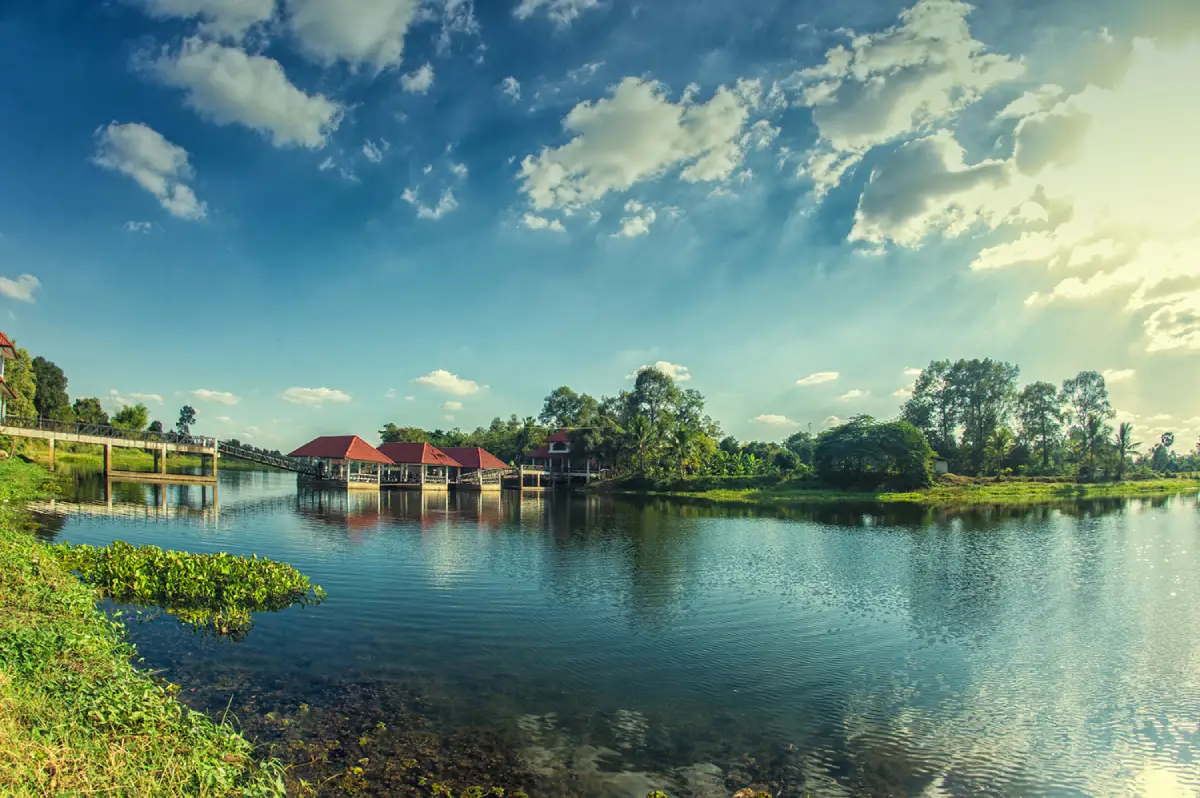
The wooden bridge is one of the most important features of the park. It crosses the water toward the temple area and works as a viewing and fish-feeding point. From the bridge, visitors can see the surface of the water, watch fish movement, and take wide photos of the surrounding landscape. The bridge gives the park a distinctive visual identity and makes the experience more interactive than simply standing on the bank.
There are also riverside pavilions and floating rafts where visitors can rest, eat, and enjoy the atmosphere. These simple facilities make the park feel informal and community-based. It is not designed for luxury tourism. Its appeal is in its local character, the calm water, the presence of fish, and the way the community welcomes visitors into a shared conservation space.
The best time to visit is in the morning or early afternoon. The park is open daily from 08.00 to 17.00. Morning visits are pleasant because the weather is cooler and the light is good for photography. Late afternoon before closing can also be relaxing, especially for travelers who prefer a quieter riverside atmosphere. On weekends and holidays, more visitors may come to feed fish and relax by the water.
Khong Kut Wai Fish Park can be visited throughout the year. In the rainy season, the surrounding landscape becomes greener and the story of water movement from the Chi River becomes easier to imagine. In the cool season, walking and sitting by the water are especially comfortable. In the hot season, visitors should come in the morning, bring water, wear a hat, and avoid staying under direct sun for too long.
Getting There is most convenient by private car. From Mueang Maha Sarakham, travel toward Koeng Subdistrict and Ban Khong Kut Wai along the Maha Sarakham-Mukdahan route or the local route recommended by navigation apps. The distance from the city is about 6 to 10 km, depending on the starting point and route. Search for “Khong Kut Wai Fish Park,” “Wang Matcha Khong Kut Wai,” or “Ban Khong Kut Wai, Koeng Subdistrict” and confirm that the destination is in Mueang Maha Sarakham District before departure.
The reference coordinates for Ban Khong Kut Wai are 16.22528929, 103.3172885. These coordinates are useful for route planning, especially for travelers unfamiliar with local village names. Since the area is community-based, visitors should drive carefully through village roads, slow down near intersections, and be mindful of motorcycles, pedestrians, and local residents.
The park is a good place to learn about the word “kut” in Isan geography. A kut is a water body often linked to an old river channel or a river that has changed its course. Such places can become important habitats for fish, local water storage areas, and seasonal ecological zones. Khong Kut Wai therefore helps travelers understand how northeastern Thai communities live with river systems, flood cycles, and local water landscapes.
The conservation idea at the park is simple but powerful. By not catching fish in the protected area, the community allowed fish numbers to increase and turned the water body into a living attraction. Instead of being used only for fishing, the site became a place for education, merit-making, community pride, and rural tourism. This transformation is what makes the fish park meaningful.
Visitors should follow responsible behavior. Do not catch fish. Do not fish in the protected area. Do not throw plastic, food waste, or unsuitable items into the water. Feed only appropriate fish food. Keep the bridge, pavilions, and floating areas clean. The health of the fish and the beauty of the park depend on how visitors behave.
Families with children should supervise them closely on the bridge and near the water. Feeding fish is a safe and enjoyable activity, but any riverside area still requires care. Children should not climb railings, run near the edge, or throw objects into the water. Good supervision makes the visit safe and enjoyable for everyone.
For photography, the park offers several attractive angles: the wooden bridge across the water, the fish rising to the surface, riverside pavilions, floating rafts, the curved waterway, and the nearby temple scenery. Morning light is best for clear and natural photos. Late afternoon light gives a softer community-tourism atmosphere.
Khong Kut Wai Fish Park can be combined with other attractions in Mueang Maha Sarakham. Nearby options include Kaeng Loeng Chan, Kaeng Loeng Chan Health Park, Maha Sarakham City Pillar Shrine, Wat Pa Wang Nam Yen, and Mahasarakham University Museum. This makes it easy to plan a half-day or full-day route combining nature, community culture, food, and city attractions.
A half-day trip can start with the fish park in the morning. Visitors can feed fish, walk across the bridge, take photos, and spend time by the water for one or two hours. After that, they can continue to restaurants or cafés in Koeng Subdistrict, Kaeng Loeng Chan, or Mueang Maha Sarakham. This route is suitable for families, older travelers, and anyone looking for a relaxed schedule.
A full-day trip can combine Khong Kut Wai Fish Park with Kaeng Loeng Chan, Wat Pa Wang Nam Yen, and the city center. Start with community-based nature learning in the morning, stop for lunch near Kaeng Loeng Chan or in town, then visit temples or cultural landmarks in the afternoon. This gives travelers a balanced view of Maha Sarakham: fish sanctuary, rural community, local food, and urban cultural sites.
Restaurants near the park range from local eateries and cafés in Koeng Subdistrict to larger restaurants near Kaeng Loeng Chan and in Mueang Maha Sarakham. Visitors can choose Isan food, Thai dishes, fish menus, coffee, desserts, and family-style restaurants. The nearby city also offers convenient dining choices for travelers continuing their trip.
Accommodation is available in Koeng Subdistrict and Mueang Maha Sarakham. Staying near Koeng is convenient for travelers who want to remain close to the fish park and Mahasarakham University area. Staying in the city center gives more hotel choices, more restaurants, and easier access to other attractions. Travelers with cars can comfortably visit the park as a short trip from most city hotels.
What makes Khong Kut Wai Fish Park different from ordinary natural attractions is the cultural story behind the water. The village name, the community organization, the temple connection, the decision not to catch fish, and the pride of being a cultural village all give the park a deeper meaning. It is not only a place to feed fish; it is a place to understand how rural communities can protect nature through shared values.
For foreign travelers, Khong Kut Wai Fish Park is a strong example of rural eco-cultural tourism in Isan. It shows a natural water body, freshwater fish, a temple-centered community, and local conservation practices in one place. Visiting the park gives travelers a deeper understanding of northeastern Thailand beyond temples, city landmarks, and mainstream tourist routes.
The best way to enjoy the park is to slow down. Walk carefully, observe the water, feed the fish responsibly, listen to the sounds of the area, and take time to understand the community. A short visit can still be meaningful when visitors respect the place and see it as a living conservation space rather than just a quick photo stop.
In summary, Khong Kut Wai Fish Park in Maha Sarakham is a rural conservation attraction built around a natural water body, a large freshwater fish population, community participation, and the cultural identity of Ban Khong Kut Wai. With fish-feeding points, a wooden bridge, floating rafts, riverside rest areas, and a nearby temple, it is suitable for families, students, nature lovers, and travelers who want to experience authentic rural Isan. Visitors should avoid catching fish, keep the area clean, feed fish responsibly, and respect the community conservation rules so that Khong Kut Wai remains a valuable learning and leisure destination for the future.
| Name | Khong Kut Wai Fish Park / Wang Matcha Khong Kut Wai |
| Location | Ban Khong Kut Wai, Moo 7, Koeng Subdistrict, Mueang Maha Sarakham District, Maha Sarakham Province |
| Address | Moo 7, Koeng Subdistrict, Mueang Maha Sarakham District, Maha Sarakham 44000, Thailand |
| Coordinates | 16.22528929, 103.3172885 |
| Highlights | Freshwater fish sanctuary in a natural curved water body connected with the Chi River landscape, with a wooden bridge, fish-feeding point, floating rafts, and rural conservation atmosphere |
| Distinctive Features | Large numbers of freshwater fish such as pla phoh, striped catfish, carp, tilapia, and other river fish living in a protected community water area |
| History / Local Context | Developed from community fish conservation in Kut Wai. Ban Khong Kut Wai was recognized as Thailand’s first cultural village in 1997, and the fish park became a community leisure and learning destination |
| Name Origin | “Khong” refers to the curved water landscape linked with the Chi River, while “Kut Wai” refers to an important water area once surrounded by dense rattan growth |
| Travel Information | From Mueang Maha Sarakham, travel toward Koeng Subdistrict and Ban Khong Kut Wai along the Maha Sarakham-Mukdahan route. Private car travel is the most convenient option |
| Current Status | Rural conservation attraction, community leisure site, and freshwater fish learning area in Maha Sarakham Province |
| Open Days | Daily |
| Opening Hours | 08.00 – 17.00 |
| Fees | No commercial-style admission fee information listed |
| Facilities | Fish-feeding point, wooden bridge, riverside pavilions, floating rafts, fish food stall, riverside resting area, and nearby temple area |
| Main Areas / Zones | Wooden bridge viewing zone, fish-feeding zone, floating raft zone, riverside pavilion zone, Wat Phithak Samakkhi Phosi 2 area, Kut Wai water zone, and Ban Khong Kut Wai community area |
| Caretaker / Local Contact Agency | Mahasarakham University together with Ban Khong Kut Wai community, local temple, and Koeng Subdistrict Municipality, Mueang Maha Sarakham District |
| Main Contact Number | 043-713-579 |
| Nearby Tourist Attractions | 1. Wat Phithak Samakkhi Phosi 2, about 1 km 2. Ban Koeng Field Station, Walai Rukhavej Botanical Research Institute, about 6 km 3. Kaeng Loeng Chan / Kaeng Loeng Chan Health Park, about 9 km 4. Maha Sarakham City Pillar Shrine, about 11 km 5. Wat Pa Wang Nam Yen / Wat Phutthawanaram, about 12 km 6. Mahasarakham University Museum, about 17 km |
| Nearby Restaurants | 1. The Chill Cafe, Koeng Subdistrict, about 6 km, Tel. 098-025-0600 2. Cafe Can&Care Restaurants, Koeng Subdistrict, about 7 km, Tel. 082-921-1566 3. White Balance Cafe, Kaeng Loeng Chan, about 9 km, Tel. 083-839-9633 4. Reuanthong Restaurant, Kaeng Loeng Chan, about 10 km, Tel. 043-777-678, 082-441-4195, 087-978-9646 5. NANA CAFE, about 12 km, Tel. 092-279-9339 6. Farm Sook Cafe Maha Sarakham, about 13 km, Tel. 064-996-6414 |
| Nearby Accommodations | 1. The Chill Hotel Sarakham / The Chill Town Home, Koeng Subdistrict, about 6 km, Tel. 083-677-0192 2. HOP INN Mahasarakham, about 10 km, Tel. 065-950-4683 3. Top Inn Hotel Mahasarakham, about 11 km, Tel. 062-545-5622, 043-711-979 4. Debua Mahasarakham, about 12 km, Tel. 043-020-191, 081-871-2232 5. Taksila Hotel Mahasarakham, about 12 km, Tel. 043-719-999 |
Frequently Asked Questions (FAQ)
Q: Where is Khong Kut Wai Fish Park located?
A: Khong Kut Wai Fish Park is located in Ban Khong Kut Wai, Moo 7, Koeng Subdistrict, Mueang Maha Sarakham District, Maha Sarakham Province. It is a rural conservation attraction and freshwater fish sanctuary near Maha Sarakham city.
Q: What are the opening days and hours of Khong Kut Wai Fish Park?
A: The park is open daily from 08.00 to 17.00. Morning to early afternoon is the best period for visiting and fish feeding.
Q: Is there an entrance fee for Khong Kut Wai Fish Park?
A: No commercial-style admission fee information is listed. Visitors can support the local community by buying fish food and using local services responsibly.
Q: What is the main highlight of Khong Kut Wai Fish Park?
A: The main highlight is the large population of freshwater fish in the protected Kut Wai water area, especially pla phoh and other river fish, along with the wooden bridge, fish-feeding point, floating rafts, and community conservation atmosphere.
Q: How do travelers get to Khong Kut Wai Fish Park?
A: From Mueang Maha Sarakham, travel toward Koeng Subdistrict and Ban Khong Kut Wai along the Maha Sarakham-Mukdahan route. The distance is about 6 to 10 km from the city, and private car travel is the most convenient option.
Q: Is Khong Kut Wai Fish Park suitable for children and families?
A: Yes. It is suitable for families because children can feed fish and learn about freshwater animals. Adults should supervise children closely on the bridge and near the water.
Q: Can visitors catch or fish in the park?
A: No. Visitors should not catch fish, fish in the protected area, or disturb aquatic animals because the park is a fish conservation and community learning area.
Q: What nearby attractions can be combined with Khong Kut Wai Fish Park?
A: Nearby attractions include Wat Phithak Samakkhi Phosi 2, Ban Koeng Field Station, Kaeng Loeng Chan, Maha Sarakham City Pillar Shrine, Wat Pa Wang Nam Yen, and Mahasarakham University Museum.
 Category: ●Entertainment and Agricultural
 Group: ●Farms, Parks and Ecotourism
Last Update : 2 MonthAgo
 Last Update : 2 MonthAgo
 Click to Access the Navigation Map GPS
 Art, Culture and Heritage
 Historical Sites and Monuments(4)
 Art, Craft Centres, Tradition(5)
 Museums(3)
 Places of Worship
 Temple(17)
 Other Sacred Sites(7)
 Research and Development
 Royal Project(2)
 Suburban Living
 Village, Community(5)
 Nature and Wildlife
 National Parks and Marine Reserves(3)
 Dam, Reservoir, Lake(10)
 River, Canal(2)
 Bays and Beaches(2)
 Other natural attractions(2)
Farms, Parks and Ecotourism(3)
Other natural attractions(2)
Farms, Parks and Ecotourism(3)
 Travel Articles, Recipes
 Food Menu, Northeastern Recipes(1)


