
lovethailand home >Northeastern Travel Attractions >Loei Travel Attractions >Phu Rua >Pla Ba > Phu Ruea Highland Agricultural Experiment Station
TL;DR: Phu Ruea Highland Agricultural Experiment Station is located at Ban Hin So, Pla Ba Subdistrict, Phu Ruea District, Loei Province 42160, Thailand, open Daily, hours 09.00 – 16.00.
Phu Ruea Highland Agricultural Experiment Station
Open Days: Daily
Opening Hours: 09.00 – 16.00
Phu Ruea Highland Agricultural Experiment Station in Loei Province, now widely known as Loei Horticultural Research Center – Phu Ruea Highland Agriculture, is an important highland agricultural research and learning center in Ban Hin So, Pla Ba Subdistrict, Phu Ruea District, Loei Province. Located in a cool mountain environment about 900 – 1,000 meters above sea level, the center plays a major role in studying, testing, and demonstrating temperate flowers, temperate fruits, local horticultural crops, and highland farming systems suitable for Loei’s climate and ecosystem. For international travelers, this is one of the best places to understand how Thailand develops highland agriculture in a cool northeastern mountain district.
The center is not only a scenic flower garden. It is a technical research station under Thailand’s Department of Agriculture, created to connect scientific research with real farming practices. Its work includes testing plant varieties, observing crop performance, studying growth under local soil and climate conditions, and transferring research results to farmers, students, officials, and interested visitors. This makes the site both an agricultural tourism destination and a practical learning center. Visitors can see how research becomes knowledge, how knowledge becomes demonstration, and how demonstration can support farmers in highland communities.
The location of the center is essential to its identity. Phu Ruea is known for cool weather, mountain scenery, mist, winter flowers, and highland horticulture. The center is located in Pla Ba Subdistrict, where the temperature is cooler than lowland northeastern Thailand throughout much of the year. During winter, the temperature can drop significantly, and frost-like ice crystals known locally as mae khaning may appear under suitable weather conditions. These environmental factors allow researchers to study crops that would not grow well in hotter plains.
The history of Phu Ruea Highland Agricultural Experiment Station began in 1986, when the Department of Agriculture established the station in a degraded forest-reserve area around Ban Hin So and Ban Pong Kwang in Pla Ba Subdistrict. The purpose was to create a research base for highland agriculture in northeastern Thailand, especially for temperate fruits, cool-season flowers, and horticultural crops that could be promoted to farmers. The station later became part of Loei Horticultural Research Center and remains an important agricultural research and tourism site today.
The center’s value lies in field-based research. Crops grown at high elevations must be tested under real local conditions. Temperature, rainfall, slope, soil texture, acidity, drainage, disease pressure, and seasonal change all influence whether a plant can grow productively. By testing crops directly in Phu Ruea, researchers can obtain practical information that is more useful for local farmers than general textbook knowledge. This is especially important when introducing new crops that may require investment and long-term care.
Temperate fruits are among the most interesting crops at the center. Visitors may see or learn about Chinese chestnut, persimmon, pear, macadamia nut, and other cool-climate fruit crops. These plants are important because they show the potential of highland areas in Loei to support alternative crops. Macadamia, for example, is a high-value nut crop that requires suitable climate and long-term management. Persimmon, pear, and chestnut also demonstrate how highland horticulture can create new opportunities for farmers in areas where ordinary lowland crops may not be the best choice.
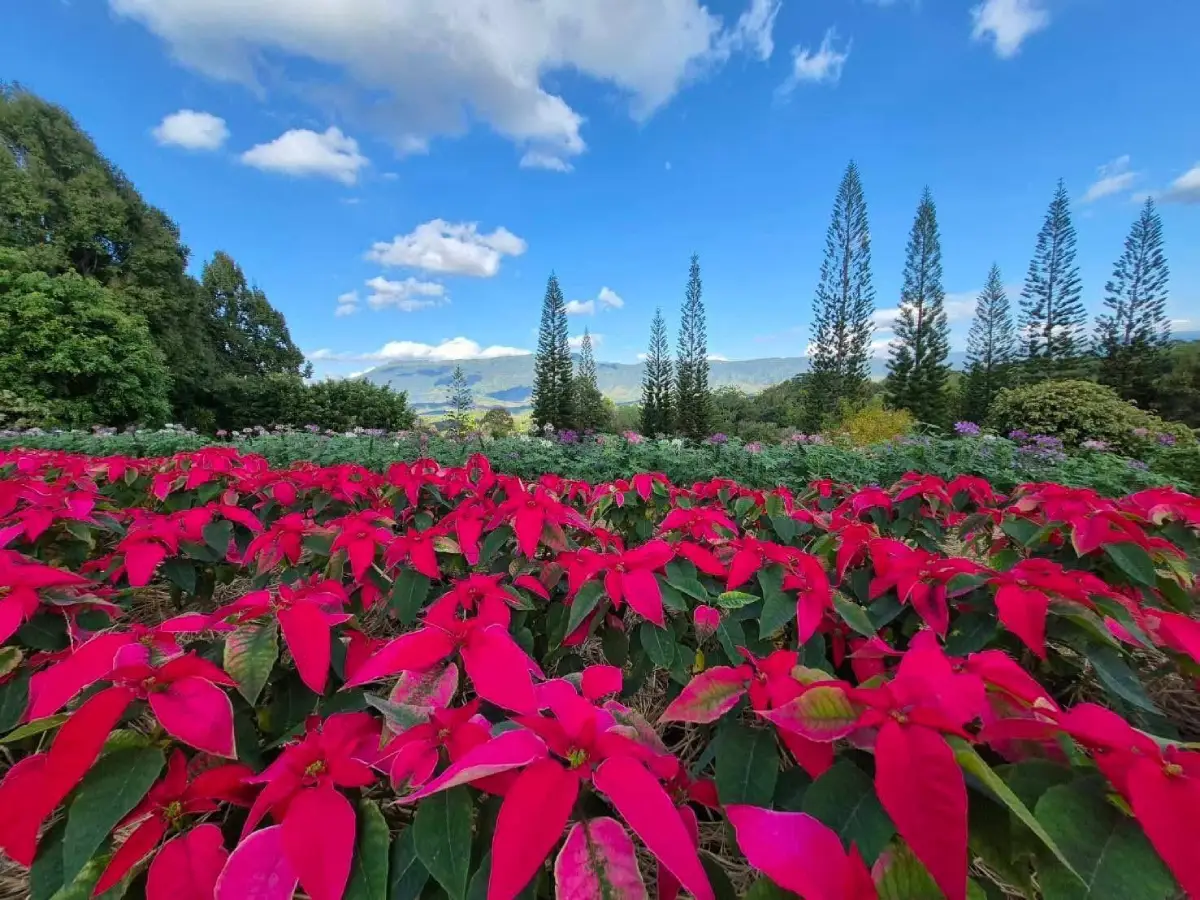
Cool-season flowers are another major highlight. From November to February, the center becomes especially attractive because many winter flowers are in season. Visitors can see ornamental flowers such as poinsettia, yellow poinsettia, petunia, snapdragon, pansy, pot marigold, ornamental cabbage, roses, blue salvia, and salvia fields. These flowers are visually beautiful, but they also represent research and cultivation knowledge. Each species requires proper management of temperature, light, water, soil media, fertilizer, and pest control. A beautiful flower display is therefore also a demonstration of technical skill.
December to January is one of the most appealing periods to visit. During this time, travelers can experience cool weather, winter flowers, strawberries, macadamia nuts, Arabica coffee, and the possibility of mae khaning when the weather is cold enough. This period connects climate, crops, tourism, and local products in a single experience. Visitors who come for flowers often discover fruit crops and coffee, while those who come for agricultural study can also enjoy the landscape and seasonal atmosphere.
From April to August, the center remains relevant through crops such as torch ginger and Siam tulip. This shows that the center is not only a winter destination. It can be visited throughout the year by those interested in horticultural research, demonstration plots, plant diversity, and group study visits. Seasonal change is part of the value of an agricultural research center. Different months reveal different plants, problems, techniques, and visual experiences.
The center can be understood through several main areas. The first is the temperate fruit demonstration area, where visitors can learn about fruit crops suited to cool highland conditions. The second is the cool-season flower area, where winter ornamental plants provide both beauty and learning. The third is the greenhouse and rare-plant area, including local plants, ferns, anthurium, gerbera, chrysanthemum, and wild orchids. The fourth is the agricultural learning and demonstration area, designed for farmers, students, and study groups. The fifth is the nature-walk and landscape-viewing area, which connects agriculture with the surrounding mountain ecosystem.
The temperate fruit plots are especially important for understanding the center’s academic function. These plots are not simply orchards for tourism. They are areas for testing and observing plant growth under actual field conditions. Visitors can learn why plant selection matters, how altitude affects fruit crops, and why long-term observation is necessary before promoting a crop to farmers. Agriculture on highland slopes involves risk, and research helps reduce that risk.
The cool-season flower area is the most visually accessible zone for general travelers. Colorful flowers make the center attractive for photography, family trips, and casual visits. Yet this area is also educational. It shows how ornamental plants can become part of local tourism and the local economy. In Phu Ruea, flowers are not only decorative; they are linked to nurseries, plant sales, winter tourism, roadside gardens, accommodations, cafés, and community income.
The greenhouse and rare-plant area adds botanical value to the visit. Plants such as ferns, local species, anthurium, gerbera, chrysanthemum, and wild orchids help visitors see plant diversity beyond seasonal flower displays. Some plants require special care or controlled environments. This zone is useful for visitors interested in plant conservation, ornamental horticulture, and the diversity of plants that can be studied or cultivated in a cool highland setting.
The agricultural learning and demonstration area is one of the center’s most practical zones. Farmers and study groups can observe crop systems, ask questions, and learn from real plots. Demonstration reduces the gap between research and practice. Farmers do not need to rely only on written information; they can see crop performance, compare plant characteristics, and discuss management techniques with staff. This is one of the reasons the center remains important to agricultural development in Loei.
The nature-walk and landscape area reminds visitors that highland agriculture must be considered together with ecology. Mountain areas are more fragile than flatlands. Soil erosion, water management, slope, forest surroundings, and local biodiversity all matter. Walking through the center and seeing the surrounding mountains helps visitors understand that agricultural development in such areas must be careful, knowledge-based, and environmentally responsible.
The center also offers accommodation and camping facilities for visitors and study groups. It has houses, camping areas, toilets, and shower rooms. It can accommodate a large number of visitors by reservation, and meals may be arranged in advance. Staying overnight allows travelers to experience the cold evening and early morning atmosphere of Phu Ruea more closely. Visitors interested in accommodation should contact the center directly before traveling.
For farmers, Loei Horticultural Research Center is valuable because it provides tested information before new crops are promoted widely. Introducing temperate fruits or highland crops without research can be risky. Farmers must consider climate, soil, investment cost, harvest period, market demand, diseases, and long-term management. The center’s research and demonstrations help reduce uncertainty and provide more reliable guidance for farmers on highland areas.
For ordinary travelers, the center makes a trip to Phu Ruea more meaningful. Instead of seeing only mountain scenery or flower gardens, visitors can understand the knowledge behind the flowers and fruits. They can see how climate creates agricultural opportunity, how research supports local production, and how highland farming becomes part of tourism. This turns sightseeing into learning without making the experience heavy or difficult.
For students and families, the center functions as an outdoor classroom. Children can observe plants, compare leaves and flowers, learn why some crops need cool weather, and understand how research affects food and farming. Parents and teachers can use the visit to discuss climate, agriculture, ecology, and local livelihoods. Learning from real fields often makes agricultural science easier to understand than reading from a textbook alone.
For photographers, the center offers winter flowers, salvia fields, mountain views, greenhouses, orchards, and cool-season atmosphere. Morning and late afternoon light are best for photography. During winter, visitors should prepare warm clothing, especially if staying overnight or visiting early in the morning. Photography should be done respectfully. Visitors should not step into research plots, pick flowers, touch fruit, or move objects without permission.
Getting There is most convenient by private car, rental car, or group vehicle. From Phu Ruea town, visitors travel toward Pla Ba Subdistrict and Ban Hin So, about 24 to 25 kilometers from the district town. From Mueang Loei, drive toward Phu Ruea District and continue to Loei Horticultural Research Center in Pla Ba Subdistrict. The route passes rural and mountain areas, so visitors should check road and vehicle conditions, especially during the rainy season or foggy periods.
Travelers coming from Bangkok can use the route through Saraburi, Phetchabun, Lom Sak, Dan Sai, and Phu Ruea before turning toward the center. Those coming from Khon Kaen can travel through Chum Phae, enter Loei Province, continue toward Phu Ruea, and follow signs to the center. Because the site is located in a highland area, visitors should plan travel time carefully, refuel in advance, and avoid rushing, especially if traveling with children or elderly people.
The best time to visit depends on the purpose. For winter flowers, November to February is ideal. For cool-season vegetables, strawberries, macadamia nuts, Arabica coffee, and cold-weather atmosphere, December to January is especially attractive. For torch ginger and Siam tulip, April to August can be interesting. For group agricultural study visits, the center can be contacted throughout the year. Choosing the right season helps visitors see the crops they are most interested in.
Visitors should contact the center before traveling, especially for group visits, study tours, accommodation, meals, or special activities. Some areas are working research plots and may not be open freely at all times. Following staff guidance protects the crops, the research work, and the safety of visitors. Advance contact also helps confirm current flower conditions, accommodation availability, and visiting arrangements.
General admission fee information should be confirmed directly with the center, especially for study groups or those using accommodation and meal services. The center clearly provides accommodation and meal services by reservation, while special arrangements may have separate costs. Confirming details before arrival helps visitors plan their budget and avoid misunderstanding.
Good visitor manners are essential at an agricultural research station. Visitors should not pick flowers, harvest fruits, walk into restricted plots, touch research equipment, move plant labels, or remove plant material without permission. Some plots may be part of ongoing research, and even small damage can affect data collection. Respectful behavior helps keep the center useful for future visitors, farmers, and researchers.
For international travelers, Phu Ruea Highland Agricultural Experiment Station is a clear example of highland agriculture in Thailand. It shows that Thailand is not only a tropical lowland farming country. In cool mountain areas like Phu Ruea, researchers can study temperate fruits, winter flowers, macadamia, Arabica coffee, strawberries, and local horticultural crops. The center is suitable for visitors interested in agriculture, botany, ecology, rural development, conservation tourism, and plant-based learning.
The center can be combined with nearby attractions such as Pla Ba Waterfall, Phu Paek Arboretum, Song Khon Waterfall, Phu Ruea Flower Center, Phu Ruea National Park, Chateau de Loei, and Phu Luang Wildlife Sanctuary. This route allows travelers to understand Phu Ruea through agriculture, forests, waterfalls, mountains, and local products. A 2-day itinerary is especially suitable for those who want to visit the center slowly and stay overnight in the cool highland atmosphere.
In summary, Phu Ruea Highland Agricultural Experiment Station, or Loei Horticultural Research Center, is one of the most valuable agricultural learning destinations in Loei Province. It studies and demonstrates temperate flowers, temperate fruits, local horticultural crops, and highland farming systems suited to Phu Ruea’s climate and ecosystem. Visitors can see fruit plots, winter flowers, rare-plant greenhouses, agricultural demonstrations, camping areas, accommodations, and mountain scenery. The center is suitable for travelers, farmers, students, families, photographers, and international visitors who want to understand Phu Ruea beyond ordinary sightseeing.
| Name | Phu Ruea Highland Agricultural Experiment Station / Loei Horticultural Research Center – Phu Ruea Highland Agriculture |
| Location | Ban Hin So, Pla Ba Subdistrict, Phu Ruea District, Loei Province 42160, Thailand |
| Address | No. 85, Moo 6, Ban Hin So, Pla Ba Subdistrict, Phu Ruea District, Loei Province 42160, Thailand |
| Highlights | A highland agricultural tourism and research center featuring temperate fruits, winter flowers, agricultural demonstration plots, rare-plant greenhouses, camping areas, accommodation, and mountain scenery |
| History | Established on 13 June 1986 by the Department of Agriculture to study and develop highland horticultural crops in northeastern Thailand, especially temperate flowers and fruits suited to the climate of Phu Ruea |
| Distinctive Features | Located about 900 – 1,000 meters above sea level, with cool weather throughout the year and suitable conditions for testing temperate fruits, winter flowers, local plants, and highland horticultural crops |
| Key Things To See | Chinese chestnut, persimmon, pear, macadamia nut, poinsettia, yellow poinsettia, petunia, snapdragon, pansy, pot marigold, ornamental cabbage, roses, blue salvia, salvia fields, torch ginger, Siam tulip, ferns, anthurium, gerbera, chrysanthemum, and wild orchids |
| Main Areas / Zones | 1. Temperate Fruit Demonstration Area 2. Winter Flower And Salvia Field Area 3. Greenhouse Area For Rare Plants, Local Plants, Ferns, Anthurium, Gerbera, Chrysanthemum, And Wild Orchids 4. Agricultural Learning And Demonstration Plot Area 5. Nature Walk And Mountain View Area 6. Accommodation, Camping, Toilets, And Shower Area 7. Meal-Service Area For Reserved Groups Or Visitors |
| Caretaker | Loei Horticultural Research Center, Horticultural Research Institute, Department of Agriculture, Ministry of Agriculture and Cooperatives; the director is Thipdarunee Sitthinam |
| Travel Information | From Phu Ruea town, travel toward Pla Ba Subdistrict and Ban Hin So, about 24 – 25 km from the district town. From Mueang Loei, drive toward Phu Ruea District and continue to Loei Horticultural Research Center. A private car, rental car, or group vehicle is recommended. |
| Current Status | Open as a highland agricultural learning center and agro-conservation tourism site under the Department of Agriculture |
| Open Days | Daily |
| Opening Hours | 09.00 – 16.00 |
| Fees | Please contact Loei Horticultural Research Center before visiting, especially for study visits, overnight stays, meals, or group arrangements |
| Accommodation And On-Site Services | Houses, camping areas, toilets, and male-female shower rooms are available. The center can accommodate visitors and study groups by reservation, and meals may be arranged in advance. |
| Main Contact Number | 0-4203-9891, 0-4203-9892 |
| Official Website / Official Page | Loei Horticultural Research Center – Phu Ruea Highland Agriculture and the Department of Agriculture Agro-Conservation Tourism website |
| Nearby Tourist Attractions | 1. Pla Ba Waterfall, about 8 km 2. Phu Paek Arboretum, about 10 km 3. Song Khon Waterfall, about 12 km 4. Phu Ruea Flower Center Or Suan Lung Wut, about 25 km 5. Phu Ruea National Park, about 30 km, Tel. 0-4281-0965, 088-509-5299 6. Chateau De Loei, about 35 km 7. Phu Luang Wildlife Sanctuary, about 45 km |
| Nearby Restaurants | 1. Yai Priao Restaurant, Pla Ba Subdistrict, about 10 km, Tel. 085-648-9088 2. Khrua Sum Bang Bar Phu Ruea, about 25 km, Tel. 085-433-8115 3. Phu Ruea Phochana, about 26 km, Tel. 042-899-159 4. Khrua Kafae Pad Thai And A La Carte Food, about 26 km, Tel. 093-364-0409 5. Ka Tak Restaurant, about 30 km, Tel. 080-013-9900 |
| Nearby Accommodations | 1. Loei Horticultural Research Center Houses And Camping Area, on site, Tel. 0-4203-9891, 0-4203-9892 2. Phu Ruea Resort, about 25 km, Tel. 091-068-3157, 042-899-048 3. Phu Ruea Panwa, about 25 km, Tel. 085-607-7559 4. Phu Ruea Bussaba Resort, about 28 km, Tel. 042-899-299, 042-899-330, 082-394-2619 5. Phu Ruea Sanctuary Resort And Spa, about 28 km, Tel. 098-289-3796 6. Phu Ruea Lake View Resort, about 30 km, Tel. 094-310-3100, 042-810-522, 085-121-1870 |
Frequently Asked Questions (FAQ)
Q: Where is Phu Ruea Highland Agricultural Experiment Station located?
A: It is located at No. 85, Moo 6, Ban Hin So, Pla Ba Subdistrict, Phu Ruea District, Loei Province 42160, Thailand.
Q: What are the opening days and hours?
A: The center is open daily from 09.00 to 16.00. Visitors planning study visits or overnight stays should contact the center in advance.
Q: What is the main highlight of the center?
A: The main highlights are temperate fruit plots, winter flower displays, rare-plant greenhouses, agricultural demonstration areas, camping facilities, and mountain scenery.
Q: When is the best time to visit?
A: November to February is best for winter flowers, while December to January is especially good for cold-weather atmosphere, strawberries, macadamia nuts, Arabica coffee, and seasonal highland produce.
Q: What plants can visitors see at the center?
A: Visitors can see Chinese chestnut, persimmon, pear, macadamia nut, poinsettia, petunia, snapdragon, pansy, ornamental cabbage, roses, blue salvia, torch ginger, Siam tulip, ferns, anthurium, gerbera, chrysanthemum, and wild orchids.
Q: Can visitors stay overnight at the center?
A: Yes. The center has houses, camping areas, toilets, and shower rooms. Visitors should contact the center directly to reserve accommodation.
Q: Who manages Phu Ruea Highland Agricultural Experiment Station?
A: It is managed by Loei Horticultural Research Center, Horticultural Research Institute, Department of Agriculture, Ministry of Agriculture and Cooperatives. The director is Thipdarunee Sitthinam.
Q: What nearby places can be visited after the center?
A: Nearby places include Pla Ba Waterfall, Phu Paek Arboretum, Song Khon Waterfall, Phu Ruea Flower Center, Phu Ruea National Park, Chateau de Loei, and Phu Luang Wildlife Sanctuary.
 Category: ●Educational Places
 Group: ●Educational Gardens, Farm
Last Update : 1 MonthAgo
 Last Update : 1 MonthAgo
 Click to Access the Navigation Map GPS
Phu Ruea Highland Agricultural Experiment Station Map
Recommend

 Art, Culture and Heritage
 Historical Sites and Monuments(2)
 Landmarks and Memorials(3)
 Art, Craft Centres, Tradition(2)
 Museums(4)
 Art Gallery(1)
Educational Gardens, Farm(2)
Art Gallery(1)
Educational Gardens, Farm(2)
 Places of Worship
 Temple(16)
 Other Sacred Sites(8)
 Research and Development
 Royal Project(3)
 Suburban Living
 Village, Community(3)
 Local Market(1)
 Nature and Wildlife
 National Parks and Marine Reserves(5)
 Mountain (Doi)(10)
 Dam, Reservoir, Lake(7)
 Waterfalls(21)
 Caves(3)
 River, Canal(5)
 Bays and Beaches(1)
 Other natural attractions(1)
 Entertainment and Agricultural
 Farms, Parks and Ecotourism(8)
 Waterpark(1)
 Outdoor and Adventure Activities(2)


