
lovethailand home >Northeastern Travel Attractions >Loei Travel Attractions >Dan Sai >Dan Sai > Wat Neramit Wipatsana
TL;DR: Wat Neramit Wipatsana is located at Ban Hua Na Yung, Dan Sai Subdistrict, Dan Sai District, Loei Province 42120, Thailand, open Daily, hours 06.00 – 18.00.

Wat Neramit Wipatsana
Open Days: Daily
Opening Hours: 06.00 – 18.00
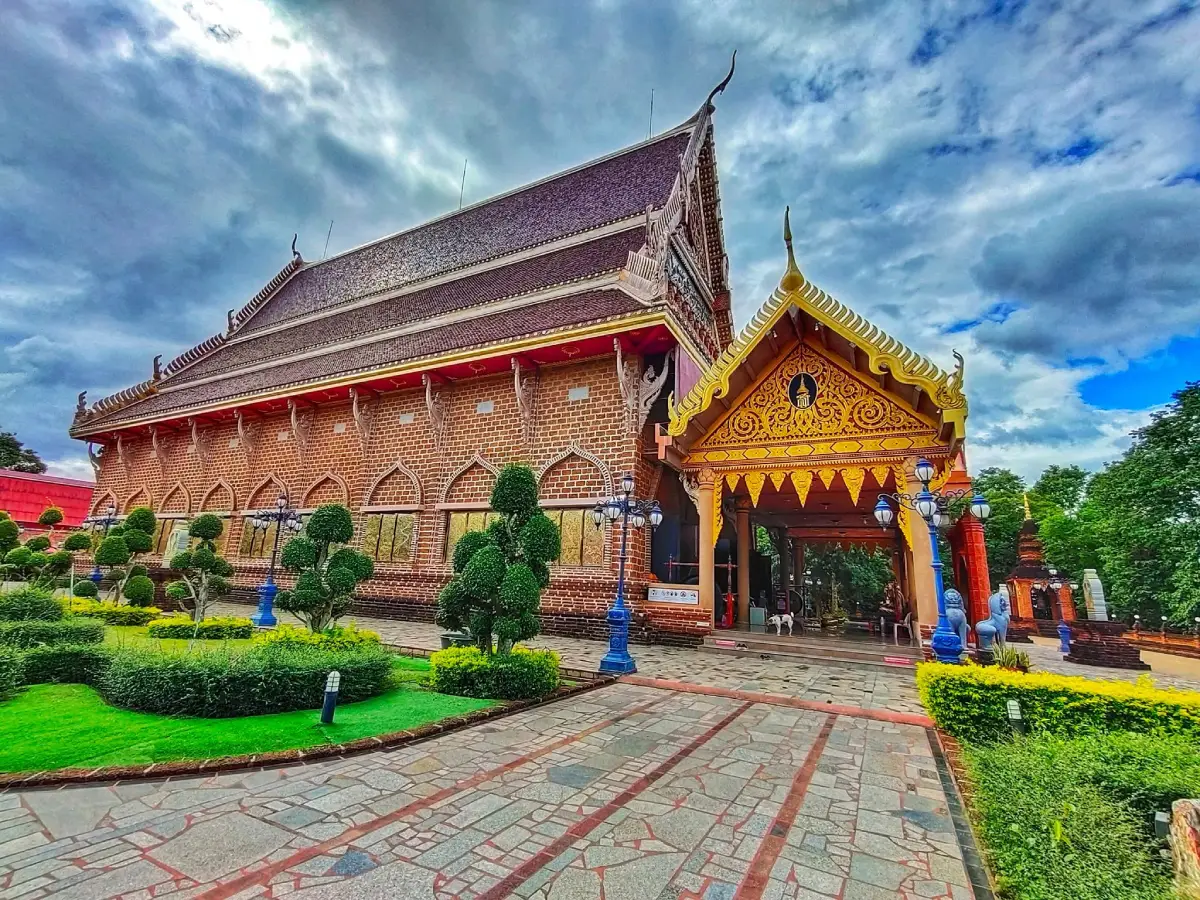
Wat Neramit Wipatsana in Loei Province is one of the most remarkable Buddhist temples in Dan Sai District. Located on a hill in Ban Hua Na Yung, Dan Sai Subdistrict, the temple stands not far from Phra That Si Song Rak, one of the most sacred landmarks of the district. Wat Neramit Wipatsana is widely admired for its large laterite ordination hall and laterite pagoda, both built with a strong visual identity that makes the temple immediately recognizable. Inside the ordination hall, a replica of Phra Phuttha Chinnarat is enshrined as the principal Buddha image, surrounded by impressive mural paintings that tell Buddhist stories, local ways of life, and moral teachings. Behind the ordination hall is the memorial mondop of Luang Pho Maha Phan Silawisuttho, the monk who initiated the temple, where his wax figure and preserved body are respectfully enshrined.
The temple combines the atmosphere of a meditation monastery, the visual power of laterite architecture, and the quiet beauty of a hilltop religious site. Visitors entering the compound can immediately sense that this is not only a place for sightseeing but also a space created for worship, contemplation, and Buddhist practice. The large ordination hall rises prominently in the temple grounds, surrounded by lawns, gardens, walkways, and laterite architectural elements. The overall atmosphere is calm, orderly, and dignified. For travelers visiting Dan Sai, the temple offers a very different experience from the nearby Phra That Si Song Rak and Phi Ta Khon Museum, while still belonging to the same cultural landscape of faith, history, and local identity.
Wat Neramit Wipatsana is closely connected with Luang Pho Maha Phan Silawisuttho, also known by his monastic title Phra Khru Phawana Wisutthiyan. He was the founding monk who transformed this hill area into a center of Buddhist practice. Born in Surin Province, he was ordained in 1944 and later studied both Buddhist doctrine and meditation practice. After years of pilgrimage and teaching, he arrived in Dan Sai and selected the area of Phu Pueai as the place to establish a permanent meditation temple. The land had once been affected by agricultural use and charcoal burning, but through the efforts of monks, novices, disciples, and local supporters, it gradually became the peaceful temple seen today.
The early development of the temple required great determination. The site was not originally a finished religious compound. Monks and lay supporters first built simple shelters, temporary dwellings, and basic structures for practice. Later, more permanent buildings were developed. In 1986, the construction of the large ordination hall began. It took many years of continuous work before the temple reached its present form. The story of Wat Neramit Wipatsana is therefore not only a story of architecture, but also a story of faith, patience, community support, and the effort to create a place where Buddhist practice could take root in Dan Sai.
The name Wat Neramit Wipatsana is meaningful. Neramit suggests the creation or manifestation of something extraordinary, while Wipatsana refers to insight meditation. Together, the name reflects the transformation of an ordinary hill area into a sacred place dedicated to Buddhist practice. Although the temple has become a popular attraction, its deeper identity remains connected with meditation, Dhamma teaching, and respect for the founding monk. Visitors should therefore approach the temple not only as a beautiful photo location but also as an active Buddhist monastery.
The laterite ordination hall is the temple’s most important architectural highlight. Laterite has a reddish-brown color and a distinctive porous texture. When used throughout a large building, it creates a sense of strength, warmth, and permanence. The ordination hall has a formal Thai architectural composition, with a tiered roof and traditional decorative elements, yet the use of laterite gives it a powerful and unusual identity. The building feels connected to the earth, the hillside, and the natural tones of the surrounding landscape. This makes Wat Neramit Wipatsana visually different from many white or concrete temples in Thailand.
The interior of the ordination hall is equally important. The replica of Phra Phuttha Chinnarat serves as the principal Buddha image, giving the space a familiar and deeply respected Buddhist focus. Phra Phuttha Chinnarat is one of the most revered Buddha-image forms in Thailand, and its presence inside the temple gives worshippers a strong point of devotion. Visitors often enter the hall to pay respect, sit quietly, and observe the murals that surround the interior walls. The atmosphere inside is peaceful, detailed, and suitable for slow viewing rather than hurried photography.
The mural paintings inside the ordination hall deserve careful attention. They show Buddhist history, Dhamma themes, local life, and cultural knowledge through the work of local artists from Dan Sai. The murals were created over a long period, and their scale and detail show a strong commitment to religious storytelling. These paintings are not simply decoration. They act as a visual teaching tool, allowing visitors to understand Buddhist stories and moral ideas through images, color, and composition. A slow walk around the interior is one of the most rewarding parts of visiting the temple.
Other sacred images inside the ordination hall include a naga-protected Buddha image, a replica of the Emerald Buddha, and a likeness of Luang Pho To. These additional images make the hall a rich devotional space. Visitors should remove their shoes before entering, dress modestly, speak softly, and avoid disturbing people who are praying. Photography should be done respectfully, without flash and without treating the sacred space as a casual studio. The beauty of the hall is best appreciated with stillness and attention.
Behind the ordination hall is the mondop of Luang Pho Maha Phan Silawisuttho. This laterite memorial building enshrines his wax figure and preserved body. Luang Pho Maha Phan passed away on 20 September 1997 at the age of 76, but his presence remains central to the identity of the temple. The mondop is a place for disciples, local people, and visitors to pay respect to the monk whose vision created the temple. For those who want to understand Wat Neramit Wipatsana deeply, this area is essential. It explains the human and spiritual story behind the buildings.
The mondop should be visited with respect. It is not only a memorial display but also a place of devotion. The wax figure and preserved body remind visitors of the founding monk’s discipline, meditation practice, and effort to build a permanent place for Dhamma practice. A short moment of quiet reflection here can make the entire visit more meaningful. The temple becomes more than an architectural site; it becomes the result of a monk’s life, intention, and faith.
The laterite pagoda is another important feature of the temple. Its material and form harmonize with the ordination hall and the memorial mondop, creating architectural unity across the compound. The pagoda is a symbolic structure associated with devotion to the Triple Gem and Buddhist remembrance. Walking around the pagoda area allows visitors to appreciate the temple’s laterite design from another perspective. The color of laterite changes subtly with sunlight, making morning and late afternoon especially suitable for photography.
The temple grounds are also carefully landscaped. Lawns, paths, shrubs, flowerbeds, and shade trees help soften the strength of the laterite architecture. The environment feels peaceful and well cared for. One tree often mentioned by visitors is the sala tree, which is connected with the Buddha’s birth in Buddhist tradition. The presence of such trees adds symbolic meaning to the landscape and helps connect the temple grounds with the life of the Buddha. The gardens also provide resting areas for visitors after worshipping inside the hall.
Wat Neramit Wipatsana is closely linked with Phra That Si Song Rak because the two sacred places are located very near each other. Many visitors naturally combine them in a single trip. Phra That Si Song Rak represents a long history of Thai-Lao relations and sacred political memory, while Wat Neramit Wipatsana represents contemporary Buddhist devotion, laterite architecture, and meditation practice. Visiting both places helps travelers understand Dan Sai from multiple perspectives: history, faith, local art, and living Buddhist practice.
Dan Sai District is also famous for Bun Luang and Phi Ta Khon, one of the most distinctive cultural festivals in Thailand. Wat Neramit Wipatsana is part of the same wider cultural landscape as Wat Phon Chai, Phi Ta Khon Museum, and Phra That Si Song Rak. Although this temple is not the central site of the Phi Ta Khon festival, it adds an important spiritual and artistic dimension to a Dan Sai itinerary. Travelers who want to understand the district beyond the festival should include this temple in their route.
The first main zone to visit is the entrance gate and arrival area. The laterite gateway introduces the temple’s architectural language from the beginning. It marks the transition from the outside world into a sacred compound. Visitors may take photographs here, but they should avoid blocking the entrance or disturbing other worshippers. This area is a good place to slow down and prepare for a respectful visit.
The second zone is the laterite ordination hall and the replica of Phra Phuttha Chinnarat. This is the central area of the temple. Visitors should observe both the exterior and interior. Outside, the laterite surface, roof structure, doors, windows, and proportions of the building are worth noticing. Inside, the principal Buddha image and murals should be viewed slowly. A meaningful visit to this area should take at least 30 to 45 minutes.
The third zone is the mural-painting area inside the ordination hall. This area is important for art and cultural interpretation. The murals show Buddhist stories and local life through the eyes of Dan Sai artists. They reflect both religious faith and local creativity. Visitors should avoid touching the walls and should keep enough distance from the paintings to protect them.
The fourth zone is the memorial mondop of Luang Pho Maha Phan Silawisuttho. This area explains the founding spirit of the temple. Luang Pho Maha Phan was not only a builder but also a meditation teacher and spiritual leader. Paying respect here helps visitors understand why the temple carries the word Wipatsana in its name.
The fifth zone is the laterite pagoda and surrounding architectural elements. This zone shows the consistency of the temple’s material and design concept. Visitors can walk around the area, appreciate the laterite texture, and see how the pagoda relates visually to the ordination hall and other buildings. It is a suitable area for quiet observation and photography.
The sixth zone is the landscaped garden, lawns, pathways, and sala tree area. This zone gives the temple a gentle and restful atmosphere. Families and elderly visitors may use this area to rest between visits to the main buildings. Visitors should keep the area clean, avoid stepping on planted areas, and respect the peaceful environment.
The seventh zone is the monastic and meditation area. Wat Neramit Wipatsana remains an active religious place with monks and Buddhist activities. Visitors should enter only areas open to the public and avoid walking into monks’ residences or private practice areas without permission. Modest dress and quiet behavior are important.
Getting There is easy from Dan Sai town. Travel toward Ban Hua Na Yung, about 1 kilometer from the district town. The temple is on a hill not far from Phra That Si Song Rak. From Mueang Loei, travel toward Dan Sai District and continue to Dan Sai Subdistrict and Ban Hua Na Yung. A private car, rental car, motorcycle, or local transport is recommended. Because Phra That Si Song Rak, Wat Phon Chai, and Phi Ta Khon Museum are nearby, visitors can easily combine these places in one route.
Visitors coming from Phu Ruea can continue along the road toward Dan Sai and enter the district town before going to the temple. Visitors coming from Phetchabun or Lom Sak can also reach Dan Sai before continuing to Loei. During the rainy season, drivers should check road conditions and drive carefully because some routes pass through hilly areas and may be wet, foggy, or slippery.
The temple is open daily from 06.00 to 18.00 and does not charge an admission fee. Visitors may make merit according to their faith. Morning is good for a peaceful atmosphere and soft light on the laterite buildings. Late afternoon is also suitable for photography and a slower walk around the grounds. Visitors who wish to study the murals carefully should allow at least 1 to 2 hours for the visit.
Basic temple etiquette is important. Visitors should dress modestly, remove shoes before entering the ordination hall, keep voices low, avoid touching the murals, avoid climbing on architectural elements, and stay away from monastic areas not open to the public. Photography should be done respectfully and without disturbing worshippers. These simple rules help preserve the temple’s religious atmosphere.
For families, Wat Neramit Wipatsana is a useful cultural learning site. Children can learn about laterite architecture, Buddha images, Buddhist murals, meditation, the founding monk, and the importance of planting trees and caring for a sacred environment. The temple can become both a place of worship and an outdoor classroom.
For art and architecture travelers, the temple deserves more time than a short photo stop. The laterite buildings, large ordination hall, murals, pagoda, memorial mondop, and landscape design all show how Buddhist faith can be expressed through material, scale, craftsmanship, and local creativity. The temple is an example of contemporary Buddhist architecture shaped by community devotion.
For international travelers, Wat Neramit Wipatsana is a clear example of contemporary Thai Buddhist architecture in northeastern Thailand. It is not an ancient Lan Xang temple like Phra That Si Song Rak, but a modern temple built from laterite and rooted in meditation practice. Its principal Buddha image, murals, memorial to the founding monk, and peaceful compound help visitors understand how Buddhism remains active and creative in local communities.
A good itinerary begins at Phra That Si Song Rak in the morning, continues to Wat Neramit Wipatsana for the laterite ordination hall and Phra Phuttha Chinnarat replica, and then goes to Wat Phon Chai and Phi Ta Khon Museum to learn about Bun Luang and Phi Ta Khon culture. With more time, visitors can continue to Phu Phra, Phu I Loet, or Phu Lom Lo depending on season and road conditions. This route combines faith, architecture, history, culture, and nature in Dan Sai District.
In summary, Wat Neramit Wipatsana in Loei Province is one of the most impressive temples in Dan Sai District. It is located on a hill near Phra That Si Song Rak and is known for its laterite ordination hall and pagoda, its replica of Phra Phuttha Chinnarat, its detailed murals, and the memorial mondop of Luang Pho Maha Phan Silawisuttho. The temple is open daily from 06.00 to 18.00 with free admission. It can be visited together with Phra That Si Song Rak, Wat Phon Chai, Phi Ta Khon Museum, and other attractions in Dan Sai. A respectful and unhurried visit allows travelers to experience both the artistic beauty and the spiritual depth of this important temple.
| Name | Wat Neramit Wipatsana, Loei Province |
| Location | Ban Hua Na Yung, Dan Sai Subdistrict, Dan Sai District, Loei Province 42120, Thailand |
| Address | 20 Moo 14, Ban Hua Na Yung, Dan Sai Subdistrict, Dan Sai District, Loei Province 42120, Thailand |
| Highlights | A hilltop Buddhist temple near Phra That Si Song Rak, featuring a laterite ordination hall, laterite pagoda, Phra Phuttha Chinnarat replica, Buddhist murals, and the memorial mondop of Luang Pho Maha Phan Silawisuttho |
| History | The temple was founded by Phra Khru Phawana Wisutthiyan, or Luang Pho Maha Phan Silawisuttho, the first abbot. The site was developed from a formerly disturbed hill area into a meditation temple. Construction of the large ordination hall began in 1986 and continued for many years through the faith and effort of monks, novices, disciples, and local supporters. |
| Distinctive Features | The temple is located on a hill about 1 km from Dan Sai town and not far from Phra That Si Song Rak. Its ordination hall and pagoda are built entirely of laterite, creating a strong and memorable architectural identity. |
| Key Things To See | Laterite ordination hall, Phra Phuttha Chinnarat replica, Buddhist murals, naga-protected Buddha image, Emerald Buddha replica, Luang Pho To image, memorial mondop of Luang Pho Maha Phan Silawisuttho, laterite pagoda, landscaped gardens, and sala tree |
| Main Areas / Zones | 1. Entrance Gate And Arrival Area 2. Laterite Ordination Hall And Phra Phuttha Chinnarat Replica 3. Mural-Painting Area Inside The Ordination Hall 4. Memorial Mondop Of Luang Pho Maha Phan Silawisuttho 5. Laterite Pagoda And Surrounding Architectural Elements 6. Garden, Lawn, Walkway, And Sala Tree Area 7. Monastic And Meditation Area 8. Route Connection To Phra That Si Song Rak, Wat Phon Chai, And Phi Ta Khon Museum |
| Abbot / Caretaker | Managed by Wat Neramit Wipatsana; the abbot is Phra Khru Phawana Wisutthaphon Wi. (Sawat Amaro, Pali Grade 3, B.A.) |
| Travel Information | From Dan Sai town, travel toward Ban Hua Na Yung, about 1 km away. The temple is on a hill near Phra That Si Song Rak. From Mueang Loei, drive toward Dan Sai District and continue to Dan Sai Subdistrict and Ban Hua Na Yung. A private car, rental car, motorcycle, or local transport is recommended. |
| Current Status | Open as an active meditation temple and important religious attraction in Dan Sai District, Loei Province |
| Open Days | Daily |
| Opening Hours | 06.00 – 18.00 |
| Fees | Free Admission |
| Facilities | Ordination hall, worship area, memorial mondop, pagoda, temple courtyard, walking paths, landscaped garden, parking area, and quiet spaces for worship and meditation |
| Main Contact Number | 042-891-226, 086-852-5950, 084-310-6090, Contact Monk Phra Bunpeng Worathammo 08-9426-4233 |
| Official Website / Official Page | Wat Neramit Wipatsana Dan Sai Facebook Page, Amazing Thailand, And Loei Tourism Information Sources |
| Nearby Tourist Attractions | 1. Phra That Si Song Rak, about 1 km 2. Wat Phon Chai, about 2 km 3. Phi Ta Khon Museum At Wat Phon Chai, about 2 km 4. Replica Phra That Si Song Rak At Wat Phon Chai, about 2 km 5. Phu Phra, about 6 km 6. Dan Sai Town Viewpoint, about 6 km 7. Phu I Loet, about 18 km 8. Phu Lom Lo, about 35 km |
| Nearby Restaurants | 1. NANA CAFE Dan Sai, about 2 km, Tel. 098-316-1420 2. Khrua Im Un Dan Sai, about 2 km, Tel. 042-891-586, 085-760-3352 3. Baandoen Cake & Coffee, about 3 km, Tel. 064-092-7899 4. Woori Cafe, about 4 km, Tel. 083-345-4585 5. Hug Na Sabai Dee Dan Sai, about 5 km, Tel. 081-051-0555 6. The Enlighten Coffee & Community, about 13 km |
| Nearby Accommodations | 1. Pupiang po Da Arte Resort, about 1 km 2. PhuNaCome Resort, about 2 km, Tel. 042-892-005, 095-155-8835, 063-851-2555 3. Baan Rak Loei Resort, about 2 km, Tel. 085-758-8875 4. Kingboon Resort, about 5 km, Tel. 093-392-1443, 042-030-140 5. Dan Sai Resort Hotel, about 6 km, Tel. 042-892-281 6. Phu Pha Nam Resort, about 20 km, Tel. 098-132-5668, 081-554-3330, 081-407-7577, 042-810-527, 042-810-526 |
Frequently Asked Questions (FAQ)
Q: Where is Wat Neramit Wipatsana located?
A: Wat Neramit Wipatsana is located at Ban Hua Na Yung, Dan Sai Subdistrict, Dan Sai District, Loei Province 42120, Thailand. It is on a hill near Phra That Si Song Rak and close to Dan Sai town.
Q: What are the opening days and hours?
A: The temple is open daily from 06.00 to 18.00.
Q: Is there an admission fee?
A: No. Admission is free. Visitors may make merit according to their faith in designated areas.
Q: What is the main highlight of Wat Neramit Wipatsana?
A: The main highlight is the large laterite ordination hall and laterite pagoda. Inside the hall is a replica of Phra Phuttha Chinnarat, beautiful Buddhist murals, and a calm worship atmosphere.
Q: Who was Luang Pho Maha Phan Silawisuttho?
A: Luang Pho Maha Phan Silawisuttho, also known as Phra Khru Phawana Wisutthiyan, was the founding monk and first abbot who initiated the development of Wat Neramit Wipatsana as a meditation temple.
Q: Who is the current abbot of Wat Neramit Wipatsana?
A: The abbot of Wat Neramit Wipatsana is Phra Khru Phawana Wisutthaphon Wi. (Sawat Amaro, Pali Grade 3, B.A.).
Q: How long should visitors spend at the temple?
A: Visitors should allow about 1 to 2 hours to worship, see the laterite ordination hall, study the murals, visit the memorial mondop of Luang Pho Maha Phan, and walk around the temple grounds calmly.
Q: What nearby places can be visited after Wat Neramit Wipatsana?
A: Nearby places include Phra That Si Song Rak, Wat Phon Chai, Phi Ta Khon Museum, Phu Phra, Phu I Loet, and Phu Lom Lo depending on the visitor’s schedule and travel season.
 Category: ●Places of Worship
 Group: ●Temple
Last Update : 3 MonthAgo
 Last Update : 3 MonthAgo
 Click to Access the Navigation Map GPS
Wat Neramit Wipatsana Map
Recommend

 Art, Culture and Heritage
 Historical Sites and Monuments(2)
 Landmarks and Memorials(3)
 Art, Craft Centres, Tradition(2)
 Museums(4)
 Art Gallery(1)
 Educational Places
 Educational Gardens, Farm(2)
Temple(16)
Educational Gardens, Farm(2)
Temple(16)
 Other Sacred Sites(8)
 Research and Development
 Royal Project(3)
 Suburban Living
 Village, Community(3)
 Local Market(1)
 Nature and Wildlife
 National Parks and Marine Reserves(5)
 Mountain (Doi)(10)
 Dam, Reservoir, Lake(7)
 Waterfalls(21)
 Caves(3)
 River, Canal(5)
 Bays and Beaches(1)
 Other natural attractions(1)
 Entertainment and Agricultural
 Farms, Parks and Ecotourism(8)
 Waterpark(1)
 Outdoor and Adventure Activities(2)
 Travel Articles, Recipes
 Travel Review, Food Review(1)


