lovethailand home >Northeastern Travel Attractions >Kalasin Travel Attractions >Kuchinarai >Nong Hang > Huai Muang Reservoir
TL;DR: Huai Muang Reservoir is located at Nong Hang Subdistrict, Kuchinarai District, Kalasin Province, open Daily, hours 08.00 – 17.00.
Huai Muang Reservoir

Open Days: Daily
Opening Hours: 08.00 – 17.00
Huai Muang Reservoir in Kalasin Province is an important community reservoir in Nong Hang Subdistrict, Kuchinarai District. It was developed to respond to the real needs of local residents, especially to relieve immediate hardship related to water, agriculture, and basic community development. More than a scenic water body, Huai Muang Reservoir functions as a village water source, a foundation for local economic and social activities, and a quiet nature-based destination for travelers who want to experience rural Kalasin beyond the usual tourist routes.
The reservoir is closely tied to the landscape of Nong Hang Subdistrict. The northern part of the subdistrict is a highland area with an elevation of about 450 metres above sea level, while the land gradually slopes southward to about 170 metres above sea level. This creates a mixed terrain of uplands, lowlands, seasonal waterways, farmland, and rural settlements. The natural stream known as Huai Muang flows through the area and forms the basis of local water use, farming, and community life.
The people of Nong Hang live a simple rural life with a strong sense of self-reliance. Most households depend on agriculture, especially rice farming during the rainy season. Farmers commonly grow Kor Khor 6 glutinous rice and jasmine rice, both of which are closely tied to the food culture and economy of northeastern Thailand. About 2,900 rai of agricultural land in the area requires water support, making Huai Muang Reservoir an essential resource for farming households and local food security.
The history of Huai Muang Reservoir reflects the needs of the local people. The reservoir was developed to help solve water-related hardship and provide a basic infrastructure system for the community. The original reservoir had a relatively small storage capacity of about 560,000 cubic metres at the storage level of +194.50, with the dam crest level at +196.50. Because the local water potential was suitable for greater storage, the reservoir was improved by raising the storage level to increase its capacity and strengthen its usefulness for the surrounding agricultural area.
The improvement of Huai Muang Reservoir was not only about storing more surface water. It was also connected with the idea of slowing water movement through upstream check dams and storing part of the water beneath the soil surface. This approach helps reduce rapid runoff from the highlands, supports moisture retention in the soil, and improves the local water system. The development of Huai Muang Stream, including dredging and related structures in selected sections, also strengthens the ability of the area to manage water for community use.
In terms of rural development, Huai Muang Reservoir is a practical example of a water project that directly supports people’s lives. In areas where agriculture depends heavily on rainfall and natural streams, a reliable community reservoir reduces risk during dry periods and supports better planning for farming. Water stored in the reservoir contributes to rice cultivation, household use, small-scale activities, and community resilience. This makes the reservoir a meaningful development asset rather than a simple sightseeing stop.
The economic value of the reservoir can be understood through its role in rice farming. When water is insufficient during crucial stages of rice cultivation, crop yields are directly affected. By helping provide water support to the agricultural land around Nong Hang, Huai Muang Reservoir strengthens household income and reduces uncertainty for farmers. It also helps preserve the local farming way of life that has long been connected to seasonal rainfall, lowland fields, and community-based water sharing.
Socially, Huai Muang Reservoir serves as a shared public space for the community. It is a place where water, farming, local cooperation, and recreation meet. Residents use the area as a local water source, a place to rest, and a natural landmark that represents community effort. For travelers, this gives the reservoir a more meaningful character than a commercial tourist attraction. It is a place where visitors can see how small-scale water infrastructure supports everyday life in rural northeastern Thailand.
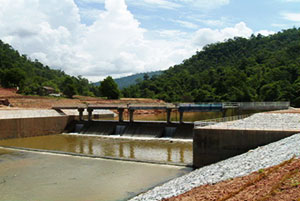
The scenery of Huai Muang Reservoir is simple but attractive. The reservoir spreads across a peaceful rural basin, with open water, agricultural land, gentle uplands, and natural vegetation around it. In the morning, the water often appears calm under soft light, making it suitable for quiet sightseeing and photography. In the late afternoon, the warm light over the water and farmland creates a relaxed atmosphere. Travelers who enjoy uncrowded nature spots will find the reservoir especially appealing.
This is not a destination built around large-scale entertainment or heavy tourism facilities. Its charm lies in the quietness of the place, the open view, the rural road, the sound of wind over the water, and the feeling of being close to a real community landscape. Visitors can walk along the reservoir edge, take photos, sit quietly, and observe the connection between the water, rice fields, and village life. The experience is slow, reflective, and suitable for travelers who value authenticity.
For photographers, Huai Muang Reservoir offers several natural compositions. The water surface, reservoir edge, farmland, sky, and distant highland areas can be used to frame landscape shots. Morning light creates a calm and fresh mood, while evening light produces warmer tones. When clouds reflect on the water, the scene becomes more dimensional. The reservoir is therefore a worthwhile stop for travelers who want images of rural Kalasin that differ from standard tourist landmarks.
Huai Muang Reservoir is also useful as an outdoor learning site. It shows how local water management works in a real agricultural community. Rainwater from the uplands flows through natural streams such as Huai Muang, and the reservoir helps store and regulate part of that water. Upstream check dams and stream improvement work help slow runoff and support water retention. Students, families, and travelers interested in environment and agriculture can use this place to understand how water shapes rural livelihoods.
The natural stream of Huai Muang is central to the area. It connects the higher northern terrain with the lower southern land and supports the flow of water through farmland and village areas. The reservoir helps capture part of this flow so that water can be used more effectively. This relationship between stream, reservoir, farmland, and people is the core of the destination. The name Huai Muang is therefore not only a place name, but also a reference to the natural waterway that sustains the community.
Recorded information notes an average annual water flow of 1,419.995 cubic metres through Huai Muang. Together with the reservoir improvement, this water potential supports the purpose of increasing storage capacity and improving community water security. The result is a reservoir that contributes to farming, basic village development, moisture retention, and community use. For travelers, this adds depth to the experience because the landscape is not only beautiful but also functional and socially important.
The people of Nong Hang Subdistrict continue to live closely with land and water. Their way of life is shaped by rice fields, seasonal water, local roads, small communities, and a practical relationship with the environment. A visit to Huai Muang Reservoir gives travelers a chance to see this living rural context. Instead of encountering a highly commercialized attraction, visitors encounter a place where development, farming, and nature remain part of everyday life.
Huai Muang Reservoir is suitable for nature-based and community-based travel. Visitors who prefer quiet places, local scenery, and meaningful landscapes will appreciate its atmosphere. It can be visited as a short trip from Kuchinarai town or included in a wider route through natural and cultural attractions in the district. Travelers can visit the reservoir in the morning, have lunch in Kuchinarai, and continue to nearby temples, cultural villages, or other natural sites in the afternoon.
The best times to visit are morning and late afternoon. These periods offer softer light, more comfortable temperatures, and a calmer reservoir atmosphere. The late rainy season and early cool season are especially attractive because the surrounding landscape is greener. The cool season is comfortable for outdoor sightseeing, while the hot season still allows for visits if travelers avoid the strongest midday sun and bring drinking water, hats, and sun protection.
During the rainy season, the surrounding fields and vegetation become lush and photogenic. However, travelers should pay attention to road conditions because local roads near farmland and water areas can become slippery after heavy rain. Vehicles should be parked safely away from the water edge, and visitors should avoid walking down steep or wet slopes near the reservoir. Natural water areas are beautiful, but they should always be visited with care.
Responsible travel is important at Huai Muang Reservoir. Visitors should not throw rubbish into the water or along the shore, disturb farmland, enter private working areas, make loud noise near the community, or swim in unsupervised places. The reservoir is a shared resource for local residents, so tourism should help preserve cleanliness, safety, and peace. Keeping the area clean is one of the simplest ways visitors can respect the community.
For travelers interested in rural development, the reservoir is a clear example of how local needs can guide practical infrastructure. It was not created as a decorative landscape, but as a response to water problems faced by local residents. Its purpose is connected to farming, community well-being, and basic development. This gives Huai Muang Reservoir a strong sense of place and a deeper value than many ordinary scenic stops.
The main areas of the reservoir include the embankment, water storage area, Huai Muang Stream, upstream check-dam areas, water-retention zones, farmland that benefits from the reservoir, and nearby village areas. These elements work together as a local water-management system. Walking around the area helps visitors understand how water moves from higher land through natural channels into storage areas and then supports agriculture and community use.
Travelers who enjoy nature routes can use Huai Muang Reservoir as a starting point for exploring Nong Hang Subdistrict and Kuchinarai District. The surrounding area includes farmland, local communities, temples, cultural sites, and natural viewpoints. Having a private vehicle makes the trip more convenient because attractions are spread across different villages and subdistricts. A slow travel style works best here because it allows visitors to see the broader landscape rather than just one location.
A simple one-day itinerary can begin in Kuchinarai town in the morning, continue to Huai Muang Reservoir for sightseeing and photography, then return to the town or Bua Khao area for lunch. In the afternoon, travelers can visit Wat Phra That Muen Hin, Wat Wang Kham, or Khok Kong Phu Thai Cultural Village. If staying overnight, visitors can add more nearby nature sites and cultural stops, making the reservoir part of a broader Kalasin travel route.
For families, Huai Muang Reservoir is a useful place to introduce children to the relationship between water, rice farming, and rural life. Children can see why farms need reservoirs, how stored water supports crops, and why communities must protect local water sources. This makes the visit more than a photo stop. It becomes a simple learning experience about food, water, community, and nature.
Visitors should prepare basic items such as drinking water, a hat, sunglasses, sunscreen, comfortable shoes, mosquito repellent, a personal rubbish bag, and a fully charged phone or camera. During the rainy season, shoes with good grip are recommended. Travelers should avoid walking too close to wet slopes or the water edge. Since the reservoir is a natural and community-based area, preparation makes the trip more comfortable and safer.
Food and accommodation planning should be based mainly in Kuchinarai town or the Bua Khao area. The immediate reservoir area is a rural community and farming landscape rather than a dense commercial zone. Restaurants, cafés, and hotels with publicly available contact information are mostly located in the town area. Planning meals before or after visiting the reservoir is more convenient, especially for families and visitors arriving late in the day.
Getting There is most convenient by private car or rental vehicle. From Kalasin city, head toward Kuchinarai District, then continue to Nong Hang Subdistrict and Ban Huai Muang. Visitors can search for “Huai Muang Reservoir Kuchinarai” or “Ban Huai Muang Nong Hang” on a map application. Starting from Kuchinarai town is easier than starting from Kalasin city because the distance is shorter and it is more convenient to connect with restaurants, accommodation, and nearby attractions.
Travelers without a private vehicle can first travel to Kuchinarai District and then arrange local transport to Nong Hang Subdistrict. Return transport should be arranged in advance because the reservoir area does not have frequent public transport like an urban zone. Hiring a local vehicle or driver is suitable for visitors who want to combine Huai Muang Reservoir with Wat Phra That Muen Hin, Khok Kong Phu Thai Cultural Village, and other nearby attractions in one trip.
Although Huai Muang Reservoir does not have extensive tourist facilities, its strength lies in its quiet setting, authentic rural context, and importance to the local community. Visitors should see it as a village water resource that also welcomes respectful nature travel. It is not a place for loud entertainment or careless behavior. The best way to enjoy the reservoir is to move slowly, observe the scenery, respect local life, and leave no trace behind.
Huai Muang Reservoir is therefore a meaningful destination for travelers looking for natural attractions in Kalasin, reservoir scenery, and a real agricultural community landscape. It tells the story of water at the village level, the story of farmers, the story of a highland-to-lowland terrain, and the story of local development designed to relieve hardship for residents. A visit here is not only about seeing a reservoir, but also about understanding how water supports life in rural Kalasin.
| Name | Huai Muang Reservoir |
| Location | Nong Hang Subdistrict, Kuchinarai District, Kalasin Province |
| Address | Ban Huai Muang, Nong Hang Subdistrict, Kuchinarai District, Kalasin 46110, Thailand |
| Highlights | Community reservoir, peaceful rural scenery, water and farmland views, local water-management value, and a nature-based rest area in Nong Hang Subdistrict |
| History | A reservoir improvement project developed in response to local residents’ needs to relieve water-related hardship and support community development; accepted as a Royal Development Project in 2006 |
| Name Origin | Named after Huai Muang, the natural stream that flows through Nong Hang Subdistrict and supports the local water system |
| Distinctive Features | Mixed upland and lowland terrain; the northern area is about 450 metres above sea level and slopes southward to about 170 metres above sea level, with Huai Muang Stream and surrounding agricultural land |
| Original Reservoir Capacity | Originally about 560,000 cubic metres at storage level +194.50, with dam crest level +196.50, before improvement to increase water storage capacity |
| Main Benefits | Village water source, agricultural water support for about 2,900 rai, hardship relief for local residents, and basic infrastructure for community development |
| Travel Information | From Kalasin city, head toward Kuchinarai District, then continue to Nong Hang Subdistrict and Ban Huai Muang. A private car or rental vehicle is recommended. Search for “Huai Muang Reservoir Kuchinarai” or “Ban Huai Muang Nong Hang” on a map application |
| Current Status | Community water source, agricultural reservoir, and nature-based attraction in Nong Hang Subdistrict, Kuchinarai District |
| Open Days | Daily |
| Opening Hours | 08.00 – 17.00 |
| Facilities | Community access roads, reservoir-side viewing area, relaxation spots, natural photo points, local roads, and surrounding farmland scenery |
| Main Areas / Zones | 1. Embankment And Reservoir Edge 2. Huai Muang Water Storage Area 3. Huai Muang Stream And Water-Retention Zone 4. Upstream Check-Dam Area And Subsurface Water Storage Zone 5. Agricultural Benefit Area 6. Ban Huai Muang And Nong Hang Community Area |
| Caretaker | Royal Irrigation Department, Kalasin Provincial Irrigation Project, Regional Irrigation Office 6, together with local authorities in Nong Hang Subdistrict |
| Main Contact Number | Kalasin Provincial Irrigation Project Tel. 0-4387-3176 Nong Hang Subdistrict Administrative Organization Tel. 0-4360-2108 |
| Official Website / Official Page | Kalasin Provincial Irrigation Project, Royal Irrigation Department / Nong Hang Subdistrict Administrative Organization / Office of the Royal Development Projects Board |
| Nearby Tourist Attractions | 1. Dan Nok Taet Tae, about 5 km 2. Wat Phra That Muen Hin, Luang Pu Sila Sirichanto, about 18 km 3. Huai Chum Chang Reservoir Or Wang Mon Reservoir, about 25 km 4. Khok Kong Phu Thai Cultural Village, about 30 km 5. Wat Wang Kham, about 35 km 6. Tat Sung Waterfall, Ban Khok Kong, about 35 km |
| Nearby Restaurants | 1. Saeng Chai Duck Noodle And Made-To-Order Food, Kuchinarai, about 27 km, Tel. 081-296-9004 2. Hug Coffee, about 27 km, Tel. 095-949-9942 3. Alala Cafe, about 28 km, Tel. 093-189-4111 4. Hianhome Salad Cafe, Kuchinarai, about 28 km, Tel. 085-879-5664 5. Bua Rin Restaurant, about 27 km 6. Piano Restaurant, about 28 km |
| Nearby Accommodations | 1. Narai Le Bua Hotel, about 27 km, Tel. 093-563-4491, 043-602-115 2. Chatrudee Park View Hotel Kuchinarai, about 28 km, Tel. 043-013-332, 094-826-4951 3. Thewa Grand Resort Kuchinarai, about 29 km, Tel. 064-882-4616 4. Wanida Tara Lake View Hotel, about 29 km, Tel. 043-851369, 090-925-6168, 081-496-3021 5. Thany Tree Resort, about 28 km 6. Kuaphiman Kuchinarai, about 28 km |
Frequently Asked Questions (FAQ)
Q: Where is Huai Muang Reservoir located?
A: Huai Muang Reservoir is located at Ban Huai Muang, Nong Hang Subdistrict, Kuchinarai District, Kalasin Province. It is a community reservoir and a quiet natural attraction.
Q: Why is Huai Muang Reservoir important?
A: It serves as a village water source, supports about 2,900 rai of agricultural land, helps relieve local water-related hardship, and provides basic infrastructure for community development.
Q: What are the opening hours of Huai Muang Reservoir?
A: The reservoir is open daily from 08.00 to 17.00. Morning and late afternoon are the most comfortable times for visiting and photography.
Q: Is there an admission fee for Huai Muang Reservoir?
A: The general reservoir area is a community water source and natural rest area. No confirmed admission fee is listed for general visits.
Q: What activities are suitable at Huai Muang Reservoir?
A: Visitors can enjoy reservoir views, nature photography, quiet relaxation, learning about community water management, and combining the visit with nearby cultural and natural attractions in Kuchinarai District.
Q: How can travelers get to Huai Muang Reservoir?
A: From Kalasin city, travel toward Kuchinarai District, then continue to Nong Hang Subdistrict and Ban Huai Muang. A private car or rental vehicle is the most convenient option.
Q: What nearby attractions can be visited with Huai Muang Reservoir?
A: Nearby attractions include Dan Nok Taet Tae, Wat Phra That Muen Hin, Huai Chum Chang Reservoir, Khok Kong Phu Thai Cultural Village, Wat Wang Kham, and Tat Sung Waterfall.
Q: Is Huai Muang Reservoir suitable for families?
A: Yes. It is suitable for families who enjoy quiet scenery and nature learning, but children should be supervised closely near the water and should not enter unsupervised areas.
Category: ●Nature and Wildlife
Group: ●Dam, Reservoir, Lake
Last Update : 2 MonthAgo