
lovethailand home >Northeastern Travel Attractions >Kalasin Travel Attractions >Khao Wong >Kut Sim Khum Mai > New Theory Agriculture Learning Plot (Suan Saen Ph..
TL;DR: New Theory Agriculture Learning Plot (Suan Saen Phan) is located at House No. 189, Moo 4, Kut Sim Khum Mai Subdistrict, Khao Wong District, Kalasin Province, open Daily, hours 08.00 – 17.00.

New Theory Agriculture Learning Plot (Suan Saen Phan)
Open Days: Daily
Opening Hours: 08.00 – 17.00
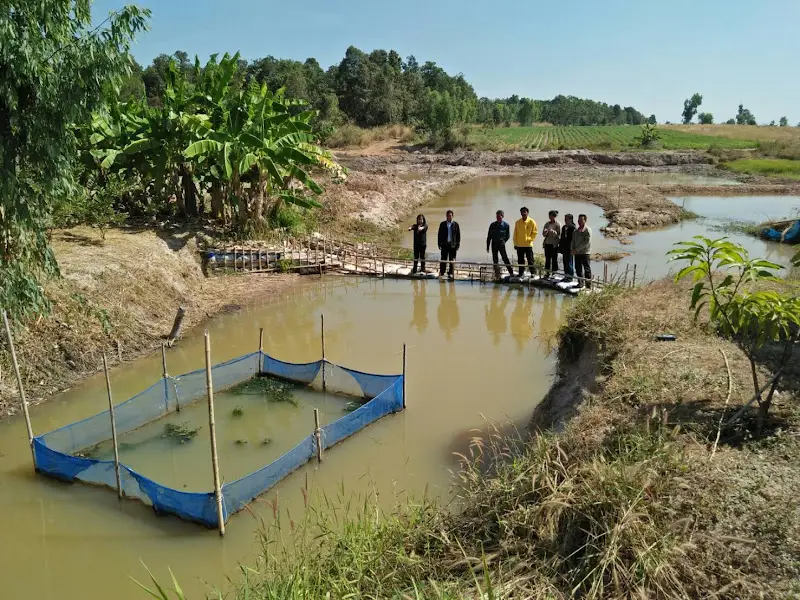
New Theory Agriculture Learning Plot (Suan Saen Phan) is an agricultural learning site located at 189 Moo 4, Kut Sim Khum Mai Subdistrict, Khao Wong District, Kalasin Province, northeastern Thailand. The plot is owned and operated by Mr. Somsri Saen Phan, a local farmer who applied His Majesty King Bhumibol Adulyadej’s New Theory Agriculture to a rain-fed farming area. From a total area of about 30 rai, he improved more than 8 rai of former paddy land and organized the farm into an integrated agricultural system with a water pond, fish raising, rice cultivation, perennial trees, fruit trees, and household vegetables. This makes Suan Saen Phan more than a private farm. It is a practical outdoor classroom showing how water management, food production, and self-reliance can work together in a rural Isan farming household.
The main value of Suan Saen Phan lies in the fact that it is based on real practice. Visitors can see how a farmer manages land according to actual conditions rather than according to theory alone. The farm includes a pond for storing rainwater, an area for rice, mixed trees, fruit trees, vegetables, and household service space. This reflects the heart of New Theory Agriculture: using land and water carefully to reduce risk and support family food security. In areas that depend heavily on rainfall, water storage is the first foundation of survival. Without water, rice, vegetables, fruit trees, and fish cannot be maintained through difficult periods.
Khao Wong District is an important area in the history of New Theory Agriculture in northeastern Thailand. The district has long been associated with royal development ideas concerning water storage, farm ponds, and rain-fed agriculture. Several subdistricts in Khao Wong, including Kut Sim Khum Mai, are connected with the expansion of New Theory farming practices. Suan Saen Phan should therefore be understood not only as an individual farmer’s plot, but also as part of the wider agricultural learning landscape of Kalasin Province.
New Theory Agriculture is widely known for its 30:30:30:10 land-use concept. About 30% of the land is used for a pond to store rainwater. Another 30% is used for rice cultivation so that the household has enough rice for consumption. Another 30% is used for field crops, fruit trees, perennial trees, vegetables, herbs, and other useful plants. The remaining 10% is used for housing, paths, farm structures, compost areas, animal shelters, and service space. However, this proportion is not a rigid formula. Farmers can adjust it according to land size, soil conditions, rainfall, labor, family needs, and local markets.
Suan Saen Phan applies this concept flexibly. Mr. Somsri Saen Phan did not depend on a single crop. Instead, he created a mixed farming system. The pond stores rainwater and supports fish raising. Rice provides the main food for the household. Fruit trees and perennial trees provide shade, biodiversity, and long-term production. Vegetables reduce household expenses and provide fresh food throughout the year. This diversity makes the farm more resilient than a monoculture system that depends too heavily on one crop and one market price.
The pond is one of the most important learning points of the farm. In a rain-fed system, storing water means storing security. The pond is not only a water reservoir. It is also a fish production area, a source of moisture for the farm, a reserve for vegetables and trees, and the center of a small ecological system. When water, plants, fish, and household activities are connected, the farm becomes a living system where resources circulate more efficiently.
Fish raising in the pond adds another layer of food production without requiring much additional land. Fish provide protein for the household and may become extra income when there is surplus. The pond also helps learners understand that water is not only for irrigation. It is part of a food system. In this way, the pond becomes a water bank, a food source, and a practical learning area for natural resource management.
The rice field area reflects the importance of rice in Isan household life. In New Theory Agriculture, rice is not only a commercial crop. It is the foundation of household food security. When a family has enough rice for consumption, expenses are reduced and the household becomes more stable. Growing rice together with vegetables, fruit trees, and fish means that the farm can provide staple food, protein, vegetables, and seasonal fruits from one integrated area.
The fruit trees and perennial trees create long-term value. Trees provide shade, improve the microclimate, reduce soil erosion, increase organic matter, and make the farm more ecologically balanced. A farm with many layers of vegetation is more similar to a natural ecosystem than a bare monoculture field. This diversity can reduce risk from pests, disease, heat, and uncertain weather. It also makes the farm more comfortable and suitable for educational visits.
Household vegetables may look small compared with rice or trees, but they are highly important in everyday life. Vegetables close to the house reduce daily expenses, provide fresh food, and make every part of the farm useful. Many vegetables grow quickly and can be rotated by season. When combined with rice, fish, and fruits, they give the household a varied food supply throughout the year.
The improvement of more than 8 rai of former paddy land within a total area of about 30 rai shows long-term planning. Many farmers in rain-fed areas face uncertain rainfall and unstable yields. Turning ordinary paddy land into a mixed learning plot requires courage, patience, and close understanding of local conditions. Digging a pond and reorganizing crops may not show full results immediately, but it builds a stronger system for the future.
Suan Saen Phan also reflects the practical meaning of Sufficiency Economy. It does not begin with the goal of producing as much as possible for sale. It begins with the goal of making the household secure: enough food, enough water, diverse crops, lower expenses, and less dependence on external inputs. When there is surplus, products can be sold or shared. This gives the household more flexibility and reduces pressure from market fluctuations.
For learners, Suan Saen Phan makes New Theory Agriculture easier to understand than reading about it in a classroom. Students, farmers, young agricultural learners, and visitors can see the pond, rice field, trees, vegetables, and farm layout in the same place. They can study water storage, mixed planting, household food production, expense reduction, and adaptation to uncertain rainfall through a real farm rather than abstract explanation.
The farm can be understood as a set of learning zones. The pond is a classroom about water. The rice field is a classroom about staple food. The fruit tree and perennial tree area is a classroom about long-term sustainability. The vegetable area is a classroom about reducing household expenses. The house and service area are a classroom about living together with food production. Together, these zones form a practical model of self-reliant rural life.
Mixed farming also helps spread labor and production throughout the year. Rice has its seasonal cycle of land preparation, planting, care, and harvest. Vegetables have short cycles and can be harvested frequently. Fruit trees require longer-term care but provide seasonal returns. Fish require water and feeding management. With good planning, these activities distribute work and food production across the year rather than depending on one harvest period.
Environmentally, Suan Saen Phan shows a farming approach that tries to restore balance in the land. Instead of using all land for one crop, the farm contains water, trees, vegetables, and food production spaces. Birds, insects, fish, soil organisms, and plants can exist together. This biodiversity supports the farm and reduces the need to depend only on outside inputs. It also makes the farm more pleasant for visitors who want to learn about sustainable agriculture.
Socially, the farm represents the role of a local farmer as a knowledge holder. Mr. Somsri Saen Phan’s value is not only that he farms his own land, but also that his farm can help others learn. Knowledge from real practice carries special weight because it comes from experience with drought, water management, crop choice, land improvement, labor, and long-term care. Other farmers can learn from the example and adapt the ideas to their own land without copying everything exactly.
A key lesson from Suan Saen Phan is that New Theory Agriculture is not a fixed blueprint. It is a way of thinking. Each farmer must consider rainfall, soil type, land slope, available labor, family needs, water sources, and nearby markets. The farm should therefore be used as a model for thinking and adapting, not as a formula that must be reproduced exactly in every place.
For agricultural tourists, Suan Saen Phan offers a different experience from a commercial fruit orchard. Its main value is not shopping or photography, but understanding how a farmer organizes water, rice, fish, vegetables, and trees into one system. The beauty of this kind of farm is the beauty of function: every part of the land has a role, and every role supports household stability.
Group visitors should coordinate in advance because this is a farmer’s learning plot, not a commercial tourist attraction with full-time staff. Advance coordination helps the owner or local contact arrange a suitable visit, explain the farm system, and guide visitors through the learning areas. This is especially important for schools, universities, farmer groups, and government or community study groups.
Visitors should respect the farm as a working food-production area. They should not step on vegetable plots, pick produce without permission, disturb the pond area, leave trash, or touch farm tools without approval. A learning visit should be modest, respectful, and focused on understanding the farmer’s work.
Getting There to Suan Saen Phan is most convenient by private car or rental vehicle. From Mueang Kalasin District, travel toward Khao Wong District, then continue to Kut Sim Khum Mai Subdistrict and Moo 4. The farm is located at house number 189. Travelers using public transport should get off in Khao Wong District and continue by local transport or a hired vehicle to Kut Sim Khum Mai. Because the site is located in a rural community, visitors should confirm the route with local contacts before traveling.
A visit to Suan Saen Phan can be combined with other learning and cultural places in Khao Wong and nearby districts. Possible nearby stops include Ban Daen Samakkhi New Theory Demonstration Project, Wat Phra That Muen Hin associated with Luang Pu Sila Sirichanto, Phu Thai cultural communities, restaurants in Khao Wong, and nearby natural attractions in Kuchinarai, Na Khu, or Sahatsakhan. This makes it possible to combine agriculture, local culture, nature, and community learning in one trip.
The best time to visit is in the morning or late afternoon when the weather is more comfortable. The rainy season and early cool season show the green character of the farm, while the dry season makes the value of water storage especially clear. Visitors who are interested in serious learning should prepare questions about pond digging, crop selection, rice cultivation, fish raising, household food security, and the economic results of changing from ordinary paddy land to integrated farming.
Overall, New Theory Agriculture Learning Plot (Suan Saen Phan) is a valuable agricultural learning site in Kalasin Province. It shows how a 30-rai rain-fed farm can be transformed into a diversified system with water, rice, fish, fruit trees, perennial trees, and vegetables. The farm is useful for anyone interested in Sufficiency Economy, sustainable agriculture, water management, food security, and rural self-reliance in northeastern Thailand.
| Name | New Theory Agriculture Learning Plot (Suan Saen Phan) |
| Location | House No. 189, Moo 4, Kut Sim Khum Mai Subdistrict, Khao Wong District, Kalasin Province |
| Address | 189 Moo 4, Kut Sim Khum Mai Subdistrict, Khao Wong District, Kalasin Province 46160, Thailand |
| Reference Area | Kut Sim Khum Mai Subdistrict, Khao Wong District, Kalasin Province |
| Highlights | A rain-fed New Theory Agriculture learning plot with a water pond, fish raising, rice cultivation, perennial trees, fruit trees, vegetables, and integrated farming activities |
| History | A farmer learning plot in Khao Wong District that applies the New Theory Agriculture concept to rain-fed land. More than 8 rai of former paddy land was improved within a total area of about 30 rai |
| Name Origin | The name Suan Saen Phan comes from the family name of the owner, Mr. Somsri Saen Phan |
| Distinctive Features | A practical farm model focusing on rainwater storage, household food production, mixed planting, risk reduction, and efficient use of land according to New Theory Agriculture |
| Travel Information | From Mueang Kalasin, travel to Khao Wong District, then continue to Kut Sim Khum Mai Subdistrict and Moo 4. Private car or rental vehicle is recommended. Public transport users should get off in Khao Wong and continue by local transport |
| Current Status | A farmer learning plot and community agricultural study site for New Theory Agriculture |
| Open Days | Daily |
| Opening Hours | 08.00 – 17.00 |
| Facilities | Rain-fed farming demonstration area, pond, rice field, fruit tree area, perennial tree area, household vegetable area, and learning spaces for visitors when coordinated in advance |
| Main Areas / Zones | Water Pond And Fish Raising Zone Rice Field Zone Perennial Tree And Fruit Tree Zone Household Vegetable Zone Integrated Farming Zone Residential And Farm Service Area New Theory Agriculture Land-Use Learning Zone |
| Caretaker / Owner | Mr. Somsri Saen Phan, owner of the learning plot Local Administrative Area: Kut Sim Khum Mai Municipality |
| Local Contact Number | Kut Sim Khum Mai Municipality: 043-859261 |
| Related Official Websites / Pages | Kut Sim Khum Mai Municipality, Office of the Royal Development Projects Board, Chaipattana Foundation, and New Theory Agriculture project information for Khao Wong District |
| Nearby Tourist Attractions | 1. Ban Daen Samakkhi New Theory Demonstration Project, about 8 km 2. Wat Phra That Muen Hin, Luang Pu Sila Sirichanto, about 14 km 3. Wat Phutthanimit Phu Khao, about 32 km 4. Ban Khok Kong Phu Thai Cultural Village, about 34 km 5. Tat Sung Waterfall, Kuchinarai District, about 38 km 6. Wat Klang Phu Laen Chang Museum, Na Khu District, about 45 km 7. Sirindhorn Museum, Sahatsakhan District, about 85 km, Tel. 0-4387-1014, 0-4387-1393-4, 0-4387-1612-6 |
| Nearby Restaurants | 1. Pla Nam Khong Restaurant, about 8 km, Tel. 081-0604547, 085-7399106 2. Lamphu Korean Barbecue Khao Wong, about 8 km, Tel. 043-859033 3. Lamphu Moo Kratha Khao Wong Branch, about 8 km, Tel. 093-381-1413 4. Sabai Jai Khao Wong, about 9 km, Tel. 062-336-3717 5. Phat Khan Thep Resort And Moo Kratha, about 11 km, Tel. 065-579-3732, 081-525-2009 6. Jungle Cafe Na Khu Branch, about 28 km, Tel. 098-632-6965 |
| Nearby Accommodations | 1. Khao Wong Mountain View Resort, about 9 km, Tel. 098-673-1250 2. Mountain View Inn, about 10 km, Tel. 082-872-5736 3. Ruean Phu Thai Resort Hotel, about 12 km, Tel. 089-862-1875 4. Phat Khan Thep Resort, about 11 km, Tel. 065-579-3732 5. Oon Rak Homestay Khao Wong, about 12 km, Tel. 084-180-8428, 095-759-9548 6. Khao Wong Homestay Baan Suan Khun Yok, about 12 km, Tel. 062-661-4264 |
Frequently Asked Questions (FAQ)
Q: Where Is New Theory Agriculture Learning Plot (Suan Saen Phan) Located?
A: It is located at 189 Moo 4, Kut Sim Khum Mai Subdistrict, Khao Wong District, Kalasin Province 46160, Thailand.
Q: Who Owns Suan Saen Phan?
A: The farm is owned and operated by Mr. Somsri Saen Phan, the local farmer who developed it as a New Theory Agriculture learning plot.
Q: What Are The Opening Days And Hours?
A: The farm is listed as open daily from 08.00 to 17.00. Group visitors should coordinate in advance for a more organized learning visit.
Q: What Makes Suan Saen Phan Interesting?
A: Its main feature is the practical application of New Theory Agriculture in a rain-fed farming area, with a pond, fish raising, rice, perennial trees, fruit trees, and household vegetables in one integrated system.
Q: Who Should Visit Suan Saen Phan?
A: It is suitable for students, teachers, farmers, agricultural study groups, travelers interested in sustainable farming, and anyone who wants to learn about Sufficiency Economy and New Theory Agriculture in practice.
Q: How Is Suan Saen Phan Connected With New Theory Agriculture?
A: The farm applies New Theory principles by organizing land and water for household food security, including water storage, rice cultivation, fish raising, fruit trees, perennial trees, and mixed vegetables.
Q: How Can Travelers Get To Suan Saen Phan?
A: From Mueang Kalasin, travel to Khao Wong District, then continue to Kut Sim Khum Mai Subdistrict and Moo 4. Private car or rental vehicle is recommended.
Q: What Nearby Places Can Be Visited After Suan Saen Phan?
A: Nearby places include Ban Daen Samakkhi New Theory Demonstration Project, Wat Phra That Muen Hin, Ban Khok Kong Phu Thai Cultural Village, Tat Sung Waterfall, and Sirindhorn Museum depending on available travel time.
 Category: ●Educational Places
 Group: ●Educational Gardens, Farm
Last Update : 2 MonthAgo
 Last Update : 2 MonthAgo
 Art, Culture and Heritage
 Historical Sites and Monuments(2)
 Landmarks and Memorials(3)
 Art, Craft Centres, Tradition(4)
 Museums(3)
 Art Gallery(1)
Educational Gardens, Farm(1)
Art Gallery(1)
Educational Gardens, Farm(1)
 Places of Worship
 Temple(21)
 Other Sacred Sites(6)
 Suburban Living
 Village, Community(3)
 Nature and Wildlife
 National Parks and Marine Reserves(3)
 Mountain (Doi)(2)
 Dam, Reservoir, Lake(5)
 Waterfalls(4)
 Caves(2)
 River, Canal(3)
 Bays and Beaches(1)
 Other natural attractions(2)
 Entertainment and Agricultural
 Animal camps and shows(1)
 Farms, Parks and Ecotourism(2)


