
lovethailand home >Northeastern Travel Attractions >Kalasin Travel Attractions >Khao Wong >Kut Sim Khum Mai > Ho Tala Mahesak
TL;DR: Ho Tala Mahesak is located at Ban Kut Sim Khum Mai, Moo 10, Kut Sim Khum Mai Subdistrict, Khao Wong District, Kalasin Province, open Daily, hours 08.00 – 17.00.
Ho Tala Mahesak
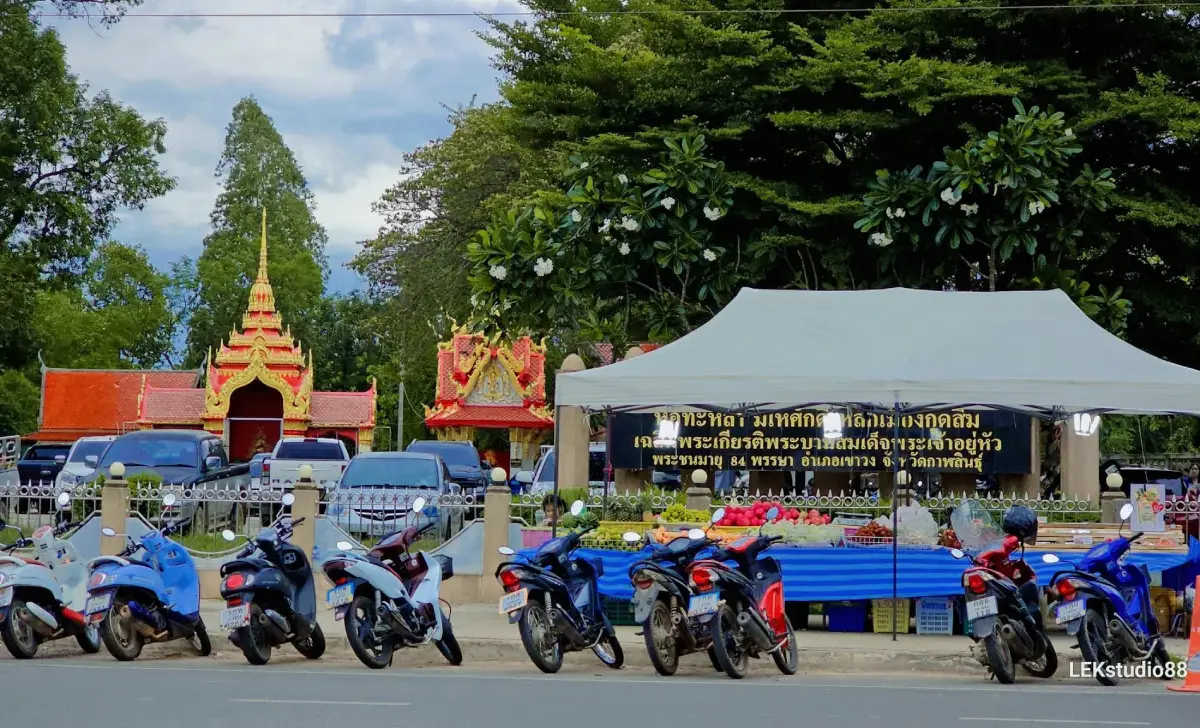
Open Days: Daily
Opening Hours: 08.00 – 17.00
Ho Thala Mahesak in Kalasin Province is a sacred community shrine located at Ban Kut Sim Khum Mai, Moo 10, Kut Sim Khum Mai Subdistrict, Khao Wong District, Kalasin Province. It is one of the most meaningful spiritual landmarks of the former town of Kut Sim Narai and the Phu Tai community of Khao Wong. For local people, this shrine is not simply a place of worship. It is a guardian shrine of the town, a symbolic city spirit, and a spiritual anchor for descendants who still regard it as a source of protection, courage, and emotional connection to their homeland.
The word “Mahesak” in local belief refers to a powerful guardian spirit of the town, often understood as a city-protecting spirit connected with royal authority, governance, warfare, and the protection of people. In the worldview of the local community, Mahesak is a sacred power that helps protect the town, support social order, and keep descendants safe. Ho Thala Mahesak is therefore a place where belief in city spirits, respect for ancestors, and the historical memory of the Phu Tai people come together.
Ho Thala Mahesak is deeply respected as a sacred landmark of Kut Sim Khum Mai and the former town of Kut Sim Narai. Local descendants come to pay respect, make offerings, ask for protection, and seek blessings before traveling far from home. For people who leave the district to study, work, serve in government, trade, or build new lives elsewhere, this shrine remains a powerful reminder of their roots. Returning to Ho Thala during important family and community occasions is also a way to reconnect with the ancestors and with the homeland.
The atmosphere around Ho Thala reflects the character of a living community shrine in rural Isan. It is not valued mainly for architectural grandeur, but for its spiritual meaning. People come here to light incense, offer respect, present ritual items, and participate in local ceremonies. During important occasions, elders, descendants, ritual specialists, community leaders, and returning family members gather at the shrine. These gatherings show that Ho Thala is not an abandoned monument; it is a living cultural space where faith continues to shape community life.
The meaning of Ho Thala cannot be separated from the history of Kut Sim Narai. Kut Sim Narai was an old Phu Tai settlement with roots in the migration of Phu Tai ancestors from the left bank of the Mekong River into Siam. Community leaders and their followers searched for suitable land and eventually found an area with the Lam Phayang watercourse, smaller streams, wetlands, and fertile plains. The place became suitable for settlement, farming, and town building. In 1845, Ban Kut Sim Narai was elevated to the status of Muang Kut Sim Narai, with Phra Thibetwongsa (Ko) as the first ruler.
The history of Kut Sim Narai is closely linked with local leadership, town administration, and the spiritual role of guardian spirits. After Phra Thibetwongsa (Ko), the town was governed by Phra Thibetwongsa (Duang) and later by Phra Thibetwongsa (Kinnari). These former rulers remain important in local memory through monuments, ceremonies, and the annual Thala-related rituals. Paying respect at Ho Thala is therefore also connected with remembering the early leaders and ancestors who established and protected the community.
For the Phu Tai people, Ho Thala represents the bond between the living, the ancestors, and the town. Phu Tai culture places great value on lineage, family memory, the village of origin, and respect for departed elders. Rituals at Ho Thala express gratitude, seek blessings, and reaffirm the community’s relationship with those who came before. These practices teach younger generations that they belong to a lineage, a place, and a cultural tradition that should be preserved.
What makes Ho Thala Mahesak especially distinctive is its role as the spiritual center of Kut Sim Narai. Local people may respectfully refer to the sacred power as Chao Pu Thala or Thala Chao Phu Kha, terms that convey intimacy, reverence, and a sense of ancestral guardianship. These names show that the shrine is not treated as a distant or abstract sacred object. It is felt as the presence of a protective elder of the town. When people face hardship, illness, travel, or major life transitions, they often remember Ho Thala and ask for protection.
The most important tradition associated with the shrine is the Liang Thala ceremony, or the ritual offering to Thala Mahesak, the guardian spirit of the town. This ceremony is closely connected with paying respect to the former rulers of Kut Sim Narai and the ancestral spirits of the Phu Tai community. It is commonly linked with the Songkran and Family Day period, when descendants return home. The gathering at Ho Thala during this season carries meaning on several levels: spiritual devotion, family reunion, cultural continuity, and community solidarity.
During the Liang Thala ceremony, ritual offerings are prepared, elders and community leaders take part, and people gather to ask for safety, prosperity, unity, and peaceful living. The ceremony honors the guardian spirit of the town and the ancestors who are believed to protect the community. It also gives returning descendants an opportunity to reconnect with their hometown before leaving again after the holiday season. For this reason, the ceremony functions as both a sacred rite and a social reunion.
Another important element connected with the shrine is the Yao ritual of the Phu Tai people. In Phu Tai culture, Mor Yao, or ritual healers, perform ceremonies that communicate with ancestral spirits and restore balance between people and the unseen world. Yao is not simply a folk performance; it is a spiritual knowledge system inherited within the community. When Yao appears alongside the Liang Thala ceremony, Ho Thala becomes an important stage for preserving Phu Tai intangible cultural heritage.
Visitors who come during the ceremony may see traditional dancing, ritual offerings, Phu Tai clothing, music, and the participation of different generations. The beauty of the event lies not only in costume or movement, but also in the feeling of people returning home to honor the same sacred center. Children and young people learn by watching elders, listening to local stories, and joining the atmosphere of the ceremony. Through these experiences, the history of the town becomes alive.
Ho Thala also helps preserve the memory of migration and settlement. In modern life, many descendants of rural communities leave home for education and work in other provinces. A sacred site such as Ho Thala gives them a place to return to. It tells them that their community has a history, that their ancestors are remembered, and that their identity is still rooted in Kut Sim Narai and Khao Wong. This emotional role is one of the reasons the shrine remains important today.
For cultural travelers, Ho Thala Mahesak should be approached with respect. This is not an entertainment attraction, but a sacred place for local people. Visitors should dress modestly, speak politely, avoid mocking local beliefs, and refrain from touching ritual objects without permission. Photography should be done carefully, especially during ceremonies. The most important rule is to respect the community’s faith and treat the shrine as a living cultural place.
The surrounding landscape of Khao Wong District adds further meaning to the visit. Khao Wong is known for its Phu Tai communities, hilly scenery, local temples, Lam Phayang, and cultural routes. The district preserves Phu Tai language, clothing, food, ritual practices, and community identity. Ho Thala can therefore be used as a starting point for understanding the cultural landscape of Khao Wong before continuing to nearby places such as Wat Pa Phuttha But, Wat Phra That Muen Hin, Wat Wang Kham, and Lam Phayang Upper Reservoir.
One nearby destination that complements a visit to Ho Thala is Wat Ban Phon Wiman, also known as Wat Pa Phuttha But, located in Kut Sim Khum Mai Subdistrict. The temple functions as a meditation and moral development center and is also associated with petrified wood and ancient fossil fish believed to be around 160 million years old. Combining Ho Thala with Wat Pa Phuttha But allows visitors to see spiritual belief, Buddhist practice, local learning, and natural history in one route.
Wat Phra That Muen Hin is another important religious site in Khao Wong and is associated with devotion to Luang Pu Sila Sirichanto. Wat Wang Kham in Ban Na Wi, Song Plueai Subdistrict, is well known for its Lan Xang-style architecture inspired by Wat Xieng Thong in Luang Prabang, Laos. These destinations make the Khao Wong route rich in Buddhist faith, Phu Tai identity, Mekong cultural influence, and local art.
From a historical perspective, Ho Thala is an entry point into the story of the old town of Kut Sim Narai. The area has Lam Phayang as an important natural feature, the memory of the former town, monuments of past rulers, and ritual practices that continue today. A visit to the shrine is therefore not just a brief stop for worship. It is a journey into the cultural geography of a Phu Tai town that has preserved its identity through memory, ritual, and community participation.
Many local people speak of the protective power of Ho Thala. This belief should be understood not only as supernatural faith, but also as a form of emotional security. The shrine gives people confidence, comfort, and a sense that they remain connected to their ancestors. When descendants travel far away, asking for blessings at Ho Thala becomes a way to strengthen the heart and to feel protected by the town spirit and ancestral guardians.
The prayers made at Ho Thala often concern safety, travel, work, family protection, and the peace of the community. People do not ask for blessings instead of making effort; rather, the ritual gives them moral strength and emotional support. This is a key part of many rural Isan belief systems, where faith, family, community, and daily life remain closely connected.
In anthropological terms, Ho Thala functions on several levels. It is a shrine for the guardian spirit of the town. It is a gathering place for the local community. It is a storehouse of memory about Kut Sim Narai and its former rulers. It is a ceremonial stage for Yao and Phu Tai rituals. It is also a cultural destination where outsiders can learn about local belief if they approach with respect. These overlapping roles make Ho Thala an important example of living heritage in northeastern Thailand.
A visit on an ordinary day offers a quiet experience. Visitors can pay respect, observe the area, and continue to other attractions in Khao Wong. A visit during the Liang Thala ceremony gives a very different experience, with ritual offerings, dancing, returning descendants, and the gathering of the Phu Tai community. Both experiences are valuable, but they reveal different aspects of the same sacred place.
The most culturally meaningful time to visit is during the Songkran and Family Day period, when the Liang Thala ceremony is associated with the return of descendants and community reunion. Travelers should check the annual schedule with the local municipality or community before making a trip, as ceremonial dates may vary by year. Those who prefer a calm visit can come in the morning or late afternoon on regular days, when the weather is more comfortable.
Getting There is most convenient by private car. Travelers can reach Khao Wong District from Kuchinarai District via Highway 2291, then continue into Kut Sim Khum Mai Subdistrict and the Kut Sim Narai city-spirit area. The coordinates are latitude 16.684387 and longitude 104.081960. Visitors traveling from Kalasin town should head toward Kuchinarai and then continue to Khao Wong. A private car or hired vehicle is recommended because it allows visitors to combine Ho Thala with nearby temples and cultural sites in the same trip.
Those using public transport should first reach Khao Wong or Kuchinarai, then arrange local transport to Kut Sim Khum Mai. Return transportation should be planned carefully, especially on weekdays or in the evening, because rural public transport can be limited. Travelers who want to visit Ho Thala, Wat Pa Phuttha But, Wat Phra That Muen Hin, and Wat Wang Kham on the same day will find private transport much more convenient.
A practical route is to begin with Ho Thala Mahesak, then visit Wat Pa Phuttha But to see the petrified wood and ancient fish fossil displays, continue to Wat Phra That Muen Hin, and then go to Wat Wang Kham for Lan Xang-style architecture. This route offers a broad understanding of Khao Wong, combining town-spirit belief, Buddhism, Phu Tai culture, and local natural heritage.
Visitors should observe proper etiquette at the shrine. Do not make jokes about local belief, do not touch offerings, do not interrupt ritual specialists, and do not photograph people closely during ceremonies without permission. If visitors wish to make offerings, they should ask local people or caretakers for guidance. Community rituals may have different customs from temple worship, and respecting those customs is essential.
Ho Thala Mahesak is also useful for understanding the concept of a city pillar or town guardian in local Isan culture. Not every community expresses this idea through an official city pillar. Some places have a guardian-spirit shrine, an ancestral shrine, or a sacred house that performs a similar symbolic role. Ho Thala shows how the Phu Tai community created its own spiritual center and uses ritual to maintain the relationship between people, town, ancestors, and sacred protection.
For younger generations, Ho Thala is a place where history can be learned through direct experience. Reading about Kut Sim Narai provides one kind of knowledge, but standing at the shrine, listening to elders, seeing ritual offerings, and hearing ceremonial sounds during the festival make the past more tangible. In this way, local history is not only preserved in books. It is carried through ceremony, memory, and community participation.
For foreign travelers, Ho Thala can be understood as a guardian-spirit shrine of a Phu Tai community. The key idea is that the town is believed to have a sacred protector, and local people honor that protector together with former rulers and ancestral spirits. The Liang Thala and Yao rituals help maintain the relationship between the community and the unseen world. Understanding the site in this way allows visitors to appreciate it as a coherent cultural system rather than as an exotic curiosity.
Ho Thala Mahesak is therefore more than a local shrine in Khao Wong District. It is a center of memory for the old town of Kut Sim Narai, a spiritual anchor for Phu Tai descendants, a ceremonial stage for Liang Thala and Yao traditions, and a meaningful starting point for travelers who want to understand Phu Tai culture in Kalasin. A small sacred site can hold the story of a town, its people, its ancestors, and its living faith with remarkable depth.
After visiting Ho Thala, travelers will see Khao Wong in a deeper way. The district is not merely a small rural area of Kalasin Province. It is a cultural homeland of the Phu Tai people, a place with the memory of an old town, reverence for former rulers and ancestors, and ceremonies that continue to shape community identity. Visiting Ho Thala is both an act of cultural learning and a respectful encounter with the spiritual heart of the community.
| Name | Ho Thala Mahesak, also known as Ho Thala Mahesak Lak Mueang Kut Sim |
| Location | Ban Kut Sim Khum Mai, Moo 10, Kut Sim Khum Mai Subdistrict, Khao Wong District, Kalasin Province |
| Address | Moo 10, Kut Sim Khum Mai Subdistrict, Khao Wong District, Kalasin Province 46160, Thailand |
| Coordinates | Latitude 16.684387, Longitude 104.081960 |
| Highlights | A sacred guardian shrine of the former Kut Sim Narai town, respected by the Phu Tai community as a place to honor the town spirit, ancestors, and protective sacred power |
| History | Connected with the history of Muang Kut Sim Narai, an old Phu Tai town elevated in 1845 and ruled by leaders bearing the title Phra Thibetwongsa |
| Name Origin | “Thala” refers to the sacred guardian respected by the community, while “Mahesak” refers to the city-protecting spirit believed to safeguard the town and its descendants |
| Distinctive Features | A community shrine and ritual space used for worship, offerings, blessings, and the Liang Thala ceremony of the Phu Tai people |
| Core Belief | Local people believe Mahesak is the guardian spirit of the town, associated with royal authority, governance, warfare, and the protection of descendants |
| Traditions / Rituals | Liang Thala ceremony, offerings to Mahesak Lak Mueang, ceremonies honoring former rulers of Kut Sim Narai, Phu Tai Yao rituals, and community gatherings during Songkran and Family Day |
| Main Areas / Zones | Ho Thala shrine, worship area, offering area, ceremonial ground, traditional dance area, and Kut Sim Narai city-spirit area near Lam Phayang |
| Travel Information | Travel by private car from Kuchinarai District to Khao Wong District via Highway 2291, then continue to Kut Sim Khum Mai Subdistrict; visitors from Kalasin town can travel via Kuchinarai toward Khao Wong |
| Current Status | Open for worship and cultural visits; remains an important sacred and ceremonial place for the Kut Sim Khum Mai community |
| Open Days | Daily |
| Opening Hours | 08.00 – 17.00 |
| Caretaker / Local Contact | Kut Sim Khum Mai Community / Kut Sim Khum Mai Municipality, Tel. 043-859261 |
| Nearby Tourist Attractions | 1. Phra Thibetwongsa Monument, Kut Sim Narai city-spirit area, about 0.1 km 2. Wat Ban Phon Wiman, or Wat Pa Phuttha But, about 5 km 3. Petrified Wood and Ancient Fish Fossil Learning Area inside Wat Pa Phuttha But, about 5 km 4. Wat Phra That Muen Hin, about 7 km 5. Wat Wang Kham, Ban Na Wi, Song Plueai Subdistrict, about 16 km |
| Nearby Restaurants | 1. Pla Nam Khong Restaurant, about 2 km, Tel. 081-060-4547, 085-739-9106 2. Ban Kor Bua Coffee, about 2 km, Tel. 086-351-6470 3. Krua Rung Arun, about 7 km, Tel. 083-355-3260 4. Huay Tiam Green View Resort and Ko Khun Phon Yang Kham, about 5 km, Tel. 089-570-2614, 086-234-3500 5. Non Na Cafe @ Khao Wong, about 4 km |
| Nearby Accommodations | 1. Taweesin Resort Khao Wong, about 4 km, Tel. 061-045-7880 2. Huay Tiam Green View Resort, about 5 km, Tel. 086-234-3500 3. Kan Kluai Resort, about 5 km, Tel. 082-872-5736 4. Mae Hong Son Resort, about 7 km, Tel. 083-358-1308 5. Khao Wong Homestay Baan Suan Khun Yok, about 9 km, Tel. 062-661-4264 |
Frequently Asked Questions (FAQ)
Q: Where is Ho Thala Mahesak located?
A: Ho Thala Mahesak is located at Ban Kut Sim Khum Mai, Moo 10, Kut Sim Khum Mai Subdistrict, Khao Wong District, Kalasin Province. It is a sacred guardian shrine of the former Kut Sim Narai town.
Q: Why is Ho Thala Mahesak important?
A: It is respected as a sacred town-spirit shrine where local Phu Tai people honor Mahesak, ancestors, and the protective spiritual power believed to safeguard the community and its descendants.
Q: What does Mahesak mean?
A: Mahesak refers to a guardian spirit or city-protecting spirit associated with governance, warfare, royal authority, and the protection of people in the town.
Q: Which traditions are connected with Ho Thala?
A: The shrine is connected with the Liang Thala ceremony, offerings to Mahesak Lak Mueang, ceremonies for former rulers of Kut Sim Narai, and Phu Tai Yao rituals, especially during Songkran and Family Day.
Q: Can travelers visit and pay respect at Ho Thala?
A: Yes. Travelers can visit and pay respect daily during opening hours. Visitors should dress respectfully, avoid touching ritual offerings, and ask permission before photographing ceremonies.
Q: How can travelers get to Ho Thala Mahesak?
A: The most convenient way is by private car. Travel from Kuchinarai District toward Khao Wong District via Highway 2291, then continue to Kut Sim Khum Mai Subdistrict. The coordinates are 16.684387, 104.081960.
Q: What nearby attractions can be combined with Ho Thala?
A: Nearby attractions include the Phra Thibetwongsa Monument, Wat Pa Phuttha But, Wat Phra That Muen Hin, Wat Wang Kham, and Phu Tai cultural learning areas in Khao Wong District.
Q: When is the best time to experience the Liang Thala tradition?
A: The Songkran and Family Day period is the most culturally meaningful time, as descendants return home and the community holds offerings, traditional dances, and Phu Tai Yao-related rituals.
 Category: ●Places of Worship
 Group: ●Other Sacred Sites
Last Update : 1 MonthAgo
 Last Update : 1 MonthAgo
 Click to Access the Navigation Map GPS
 Art, Culture and Heritage
 Historical Sites and Monuments(2)
 Landmarks and Memorials(3)
 Art, Craft Centres, Tradition(4)
 Museums(3)
 Art Gallery(1)
 Educational Places
 Educational Gardens, Farm(1)
 Temple(21)
Other Sacred Sites(6)
Temple(21)
Other Sacred Sites(6)
 Suburban Living
 Village, Community(3)
 Nature and Wildlife
 National Parks and Marine Reserves(3)
 Mountain (Doi)(2)
 Dam, Reservoir, Lake(5)
 Waterfalls(4)
 Caves(2)
 River, Canal(3)
 Bays and Beaches(1)
 Other natural attractions(2)
 Entertainment and Agricultural
 Animal camps and shows(1)
 Farms, Parks and Ecotourism(2)


