
lovethailand home >Northeastern Travel Attractions >Kalasin Travel Attractions >Sahasakan >Sahatsakhan > Wat Phuttha Nimit (Phu Khao)
TL;DR: Wat Phuttha Nimit (Phu Khao) is located at Ban Na Si Nuan, Sahatsakhan Subdistrict, Sahatsakhan District, Kalasin Province, open Daily, hours 08.30 – 16.30.
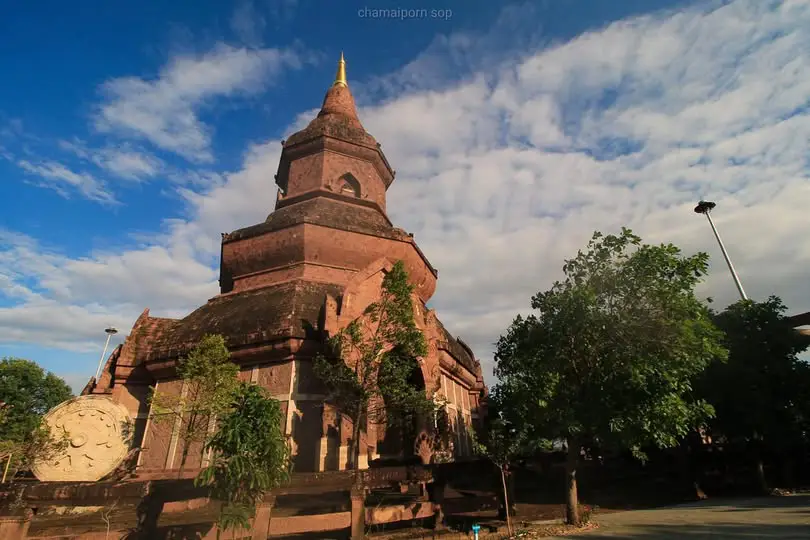
Wat Phuttha Nimit (Phu Khao)
Open Days: Daily
Opening Hours: 08.30 – 16.30
Wat Phuttha Nimit (Phu Khao) in Kalasin Province is one of the most meaningful Buddhist and cultural attractions in Sahatsakhan District. Located in Ban Na Si Nuan, Sahatsakhan Subdistrict, the temple is about 7 kilometers from Sahatsakhan town and about 4 kilometers from Phu Sing. It is best known for its ancient left-side reclining Buddha image without a flame-like head finial, a beautifully carved wooden ordination hall, the Sangha Nimit Hall that houses rare Buddha images and amulets, and a large sandstone pagoda known as Phra Maha That Chedi Phuttha Nimit. The temple is peaceful, shaded, and deeply rooted in local faith, making it suitable for merit-making, cultural travel, Buddhist art appreciation, and slow travel in northeastern Thailand.
The word “Phu Khao” is connected with the Isan word “khao,” meaning rope. The hill on which the temple stands has a long shape resembling a rope, and this landscape gave the place its name. The temple is sometimes called Wat Phu Khao or Wat Phuttha Nimit Phu Khao, while the commonly used name is Wat Phuttha Nimit (Phu Khao). This name reflects both the geography of the hill and the local Isan way of naming sacred places through natural forms.
The reclining Buddha image is the spiritual heart of the temple. Unlike most reclining Buddha images, which usually lie on the right side, the Phu Khao reclining Buddha lies on the left side and has no ketumala, or flame-like head finial. The image is about 2 meters long and about 50 centimeters wide. It is enshrined near the mouth of a cave on an ancient rock surface, where local people and visitors come to pay respect. Its unusual posture has long attracted the attention of worshippers, travelers, and people interested in Buddhist iconography.
Local tradition links the reclining Buddha with Phra Maha Moggallana, one of the Buddha’s chief disciples and the foremost disciple on the left side. This connection gives the image a special symbolic meaning for the community. The local legend also says that the image is more than 2,000 years old. Whether approached as faith, oral tradition, or cultural memory, the story shows how deeply the people of Kalasin have connected this sacred image with Buddhist devotion and local identity.
Every year on 19 April, the temple holds the ceremonial bathing of the reclining Buddha image. This annual ritual takes place after Songkran and has been observed by local people for many decades. Worshippers gather to bathe the sacred image, make merit, and ask for blessings. The ceremony connects water, purification, Buddhist devotion, Thai New Year customs, and community memory. For visitors, this is one of the best times to experience the temple as a living sacred place rather than simply as a tourist site.
The location of the reclining Buddha on the hill creates a strong sense of sacred atmosphere. The surrounding trees, rock surfaces, pathways, and elevated landscape give the temple a quiet and contemplative feeling. Visitors who come to pay respect often experience a sense of calm before and after worship. This makes Wat Phuttha Nimit (Phu Khao) suitable not only for sightseeing, but also for personal reflection and spiritual rest.
Another major highlight is the carved wooden ordination hall. This building is one of the most impressive examples of wooden religious architecture in Kalasin. It was constructed using large pieces of timber brought up from the area beneath Lam Pao Dam. The hall has a traditional Thai wooden form, tiered gables, extended eaves on all sides, and detailed carvings on the doors, windows, pediments, and ceiling. The carvings depict scenes from the life of the Buddha, the Ten Jataka stories, floral motifs, and three-dimensional relief-style details.
The wooden ordination hall is valuable not only because of its beauty, but also because of its connection to the local landscape. The timber used in the building came from an area affected by the creation of Lam Pao Dam. Once transformed into a sacred building, the wood became part of a religious and cultural monument. In this sense, the ordination hall preserves both local material history and Buddhist artistic heritage.
Inside the wooden ordination hall, the principal Buddha image is Phra Mongkhon Chai Sit Rotchanarit Prasitphon, a golden seated Buddha in the meditation posture. Above the image, the ceiling area is decorated with low-relief wooden carvings painted in gold, telling episodes from the Buddha’s life. When natural light enters the hall and falls across the wooden surfaces and the golden Buddha image, the interior feels warm, sacred, and visually rich. Visitors interested in wood carving should take time to look closely at the doors, window panels, ceiling, and surrounding decorative details.
The carvings are not merely decorative. They also serve as visual teachings. Scenes from the Buddha’s life and the Ten Jataka stories help communicate Buddhist values, the cultivation of virtue, generosity, patience, and wisdom. In Thai temple culture, art often functions as a form of education. Through carved wood, visitors can read Buddhist stories visually, even without studying religious texts directly.
The Sangha Nimit Hall is another important area of the temple. It houses many Buddha images, amulets, and rare sacred objects. The walls and upper areas of the hall are decorated with numerous amulets, creating a striking visual display of accumulated devotion. For travelers interested in Thai amulet culture, Buddhist material culture, or local expressions of faith, this hall reveals how sacred objects can carry memory, blessing, and personal belief across generations.
Visitors should view the objects inside the Sangha Nimit Hall respectfully. The Buddha images and amulets are not simply collectibles; they are sacred objects connected with faith, teachers, temples, and personal acts of devotion. They should not be touched, moved, or photographed intrusively. Quiet observation is the best way to appreciate this space.
Wat Phuttha Nimit (Phu Khao) also contains Phra Maha That Chedi Phuttha Nimit, a large sandstone pagoda. The pagoda is about 80 meters high, with a base approximately 45 by 45 meters. Each entrance is about 7 meters high, and the interior includes 32 large columns. The upper area enshrines ancient Buddha images from different periods, while the lower area contains many carved stone Buddha images. The golden top of the pagoda weighs about 30 kilograms and enshrines sacred relics, including relics of the Buddha, arahants, and revered monks.
This large pagoda expands the temple’s identity from a hill temple with an ancient reclining Buddha into a major center of Buddhist devotion in Kalasin. Many visitors arrive intending to see only the reclining Buddha, but discover that the temple offers several important areas: the wooden ordination hall, the Sangha Nimit Hall, the sacred pagoda, the cave-side reclining Buddha, a replica Buddha footprint, and hilltop viewpoints. A good visit should allow at least 1.5 to 2 hours.
The temple is also well connected with other attractions in Sahatsakhan District. Nearby places include Wat Phutthawat on Phu Sing, Sirindhorn Museum, the Phu Kum Khao dinosaur excavation site, Thepsuda Bridge, and Lam Pao Dam. This makes Wat Phuttha Nimit (Phu Khao) an excellent stop in a full-day Kalasin itinerary that combines Buddhist culture, natural scenery, geological history, and reservoir landscapes.
For photography, the temple offers many strong visual angles. The wooden ordination hall is beautiful from the front, while its carved doors and windows reward close observation. The reclining Buddha image has a distinctive sacred setting against the rock surface. The Sangha Nimit Hall and the sandstone pagoda provide additional subjects for cultural photography. Visitors should photograph respectfully, avoid disturbing worshippers, and avoid using flash in sensitive areas.
Temple etiquette is important. Visitors should dress modestly, remove shoes before entering sacred buildings where required, keep their voices low, and avoid touching Buddha images, amulets, wooden carvings, or religious objects. If a ceremony is taking place, visitors should give priority to monks and local worshippers. Wat Phuttha Nimit (Phu Khao) is not only an attraction; it is a living Buddhist temple and a sacred community space.
Getting There is most convenient by private car, rental car, or hired local vehicle. From Sahatsakhan District, take Highway 227 toward Kham Muang District. After passing Ban Sing Sa-at School for about 4.5 kilometers, reach the intersection near Kham Lue Cha Health Station and turn left for about 1 kilometer. At the next three-way junction, turn left again and continue for about 300 meters. The temple is on the left, and the reclining Buddha cave area is a little farther ahead.
From Kalasin town, the temple is about 41 kilometers away and takes around 45 minutes by car. There is no direct public transport to the temple entrance, so travelers without a private vehicle should arrange a hired car or local transport. Those staying in Sahatsakhan or Kalasin town can easily include the temple in a half-day or full-day itinerary.
The best time to visit is from morning to afternoon, when natural light makes it easier to see the wooden carvings and architectural details. Visitors who want to experience the annual ritual should come around 19 April for the ceremonial bathing of the reclining Buddha. Those who prefer a quiet visit should choose a weekday outside major festivals.
There is no admission fee. Visitors may make merit according to their faith. The temple has a large parking area that can accommodate many vehicles, making it suitable for individual travelers, families, student groups, merit-making groups, and cultural tours. During long holidays and the annual 19 April ceremony, visitors should allow extra time for parking and walking between different areas of the temple.
For families, Wat Phuttha Nimit (Phu Khao) is a useful cultural learning site. Children can learn about temple manners, Buddhist worship, the significance of sacred images, wood carving, and the relationship between local legends and community faith. Explaining why people bathe the Buddha image after Songkran and why the reclining Buddha is special can turn the visit into a meaningful cultural experience.
For foreign travelers, the temple offers a deeper view of Thai Buddhism beyond the most famous temples. It combines a hill landscape, an unusual reclining Buddha, sacred legend, wooden architecture, amulet culture, and a large pagoda in one place. With local interpretation or careful reading, the visit becomes much more than sightseeing; it becomes an encounter with the living religious culture of Isan.
Overall, Wat Phuttha Nimit (Phu Khao) is one of the most worthwhile temples to visit in Kalasin Province. It offers ancient sacred heritage, remarkable wood carving, a rare left-side reclining Buddha image, a major annual ritual, and peaceful hilltop surroundings. It is ideal for merit-making travelers, cultural tourists, Buddhist art enthusiasts, photographers, and anyone who wants to experience Kalasin in a calm, meaningful, and spiritually rich way.
| Name | Wat Phuttha Nimit (Phu Khao) |
| Location | Ban Na Si Nuan, Sahatsakhan Subdistrict, Sahatsakhan District, Kalasin Province |
| Address | Ban Na Si Nuan, Sahatsakhan Subdistrict, Sahatsakhan District, Kalasin Province 46140, Thailand |
| Highlights | Ancient left-side reclining Buddha image, carved wooden ordination hall, Sangha Nimit Hall, large sandstone pagoda, and the annual Buddha image bathing ceremony on 19 April |
| History | A hill temple associated with the ancient reclining Buddha image of Phu Khao, traditionally believed to be more than 2,000 years old and revered as an important sacred object of Kalasin Province |
| Name Origin | In the Isan language, “khao” means rope. The hill has a long form resembling a rope, giving rise to the name Phu Khao. |
| Distinctive Features | A left-side reclining Buddha image about 2 meters long and 50 centimeters wide, without a ketumala, enshrined near a cave mouth on Phu Khao, together with an elaborately carved wooden ordination hall |
| Main Areas / Zones | 1. Phu Khao Reclining Buddha 2. Carved wooden ordination hall 3. Sangha Nimit Hall 4. Phra Maha That Chedi Phuttha Nimit 5. Replica Buddha footprint 6. Hilltop viewpoints and temple grounds 7. Parking and visitor resting areas |
| Travel Information | From Sahatsakhan, take Highway 227 toward Kham Muang, pass Ban Sing Sa-at School for about 4.5 km, turn left at the Kham Lue Cha Health Station intersection for about 1 km, then turn left again for about 300 m. The temple is on the left. |
| Current Status | Open for worship, merit-making, and cultural visits |
| Open Days | Daily |
| Opening Hours | 08.30 – 16.30 |
| Fees | No admission fee |
| Facilities | Large parking area for about 100 vehicles, resting areas inside the temple grounds, and walking routes to the main sacred areas |
| Abbot / Caretaker | Luang Ta Narong Chayamangkhalo |
| Main Contact Number | 043-811-620 |
| Nearby Tourist Attractions | 1. Wat Phutthawat Phu Sing, about 4 km 2. Sirindhorn Museum, about 6 km 3. Phu Kum Khao Dinosaur Excavation Site, about 6 km 4. Thepsuda Bridge, about 18 km 5. Lam Pao Dam, about 20 km |
| Nearby Restaurants | 1. With Love Cafe Sahatsakhan, about 6 km, Tel. 061-923-7116 2. Baan Choeng Khao Restaurant (Pho Phiang), about 6 km 3. Sod Tiew Kai Mara Sahatsakhan, about 6 km, Tel. 081-779-9282 4. Mae Kong / Krua Mae Kong, about 6 km, Tel. 084-717-5825 5. Huan Pha Khao, about 8 km, Tel. 088-561-6629, 097-305-0888 |
| Nearby Accommodations | 1. Phupeng House Resort, about 2 km, Tel. 082-477-7702 2. Sukwan Boutique Home Resort, about 4 km, Tel. 094-540-2607 3. Miss Love Poolvilla Sahatsakhan Kalasin, about 7 km, Tel. 086-041-6065 4. Baan Suan Khwam Huk Resort, about 7 km, Tel. 082-117-9083 5. Iyara Resort Kalasin, about 8 km, Tel. 098-661-4929 |
Frequently Asked Questions (FAQ)
Q: Where is Wat Phuttha Nimit (Phu Khao) located?
A: It is located in Ban Na Si Nuan, Sahatsakhan Subdistrict, Sahatsakhan District, Kalasin Province, about 7 km from Sahatsakhan town and about 4 km from Phu Sing.
Q: What is the main highlight of Wat Phuttha Nimit (Phu Khao)?
A: The main highlights are the ancient left-side reclining Buddha image, the beautifully carved wooden ordination hall, the Sangha Nimit Hall, and the large sandstone pagoda.
Q: What is special about the Phu Khao reclining Buddha?
A: The image lies on its left side, has no ketumala, measures about 2 meters long and 50 centimeters wide, and is deeply revered by local people and visitors.
Q: When is the annual ceremony at Wat Phuttha Nimit (Phu Khao)?
A: The annual bathing ceremony of the reclining Buddha takes place on 19 April every year, after Songkran.
Q: Is there an admission fee?
A: No. There is no admission fee, but visitors may make merit according to their faith.
Q: How long should visitors spend at the temple?
A: Visitors should allow at least 1.5 to 2 hours to see the reclining Buddha, wooden ordination hall, Sangha Nimit Hall, pagoda, and other important areas.
Q: How can travelers get to Wat Phuttha Nimit (Phu Khao)?
A: From Sahatsakhan, take Highway 227 toward Kham Muang, pass Ban Sing Sa-at School for about 4.5 km, turn left near Kham Lue Cha Health Station for about 1 km, then turn left again for about 300 m. The temple is on the left.
Q: What nearby attractions can be visited on the same trip?
A: Nearby attractions include Wat Phutthawat Phu Sing, Sirindhorn Museum, Phu Kum Khao Dinosaur Excavation Site, Thepsuda Bridge, and Lam Pao Dam.
 Category: ●Places of Worship
 Group: ●Temple
Last Update : 3 MonthAgo
 Last Update : 3 MonthAgo
 Click to Access the Navigation Map GPS
Wat Phuttha Nimit (Phu Khao) Map

 Art, Culture and Heritage
 Historical Sites and Monuments(2)
 Landmarks and Memorials(3)
 Art, Craft Centres, Tradition(4)
 Museums(3)
 Art Gallery(1)
 Educational Places
 Educational Gardens, Farm(1)
Temple(21)
Educational Gardens, Farm(1)
Temple(21)
 Other Sacred Sites(6)
 Suburban Living
 Village, Community(3)
 Nature and Wildlife
 National Parks and Marine Reserves(3)
 Mountain (Doi)(2)
 Dam, Reservoir, Lake(5)
 Waterfalls(4)
 Caves(2)
 River, Canal(3)
 Bays and Beaches(1)
 Other natural attractions(2)
 Entertainment and Agricultural
 Animal camps and shows(1)
 Farms, Parks and Ecotourism(2)


