
lovethailand home >Northeastern Travel Attractions >Chaiyaphum Travel Attractions >Muang Chaiyaphum >Nai Muang > Chao Pho Phraya Lae shrine
TL;DR: Chao Pho Phraya Lae shrine is located at Government Center Roundabout, Chaiyaphum City, Mueang Chaiyaphum District, Chaiyaphum Province, open Daily, hours 09.00 – 16.00.
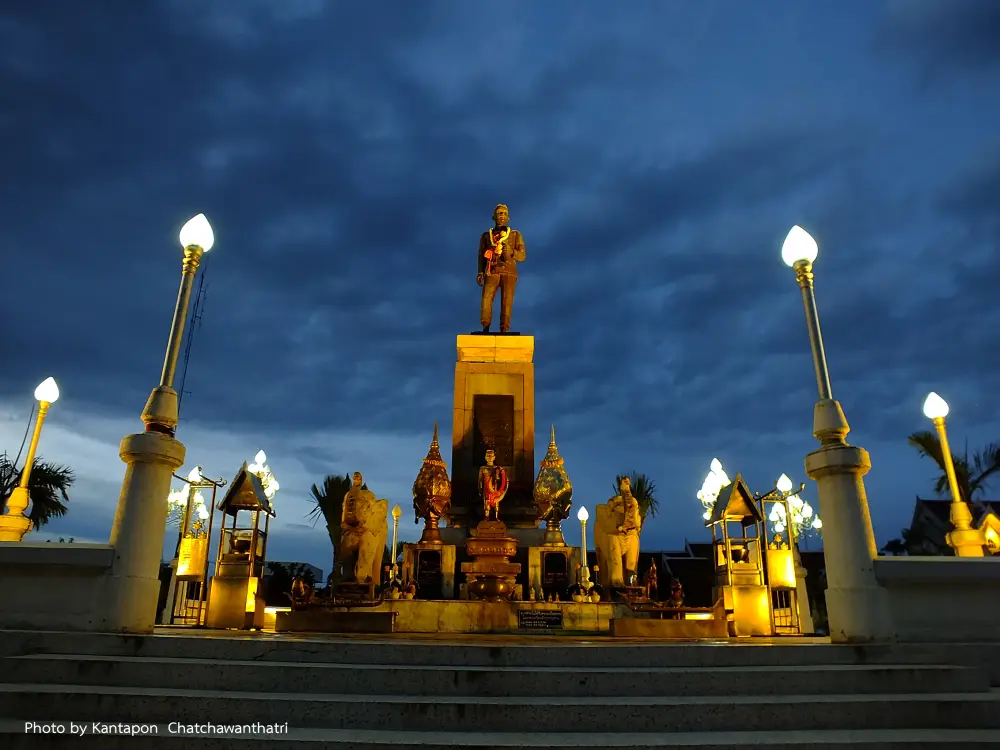
Chao Pho Phraya Lae shrine
Open Days: Daily
Opening Hours: 09.00 – 16.00
Phraya Phakdi Chumphon (Lae) Monument, widely known among local people as the Chao Pho Phaya Lae Monument, is one of the most important landmarks in Chaiyaphum Province. Standing at the roundabout in the government center of Chaiyaphum city, the monument is not only a memorial statue but also a powerful symbol of local identity, loyalty, gratitude, and collective memory. For many Thai visitors and foreign travelers, this is the best place to begin understanding Chaiyaphum because it introduces the story of the province’s first governor, the founding of the city, and the deep respect that local people continue to express toward Chao Pho Phaya Lae today.
For travelers who want to understand Chaiyaphum beyond its mountains, waterfalls, national parks, and flower fields, this monument is an essential stop. It tells the story of a city shaped by migration, leadership, political change, and sacrifice. Visitors may spend only a short time here to pay respect, take photographs, and observe the surrounding city atmosphere, but the historical meaning behind the monument reaches back to the early Rattanakosin period and connects Chaiyaphum with Vientiane, Nakhon Ratchasima, and Bangkok during the reigns of King Rama II and King Rama III.
The monument was built in 1975 through the cooperation of government authorities, merchants, and the people of Chaiyaphum as a memorial to Phraya Phakdi Chumphon (Lae), the first governor of Chaiyaphum. The bronze statue stands prominently on a tall base at the roundabout, portraying Phraya Phakdi Chumphon in the dignified appearance of a Thai nobleman. At the base, visitors often see garlands, flowers, incense, candles, and other offerings placed by local residents and travelers. This continuous act of worship shows that the monument is not treated merely as a historical sculpture but as a living place of respect.
Phraya Phakdi Chumphon was originally named Lae. He came from the Vientiane region and had served under Chao Anouvong of Vientiane. According to local history, in 1817, during the reign of King Rama II, Lae migrated with his family and followers across the Mekong River and first settled at Ban Nam Khun, in the area of present-day Sung Noen District, Nakhon Ratchasima Province. This migration marked the beginning of a journey that would eventually lead to the establishment of a new community in the area that became Chaiyaphum.
Lae later moved his community to Non Nam Om at Ban Chi Long, about 6 km from the present city of Chaiyaphum. In the early stage, the community still sent tribute to Chao Anouvong of Vientiane. Later, the settlement was moved again to Ban Luang, within the area of present-day Mueang Chaiyaphum District. These movements show Lae’s leadership, his ability to choose strategic settlement locations, and his capacity to organize people into a stable community. He was not simply the head of a migrating group, but a capable local leader with strong administrative ability.
A major turning point came when Lae shifted his allegiance to Nakhon Ratchasima and the Siamese court in Bangkok during the reign of King Rama III, instead of continuing to submit to Vientiane. This decision carried great political significance. At that time, northeastern Thailand was located within a complex sphere of influence involving Vientiane, Nakhon Ratchasima, and Bangkok. Because Lae demonstrated loyalty to Siam, King Rama III elevated Ban Luang to the status of Mueang Chaiyaphum and appointed Khun Phakdi Chumphon (Lae) as the first governor of Chaiyaphum.
The name “Chaiyaphum” itself carries a meaningful sense of place. It can be understood as an auspicious and strategic location, a place suited for settlement and victory. When connected to the life of Phraya Phakdi Chumphon, the name becomes more than a provincial title. It reflects the process of building a new community, establishing security, and turning a settlement into an organized town. The story of Phraya Phakdi Chumphon therefore gives Chaiyaphum a deep human dimension, rooted in leadership, courage, and the ability to create a new civic foundation.
The event that made Phraya Phakdi Chumphon (Lae) a heroic figure in Chaiyaphum occurred in 1826, when Chao Anouvong of Vientiane led a rebellion and advanced toward Nakhon Ratchasima. Khun Phakdi Chumphon, together with nearby city rulers, brought forces to support Khun Ying Mo, later known as Thao Suranari, in resisting Chao Anouvong’s army. Their combined action contributed to the defeat of the invading forces. This episode became an important part of the history of northeastern Thailand and strengthened the association of Phraya Phakdi Chumphon with loyalty, bravery, and the defense of Siam.
After Chao Anouvong’s forces were defeated, he returned with anger and captured Khun Phakdi Chumphon (Lae). He was executed under a tamarind tree beside Nong Pla Thao. This tragic event became one of the most important memories in the history of Chaiyaphum. The leader who had founded the city and shown loyalty to Siam lost his life because of that loyalty. Because of his contributions, he was later honored with the title Phraya Phakdi Chumphon (Lae), and the people of Chaiyaphum came to revere him as Chao Pho Phaya Lae, the guardian spirit and heroic founder of the province.
The devotion to Phraya Phakdi Chumphon is not limited to the city monument. It is strongly connected with Chao Pho Phaya Lae Shrine at Nong Pla Thao, located near the pond about 3 – 4 km from the city center. This sacred site is associated with the location where Phraya Phakdi Chumphon was killed, and the large tamarind tree in the area remains part of the local memory. The shrine is an important spiritual center where people come to pay respect, make wishes, fulfill vows, and participate in major annual rituals.
The monument in the city center and the shrine at Nong Pla Thao should be understood together. The monument serves as a public historical symbol that commemorates the first governor of Chaiyaphum, while the shrine functions as a living sacred space where local faith is actively practiced. Many Chaiyaphum residents and visitors pay respect at both places. Starting at the monument and continuing to the shrine gives travelers a more complete understanding of Phraya Phakdi Chumphon’s life, death, and continuing presence in local culture.
The atmosphere around the monument reflects its role as a central landmark of Chaiyaphum city. It stands near government offices, main roads, shops, and urban communities. Anyone driving through the city center can easily see the statue, and locals often use it as a reference point when giving directions. Although the monument is located at a traffic roundabout, many people still stop nearby to pay respect, especially in the morning, evening, or on important occasions. Visitors should be careful when crossing the road and should park only in appropriate areas before approaching the monument.
At the monument, visitors will see the statue of Phraya Phakdi Chumphon standing on a tall base. The arrangement is formal, visible from several directions, and suitable as a central civic memorial. Garlands, especially marigold garlands, are often placed at the base along with other offerings. The overall atmosphere is respectful rather than purely touristic. For local people, this is not simply a place to take photographs; it is a place of gratitude and reverence.
Those who wish to pay respect commonly bring garlands, flowers, incense, candles, or other appropriate offerings. Many people come to ask for blessings related to travel safety, success, work, health, or protection in daily life. These beliefs are rooted in the image of Phraya Phakdi Chumphon as a leader who protected the city and sacrificed himself for the common good. Paying respect here is therefore both a spiritual act and a gesture of remembrance toward the founder of Chaiyaphum.
The most important annual tradition related to Chao Pho Phaya Lae is the Bun Duean Hok Festival at Chao Pho Phaya Lae Shrine. The event is held every year around the sixth lunar month, usually before or near Visakha Bucha Day. It includes worship ceremonies, offerings, devotional dance, local rituals, and other activities that reflect the beliefs of the Chaiyaphum community. This festival is one of the province’s major annual events and shows how history, faith, ritual, and community identity continue to come together.
The devotional dance offered to Chao Pho Phaya Lae is one of the most memorable parts of the festival. Many participants dress in coordinated traditional attire and join the ceremony together. The dance expresses unity, gratitude, and reverence. For visitors, it is a chance to witness living culture rather than a static historical display. Through music, movement, clothing, and ritual, the people of Chaiyaphum continue to pass on the memory of their founder from one generation to the next.
In some years, additional worship ceremonies are also held around January at the monument in the city center. These events show that local devotion exists in both main locations: the city monument and the shrine at Nong Pla Thao. Travelers interested in local festivals should check the annual schedule before visiting, because festival dates can vary according to the lunar calendar and the decisions of the organizing committee.
From the perspective of local history, the Phraya Phakdi Chumphon (Lae) Monument acts as a gateway to the memory of Chaiyaphum. It immediately shows visitors how strongly the province values its founder. The fact that the monument stands in the middle of the government roundabout, rather than in a distant or enclosed area, demonstrates that Chao Pho Phaya Lae remains present in the daily life of the city. Local people see the monument when they travel through town, and his name continues to appear in directions, stories, ceremonies, and everyday speech.
Cultural travelers should connect this monument with nearby sites such as Chao Pho Phaya Lae Shrine at Nong Pla Thao, Prang Ku Chaiyaphum, the city market area, and Chaiyaphum Night Bazaar. Each place adds a different layer to the city. The monument tells the story of leadership and sacrifice. The shrine tells the story of faith and ritual. Prang Ku tells the story of ancient Khmer influence and Mahayana Buddhist heritage. The markets and city streets show the living rhythm of modern Chaiyaphum.
The best time to visit the monument is in the morning or late afternoon, when the weather is more comfortable and the light is better for photography. Since the monument stands at a roundabout, visitors should be especially careful when taking photographs. They should not stand in traffic lanes or obstruct vehicles. To observe the monument safely, it is best to park nearby in an appropriate area and walk carefully to the worship point.
If travelers continue to Chao Pho Phaya Lae Shrine at Nong Pla Thao, the atmosphere changes from a busy urban roundabout to a sacred lakeside setting. The shrine stands near Nong Pla Thao and is closely connected to the final moments of Phraya Phakdi Chumphon’s life. Inside the shrine area, visitors will find sacred images, offerings, and signs of ongoing devotion. The shrine is open daily from 06.00 to 18.00 and remains one of the most important spiritual destinations in Chaiyaphum.
Visitors should behave respectfully at both the monument and the shrine. Dress modestly, keep your voice at a suitable level, do not touch sacred images or other people’s offerings, and keep the area clean. During annual festivals, visitors should allow extra travel time because large numbers of local people may attend the ceremonies, and traffic management around the area may change. Good preparation makes the visit smoother and allows travelers to experience the local atmosphere more fully.
Getting There to Phraya Phakdi Chumphon (Lae) Monument is very convenient because it is located in the center of Chaiyaphum city at the government roundabout. Travelers with private cars can follow the main routes into the city and head toward the monument roundabout. To continue to Chao Pho Phaya Lae Shrine, use Highway 2159 and turn onto Highway 2051, or take the Chaiyaphum – Ban Khwao route on Highway 225 toward Nong Pla Thao. The shrine is about 3 – 4 km from the city center.
Travelers without private vehicles can use local transport, songthaews, or local ride services. It is best to tell the driver “Chao Pho Phaya Lae Monument” or “Chao Pho Phaya Lae Shrine at Nong Pla Thao,” as both names are well known locally. With half a day, visitors can make a meaningful route starting at the city monument, continuing to the shrine at Nong Pla Thao, visiting Prang Ku, and ending with a local restaurant or cafe in Chaiyaphum city.
As a travel destination, the monument is suitable for many types of visitors. Families can bring children to learn about local history. Students can use it as an outdoor learning site. Cultural travelers can better understand the first governor of Chaiyaphum and the Bun Duean Hok tradition. Photographers can capture one of the most recognizable symbols of the province. Most importantly, there is no admission fee, and the site is easy to reach from other places within the city.
What makes Phraya Phakdi Chumphon Monument different from many other civic monuments is the continuing power of faith. Chao Pho Phaya Lae is not remembered only as a historical figure; he remains a guardian-like presence whom local people still honor, pray to, and celebrate in annual rituals. For this reason, the site clearly shows the overlap between past and present. Visitors do not only see a statue on a pedestal; they encounter the relationship between people, city, leadership, memory, and faith.
In summary, Phraya Phakdi Chumphon (Lae) Monument is one of the first places travelers should visit in Chaiyaphum. It opens the door to understanding the province’s foundation, its early political history, the sacrifice of its first governor, the devotion to Chao Pho Phaya Lae, and the annual traditions that the people of Chaiyaphum continue to preserve. When combined with a visit to Chao Pho Phaya Lae Shrine at Nong Pla Thao, the experience becomes even more complete, showing both the public monument in the city and the sacred site that remains central to the spiritual life of Chaiyaphum.
| Name | Phraya Phakdi Chumphon (Lae) Monument / Chao Pho Phaya Lae Monument |
| Location | Government Center Roundabout, Chaiyaphum City, Mueang Chaiyaphum District, Chaiyaphum Province |
| Address | Government Center Roundabout, Nai Mueang Subdistrict, Mueang Chaiyaphum District, Chaiyaphum 36000, Thailand |
| Highlights | A monument honoring the first governor of Chaiyaphum, a major symbol of local identity, history, and devotion |
| History | Built in 1975 to commemorate Phraya Phakdi Chumphon (Lae), the first governor of Chaiyaphum, whose life is closely linked to the early history of the province during the reigns of King Rama II and King Rama III |
| Name Origin | Phraya Phakdi Chumphon was originally named Lae. Local people respectfully call him Chao Pho Phaya Lae or Chao Pho Phra Ya Lae |
| Distinctive Features | A dignified statue of Phraya Phakdi Chumphon standing on a tall base at the city roundabout, used for worship, garland offerings, blessings, and photography |
| Importance | A memorial to the founder of Chaiyaphum and a key spiritual landmark connected with Chao Pho Phaya Lae Shrine at Nong Pla Thao and the Bun Duean Hok Festival |
| Travel Information | Located in the center of Chaiyaphum city at the government roundabout. To continue to Chao Pho Phaya Lae Shrine, take Highway 2159 and turn onto Highway 2051, or use Highway 225 toward Nong Pla Thao |
| Current Status | An important worship site and city landmark, open to visitors daily |
| Open Days | Daily |
| Opening Hours | 09.00 – 16.00 |
| Fees | No admission fee |
| Facilities | Worship area around the monument base, surrounding city roads, and nearby shops and services in central Chaiyaphum |
| Main Areas / Zones | 1. Phraya Phakdi Chumphon (Lae) Statue 2. Monument Base and Offering Area 3. Government Center Roundabout 4. Route to Chao Pho Phaya Lae Shrine at Nong Pla Thao 5. Old Chaiyaphum City and Nearby Government Area |
| Caretaker | Chaiyaphum Province, Chaiyaphum Municipality, and related local authorities |
| Related Sacred Site | Chao Pho Phaya Lae Shrine at Nong Pla Thao, Haruethai Road, Nai Mueang Subdistrict, Mueang Chaiyaphum District. Open daily 06.00 – 18.00. Tel. 044-835-030 |
| Annual Tradition | Bun Duean Hok Festival at Chao Pho Phaya Lae Shrine, held annually around the sixth lunar month before or near Visakha Bucha Day, with worship ceremonies, offerings, devotional dance, and local rituals |
| Nearby Tourist Attractions | 1. Chao Pho Phaya Lae Shrine at Nong Pla Thao, about 4 km 2. Prang Ku Chaiyaphum, about 2 km 3. Chaiyaphum Night Bazaar / Walking Street, about 1 km 4. Nong Pla Thao Public Park, about 4 km 5. Wat Sila At Phu Phra, about 14 km 6. Tat Ton National Park, about 23 km 7. Mor Hin Khao, about 47 km |
| Nearby Restaurants | 1. Duang Thai Food, about 1 km, Tel. 044-833-840, 083-721-1101 2. Le Pain, about 2 km, Tel. 085-763-2959 3. Lakeside Coffee & Cuisine, about 5 km, Tel. 084-589-1616 4. SAYA Cafe & Restaurant, about 1 km, Tel. 090-564-5799 5. Roti Riski Chaiyaphum, about 1 km, Tel. 061-053-5509 |
| Nearby Accommodations | 1. Lertnimit Hotel, about 1 km, Tel. 044-811-522, 080-165-9494 2. Siam River Resort, about 2 km 3. HOP INN Chaiyaphum, about 3 km, Tel. 02-080-2222 4. Phusuay Park View Hotel, about 7 km 5. Chaiyaphum Park Hotel, about 7 km |
Frequently Asked Questions (FAQ)
Q: Where is Phraya Phakdi Chumphon (Lae) Monument located?
A: The monument is located at the government center roundabout in Chaiyaphum city, Nai Mueang Subdistrict, Mueang Chaiyaphum District, Chaiyaphum Province.
Q: What are the opening hours of Phraya Phakdi Chumphon Monument?
A: The monument is open daily from 09.00 to 16.00. Daytime visits are recommended for convenience, worship, and photography.
Q: Is there an admission fee?
A: No. Visitors can pay respect and take photographs at the monument free of charge.
Q: Who was Phraya Phakdi Chumphon (Lae)?
A: Phraya Phakdi Chumphon (Lae) was the first governor and founder of Chaiyaphum. Local people respectfully call him Chao Pho Phaya Lae.
Q: Why do local people respect Chao Pho Phaya Lae?
A: Local people respect him because he founded Chaiyaphum, showed loyalty to Siam, defended the region during a major historical conflict, and sacrificed his life.
Q: What nearby places should travelers visit with the monument?
A: Travelers should combine the monument with Chao Pho Travelers should combine the monument with Chao Pho Phaya Lae Shrine at Nong Pla Thao, Prang Ku Chaiyaphum, Chaiyaphum Night Bazaar, Nong Pla Thao Public Park, and Wat Sila At Phu Phra.
Q: When is the annual festival related to Chao Pho Phaya Lae held?
A: The Bun Duean Hok Festival is held annually around the sixth lunar month before or near Visakha Bucha Day, with worship ceremonies, devotional dance, offerings, and local rituals.
Q: What should visitors keep in mind when visiting?
A: Visitors should dress modestly, speak respectfully, be careful when crossing the roundabout, avoid obstructing traffic, avoid touching other people’s offerings, and keep the area clean.
 Category: ●Art, Culture and Heritage
 Group: ●Landmarks and Memorials
Last Update : 4 MonthAgo
 Last Update : 4 MonthAgo
 Click to Access the Navigation Map GPS
Chao Pho Phraya Lae shrine Map
Recommend

 Historical Sites and Monuments(1)
Landmarks and Memorials(3)
Historical Sites and Monuments(1)
Landmarks and Memorials(3)
 Royal Palace(1)
 Art, Craft Centres, Tradition(3)
 Educational Places
 Educational Gardens, Farm(1)
 Places of Worship
 Temple(141)
 Other Sacred Sites(7)
 Suburban Living
 Village, Community(4)
 Nature and Wildlife
 National Parks and Marine Reserves(7)
 Mountain (Doi)(5)
 Dam, Reservoir, Lake(10)
 Waterfalls(15)
 Caves(5)
 River, Canal(4)
 Other natural attractions(1)
 Entertainment and Agricultural
 Farms, Parks and Ecotourism(2)
 Waterpark(2)
 Travel Articles, Recipes
 Travel Review, Food Review(1)


