
lovethailand home >Northeastern Travel Attractions >Chaiyaphum Travel Attractions >Muang Chaiyaphum >Nai Muang > Ti Khli Fai Tradition
TL;DR: Ti Khli Fai Tradition, Chaiyaphum attractions : Art, Culture and Heritage, Art, Craft Centres, Tradition.
Ti Khli Fai Tradition
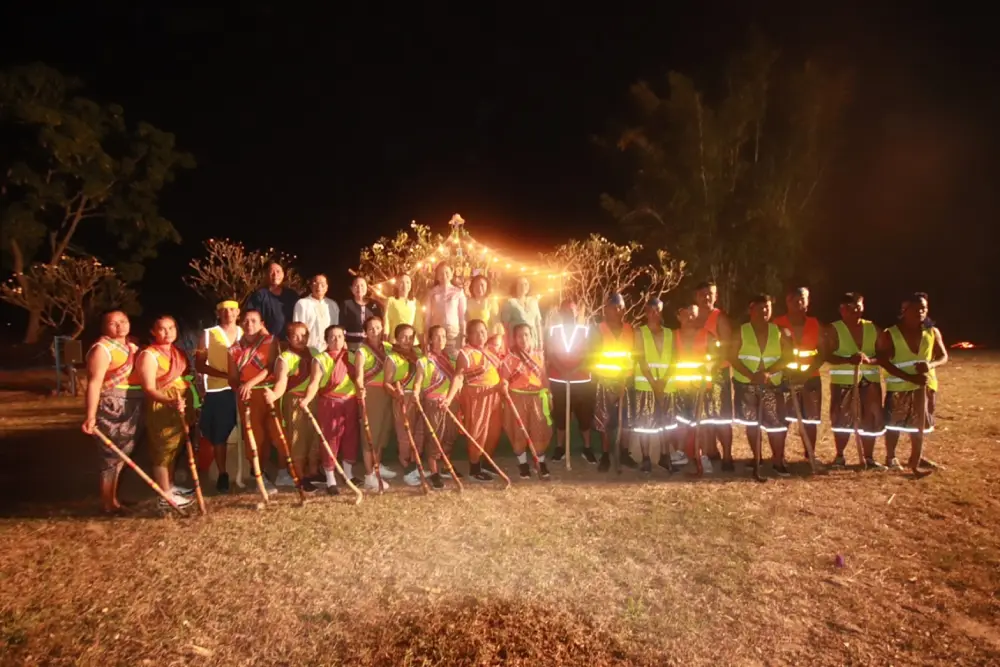
Open Days: Held Once A Year During The Year-End / Winter Season According To The Annual Local Schedule
Opening Hours: Activities Take Place Throughout The Day, With The Main Ti Khli Fai Competition Beginning In The Evening Around 18.00
Ti Khli Fai Tradition in Chaiyaphum Province is one of the most distinctive folk traditions of northeastern Thailand. The event is held at Wat Chaeng Sawang in Ban Nong Khueang, Kut Tum Subdistrict, Mueang Chaiyaphum District, Chaiyaphum Province. It is best known for a traditional fire-ball game in which players use curved bamboo-root sticks to hit a burning wooden ball toward the opponent’s goal. The game resembles a combination of hockey and football, but its glowing fireball, night-time atmosphere, and deep community roots make it a rare cultural experience.
For foreign travelers, Ti Khli Fai is not simply a dramatic fire performance. It is a living folk sport shaped by agricultural life, the cold season, village leisure, local materials, and community cooperation. The tradition shows how villagers transformed ordinary things around them, such as bamboo roots, light wood, open fields, campfires, and evening free time, into a thrilling and meaningful cultural activity. Watching Ti Khli Fai allows visitors to understand Chaiyaphum through the energy of a real community event rather than through a museum display alone.
The origin of Ti Khli Fai is closely connected with Ban Nong Khueang in Kut Tum Subdistrict. Before it became known as a fire-ball game, villagers played a simpler folk game called Khli Lon, in which players used bent bamboo roots as sticks and small wooden pieces as balls. The goal was to hit the wooden ball toward the opposing side. In earlier times, after returning from farm work, young men in the village gathered near natural water sources or open community areas to play, exercise, socialize, and warm themselves during the cool season.
The transformation from Khli Lon into Ti Khli Fai came from a memorable accident in village life. During cold evenings, villagers often built fires for warmth. One day, while playing Khli Lon near a fire, the wooden ball rolled into the flames and caught fire. Instead of stopping the game, the players continued hitting the burning ball. The glowing movement of the fireball in the dark was exciting, beautiful, and easier to see at night. This moment gradually became the basis of Ti Khli Fai, or the fire-ball folk game, which the people of Ban Nong Khueang later preserved as a local tradition.
The visual highlight of the tradition is the burning wooden ball moving rapidly across the field. Players must combine agility, timing, courage, teamwork, and control. The ball is usually made from light wood such as kapok or similar soft wood, which can catch fire and remain manageable during play. The stick is made from a bamboo rhizome with a natural curve, shaped like a hooked club. This use of local materials shows the intelligence of village craftsmanship and the practical knowledge of people who understood the properties of bamboo and wood.
The rules of Ti Khli Fai are similar to hockey and football. Players are divided into 2 sides, and the number of players may vary according to the size of the field and the local competition format, often 7 or 11 players per side. Each team tries to hit the burning wooden ball into the opponent’s goal. A successful goal counts as 1 point. To reduce danger, players are not allowed to raise their sticks above waist level. Players also cannot use their bodies to play the ball, except for the goalkeeper, who protects the goal. These rules help make the game more systematic and safer for both players and spectators.
Although the fire makes the tradition look dramatic and risky, the heart of Ti Khli Fai is not danger alone. Its deeper meaning lies in warmth, courage, cooperation, and village unity. In the past, the cool season came after months of hard agricultural work. Gathering around a fire, playing a game, sharing food, and cheering together created a strong social bond. The game became a way for villagers to relax, strengthen friendship, and enjoy the open space of their community after a long working season.
Fire also carries symbolic meaning in local culture. It represents warmth, light, energy, and renewal. In the context of Ti Khli Fai, the glowing ball moving through the night can be understood as a symbol of positive energy and community vitality. Some people connect the fire with the idea of clearing away misfortune and welcoming good luck, but the tradition is best understood as a community folk sport that blends practical village life with symbolic meaning and collective participation.
Today, Ti Khli Fai is held as an annual community tradition in Ban Nong Khueang. The festival usually takes place during the year-end or winter season according to the annual local schedule. Activities are held throughout the day and evening. Daytime activities may include boat races, folk sports, lantern-related activities, exhibitions, local food stalls, and contests related to Khli sticks and fire balls. The main highlight takes place in the evening, when the burning ball becomes clearly visible against the dark field.
Wat Chaeng Sawang plays an important role as the center of the event. In northeastern Thai communities, temples are not only religious sites but also cultural and social centers. They host merit-making activities, village meetings, public ceremonies, and local festivals. By holding Ti Khli Fai in the area of Wat Chaeng Sawang and Ban Nong Khueang, the community connects the folk sport with the social and spiritual heart of the village.
Organizing the tradition requires strong cooperation. Villagers help prepare the field, make the equipment, control the fire area, arrange food stalls, manage spectators, and coordinate with local authorities. Players train and learn the rules. Elders pass on stories and memories. Youth groups learn by helping with real tasks. Local government agencies support the event so that it can continue safely and reach visitors from outside the village. This cooperation is one of the most important values of the tradition.
Food is another meaningful part of the Ti Khli Fai experience. Ban Nong Khueang is known for its village atmosphere and local food culture. During the festival, visitors may find Isan dishes, seasonal vegetables, grilled food, sticky rice, som tam, local snacks, and special community dishes. The food turns the event into a complete cultural experience. Visitors do not only watch a game; they also taste the flavors of the community and meet local people in a relaxed atmosphere.
The daytime activities help make the festival more than an evening fire sport. Boat races connect the event with the local water landscape. Folk sports involve children, women, elders, and community groups. Exhibitions and contests related to the fire-ball equipment help explain how the tradition is made and preserved. Together, these activities show that Ti Khli Fai is not an isolated performance but a full community festival.
In some years, light-and-sound performances are organized to tell the legend and history of Ti Khli Fai. These performances help younger generations and visitors understand how the game began, how it developed from Khli Lon, and why Ban Nong Khueang continues to preserve it. Modern presentation does not erase the traditional roots of the event. Instead, it helps the old story communicate more clearly to contemporary audiences.
From a sporting perspective, Ti Khli Fai requires real skill. Players must control the burning ball without losing direction, pass it to teammates, avoid dangerous movements, and aim accurately at the goal. Strength alone is not enough. A good player must understand timing, field position, ball movement, and safety. This makes the game both exciting to watch and difficult to master.
The preservation of Ti Khli Fai depends on balancing authenticity and safety. If the fire element is removed completely, the game loses its distinctive character. If the fire is handled without rules, the tradition becomes too dangerous to continue. Ban Nong Khueang’s continued practice of the tradition shows how a community can adapt rules, space, and organization while keeping the core identity of the old game alive.
Visitors should watch the game from the designated spectator areas. Do not cross into the playing field, move beyond safety barriers, disturb players, or use equipment that distracts the competition. Wear comfortable shoes, keep children close, and follow the instructions of local officials. Because real fire is used, responsible behavior is essential for everyone’s safety.
For photographers, the best time to capture Ti Khli Fai is after sunset when the burning ball is clearly visible. Interesting images include the fireball flying from the bamboo stick, players waiting with their sticks, sparks moving across the field, and the crowd watching from the edge of the arena. However, photographs should be taken only from safe areas and in a way that does not interfere with the game.
The tradition is also valuable for education. It shows young people that culture can grow from everyday life. A game does not always need a modern stadium or expensive equipment. Bamboo roots, village fields, wood, fire, and teamwork can become a distinctive sport when a community gives them meaning and rules. In this sense, Ti Khli Fai teaches creativity, resilience, and respect for local knowledge.
For cultural tourism, Ti Khli Fai gives travelers a different view of Chaiyaphum. Many visitors know the province for Tat Ton National Park, Mor Hin Khao, Phraya Phakdi Chumphon Monument, and Siam Tulip fields. Ti Khli Fai shows another side of the province: local sport, village food, temple-based festivals, agricultural life, and community identity. It is a good choice for travelers who want a deeper and more authentic experience.
Getting There from Chaiyaphum city is convenient by private car, rental car, or local transport. Head toward Kut Tum Subdistrict and continue to Wat Chaeng Sawang, Ban Nong Khueang, Mueang Chaiyaphum District. The distance from central Chaiyaphum is about 12 – 15 km, depending on the starting point. Visitors unfamiliar with the area should search for Wat Chaeng Sawang Ban Nong Khueang or ask Kut Tum Municipality and local residents for directions before traveling.
Because the main competition takes place in the evening, visitors should leave the city earlier than usual to allow time for parking and walking to the festival area. During the event, traffic and parking may be managed temporarily by the community and local authorities. Travelers should follow local instructions and avoid parking in ways that block village roads or emergency access.
The festival can be combined with nearby attractions in Chaiyaphum. During the day, visitors may go to Phraya Phakdi Chumphon Monument, Tamnak Khiao, Prang Ku Chaiyaphum, or Chao Pho Phaya Lae Shrine at Nong Pla Thao before heading to Ban Nong Khueang in the evening. This route offers city history, local faith, archaeology, and living folk tradition in one trip.
Travelers who plan to stay overnight can choose accommodation in Kut Tum or Chaiyaphum city. Staying in the city gives more hotel options and makes it easy to continue to other attractions the next day. Staying closer to Kut Tum reduces travel time after the evening event. Advance planning is recommended during festival periods because local accommodation and transport may be busier than usual.
Ti Khli Fai is a powerful example of living heritage. It has survived because villagers continue to participate, teach, organize, and adapt. Elders keep the stories. Players keep the rules. Local artisans understand the equipment. Community groups prepare food and activities. Local authorities help manage the event. Visitors who come respectfully also become part of the support system that helps the tradition continue.
In summary, Ti Khli Fai in Chaiyaphum Province is a unique folk sport and cultural tradition rooted in Ban Nong Khueang. It developed from simple village play into a remarkable fire-ball competition that represents local wisdom, agricultural life, courage, teamwork, and community pride. Watching the burning ball move across the night field is memorable, but the deeper value of the event lies in the people who continue to preserve it. For travelers seeking a genuine cultural experience in northeastern Thailand, Ti Khli Fai is one of Chaiyaphum’s most distinctive traditions.
| Name | Ti Khli Fai Tradition, Chaiyaphum Province |
| Location | Wat Chaeng Sawang, Ban Nong Khueang, Kut Tum Subdistrict, Mueang Chaiyaphum District, Chaiyaphum Province |
| Address | Wat Chaeng Sawang, Ban Nong Khueang, Kut Tum Subdistrict, Mueang Chaiyaphum District, Chaiyaphum 36000, Thailand |
| Highlights | A traditional fire-ball folk sport in which players use curved bamboo-root sticks to hit a burning wooden ball toward the opponent’s goal at night |
| History | Developed from Khli Lon, an older folk game of Ban Nong Khueang, and became Ti Khli Fai through the village practice of playing near campfires during the cool season |
| Name Origin | The name means hitting a fire ball, referring to the burning wooden ball used in the game |
| Distinctive Features | Players use bamboo-root sticks and light wooden balls made from materials such as kapok or similar soft wood. The ball is burned before being played in a team competition |
| Importance | A living cultural heritage of Ban Nong Khueang that reflects local wisdom, agricultural life, teamwork, courage, and community identity |
| Festival Period | Held once a year during the year-end / winter season according to the annual local schedule |
| Opening Hours | Activities take place throughout the day, with the main fire-ball competition beginning in the evening around 18.00 |
| Travel Information | From Chaiyaphum city, travel toward Kut Tum Subdistrict and continue to Wat Chaeng Sawang, Ban Nong Khueang, about 12 – 15 km from the city center |
| Current Status | Preserved as an annual folk tradition of Ban Nong Khueang and Kut Tum Subdistrict, with modern adjustments for visitor and player safety |
| Fees | No admission fee |
| Facilities | Temple and village event area, competition field, temporary viewing areas, local food stalls, temporary parking, and local coordination points |
| Main Areas / Zones | 1. Wat Chaeng Sawang 2. Ti Khli Fai Competition Field 3. Fire-Ball Preparation Area 4. Spectator Area 5. Local Food Zone 6. Folk Sports Zone 7. Khli Stick And Fire-Ball Exhibition / Contest Area 8. Ban Nong Khueang Community Area |
| Organizers / Caretakers | Ban Nong Khueang community, Kut Tum Municipality, local authorities, and the Ti Khli Fai organizing committee |
| Main Contact Number | Kut Tum Municipality, Tel. 0-4410-0184, 0-4410-0186, 0-4410-0185 |
| Official Website / Official Page | Kut Tum Municipality website and Chaiyaphum provincial communication channels |
| Nearby Tourist Attractions | 1. Nong Khueang Pond, about 1 km 2. Wat Chaeng Sawang, inside the event area 3. Phraya Phakdi Chumphon (Lae) Monument, about 13 km 4. Tamnak Khiao, about 13 km 5. Prang Ku Chaiyaphum, about 14 km 6. Chao Pho Phaya Lae Shrine at Nong Pla Thao, about 16 km 7. Tat Ton National Park, about 35 km |
| Nearby Restaurants | 1. Krua Suan Nguen Resort, about 6 km, Tel. 082-112-2841 2. Jungle Cafe Ban Lat Yai Branch, about 9 km, Tel. 080-412-7778 3. Duang Thai Food, about 13 km, Tel. 044-811-840, 083-721-1101 4. SAYA Cafe & Restaurant, about 15 km, Tel. 090-564-5799 5. Lakeside Coffee & Cuisine, about 16 km, Tel. 084-589-1616 |
| Nearby Accommodations | 1. Suan Nguen Resort, about 6 km, Tel. 0-4483-3547, 081-725-5947 2. Siam River Resort, about 13 km, Tel. 044-811-999 3. Lertnimit Hotel, about 14 km, Tel. 044-811-522, 080-165-9494 4. HOP INN Chaiyaphum, about 16 km, Tel. 02-080-2222 5. Phusuay Park View Hotel, about 19 km, Tel. 044-854-111 |
Frequently Asked Questions (FAQ)
Q: Where is the Ti Khli Fai Tradition held?
A: It is held at Wat Chaeng Sawang, Ban Nong Khueang, Kut Tum Subdistrict, Mueang Chaiyaphum District, Chaiyaphum Province, the home community of this tradition.
Q: When is Ti Khli Fai held?
A: It is held once a year during the year-end or winter season according to the annual local schedule. The main fire-ball competition usually begins in the evening around 18.00.
Q: What is Ti Khli Fai?
A: Ti Khli Fai is a Chaiyaphum folk sport in which players use bamboo-root sticks to hit a burning wooden ball toward the opponent’s goal, similar to hockey and football.
Q: Why is Ti Khli Fai important?
A: It is a living cultural heritage that reflects local wisdom, agricultural life, teamwork, courage, and the community identity of Ban Nong Khueang.
Q: Is it safe for visitors to watch?
A: Visitors can watch safely if they stay in designated spectator areas, avoid crossing into the field, follow local officials’ instructions, and keep children close.
Q: What activities are included in the festival?
A: Activities may include folk sports, boat races, contests for Khli sticks and fire balls, local food stalls, light-and-sound performances, and the evening Ti Khli Fai competition.
Q: Where should travelers stay when visiting Ti Khli Fai?
A: Travelers can stay in Kut Tum or Chaiyaphum city. Chaiyaphum city offers more hotel choices, while staying closer to Kut Tum reduces travel time after the evening event.
Q: What nearby attractions can be combined with Ti Khli Fai?
A: The tradition can be combined with Phraya Phakdi Chumphon Monument, Tamnak Khiao, Prang Ku Chaiyaphum, Chao Pho Phaya Lae Shrine at Nong Pla Thao, and Tat Ton National Park.
 Category: ●Art, Culture and Heritage
 Group: ●Art, Craft Centres, Tradition
Last Update : 3 MonthAgo
 Last Update : 3 MonthAgo
 Click to Access the Navigation Map GPS
Ti Khli Fai Tradition Map
Recommend

 Historical Sites and Monuments(1)
 Landmarks and Memorials(3)
 Royal Palace(1)
Art, Craft Centres, Tradition(3)
Royal Palace(1)
Art, Craft Centres, Tradition(3)
 Educational Places
 Educational Gardens, Farm(1)
 Places of Worship
 Temple(141)
 Other Sacred Sites(7)
 Suburban Living
 Village, Community(4)
 Nature and Wildlife
 National Parks and Marine Reserves(7)
 Mountain (Doi)(5)
 Dam, Reservoir, Lake(10)
 Waterfalls(15)
 Caves(5)
 River, Canal(4)
 Other natural attractions(1)
 Entertainment and Agricultural
 Farms, Parks and Ecotourism(2)


