
lovethailand home >Northeastern Travel Attractions >Chaiyaphum Travel Attractions >Khon Sawan >Si Samran > Wat Sawang Namon
TL;DR: Wat Sawang Namon is located at Ban Namon, Village No. 3, Si Samran Subdistrict, Khon Sawan District, Chaiyaphum Province, open Daily, hours 08.00 – 17.00.
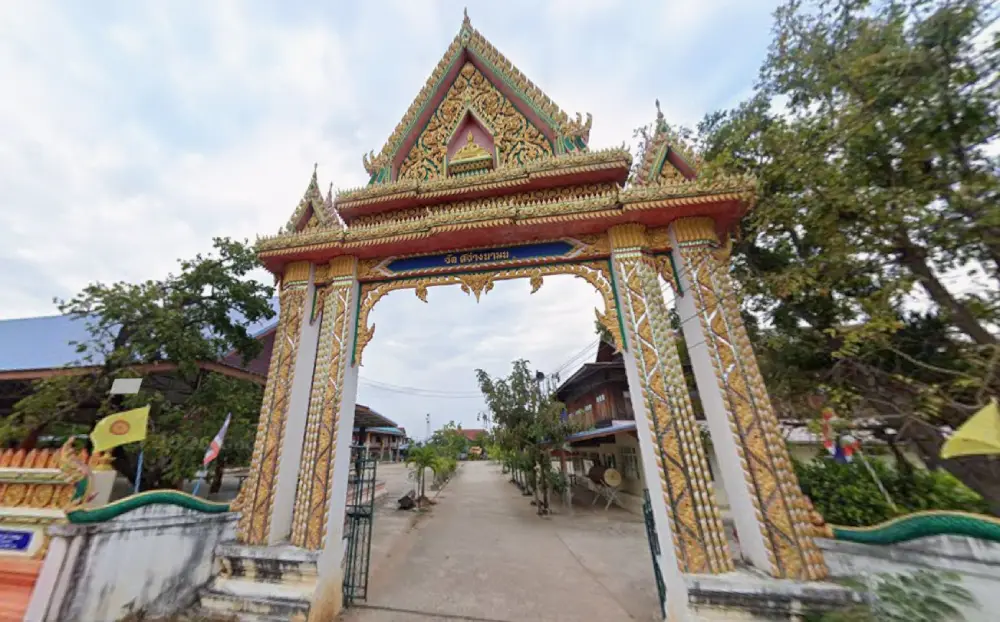
Wat Sawang Namon
Open Days: Daily
Opening Hours: 08.00 – 17.00
Wat Sawang Namon is located at No. 141, Ban Namon, Village No. 3, Si Samran Subdistrict, Khon Sawan District, Chaiyaphum Province. It is a local Buddhist temple under the Mahanikaya order and serves as an important religious, educational, and cultural center for monks, Buddhist devotees, villagers, and general visitors. The temple was established in B.E. 2466 and received its royal consecrated boundary, known in Thai as Wisungkhamsima, in B.E. 2529. It occupies 6 rai of land under title deed No. 8197 and continues to function as a place for Buddhist ceremonies, meditation, local traditions, cultural activities, and village gatherings.
Wat Sawang Namon is closely connected with Ban Namon and Si Samran Subdistrict. Like many rural temples in northeastern Thailand, it is not separate from village life. It stands within a social landscape of homes, local roads, agricultural areas, and community networks. Villagers come to the temple to make merit, offer food to monks, listen to Dhamma teachings, observe Buddhist holy days, support annual ceremonies, and gather during important moments in family and community life. For travelers who want to understand village-level Buddhism in Chaiyaphum, Wat Sawang Namon offers a calm and meaningful experience.
The temple land covers 6 rai, with public roads bordering the temple on all four sides. This setting makes the temple easily accessible to villagers and reinforces its role as a central community space. When merit-making events, Kathin ceremonies, Buddhist Lent activities, funerals, or community gatherings take place, people can reach the temple conveniently. The location also reflects the practical character of rural Isan temples: they are built not for distance or isolation, but for daily connection with the people they serve.
The temple was founded in B.E. 2466 through the cooperation of monks, the village headman, and local people. The name of the temple follows the name of Ban Namon, showing a direct connection between the temple and the village. This origin is important because it shows that Wat Sawang Namon was built from shared local faith. Villagers needed a place for Buddhist ceremonies, moral guidance, education, and community unity. The temple therefore grew from both devotion and practical need.
The name “Sawang Namon” carries both spiritual and local meaning. “Sawang” means brightness or illumination, suggesting wisdom, clarity, and the light of Dhamma. “Namon” refers to the village where the temple is located. Together, the name can be understood as a spiritual light for Ban Namon, a place where villagers return for merit-making, reflection, and moral guidance. The name also preserves the identity of the village within the temple itself.
The granting of Wisungkhamsima in B.E. 2529 is a major milestone in the temple’s religious history. Wisungkhamsima is a consecrated boundary used for formal Sangha rites, including ordination and other important monastic activities. At Wat Sawang Namon, the consecrated boundary measures 30 meters wide and 20 meters long. This confirms the temple’s readiness to support formal Buddhist functions according to monastic discipline and gives the temple added religious significance within the community.
The ordination hall at Wat Sawang Namon measures 6 meters wide and 20 meters long. It was built in B.E. 2522 as a concrete structure with a tiled roof. The ordination hall is one of the most sacred areas within the temple because it is connected with formal monastic rites and the continuity of Buddhist discipline. Visitors should approach this area respectfully by dressing modestly, speaking quietly, removing shoes where required, and avoiding behavior that may disturb monks or local devotees.
The sermon hall measures 15 meters wide and 21 meters long. It was built in B.E. 2514 as a wooden building and remains one of the main community spaces within the temple. In a rural Isan temple, a sermon hall is used for Dhamma listening, Buddhist holy day activities, merit-making, Kathin ceremonies, robe offerings, village meetings, and annual community events. At Wat Sawang Namon, the sermon hall functions as both a religious venue and a shared social space.
The temple also has three monk residences, two of which are half-concrete and half-wooden structures. Other facilities include one funeral merit pavilion, one kitchen, one bell tower, and two resting pavilions for visitors or participants in temple activities. These buildings show that Wat Sawang Namon is a functioning community temple. Its facilities support monks, villagers, ceremonies, food preparation, funeral rites, and people who come to participate in religious events.
Wat Sawang Namon is also important in the educational history of Si Samran Subdistrict. The temple was once the first school of the subdistrict, and it later opened a Dhamma study school in B.E. 2495. This educational role gives the temple added value. It shows that the temple was not only a place for ceremonies, but also a center of learning, moral development, and community instruction. For many rural communities, temples served as early educational institutions before formal schools became widespread.
The history of the temple preserves a line of abbots who helped maintain and develop the temple over time. These include Phra Chulu, Phra Bun Techadhammo, Phra Somsri, Phra Sing Thitadhammo, Phra Ding, Phra Buasri Pasanno, Phra Phila Sappanyo, Phra Thongplaeo Sappanyo, Phra Khru Siripathumanurak, and Phra Bunlom Sappanyo. This continuity of monastic leadership shows how the temple has been preserved across generations through the cooperation of monks and villagers.
Current ecclesiastical information identifies Phra Khru Ophat Theeranuwat, also known as Bunlom, as the abbot of Wat Sawang Namon. In a community temple, the role of an abbot is central. The abbot oversees religious practice, resident monks, temple maintenance, ceremonies, monastic discipline, and relationships with villagers. He also serves as a spiritual guide during ordinary days and important life events such as ordinations, funerals, family ceremonies, annual merit-making, and Buddhist holy days.
Wat Sawang Namon is used throughout the year for Buddhist and local traditions. These include Buddhist holy day merit-making, offering food to monks, listening to Dhamma teachings, observing precepts, meditation, Buddhist Lent, the end of Buddhist Lent, Kathin, robe-offering ceremonies, Songkran, Bun Khao Chi, Bun Phra Wet, and other Isan merit-making traditions. Through these activities, the temple remains active and continues to support the cultural rhythm of village life.
During Buddhist Lent, villagers often come to the temple to offer candles, robes, food, and daily necessities to monks. Many people also focus more on moral discipline, Dhamma listening, and merit-making during this period. At the end of Buddhist Lent and during Kathin season, the community gathers again to support the temple. These annual cycles strengthen the relationship between monks and laypeople and keep the temple at the center of village life.
Bun Phra Wet, or the Mahachat sermon tradition, is one of the important merit-making traditions in Isan. It involves listening to the Vessantara Jataka and reflecting on generosity, patience, sacrifice, and compassion. When such an event is held in a community temple, it becomes both a religious ceremony and a village effort. People help prepare food, offerings, decorations, and ceremonial arrangements. Wat Sawang Namon therefore becomes a place where Buddhist teachings are practiced through cooperation as much as through listening.
Bun Khao Chi is another tradition closely connected with Isan temples. Villagers prepare grilled sticky rice, often coated with egg, and offer it to monks as a simple act of merit. This tradition links local food, generosity, gratitude, and Buddhist devotion. At Wat Sawang Namon, such traditions remain part of real village life. They are not merely cultural memories, but living practices shared by people in the community.
Songkran is also meaningful in a community temple setting. Villagers often make merit, bathe Buddha images, ask blessings from elders, and take part in temple-based ceremonies. At Wat Sawang Namon, Songkran can be understood as a time when family, faith, respect, and community identity come together. The temple provides a proper setting for gratitude, renewal, and collective blessing during the Thai New Year period.
Wat Sawang Namon is also suitable for meditation and quiet Dhamma practice. Practice in a community temple does not always require a formal retreat. It may include chanting, listening to Dhamma, keeping precepts, helping with temple work, reducing selfishness, and living with greater mindfulness. These ordinary forms of practice help Buddhism remain close to daily life. Children learn temple manners, adults return for merit-making, elders gather for religious observances, and monks provide moral guidance.
For children and young people, Wat Sawang Namon is a place where moral values can be learned through real participation. They learn how to pay respect to monks, help elders during ceremonies, behave properly in sacred spaces, and understand the meaning of community contribution. Older villagers use the temple as a place for merit-making, reflection, and social connection. Working adults return during festivals and important ceremonies to support their home community.
For cultural travelers, Wat Sawang Namon is valuable because it shows a living village temple rather than a staged attraction. The temple is modest, peaceful, and closely tied to local people. Its appeal lies in its history, its educational role, its monastic buildings, its annual traditions, and the faith of villagers who continue to use it. Visitors who approach the temple slowly and respectfully will see how Buddhism remains woven into daily life in rural Chaiyaphum.
Si Samran Subdistrict has several nearby temples that can be included in the same route, including Wat Sawang Na Hi, Wat Nong Pla Pueng, Wat Nong Ben Mangkhalaram, Wat Nong Bua Ban Yen, Wat Phumisawan, Wat Pho Si, and Wat Pa Na Hi Samakkhi Tham. These temples show that Buddhism in the subdistrict is not centered in only one place. Instead, each village temple supports its own community while forming part of a wider network of faith and local culture.
Wat Sawang Na Hi is one of the nearby temples in Si Samran Subdistrict. Visiting Wat Sawang Namon together with Wat Sawang Na Hi, Wat Nong Pla Pueng, or Wat Nong Ben Mangkhalaram helps travelers understand how village temples function across the subdistrict. Each temple has its own local role, yet together they reflect the strength of Buddhist culture in Khon Sawan District.
Travelers can also combine Wat Sawang Namon with Bueng Waeng or Nong Waeng, Wat Khon Sawan, and the Dvaravati Buddha image at Wat Khon Sawan. Bueng Waeng is an important natural lake and waterbird habitat in Khon Sawan District, while Wat Khon Sawan adds a deeper historical and religious dimension. A route combining Wat Sawang Namon with these destinations gives visitors a balanced experience of community temples, local nature, and older Buddhist heritage.
Bueng Waeng, also known as Nong Waeng, is suitable for relaxation, birdwatching, photography, and evening scenery. Combining the lake with Wat Sawang Namon allows travelers to experience both the calm of a village temple and the natural atmosphere of Khon Sawan District. This kind of route is well suited to visitors who prefer slow cultural travel rather than crowded tourist attractions.
Wat Khon Sawan and the Dvaravati Buddha image are meaningful nearby destinations. The large Buddha image connected with the Dvaravati period reflects the deeper Buddhist roots of the area. A route from Wat Sawang Namon to Wat Khon Sawan allows travelers to see the continuity of faith from a living village temple to an older Buddhist heritage site. This makes the area especially suitable for travelers interested in religion, local history, and rural Thai culture.
The atmosphere of Wat Sawang Namon is peaceful, modest, and suitable for slow cultural travel. The temple does not depend on grand architecture or heavy tourism development. Its value comes from its long history, its consecrated boundary, its educational role, its community activities, and the faith of local people. Visitors can make merit, observe the temple grounds, pay respect in sacred areas, and spend quiet time reflecting in a calm village setting.
Temple etiquette is important when visiting Wat Sawang Namon. Visitors should dress modestly, covering shoulders and knees. Shoes should be removed before entering sacred buildings or designated areas. Voices should be kept low, and visitors should avoid disturbing monks, villagers, or ceremonies. Photography should be done respectfully, especially when people or religious activities are present. If a ceremony or community activity is taking place, visitors should give priority to local participants.
For foreign travelers, Wat Sawang Namon provides a useful example of Buddhism at the village level. Famous temples in major cities often show Thailand’s grand religious art, but community temples reveal how Buddhism supports everyday life. Wat Sawang Namon is where people make merit, learn manners, support monks, gather for annual festivals, preserve shared memory, and pass Buddhist values to younger generations. Visiting this kind of temple helps travelers understand Thai culture in a more grounded and respectful way.
Wat Sawang Namon is also a place of community memory. Many villagers have grown up with the temple through annual festivals, Dhamma listening, food offerings, bell sounds, family ceremonies, temple school activities, and shared volunteer work. The temple holds memory not only through written history but also through repeated practices, familiar spaces, and the presence of people returning year after year. This is why a community temple can be deeply meaningful even when it is not widely known as a national tourist attraction.
When considering its history, consecrated boundary, ordination hall, sermon hall, Dhamma school, abbot, annual traditions, and community role, Wat Sawang Namon is clearly an important local temple in Si Samran Subdistrict. Its value lies not only in its age, but also in the way it continues to serve monks, villagers, children, families, and visitors today. The temple remains a living center of Buddhism, learning, local culture, and village identity.
Getting There is most convenient by private car or rental car. Set your destination to Wat Sawang Namon, Ban Namon, Village No. 3, Si Samran Subdistrict, Khon Sawan District, Chaiyaphum Province, or use the coordinates 15.996264, 102.336529 in your navigation system. From Chaiyaphum town, follow the route toward Khon Sawan District and continue to Si Samran Subdistrict according to your navigation system. The temple is suitable for a day trip and can be combined with Wat Sawang Na Hi, Wat Nong Ben Mangkhalaram, Bueng Waeng, Wat Khon Sawan, and local restaurants in Khon Sawan.
Public transport users should first travel to Chaiyaphum town or Khon Sawan District, then arrange a local vehicle to the temple because village-level transport may not operate frequently throughout the day. Daytime travel is recommended for easier navigation and a more appropriate temple visit. During the rainy season, travelers should check road and weather conditions before combining the temple with nearby lakeside or rural attractions.
Overall, Wat Sawang Namon is a meaningful community temple in Chaiyaphum Province. It was established in B.E. 2466, received Wisungkhamsima in B.E. 2529, occupies 6 rai of land, and has an ordination hall, sermon hall, monk residences, funeral merit pavilion, kitchen, bell tower, and visitor pavilions. It also has educational importance as the first school of Si Samran Subdistrict and as a temple with a Dhamma study school opened in B.E. 2495. Under the care of Phra Khru Ophat Theeranuwat (Bunlom), the temple continues to serve as a place for Buddhist activities, meditation, local traditions, learning, and village gatherings. For travelers seeking an authentic and respectful Buddhist temple experience in northeastern Thailand, Wat Sawang Namon is a worthwhile stop in Khon Sawan District.
| Name | Wat Sawang Namon |
| Location | Ban Namon, Village No. 3, Si Samran Subdistrict, Khon Sawan District, Chaiyaphum Province |
| Address | No. 141, Ban Namon, Village No. 3, Si Samran Subdistrict, Khon Sawan District, Chaiyaphum 36140, Thailand |
| Coordinates | 15.996264, 102.336529 |
| Place Type | Local Buddhist Temple, Mahanikaya Order |
| Land Area | 6 Rai, Land Title Deed No. 8197 |
| Highlights | A long-standing community temple of Ban Namon, established in B.E. 2466 and granted Wisungkhamsima in B.E. 2529, used for Buddhist activities, meditation, local traditions, cultural events, and village gatherings |
| History | Established in B.E. 2466 by monks, the village headman, and local villagers. The temple was named after Ban Namon and received Wisungkhamsima in B.E. 2529. |
| Name Origin | The name combines “Sawang,” meaning brightness or illumination, with Namon, the village name, suggesting a spiritual light for the local community |
| Distinctive Features | A rural Isan community temple closely connected with merit-making, Dhamma listening, meditation, local traditions, and village life |
| Temple Buildings | Ordination Hall 6 m x 20 m, built in B.E. 2522; Sermon Hall 15 m x 21 m, built in B.E. 2514; 3 monk residences; 1 funeral merit pavilion; 1 kitchen; 1 bell tower; and 2 visitor resting pavilions |
| Educational Role | Formerly the first school of Si Samran Subdistrict and home to a Dhamma study school opened in B.E. 2495 |
| Travel Information | Best reached by private car or rental car. Use Wat Sawang Namon, Si Samran Subdistrict, or coordinates 15.996264, 102.336529 for navigation. Public transport users should connect from Khon Sawan District or Chaiyaphum town. |
| Current Status | Active as a local Buddhist temple used for religious activities, meditation, local traditions, cultural learning, and community gatherings |
| Open Days | Daily |
| Opening Hours | 08.00 – 17.00 |
| Main Areas / Zones | Ordination Hall, Sermon Hall, Monk Residences, Funeral Merit Pavilion, Kitchen, Bell Tower, Visitor Resting Pavilions, Religious Activity Area, Meditation Area, Community Activity Area, and Peaceful Temple Grounds |
| Abbot / Caretaker | Phra Khru Ophat Theeranuwat (Bunlom) |
| Consecrated Boundary | 30 m x 20 m |
| Nearby Tourist Attractions | 1. Wat Sawang Na Hi, Si Samran Subdistrict, about 4 km 2. Wat Nong Pla Pueng, Si Samran Subdistrict, about 5 km 3. Wat Nong Ben Mangkhalaram, Si Samran Subdistrict, about 6 km 4. Wat Nong Bua Ban Yen, Si Samran Subdistrict, about 8 km 5. Wat Phumisawan, Ban Na Chot, Si Samran Subdistrict, about 9 km 6. Wat Pho Si, Si Samran Subdistrict, about 10 km 7. Bueng Waeng / Nong Waeng, about 14 km 8. Wat Khon Sawan And The Dvaravati Buddha Image, about 14 km |
| Nearby Restaurants | 1. Jungle Cafe Khon Sawan Chaiyaphum Branch, about 14 km, Tel. 095-660-9498 2. 13 Cafe, about 14 km, Tel. 062-662-9563 3. Rim Bueng Korean BBQ, about 15 km, Tel. 084-826-3438 4. Khun Ngoen Restaurant, about 20 km, Tel. 091-017-2256 5. Bowwy Mookata, about 21 km, Tel. 098-935-9618 6. Im Aroi By Je Kai Restaurant, about 27 km, Tel. 093-327-6866 |
| Nearby Accommodations | 1. Wassanadee Resort Khon Sawan, about 14 km, Tel. 064-454-3945, 080-423-7719 2. Nonna Resort, about 15 km, Tel. 062-905-0145 3. Ban Poo Nim Resort Khon Sawan, about 16 km, Tel. 089-932-7390 4. Phrutsakan Resort, about 21 km, Tel. 096-469-8645, 044-100-096, 099-359-3597 5. Nithinat Resort, about 27 km, Tel. 081-790-5186 6. Hongsawan Resort, about 29 km, Tel. 098-157-6599 |
Frequently Asked Questions (FAQ)
Q: Where is Wat Sawang Namon located?
A: Wat Sawang Namon is located at No. 141, Ban Namon, Village No. 3, Si Samran Subdistrict, Khon Sawan District, Chaiyaphum Province 36140, Thailand.
Q: What are the opening days and hours of Wat Sawang Namon?
A: Wat Sawang Namon is open daily from 08.00 to 17.00, making daytime visits suitable for merit-making, temple visits, meditation, and cultural learning.
Q: What is the historical background of Wat Sawang Namon?
A: Wat Sawang Namon was established in B.E. 2466 by monks, the village headman, and local villagers, and it received Wisungkhamsima in B.E. 2529.
Q: Who is the abbot of Wat Sawang Namon?
A: The abbot of Wat Sawang Namon is Phra Khru Ophat Theeranuwat (Bunlom).
Q: What important buildings are found inside Wat Sawang Namon?
A: The temple has an ordination hall, sermon hall, monk residences, funeral merit pavilion, kitchen, bell tower, and visitor resting pavilions.
Q: What educational role does Wat Sawang Namon have?
A: Wat Sawang Namon was once the first school of Si Samran Subdistrict and has a Dhamma study school opened in B.E. 2495.
Q: What is the best way to get to Wat Sawang Namon?
A: The most convenient way is by private car or rental car. Visitors can use the coordinates 15.996264, 102.336529 or search for Wat Sawang Namon, Si Samran Subdistrict, Khon Sawan District, Chaiyaphum Province.
Q: What nearby attractions can travelers visit after Wat Sawang Namon?
A: Nearby attractions include Wat Sawang Na Hi, Wat Nong Pla Pueng, Wat Nong Ben Mangkhalaram, Wat Nong Bua Ban Yen, Bueng Waeng, Wat Khon Sawan, and the Dvaravati Buddha image at Wat Khon Sawan.
 Category: ●Places of Worship
 Group: ●Temple
Last Update : 3 DayAgo
 Last Update : 3 DayAgo
 Click to Access the Navigation Map GPS
 Art, Culture and Heritage
 Historical Sites and Monuments(1)
 Landmarks and Memorials(3)
 Royal Palace(1)
 Art, Craft Centres, Tradition(3)
 Educational Places
 Educational Gardens, Farm(1)
Temple(141)
Educational Gardens, Farm(1)
Temple(141)
 Other Sacred Sites(7)
 Suburban Living
 Village, Community(4)
 Nature and Wildlife
 National Parks and Marine Reserves(7)
 Mountain (Doi)(5)
 Dam, Reservoir, Lake(10)
 Waterfalls(15)
 Caves(5)
 River, Canal(4)
 Other natural attractions(1)
 Entertainment and Agricultural
 Farms, Parks and Ecotourism(2)


