
lovethailand home >Northeastern Travel Attractions >Buri Ram Travel Attractions >Ban Kruat >Hin Lat > Prasat Thamo (Ban Lahan Sai Kao)
TL;DR: Prasat Thamo (Ban Lahan Sai Kao) is located at Ban Lahan Sai Kao, Moo 2, Hin Lat Subdistrict, Ban Kruat District, Buriram Province, open Daily, hours 08.00 – 17.00.

Prasat Thamo (Ban Lahan Sai Kao)
Open Days: Daily
Opening Hours: 08.00 – 17.00
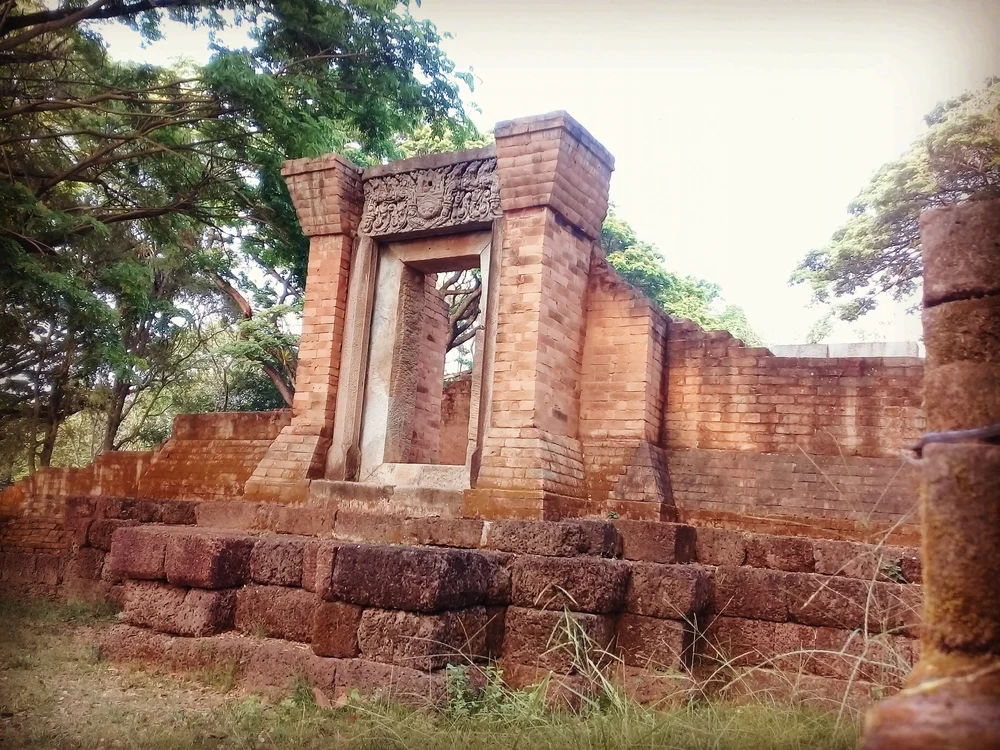
Prasat Thamo, also written as Prasat Thamor or Prasat Tamo, is an ancient Khmer dharmasala, or travelers’ rest house, located at Ban Lahan Sai Kao, Moo 2, Hin Lat Subdistrict, Ban Kruat District, Buriram Province. The name “Thamo” is associated with the Khmer word for stone, so the name can be understood as “stone sanctuary.” The surviving laterite structure shows a rectangular plan, sandstone door and window frames, an eastern entrance, 5 window openings on the southern wall, an inner chamber with a sandstone pedestal for a sacred image, and surrounding ponds. It is an important site for understanding the ancient route between Angkor and Phimai during the reign of King Jayavarman VII.
Prasat Thamo, also known as Prasat Thamor or Prasat Tamo, is located in Ban Lahan Sai Kao, Moo 2, Hin Lat Subdistrict, Ban Kruat District, Buriram Province. It is a compact but historically significant Khmer monument. The word “Thamo” is connected with the Khmer word for stone, giving the name the meaning of a stone sanctuary. Although the building is no longer complete, its surviving laterite walls, sandstone frames, inner chamber, and water features still make it possible to understand its original function as a dharmasala, or travelers’ rest house, in the ancient Khmer road system.
The Lahan Sai Kao and Ban Kruat area is important in the history of Khmer civilization in lower northeastern Thailand. The district contains ancient kiln sites, sandstone quarrying sites, Khmer sanctuaries, and routes connected with ancient communities. Prasat Thamo is therefore not an isolated ruin. It belongs to a broader cultural landscape that combined travel, trade, pilgrimage, temporary shelter, water management, and religious practice. Seen in this context, Ban Kruat was not only a border district in the modern sense, but also a productive and strategic zone in the ancient Khmer world.
Architecturally, Prasat Thamo was originally a rectangular building made mainly of laterite. Sandstone was used for door frames and window frames, the architectural parts that required greater strength and more refined shaping. The building faces east, which is a common and meaningful direction in Khmer sacred architecture. The eastern side formed the main entrance. Ancient travelers would have entered the structure from this direction before moving toward the inner chamber at the western end of the building, where a sacred image once stood.
The southern wall contains 5 window openings. This feature is especially important because it matches the architectural pattern of Khmer dharmasala or vahnigriha buildings. Windows along one side allowed light and air into the interior, while the other walls remained more solid and supportive. The combination of a long rectangular plan, eastern entrance, laterite walls, sandstone frames, and multiple southern windows helps identify the building as a travelers’ rest house rather than a normal temple tower.
Inside the western part of the structure is a stair or threshold leading into an inner chamber. This chamber contains a sandstone pedestal for a sacred image. The innermost chamber once had a higher domed or vaulted roof than the front part of the building, making it the most sacred part of the structure. This shows that Prasat Thamo was not simply a shelter from sun and rain. It also served as a religious space where travelers could worship or seek protection before continuing their journey.
The presence of a pedestal for a sacred image is crucial for understanding the character of Khmer rest houses. In the Khmer world, a dharmasala was not only a practical building. It was a religious resting point. Travelers could stop, rest, pray, perform rituals, and continue along the road with spiritual assurance. Physical movement and religious devotion were therefore closely connected in the ancient road system.
Prasat Thamo is interpreted as one of the dharmasala sites related to the ancient route from Yasodharapura, the Khmer capital at Angkor, to Phimai, an important ancient city in present-day northeastern Thailand. The Preah Khan inscription in Cambodia mentions 17 rest houses along the route to Phimai. Prasat Thamo is important because it helps turn that inscriptional record into a real landscape that can still be visited today.
The monument is associated with the 18th Buddhist century during the reign of King Jayavarman VII. This ruler is well known for supporting Mahayana Buddhism and for establishing networks of religious and public infrastructure throughout the Khmer Empire. These included hospitals, rest houses, sanctuaries, and route-related structures. Prasat Thamo reflects this wider system. It shows that Khmer authority was expressed not only through grand temples but also through infrastructure that supported movement between cities.
In terms of materials, Prasat Thamo is a clear example of how Khmer builders used laterite and sandstone for different functions. Laterite was used for walls and structural mass because it was durable and available in the region. Sandstone was used for frames, thresholds, and sacred architectural elements because it could be shaped more precisely. This material selection reflects the practical and technical intelligence of Khmer construction.
The sandstone door and window frames are key features of the monument. They define movement and light within the building. The eastern entrance led into the front section, the southern windows brought light and ventilation into the interior, and the western inner doorway led toward the sacred chamber. The plan therefore creates a sequence from the outside world of travel to the inner world of worship.
Although the upper parts of Prasat Thamo have collapsed, the remaining base and wall fragments are still highly valuable. They preserve the plan and function of the building. Small monuments like this are often overlooked when compared with major Khmer sanctuaries, but from the perspective of ancient travel history, they are essential. They show how routes were supported by shelters, sacred spaces, water features, and resting points.
Another remarkable feature is the water system. The building was surrounded by a horseshoe-shaped pond, leaving the eastern side open as the approach path. To the northeast, there is also a square pond. These water features are significant because water served practical, ritual, and symbolic roles. Travelers could use water for drinking, washing, ritual purification, or preparation before continuing the journey.
The horseshoe-shaped pond also shows how the monument was integrated into a planned landscape. Prasat Thamo was not placed randomly. Its entrance, axis, building, ponds, and surrounding space were arranged with clear intention. The open eastern approach guided travelers into the building, while the water around the structure marked the monument as a distinct and meaningful place.
Prasat Thamo can be compared with Prasat Ban Bu in Prakhon Chai District, another Khmer rest house in Buriram. Both have rectangular plans, laterite construction, sandstone architectural elements, and a relationship with the ancient route from Angkor to Phimai. This comparison shows that dharmasala buildings were not isolated local experiments. They were part of a wider architectural and travel system across the Khmer realm.
The site also helps explain Ban Kruat District as a major Khmer cultural zone. In addition to Prasat Thamo, Ban Kruat contains ancient kiln sites that produced Khmer ceramics, sandstone quarry areas, and several Khmer monuments such as Prasat Thong and other nearby sites. Ban Kruat should therefore be understood as a landscape of production, movement, religion, and community rather than as a single archaeological point.
If Phanom Rung and Prasat Mueang Tam represent monumental Khmer sacred architecture, Prasat Thamo represents the infrastructure of travel. It shows how ancient routes required rest houses, water sources, sacred images, and durable buildings for people on the move. For this reason, the site has a larger meaning than its modest size may suggest.
Visitors interested in Khmer history should allow at least 30 to 45 minutes at Prasat Thamo. Walk around the rectangular laterite building, observe the southern window openings, the eastern entrance, the inner chamber, the sacred pedestal, and the pond system. Slow observation is useful because even simple features such as a doorway or a window can explain how the building was used.
For photography, the site is best captured through wide views of the rectangular laterite structure, close-up images of sandstone frames, the southern windows, and the aged surface of laterite blocks. Morning and late afternoon light help reveal texture more clearly than harsh midday light. Visitors should walk carefully because some ground surfaces may be uneven, especially around the building base and pond edges.
Getting There is easiest by private car, rental car, or hired local vehicle. From Buriram city, travel toward Prakhon Chai and Ban Kruat District, then continue to Hin Lat Subdistrict and Ban Lahan Sai Kao. From Ban Kruat town, follow the local route toward Hin Lat. The distance from Ban Kruat town to Prasat Thamo is about 18 km. It is advisable to confirm the final local route with residents because the site is located in a community area rather than a large historical park with extensive tourist signage.
A half-day route can combine Prasat Thamo with Prasat Thong or Prasat Ta Jia, Ban Kruat Ancient Kiln Sites, and Ban Kruat Stone Quarry Site. A full-day route can extend to Prasat Nong Hong, Prasat Mueang Tam, and Phanom Rung Historical Park. This itinerary allows travelers to experience several sides of Khmer heritage: rest houses, ceramics, sandstone resources, temple architecture, and ancient communities.
Visitors should dress respectfully, speak quietly, avoid climbing on the monument, avoid scratching laterite or sandstone surfaces, and never move stone fragments. Every architectural piece in the area has archaeological value. Even stones that appear loose may help researchers understand the original structure and the process of collapse or change over time.
Prasat Thamo is suitable for history-focused travelers, students, Khmer architecture enthusiasts, and visitors who want to understand more than only the famous major temples. The site explains how the ancient road system worked through rest houses, water, worship, and carefully planned architecture. Understanding Prasat Thamo makes the whole Khmer heritage route in lower northeastern Thailand more meaningful.
From a community perspective, Prasat Thamo is part of the local memory of Ban Lahan Sai Kao and Hin Lat Subdistrict. The surrounding community helps preserve the area through everyday care and awareness. Visitors should respect local residents, avoid blocking access routes, and ask for directions politely when needed. Small community-based archaeological sites depend greatly on respectful tourism.
Prasat Thamo is therefore a worthwhile stop on the Ban Kruat heritage route. It does not have the grandeur of a major restored sanctuary or elaborate decorative carvings, but it has strong historical value through its plan, materials, water system, and function as a travelers’ rest house. Standing inside the laterite remains of Prasat Thamo allows visitors to imagine ancient travelers stopping here to rest, worship, and continue along one of the great roads of the Khmer world.
| Name | Prasat Thamo |
| Alternative Names | Prasat Thamor, Prasat Tamo, Prasat Thamo Ban Lahan Sai Kao |
| Location | Ban Lahan Sai Kao, Moo 2, Hin Lat Subdistrict, Ban Kruat District, Buriram Province |
| Address | Ban Lahan Sai Kao, Hin Lat Subdistrict, Ban Kruat District, Buriram 31180, Thailand |
| Coordinates | 14.454491, 103.126911 |
| Highlights | A Khmer Dharmasala Or Travelers’ Rest House Built Of Laterite, With Sandstone Door And Window Frames, 5 Southern Window Openings, An Inner Chamber, A Sandstone Pedestal, And Surrounding Ponds |
| History | 18th Buddhist Century, Reign Of King Jayavarman VII, Related To The 17 Dharmasala Rest Houses On The Ancient Route From Angkor To Phimai |
| Name Origin | The Word “Thamo” Is Associated With The Khmer Word For Stone, So The Name Can Be Understood As Stone Sanctuary |
| Distinctive Features | Rectangular Laterite Building Facing East, With A Main Eastern Entrance, 5 Windows On The Southern Wall, An Inner Western Chamber, And A Sacred Image Pedestal |
| Main Areas / Zones | 1. Eastern Entrance 2. Rectangular Laterite Building 3. Sandstone Door And Window Frames 4. Five Southern Window Openings 5. Inner Western Doorway Of The Dharmasala 6. Sacred Image Chamber 7. Sandstone Pedestal For A Sacred Image 8. Horseshoe-Shaped Pond Around The Building 9. Square Pond To The Northeast |
| Key Evidence | Laterite Base And Walls, Sandstone Door Frames, 5 Window Openings, Sandstone Pedestal For A Sacred Image, Horseshoe-Shaped Pond, And Square Pond |
| Registration | Registered As A National Ancient Monument By The Fine Arts Department On March 8, 1935, With Protected Boundary Defined On October 21, 1982, Covering 10 Rai, 3 Ngan, And 24 Square Wah |
| Travel Information | From Buriram City, Travel Toward Prakhon Chai And Ban Kruat District, Then Continue To Hin Lat Subdistrict And Ban Lahan Sai Kao. Best Reached By Private Car, Rental Car, Or Hired Local Vehicle. |
| Current Status | Khmer Archaeological Site In Ban Lahan Sai Kao Community And Part Of The Ban Kruat Khmer Heritage Route |
| Open Days | Daily |
| Opening Hours | 08.00 – 17.00 |
| Facilities | Community Parking Area, Walking Access To The Monument, Outdoor Learning Area, And Local Shops In Ban Kruat District |
| Caretaker | The Fine Arts Department Through Fine Arts Office 10 Nakhon Ratchasima, Together With Local Authorities And Ban Lahan Sai Kao Community |
| Main Contact Number | Fine Arts Office 10 Nakhon Ratchasima, Tel. 044-471-518 Buriram Local Natural And Cultural Environment Conservation Unit, Tel. 044-611-221 Ext. 7601 |
| Nearby Tourist Attractions | 1. Prasat Thong Or Prasat Ta Jia, Ban Kruat District, About 9 Km 2. Ban Kruat District Cultural Center And Ban Kruat Ancient Kiln Sites, About 17 Km 3. Ban Kruat Stone Quarry Site, About 18 Km 4. Prasat Nong Hong, Non Din Daeng District, About 35 Km 5. Prasat Mueang Tam, About 48 Km 6. Phanom Rung Historical Park, About 52 Km |
| Nearby Restaurants | 1. RINTR Plus Cafe Bar Restaurant Ban Kruat, About 16 Km, Tel. 061-363-9874 2. Coco Cool Cafe’ Ban Kruat, About 16 Km, Tel. 064-778-7799 3. PunThai Coffee 2445 Road Ban Kruat, About 17 Km, Tel. 098-282-1651 4. First Da & Ped Ban Kruat, About 18 Km, Tel. 098-597-1641 5. SMiNi Cafe Ban Kruat, About 17 Km |
| Nearby Accommodations | 1. Wanasin Resort Ban Kruat, About 16 Km, Tel. 044-679-295, 080-354-6956 2. Ban Kruat Garden Resort, About 17 Km, Tel. 044-679-263, 086-250-4186 3. King Kruat Resort Ban Kruat, About 18 Km, Tel. 089-846-1177 4. Ruean Mai Resort, Prasat Subdistrict, About 20 Km, Tel. 083-374-2046 5. Phromsuk Resort, Prasat Subdistrict, About 20 Km, Tel. 081-955-5025 6. Sutirak Resort, Prasat Subdistrict, About 21 Km, Tel. 084-958-8740 |
Frequently Asked Questions (FAQ)
Q: Where Is Prasat Thamo Located?
A: Prasat Thamo is located at Ban Lahan Sai Kao, Moo 2, Hin Lat Subdistrict, Ban Kruat District, Buriram Province.
Q: Are Prasat Thamo And Prasat Thamor The Same Place?
A: Yes. Prasat Thamo, Prasat Thamor, and Prasat Tamo refer to the same Khmer archaeological site at Ban Lahan Sai Kao.
Q: What Does The Name Thamo Mean?
A: The word Thamo is associated with the Khmer word for stone, so the name can be understood as stone sanctuary.
Q: Why Is Prasat Thamo Important?
A: It is a Khmer dharmasala, or travelers’ rest house, related to the ancient road from Angkor to Phimai and the public infrastructure of King Jayavarman VII.
Q: What Are The Main Highlights Of Prasat Thamo?
A: Its highlights include a rectangular laterite building, sandstone door and window frames, 5 southern windows, an inner sacred chamber, a sandstone pedestal, and surrounding ponds.
Q: When Was Prasat Thamo Built?
A: The site is associated with the 18th Buddhist century during the reign of King Jayavarman VII, when rest houses were built along important Khmer routes.
Q: What Nearby Places Can Be Visited Together With Prasat Thamo?
A: Nearby places include Prasat Thong, Ban Kruat Ancient Kiln Sites, Ban Kruat Stone Quarry Site, Prasat Nong Hong, Prasat Mueang Tam, and Phanom Rung Historical Park.
Q: What Should Visitors Be Careful About?
A: Visitors should dress respectfully, avoid climbing on the monument, not move stones, not scratch laterite or sandstone surfaces, and keep the surrounding community area clean.
 Category: ●Art, Culture and Heritage
 Group: ●Historical Sites and Monuments
Last Update : 3 MonthAgo
 Last Update : 3 MonthAgo
 Click to Access the Navigation Map GPS
Prasat Thamo (Ban Lahan Sai Kao) Map
Recommend
 Historical Sites and Monuments(14)
 Landmarks and Memorials(2)
 Art, Craft Centres, Tradition(6)
 Museums(3)
 Educational Places
 Museum for Study(1)
 Places of Worship
 Temple(74)
 Other Sacred Sites(5)
 Suburban Living
 Village, Community(3)
 Nature and Wildlife
 National Parks and Marine Reserves(2)
 Mountain (Doi)(1)
 Dam, Reservoir, Lake(14)
 River, Canal(1)
 Bays and Beaches(1)
 Other natural attractions(2)
 Entertainment and Agricultural
 Animal camps and shows(1)
 Stadium(2)
 Farms, Parks and Ecotourism(2)
 Waterpark(1)


