
lovethailand home >Northeastern Travel Attractions >Buri Ram Travel Attractions >Ban Kruat >Non Charoen > Sawai Ancient Kiln
TL;DR: Sawai Ancient Kiln is located at Non Charoen Subdistrict, Ban Kruat District, Buri Ram Province, open Open Daily, hours 08.00 – 17.00.

Sawai Ancient Kiln
Open Days: Open Daily
Opening Hours: 08.00 – 17.00
Sawai Ancient Kiln in Buri Ram Province, commonly known as Tao Sawai, is an important archaeological site in Ban Kruat District. It represents one of the clearest traces of ancient Khmer ceramic production in southern Isan. This site is not merely an old kiln ruin. It is evidence of a sophisticated production system that once connected local resources, skilled craftsmanship, high-temperature firing technology, community life, and the wider cultural network of the ancient Khmer world. For travelers interested in archaeology, ceramics, Khmer civilization, or the hidden history of Buri Ram, Sawai Ancient Kiln is a meaningful place to visit.
Ban Kruat District is widely associated with ancient ceramic production. The area contains traces of old kilns, pottery fragments, glazed ware, and archaeological evidence showing that it was once an important production zone. Sawai Ancient Kiln helps visitors understand that Buri Ram’s historical value is not limited to famous stone sanctuaries such as Phanom Rung or Prasat Mueang Tam. It also includes production sites where skilled workers made vessels, storage jars, bowls, and glazed ceramics that served the daily and ritual needs of ancient communities.
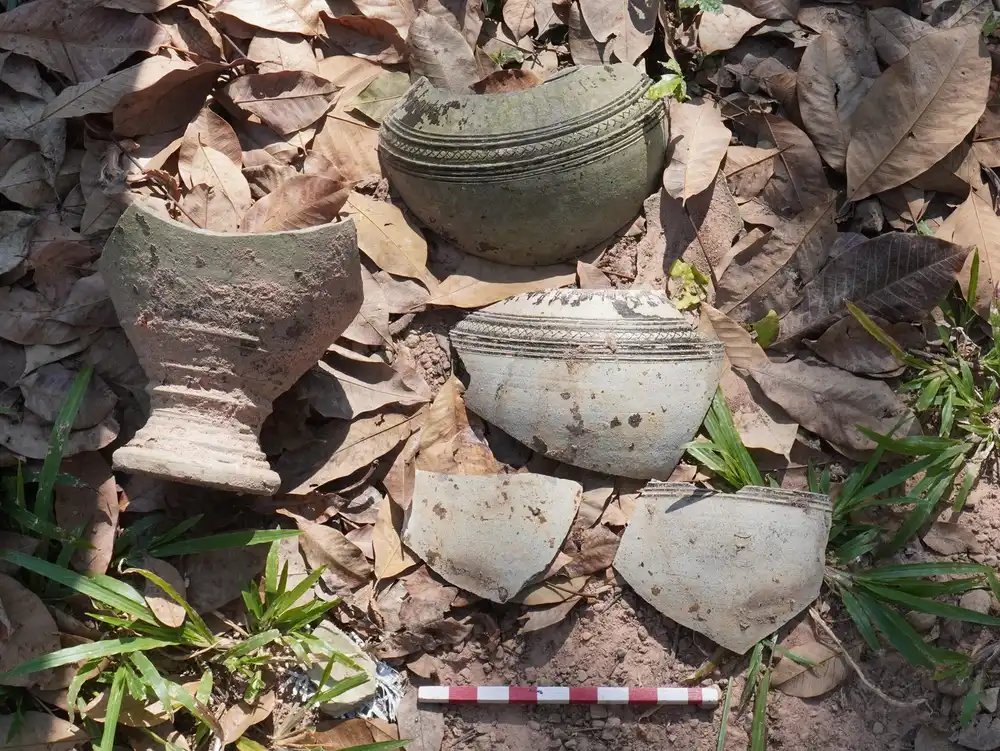
The importance of Sawai Ancient Kiln lies in its connection with Khmer material culture. Ceramic vessels from the Ban Kruat area are often hard-bodied wares, sometimes decorated with brown or green glaze. These objects may look simple at first, but they are deeply informative. They reveal how ancient people selected clay, shaped vessels, applied glaze, arranged items inside kilns, controlled fire, and produced objects that were strong enough for use and distribution. A single ceramic fragment can tell stories about technology, diet, storage, trade, ritual, and everyday life.
Sawai Ancient Kiln is one of the kiln sites studied, excavated, and restored by the Fine Arts Department. A protective roof structure covers the excavated kiln remains, allowing visitors to observe the archaeological features while helping protect them from sun, rain, and erosion. Inside the site, visitors can see the remains of kiln structures, fired clay, pottery fragments, ancient ceramic evidence, and interpretive displays that help explain how the kilns were used. Seeing the actual remains gives visitors a much clearer understanding of ancient technology than reading about it in a book.
Sawai Ancient Kiln is often mentioned together with Nai Chian Kiln, another important ancient kiln in Ban Kruat District. Together, these two sites show that the Ban Kruat area was not a small isolated production spot but part of a wider ceramic landscape. The presence of several kiln sites suggests skilled workers, local knowledge, suitable raw materials, and sustained demand for ceramic products. Visiting Sawai Ancient Kiln therefore helps travelers understand Ban Kruat as a production center in the ancient Khmer cultural sphere.
When entering the Sawai Ancient Kiln area, visitors should first pay attention to the shape of the kiln remains and the protective building. Ancient kiln sites often appear as mounds or raised earth areas because fired clay, broken vessels, ash, and kiln debris accumulated over time. These features are different from ordinary residential areas. They contain evidence of repeated firing activity, including fired clay walls, vessel fragments, kiln furniture, and heat-altered soil. Observing these details helps visitors understand how archaeologists identify a production site.
One fascinating feature of ancient ceramic production is the use of small clay supports or kiln furniture. These objects helped separate vessels during firing and prevented glaze from sticking one vessel to another. In high-temperature firing, glaze could melt and flow. Without proper supports, vessels could be damaged or fused together. Small clay supports may seem minor, but they reveal technical intelligence. They show that ancient craftsmen understood the problems of firing and developed practical solutions through experience.
Ban Kruat ceramics are closely related to ancient Khmer culture. During the period when Khmer influence extended into southern Isan, people built religious monuments, developed settlements, used regional routes, and produced the objects needed for daily and ritual life. Pottery and glazed ceramics were part of this world. They were used for storage, food preparation, transport, offerings, and household activities. Sawai Ancient Kiln therefore reveals the everyday side of Khmer civilization, complementing the grand religious architecture seen at Phanom Rung and Prasat Mueang Tam.
If Phanom Rung and Prasat Mueang Tam represent religion, architecture, and sacred power, Sawai Ancient Kiln represents production, labor, and technical knowledge. Together, these sites give a fuller picture of ancient society. A civilization cannot be understood only through temples and monuments. It also depends on food, tools, vessels, craftsmen, fuel, raw materials, transport, and exchange. Sawai Ancient Kiln helps bring these practical and human dimensions into view.
The site is located in Non Charoen Subdistrict, Ban Kruat District, Buri Ram Province. Travel is most convenient by private car or rental car. Visitors can reach Ban Kruat and continue toward Non Charoen, using local roads including Highway 2165 on the Non Charoen–Pachi route, about 16 kilometers according to local travel information. Because the site is in a rural community area rather than a city center, visitors should use online maps together with local signage or directions from residents.
Getting There from Buri Ram city usually involves traveling toward Prakhon Chai and then continuing to Ban Kruat District. From Ban Kruat town, visitors can proceed to Non Charoen Subdistrict and the area around Sawai Ancient Kiln. The site can be combined with other archaeological attractions in Ban Kruat, including Nai Chian Kiln, Ban Kruat stone quarry, Prasat Thong, Prasat Thamo, and Prasat Bai Baek. This route is suitable for travelers who want to understand both production sites and Khmer monuments in one district.
Visitors should prepare comfortable walking shoes, drinking water, a hat, and a camera. Although the kiln remains are protected by a roofed structure, the surrounding area is still part of a local rural landscape. Visitors should dress politely, avoid climbing on the kiln remains, not touch or remove pottery fragments, avoid scratching or writing on surfaces, keep the area clean, and follow local guidance. Even small fragments at an archaeological site may have historical value, so respectful behavior is essential.
Sawai Ancient Kiln is suitable for travelers interested in history, archaeology, ceramics, Khmer culture, local technology, and educational tourism. It is also suitable for students and families. For young learners, seeing the kiln remains, heat-altered soil, and pottery fragments in person makes history more concrete. The site can connect many subjects: archaeology, science, geology, materials, temperature, technology, society, and trade. It is a small site with strong educational value.
For general visitors, Sawai Ancient Kiln may not require a long visit, but it rewards careful observation. A kiln is not just a hole in the ground. It represents a whole production process: digging clay, preparing the clay body, shaping vessels, drying them, applying glaze, arranging vessels inside the kiln, controlling fire, cooling the kiln, and removing finished products. When visitors imagine this process, the site becomes much more vivid and meaningful.
The site also helps explain the reputation of Ban Kruat ceramics. Ban Kruat is not simply a place where ancient objects were found by chance. It was a production area with archaeological evidence. The ceramic products from this area are important for the study of Thai and Southeast Asian ceramic history. Visiting Sawai Ancient Kiln allows travelers to approach the source of these ancient wares and understand how they were made before they became objects of study in museums and collections.
From a cultural geography perspective, Ban Kruat is located in an area that connected the Khorat Plateau with the ancient Khmer cultural world. The discovery of many kiln sites in this district suggests that production was linked with broader networks of people, objects, and routes. Vessels produced here may have circulated among nearby communities, ancient towns, and religious sites. Sawai Ancient Kiln therefore helps visitors understand the movement of goods and culture in the past.
Sawai Ancient Kiln also demonstrates the relationship between nature and technology. Choosing a kiln location required knowledge of clay, landform, fuel, water, air circulation, and temperature control. Ancient craftspeople may not have used modern scientific language, but they understood practical science through repeated experience. They knew how to use earth, fire, air, and timing to produce durable ceramics. This makes the kiln site a powerful classroom for understanding ancient knowledge.
Inside the protective building, visitors should observe the soil layers, fired clay, kiln channels, and displayed fragments. Complete vessels may be beautiful, but broken fragments are equally important for archaeology. They help specialists analyze vessel forms, firing techniques, glaze behavior, kiln temperature, and production failures. Sawai Ancient Kiln teaches visitors to value evidence that might otherwise be overlooked.
Conservation is especially important at this site because kiln remains are more fragile than stone monuments. Clay, fired soil, and exposed archaeological layers can be damaged by weather and human contact. The protective roof helps, but visitor behavior also matters. Not touching, stepping on, or removing anything from the site is part of responsible cultural tourism. Ancient kilns may not appear as visually grand as stone temples, but they are essential for understanding real life in the ancient world.
Travelers who want to explore Ban Kruat in depth should allow at least half a day or a full day. The district contains several important cultural and archaeological stops, including Sawai Ancient Kiln, Nai Chian Kiln, Ban Kruat stone quarry, Prasat Thong, Prasat Thamo, and Prasat Bai Baek. Each site explains a different part of the ancient Khmer world. Kilns explain ceramic production. Quarries explain stone supply. Sanctuaries explain religion and art. Together, they make Ban Kruat one of Buri Ram’s most interesting historical districts.
Ban Kruat stone quarry is particularly useful for comparison with Sawai Ancient Kiln. It shows where sandstone blocks were cut for construction. The quarry marks reveal how ancient workers selected stone, cut channels, divided blocks, and removed them for transport. When seen together with Sawai Ancient Kiln, the quarry shows that Ban Kruat had both ceramic production and stone production. This strengthens the understanding of the district as an important production zone in ancient Khmer culture.
Prasat Thong and Prasat Thamo are nearby ancient sites that help complete the historical picture. Prasat Thong is a Hindu sanctuary built with brick, laterite, and sandstone, while Prasat Thamo is connected with ancient routes and the concept of rest houses along Khmer-period travel networks. Visiting these monuments together with Sawai Ancient Kiln reveals that Ban Kruat was connected not only to production but also to religion, travel, settlement, and regional movement.
Including Sawai Ancient Kiln in a Buri Ram travel itinerary also helps visitors move beyond the most famous destinations. Many travelers know Phanom Rung and Prasat Mueang Tam, but fewer understand the production systems that supported ancient communities. Large temples speak about religion and power. Kilns speak about labor, skill, technology, and everyday life. Both are necessary for a complete understanding of the past.
For international visitors, Sawai Ancient Kiln offers a deeper view of Khmer heritage in Thailand. Ancient Khmer civilization did not leave only temples and sculptures. It also left evidence of crafts, industry, storage, domestic life, and regional exchange. By learning about kilns and ceramics, foreign travelers can better understand the practical foundations of the ancient world before or after visiting Phanom Rung, Prasat Mueang Tam, and other Khmer sites in Buri Ram.
The best time to visit is in the morning or late afternoon when the weather is more comfortable. Although the kiln remains are covered, the surrounding area can be hot in the middle of the day. In the rainy season, visitors should check road conditions and wear appropriate shoes. In the hot season, drinking water and sun protection are useful. With good planning, travelers can combine Sawai Ancient Kiln with other Ban Kruat sites without rushing.
Sawai Ancient Kiln should be seen as more than a small tourist stop. It is part of the history of ceramic production in southern Isan. The evidence here shows that ancient people understood raw materials, fire, kiln construction, firing control, and ceramic use. This was practical knowledge developed through hands-on work over generations. The site makes the word civilization tangible, showing that history is made not only by rulers and temples, but also by craftspeople, materials, and everyday objects.
Overall, Sawai Ancient Kiln in Buri Ram Province deserves a place in any serious cultural travel route through Ban Kruat District. It has value in archaeology, ceramic history, ancient technology, Khmer culture, and local heritage education. It may not be as visually monumental as a stone temple, but it tells a deep human story. Visitors who come here can see that the prosperity of ancient Khmer culture was not found only in sanctuaries, but also in earth, fire, vessels, skilled hands, and the production systems that supported life in the ancient world.
| Name | Sawai Ancient Kiln / Tao Sawai |
| Location | Non Charoen Subdistrict, Ban Kruat District, Buri Ram Province |
| Address | Ban Khok Yai Area / Non Charoen Subdistrict, Ban Kruat District, Buri Ram 31180, Thailand |
| Map Search | Sawai Ancient Kiln, C5W5+6H2, Hin Lat, Ban Kruat District, Buri Ram 31180 |
| Distinctive Features | An ancient Khmer ceramic kiln site with kiln structure remains, pottery fragments, glazed ware evidence, interpretive displays, and a protective building over the archaeological remains |
| History / Period | A ceramic and glazed ware production site in ancient Khmer culture. The Ban Kruat kiln area was an important production zone around the 15th–18th Buddhist centuries, with ceramic evidence associated with the 14th–19th Buddhist centuries |
| Name Origin | The name Tao Sawai refers to the ancient kiln site in Non Charoen Subdistrict, Ban Kruat District, one of Buri Ram’s important ancient kiln sites together with Nai Chian Kiln |
| Importance | Important evidence of ancient ceramic technology, glazed ware production, craft knowledge, and economic activity within the Khmer cultural sphere of southern Isan |
| Travel Information | Travel by private car through Ban Kruat District and Non Charoen Subdistrict. Highway 2165 on the Non Charoen–Pachi route, about 16 km, can be used as part of the access route. Online maps and local directions are recommended |
| Current Status | Open As An Archaeological Learning Site In Ban Kruat District, With A Protective Building And Visitor Viewing Area |
| Open Days | Open Daily |
| Opening Hours | 08.00 – 17.00 |
| Admission Fee | No Admission Fee |
| Caretaker / Area Coordinator | Fine Arts Department As The National Heritage Authority, Together With Non Charoen Subdistrict Municipality In The Local Area |
| Local Contact Number | Non Charoen Subdistrict Municipality, Tel. 044-197-227 |
| Facilities | Protective Kiln Building, Indoor Viewing Walkway, Exhibition Area, And Nearby Parking Area |
| Main Areas / Zones | Protective Building Over The Ancient Kiln Excavated Kiln Structure Area Ancient Pottery And Ceramic Fragment Display Area Ancient Glazed Ware Interpretation Area Visitor Walkway And Information Points Outdoor Context Area Around The Archaeological Site |
| Visitor Etiquette | Do Not Climb On Or Touch The Kiln Remains, Do Not Remove Pottery Fragments, Do Not Write On Surfaces, Keep The Area Clean, And Visit Carefully To Help Preserve The Site |
| Nearby Tourist Attractions | 1. Nai Chian Kiln, About 5 km 2. Ban Kruat Stone Quarry, About 12 km, Tel. 085-668-3710 3. Prasat Thong Ban Khok Prasat, About 15 km 4. Prasat Thamo, About 18 km 5. Prasat Bai Baek, About 25 km |
| Nearby Restaurants | 1. RINTR Plus Cafe Bar Restaurant, About 14 km, Tel. 081-966-1766 2. Bao Bao Ban Kruat, About 14 km, Tel. 065-739-3939 3. 3 Num Mum Aroi Phanom Rung, About 35 km, Tel. 044-628-266 4. AERY Coffee&Space Buriram, About 36 km, Tel. 096-361-9666 5. Lang Wang Restaurant, About 38 km, Tel. 084-605-4324 |
| Nearby Accommodations | 1. Fresh Garden Resort, About 8 km, Tel. 061-038-4295 2. Wanasin Resort, About 13 km, Tel. 044-115-225 3. Ban Kruat Garden Resort, About 14 km, Tel. 044-679-263 4. King Kruat Resort, About 15 km, Tel. 044-679-284 5. The Sun Resort, About 18 km, Tel. 088-469-9843 |
Frequently Asked Questions (FAQ)
Q: Where is Sawai Ancient Kiln located?
A: Sawai Ancient Kiln is located in Non Charoen Subdistrict, Ban Kruat District, Buri Ram Province, and is one of the important ancient Khmer kiln sites in southern Isan.
Q: Why is Sawai Ancient Kiln important?
A: It is evidence of ancient ceramic and glazed ware production in Khmer culture, showing knowledge of clay, firing, kiln construction, and production technology in the past.
Q: What are the opening hours of Sawai Ancient Kiln?
A: The site is open daily from 08.00 to 17.00.
Q: Is there an admission fee?
A: No. Sawai Ancient Kiln does not charge an admission fee.
Q: What can visitors see at the site?
A: Visitors can see the protective kiln building, excavated kiln remains, pottery fragments, ancient ceramic evidence, glazed ware interpretation, and archaeological information areas.
Q: How should visitors travel to Sawai Ancient Kiln?
A: Travel by private car or rental car is recommended. Visitors can travel through Ban Kruat District and Non Charoen Subdistrict, using Highway 2165 on the Non Charoen–Pachi route as part of the access route.
Q: Who should visit Sawai Ancient Kiln?
A: The site is suitable for travelers interested in history, archaeology, ceramics, Khmer culture, educational tourism, families, students, and international visitors who want a deeper view of ancient civilization.
Q: What nearby sites can be combined with Sawai Ancient Kiln?
A: Nearby sites include Nai Chian Kiln, Ban Kruat Stone Quarry, Prasat Thong, Prasat Thamo, and Prasat Bai Baek, which together explain the archaeological landscape of Ban Kruat District.
 Category: ●Art, Culture and Heritage
 Group: ●Art, Craft Centres, Tradition
Last Update : 3 MonthAgo
 Last Update : 3 MonthAgo
 Click to Access the Navigation Map GPS
 Historical Sites and Monuments(14)
 Landmarks and Memorials(2)
Art, Craft Centres, Tradition(6)
Landmarks and Memorials(2)
Art, Craft Centres, Tradition(6)
 Museums(3)
 Educational Places
 Museum for Study(1)
 Places of Worship
 Temple(74)
 Other Sacred Sites(5)
 Suburban Living
 Village, Community(3)
 Nature and Wildlife
 National Parks and Marine Reserves(2)
 Mountain (Doi)(1)
 Dam, Reservoir, Lake(14)
 River, Canal(1)
 Bays and Beaches(1)
 Other natural attractions(2)
 Entertainment and Agricultural
 Animal camps and shows(1)
 Stadium(2)
 Farms, Parks and Ecotourism(2)
 Waterpark(1)


