
lovethailand home >Northeastern Travel Attractions >Buri Ram Travel Attractions >Non Din Daeng >Non Din Daeng > Khlong Manao Reservoir
TL;DR: Khlong Manao Reservoir is located at Ban Non Din Daeng, Non Din Daeng Subdistrict, Non Din Daeng District, Buri Ram Province, open Daily, hours 08.00 – 17.00.

Khlong Manao Reservoir
Open Days: Daily
Opening Hours: 08.00 – 17.00
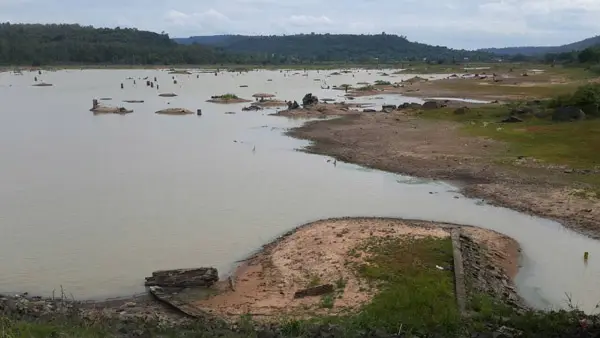
Khlong Manao Reservoir in Buri Ram Province is a nature-based reservoir attraction located around Ban Non Din Daeng, Non Din Daeng Subdistrict, Non Din Daeng District. It lies close to Rao Su Monument and Lam Nang Rong Dam, making it part of one of the most meaningful water, history, and borderland routes in southern Isan. The reservoir is an earth dam with a concrete foundation and a paved road along the dam crest. It was developed as a royal-initiative water project to help solve water shortage problems, support agriculture, and provide enough water for local consumption and community use throughout the year.
The appeal of Khlong Manao Reservoir lies in its quiet, simple, and natural atmosphere. Although it is smaller than the nearby Lam Nang Rong Dam, it has its own charm as a peaceful reservoir where visitors can enjoy open water views, walk or drive along the dam crest, take photos, and relax without the crowds often found at larger leisure areas. For travelers who prefer calm scenery and local places, Khlong Manao Reservoir is a worthwhile stop in Non Din Daeng District.
The reservoir is important because it supports local water security. It helps reduce water shortage problems for residents and provides a water source for agriculture and daily use. In borderland rural areas such as Non Din Daeng, reliable water storage is essential for farming, settlement, and community stability. Khlong Manao Reservoir is therefore not only a scenic viewpoint, but also a practical water-management structure that supports the lives of people in the surrounding area.
The history of Khlong Manao Reservoir is connected with the royal initiative of King Bhumibol Adulyadej to develop the Lam Nang Rong watershed and the Non Din Daeng border area. The project began in 1979 with the objective of creating a water source for local communities, agriculture, and household use. It represents the principle of developing water resources in areas where people needed stable access to water in order to live, farm, and strengthen the community.
Non Din Daeng has an important background as a borderland area. Development projects in this district were not only about building reservoirs, but also about creating stability for communities that had faced hardship in the past. Khlong Manao Reservoir is part of this broader development story, together with Lam Nang Rong Dam and other water-management projects in the region. Visiting the reservoir helps travelers understand how water, agriculture, security, and local development are connected in southern Isan.
One distinctive feature of the reservoir is its paved dam-crest road, which also connects toward model village routes such as Nong Ta Yao and Nong Wa development villages near the border area. Driving along this route allows visitors to see reservoir scenery, rural landscapes, farming areas, and the changing geography toward the Thai–Cambodian border. It is a suitable route for travelers who want to observe the wider setting of Non Din Daeng rather than visiting only one viewpoint.
Another unique feature at Khlong Manao Reservoir is the presence of floating stones or volcanic stones placed along the dam crest to help prevent erosion. These stones appear in blocks and slabs with layered colors, creating an unusual and attractive natural detail around the dam. For visitors interested in photography, geology, or landscape textures, these stones add visual interest and make the reservoir different from many ordinary water-storage sites.
The atmosphere at Khlong Manao Reservoir is generally quieter than Lam Nang Rong Dam. Visitors can sit by the dam crest, look across the water, feel the breeze, and enjoy the simple reservoir landscape. In the late afternoon, the soft light over the water creates a peaceful mood, while the morning is suitable for walking and quiet sightseeing. The reservoir works well as a short stop before or after visiting Rao Su Monument, Lam Nang Rong Dam, or Nong Hong Sanctuary.
For tourism planning, Khlong Manao Reservoir is best included as part of a Non Din Daeng route. Travelers can begin with Rao Su Monument to learn about the area’s borderland history, continue to Khlong Manao Reservoir for quiet reservoir scenery, and then visit Lam Nang Rong Dam, Nong Hong Sanctuary, or Lam Nang Rong Beach. This route combines history, water-resource development, nature, local food, and ancient Khmer heritage in one compact journey.
Compared with Lam Nang Rong Dam, Khlong Manao Reservoir feels more intimate and peaceful. Lam Nang Rong Dam is larger and has lakeside restaurants, guesthouse facilities, meeting rooms, and camping areas. Khlong Manao Reservoir is smaller and quieter, making it more suitable for travelers who want a calm scenic stop and a simple local atmosphere. The two places complement each other well and should ideally be visited together.
The two reservoirs are also connected through the broader Lam Nang Rong water-development story. Lam Nang Rong Dam was built later as a larger earth dam that stores about 150 million cubic meters of water, with construction beginning in 1980 and completion in 1982. Khlong Manao Reservoir began earlier in 1979 and serves at a smaller local scale. Together, they form part of the water network that helped support agriculture and community development in Non Din Daeng.
For travelers interested in royal-initiative projects, Khlong Manao Reservoir is a clear example of how a relatively small water project can solve real local problems. The objective is not simply to create a large landmark, but to provide practical water access for people in a specific area. With water available, agriculture becomes more stable, communities become stronger, and borderland development becomes more sustainable. This makes the reservoir meaningful beyond its scenery.
Recommended activities include walking along the dam crest, viewing the reservoir, photographing the water and volcanic stones, driving slowly along the connected village route, resting quietly, and continuing to nearby attractions. Since this is a working reservoir area, visitors should avoid restricted sections, should not climb dam structures, should not swim in unsafe areas, and should not leave waste around the dam or water edge.
Photographers will find several useful visual elements here, including the paved crest road, reservoir surface, volcanic stones, rural background, farming land, open sky, and quiet water views. Morning and late afternoon are the best times for photography. Late afternoon is especially suitable for soft reservoir light, while morning is better for peaceful walking and clean, fresh scenery.
Families can visit Khlong Manao Reservoir as a short nature stop, but children should always be supervised near water and sloped dam areas. The reservoir is not a theme park or a fully serviced recreation zone, so visitors should choose safe areas for resting and walking. Elderly visitors should wear comfortable shoes and avoid unstable stones or steep slopes. Drinking water, hats, and sun protection are useful, especially during the hot season.
The best season to visit is from the late rainy season through the cool season, when the landscape looks greener and the weather is more comfortable. During the hot season, the reservoir can still be visited, but morning and late afternoon are preferable. During the rainy season, travelers should be careful with slippery roads, wet ground, and changing water levels around the reservoir.
Getting There is most convenient by private car. From Non Din Daeng District, use Highway 348, the Lahan Sai–Ta Phraya route. Before reaching Rao Su Monument, look for the left turn that leads into Khlong Manao Reservoir. The route is close to Rao Su Monument, Lam Nang Rong Dam, and Nong Hong Sanctuary, so it is easy to combine several attractions in one trip.
Visitors without a private car can first reach Non Din Daeng District and then arrange local transport or a hired vehicle to Rao Su Monument and Khlong Manao Reservoir. Return arrangements should be made in advance, especially if staying for sunset or continuing to Lam Nang Rong Dam. For foreign travelers, a rental car with a driver is the most convenient and reliable option because local public transport may not be frequent.
Rao Su Monument is one of the most important nearby places. It commemorates the courage of civilians, police, and soldiers who lost their lives during the conflict connected with the Thai border area and strategic route development. Visiting the monument together with Khlong Manao Reservoir helps travelers understand why water development, road development, and community stability were important in Non Din Daeng.
Another important nearby site is Nong Hong Sanctuary, an ancient Khmer monument in Non Din Daeng District. Combining the reservoir with the sanctuary gives visitors a more complete route that includes natural scenery, modern development history, and ancient cultural heritage. This makes the area especially suitable for travelers who want to see several layers of Buri Ram in one day.
Lam Nang Rong Beach and the lakeside restaurants around Lam Nang Rong Dam are good places to complete the trip. After visiting Khlong Manao Reservoir, travelers can continue to Lam Nang Rong Dam for food, wide reservoir views, and relaxation by the water. Freshwater fish, Isan dishes, Thai food, and cold drinks are especially suitable for the lakeside setting. Groups and weekend travelers should call ahead when possible.
Accommodation is available around Lam Nang Rong Dam and Non Din Daeng District. The Lam Nang Rong Dam guesthouse and camping facilities can be contacted through the Lam Nang Rong Operation and Maintenance Project during official working hours. Additional private resorts and local accommodation are available in the surrounding district. Travelers who want more town services may stay farther away in Nang Rong or Prakhon Chai and visit the reservoir as a day trip.
For international travelers, Khlong Manao Reservoir provides a local and meaningful view of Buri Ram. It is not a major commercial attraction, but it explains how water-resource development, rural settlement, borderland geography, and community life are connected. It is particularly suitable for travelers who want to understand southern Isan beyond famous historical parks, stadiums, and city attractions.
The beauty of Khlong Manao Reservoir is quiet rather than dramatic. The reservoir surface tells a story of water management, the dam crest shows the practical structure of the project, the volcanic stones add natural texture, and the nearby Rao Su Monument and Lam Nang Rong Dam add historical and developmental context. Together, these elements make this small reservoir more meaningful than it first appears.
In summary, Khlong Manao Reservoir in Buri Ram Province is a royal-initiative water project and peaceful nature stop in Non Din Daeng District. It is suitable for travelers who want quiet reservoir views, local scenery, photography, and a route that connects easily with Rao Su Monument, Lam Nang Rong Dam, Nong Hong Sanctuary, and Lam Nang Rong Beach. Although it is smaller than Lam Nang Rong Dam, it has a distinctive charm through its peaceful atmosphere, paved dam crest, layered volcanic stones, and strong connection with the development history of the southern Isan borderland.
| Name | Khlong Manao Reservoir |
| Location | Ban Non Din Daeng, Non Din Daeng Subdistrict, Non Din Daeng District, Buri Ram Province |
| Address | Khlong Manao Reservoir Area, Non Din Daeng Subdistrict, Non Din Daeng District, Buri Ram 31260, Thailand |
| Coordinates | 14.297753, 102.748197 |
| Highlights | Royal-initiative reservoir near Rao Su Monument, with a peaceful atmosphere, paved dam crest, layered volcanic stones, and easy connection to Lam Nang Rong Dam |
| History | A royal-initiative water-resource development project that began in 1979 to solve water shortage problems and support agriculture and local water use in Non Din Daeng |
| Name Origin | Named after Khlong Manao, the local waterway developed into a reservoir for community and agricultural water use |
| Distinctive Features | Earth dam with concrete foundation, paved dam crest, quiet reservoir scenery, mountain-side landscape, layered volcanic stones, and a road connection to border-area development villages |
| Local Importance | Helps reduce water shortage, supports agriculture, provides local water for community use, and serves as a quiet nature-based recreation area in Non Din Daeng District |
| Reservoir Capacity | Approximately 2.85 million cubic meters |
| Travel Information | Use Highway 348, the Lahan Sai–Ta Phraya route. Before reaching Rao Su Monument, turn left into the route leading to Khlong Manao Reservoir |
| Current Status | Active royal-initiative reservoir and peaceful nature stop open for sightseeing and relaxation during suitable visiting hours |
| Open Days | Daily |
| Opening Hours | 08.00 – 17.00 |
| Fees | No admission fee |
| Facilities | Paved dam-crest road, reservoir viewpoint, resting area, connection to local development villages, and nearby restaurants / accommodation around Lam Nang Rong Dam and Non Din Daeng town |
| Main Areas / Zones | Paved dam crest, reservoir viewpoint, volcanic-stone erosion-protection area, village-connection route, agricultural water-use area, and route connected with Rao Su Monument / Lam Nang Rong Dam |
| Caretaker | Lam Nang Rong Operation and Maintenance Project, Royal Irrigation Department, led by Mr. Nattaset Thirawatthanakorn, Director of Lam Nang Rong Operation and Maintenance Project |
| Main Contact Number | Lam Nang Rong Operation and Maintenance Project Tel. 044-606336 |
| Official Website / Official Page | lamnangrong.rid.go.th |
| Nearby Tourist Attractions | 1. Rao Su Monument, about 1 km 2. Lam Nang Rong Dam, about 2 km 3. Nong Hong Sanctuary, about 3 km 4. Chao Pho Nong Hong Shrine, about 3 km 5. Lam Nang Rong Beach, about 4 km 6. Phra Siam Thewathirat, Ban Nong Samet, about 15 km 7. Pha Daeng Viewpoint, Ta Phraya National Park, about 30 km 8. Dong Yai Wildlife Sanctuary / Laloeng Roi Ru area, about 35 km |
| Nearby Restaurants | 1. Khrua Saichon, Lam Nang Rong Dam Welfare Restaurant, about 2 km, Tel. 093-691-9764, 081-063-3212 2. Lam Nang Rong Dam Welfare Restaurant, about 2 km, Tel. 093-691-9764 3. Ping Pong Restaurant, Lam Nang Rong Dam, about 2 km, Tel. 092-159-2158 4. Phan Rung Restaurant, Lam Nang Rong Dam, about 2 km, Tel. 091-019-2555 5. Local Lakeside Restaurants Around Lam Nang Rong Reservoir, about 2–4 km 6. Local Restaurants in Non Din Daeng Town, about 10 km |
| Nearby Accommodations | 1. Lam Nang Rong Dam Guesthouse, about 2 km, Tel. 0-4460-6336 ext. 159 2. Suan Phupha Green View, about 7 km, Tel. 095-191-4629, 081-265-9879 3. Suan Kaew Mangkorn, about 9 km, Tel. 089-546-3621 4. Suk Kasem 1 Guesthouse, about 10 km, Tel. 085-767-5545 5. Phu Pana Camping, about 12 km, Tel. 081-976-8787 6. Suan Mon Accommodation, about 13 km, Tel. 081-466-8444 7. Hotel de l’amour, Prakhon Chai District, about 49 km, Tel. 044-651-555 |
Frequently Asked Questions (FAQ)
Q: Where is Khlong Manao Reservoir located?
A: Khlong Manao Reservoir is located around Ban Non Din Daeng, Non Din Daeng Subdistrict, Non Din Daeng District, Buri Ram Province, about 1 km from Rao Su Monument.
Q: What are the main highlights of Khlong Manao Reservoir?
A: The highlights include its royal-initiative background, earth-dam structure with concrete foundation, paved dam crest, peaceful atmosphere, and layered volcanic stones placed along the dam area.
Q: How is Khlong Manao Reservoir connected with royal-initiative development?
A: It is a royal-initiative water-development project that began in 1979 to solve water shortage problems, support agriculture, and provide water for local community use in Non Din Daeng.
Q: Is there an admission fee at Khlong Manao Reservoir?
A: No. Visitors can enter the reservoir area for sightseeing and relaxation during suitable visiting hours without an admission fee.
Q: When is the best time to visit Khlong Manao Reservoir?
A: Morning and late afternoon are the best times because the weather is more comfortable and the natural light is suitable for photography around the dam crest, water surface, and volcanic stones.
Q: How can travelers get to Khlong Manao Reservoir?
A: Use Highway 348, the Lahan Sai–Ta Phraya route. Before reaching Rao Su Monument, turn left into the route leading to Khlong Manao Reservoir.
Q: What nearby places can be combined with Khlong Manao Reservoir?
A: Nearby places include Rao Su Monument, Lam Nang Rong Dam, Nong Hong Sanctuary, Chao Pho Nong Hong Shrine, Lam Nang Rong Beach, Phra Siam Thewathirat, and Pha Daeng Viewpoint.
Q: Is Khlong Manao Reservoir suitable for foreign travelers?
A: Yes. It is suitable for foreign travelers who want to experience a royal-initiative reservoir, a quiet local landscape, borderland history, and a nature route connected with important sites in Non Din Daeng.
 Category: ●Nature and Wildlife
 Group: ●Dam, Reservoir, Lake
Last Update : 2 MonthAgo
 Last Update : 2 MonthAgo
 Click to Access the Navigation Map GPS
Khlong Manao Reservoir Map
Recommend

 Art, Culture and Heritage
 Historical Sites and Monuments(14)
 Landmarks and Memorials(2)
 Art, Craft Centres, Tradition(6)
 Museums(3)
 Educational Places
 Museum for Study(1)
 Places of Worship
 Temple(74)
 Other Sacred Sites(5)
 Suburban Living
 Village, Community(3)
 National Parks and Marine Reserves(2)
 Mountain (Doi)(1)
Dam, Reservoir, Lake(14)
Mountain (Doi)(1)
Dam, Reservoir, Lake(14)
 River, Canal(1)
 Bays and Beaches(1)
 Other natural attractions(2)
 Entertainment and Agricultural
 Animal camps and shows(1)
 Stadium(2)
 Farms, Parks and Ecotourism(2)
 Waterpark(1)


