
lovethailand home >Northeastern Travel Attractions >Buri Ram Travel Attractions >Nang Rong >Thanon Hak > Wat Mai Rerai Thong
TL;DR: Wat Mai Rerai Thong is located at Thanon Hak Subdistrict, Nang Rong District, Buriram Province, Thailand, open Daily, hours 08.00 – 17.00.
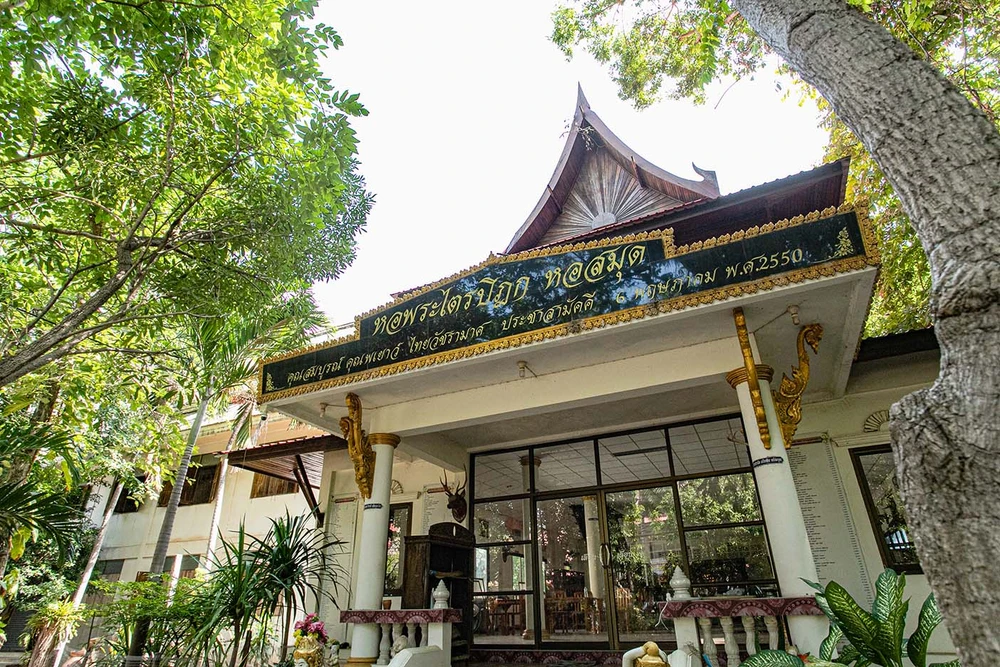
Wat Mai Rerai Thong
Open Days: Daily
Opening Hours: 08.00 – 17.00
Wat Mai Rerai Thong in Buriram Province is an old Buddhist temple in Nang Rong District, located in Thanon Hak Subdistrict not far from central Nang Rong and the Nang Rong Bus Station. For travelers who want to understand the quieter cultural side of Buriram, this temple offers a meaningful local experience through its long history, old ordination hall, provincial meditation center, and the large white Buddha image known as Phra Rattanamongkhon Thep Niramitr. The temple is suitable for merit-making, Buddhist worship, quiet reflection, cultural travel, and a short stop on a wider Nang Rong itinerary.
Wat Mai Rerai Thong is not a large commercial tourist attraction. Its value lies in its identity as a living community temple with deep roots in local Buddhist life. Visitors can pay respect to sacred Buddha images, walk around the old temple buildings, observe the calm atmosphere of a Thai Buddhist community temple, and see how religion remains part of daily life in southern Isan. The temple is especially useful for foreign visitors who want to see a real local temple rather than only the famous historical parks and major landmarks of Buriram.
The history of Wat Mai Rerai Thong dates back to 1697 CE, or 2240 BE. In its early period, the temple was known as Wat Ban Sung, or Wat Anujari Simaram. Monks resided at the temple and continued to maintain the religious site over time. Later, a leading monk named Phra Ajarn Thong separated and established a new temple, which became known as Wat Mai Rerai Thong. The present name therefore carries the memory of both the new foundation and Phra Ajarn Thong, the monk associated with the temple’s early development.
The temple’s religious status became more clearly defined through its consecrated boundary, or wisungkhammasima. Wat Mai Rerai Thong received its first royal grant of consecrated boundary in 1887 CE, or 2420 BE, and later received another in 2000 CE, or 2543 BE. In Thai Buddhist tradition, this boundary is important because it defines the sacred space used for formal monastic ceremonies, especially ordination rites within the ordination hall. This history shows that the temple has had an official and continuous role in Buddhist practice for a long period of time.
Like many old community temples in Thailand, Wat Mai Rerai Thong existed before modern documentation became systematic. Since the temple was already in existence before 1943, early construction records were not fully available. The temple later requested official recognition and registration so that its status could be used for administrative and religious purposes. This background reflects the way many older Thai temples developed: first through the living faith of local people, and later through formal documents and state registration.
The temple grounds cover 22 rai and 29 square wah, with additional monastic land of 7 rai, 1 ngan, and 93 square wah. This gives the temple enough space for religious ceremonies, meditation practice, community activities, and everyday temple life. The temple is not used only during major festivals. It also serves local people throughout the year as a place for making merit, attending ceremonies, supporting Buddhist activities, and maintaining a connection with the Sangha and the community.
One of the most important features of Wat Mai Rerai Thong is its old ordination hall. The building reflects traditional Thai temple art and has a calm, dignified presence. It is not designed for dramatic spectacle, but for religious function, beauty, and continuity. Visitors who appreciate old temple architecture will enjoy observing the proportions, details, and atmosphere of the ordination hall. The building expresses the devotion of the local community and the careful craftsmanship associated with older Buddhist architecture in Thailand.
The temple also includes Provincial Meditation Center No. 27, which was appointed in 2012. This gives Wat Mai Rerai Thong a deeper role beyond ordinary temple activities. It is a place where Buddhist practitioners can cultivate mindfulness, listen to Dhamma teachings, practice meditation, and spend quiet time developing inner calm. For visitors, this means the temple should be approached with respect and a quiet attitude, especially around areas used for meditation and religious practice.
Phra Rattanamongkhon Thep Niramitr is one of the temple’s most striking sacred images. This large white Buddha image was built through the faith of monks and local supporters at the provincial meditation center. Under the leadership of Phra Khru Inthapanya Phirom, monks and villagers worked together to create the image, and a Buddhist consecration ceremony was held on March 10, 2024. The image has become an important place for worship, blessing, and spiritual reflection within the temple grounds.
The presence of Phra Rattanamongkhon Thep Niramitr gives the temple a clear contemporary landmark while still preserving the older identity of the site. This combination is one of the temple’s most interesting qualities. Wat Mai Rerai Thong is both old and active, both historical and still developing. The large white Buddha image shows how local faith continues to create new sacred spaces within a temple that already has centuries of history.
The current abbot of Wat Mai Rerai Thong is Phra Khru Inthapanya Phirom, also known as Phra Kham Inpanyo, family name Tonkaew. He was born on April 6, 1969, in Ban Ranam Phluang, Khok Sanuan Subdistrict, Chamni District, Buriram Province. He became a novice monk on April 30, 1983, and was ordained as a monk on April 15, 1989. He currently serves as both the ecclesiastical chief of Nong Sano Subdistrict and the abbot of Wat Mai Rerai Thong. His leadership has helped maintain the temple’s religious role and support its ongoing development.
Under the care of Phra Khru Inthapanya Phirom, Wat Mai Rerai Thong continues to function as a center for worship, meditation, and community support. The construction of Phra Rattanamongkhon Thep Niramitr is a strong example of how the temple continues to grow through shared faith. This development does not erase the old character of the temple. Instead, it adds a modern layer of devotion to a site that already carries a long history.
Wat Mai Rerai Thong is closely connected with the community of Thanon Hak. In southern Isan, a temple often serves many roles at once: a place for Buddhist ceremonies, a center for local festivals, a place for ordination, a place for funerals and merit-making, and a space where people gather in times of need. Wat Mai Rerai Thong reflects this traditional relationship clearly. It is a temple that belongs to the daily life of the community, not a site separated from local people.
For travelers, the temple helps reveal a deeper side of Nang Rong District. Many visitors know Nang Rong mainly as a convenient base for Phanom Rung Historical Park, but the district itself has temples, markets, sacred sites, cafés, restaurants, and older community areas worth exploring. Wat Mai Rerai Thong is one of the places that adds depth to a Nang Rong itinerary because it combines history, faith, local architecture, and community life in one visit.
Visitors interested in old temples around Nang Rong can combine Wat Mai Rerai Thong with Wat Klang Nang Rong, Wat Khun Kong, Wat Hua Saphan, Wat Pa Rerai, and Wat Rong Man Thet. Each temple has its own character. Wat Klang Nang Rong is known as an old temple in the town center. Wat Khun Kong is associated with the local legend of Thao Pachit and Nang Oraphim. Wat Pa Rerai has a strong devotional atmosphere. Wat Rong Man Thet reflects the history of old Nang Rong. Wat Mai Rerai Thong stands out for its old ordination hall, meditation center, and large white Buddha image.
The atmosphere of Wat Mai Rerai Thong is peaceful and approachable. Visitors will see a temple that is still used by monks and local residents. There may be religious activities, temple work, or local people coming to make merit. This ordinary temple life is part of the attraction. It allows travelers to experience a Thai Buddhist temple in its natural community context rather than as a staged tourist venue.
A good visit should begin with paying respect to the principal Buddha images or sacred areas of the temple. After that, visitors can walk around the old ordination hall, observe the temple grounds, and continue to Phra Rattanamongkhon Thep Niramitr. The visit does not need to be rushed. Even a short stay can be meaningful if travelers move quietly, observe respectfully, and allow the temple’s calm atmosphere to shape the experience.
Visitors should dress modestly when entering the temple. Clothing should be appropriate for a Buddhist religious site, and behavior should remain quiet around the ordination hall, meditation areas, and Buddha images. If ceremonies or meditation activities are taking place, visitors should give priority to worshippers and practitioners. Photography should be done respectfully, especially near sacred images, monks, and people who are praying or meditating.
The best time to visit Wat Mai Rerai Thong is in the morning or late afternoon. The morning is suitable for merit-making and a quiet start to the day, while late afternoon offers a softer atmosphere for walking and photography. During Buddhist holy days or local merit-making events, visitors may see the temple in a more active community role. These moments can be culturally meaningful, as long as visitors remain respectful and do not interrupt religious activities.
For photographers, the old ordination hall and the large white Buddha image are the main visual highlights. The ordination hall reflects traditional temple character, while Phra Rattanamongkhon Thep Niramitr provides a more contemporary devotional landmark. Visitors should avoid inappropriate poses near Buddha images and should not climb on religious structures. Drone photography or professional photography equipment should be used only with permission from temple caretakers.
Getting There is convenient by private car, motorcycle, local taxi, or hired vehicle from Nang Rong town. The temple is about 4 km from Nang Rong Bus Station. Travelers staying in central Nang Rong can reach the temple in a short ride. Those coming from Buriram city should first travel to Nang Rong District, then continue toward Thanon Hak Subdistrict. The temple can be included in a half-day temple route or used as a quiet stop before exploring markets, cafés, and other attractions in Nang Rong.
A practical half-day itinerary can begin at Wat Mai Rerai Thong in the morning, continue to nearby temples such as Wat Pa Rerai or Wat Hua Saphan, then move toward central Nang Rong for food, cafés, or the market area. Travelers who want a broader cultural route can stay overnight in Nang Rong and continue to Phanom Rung Historical Park or Prasat Muang Tam the next day. This makes Wat Mai Rerai Thong a useful and meaningful stop for both religious travelers and cultural visitors.
For families, the temple is easy to visit because it is close to town and does not require a long walk. Elderly visitors can come to pray and rest quietly, while younger visitors can learn about old temple architecture, Buddhist worship, and the role of temples in Thai communities. Groups should remain orderly, especially when ceremonies or meditation activities are taking place. The temple is an active religious site, and respect for local worshippers should always come first.
From a cultural perspective, Wat Mai Rerai Thong is a clear example of a living Buddhist temple in southern Isan. A community temple in Thailand is not separate from everyday life. It is connected with ordination, merit-making, funerals, festivals, meditation, education, and social support. The temple preserves culture not by standing still, but by continuing to serve people. This is why a quiet local temple like Wat Mai Rerai Thong can be as meaningful as more famous tourist attractions.
Foreign travelers who want to understand Thai Buddhism at the community level will find Wat Mai Rerai Thong particularly useful. The temple shows many parts of Buddhist life in one place: an old ordination hall, a large Buddha image, a meditation center, monks, local worshippers, and community space. With a Thai companion or local guide, the visit can become even more informative because the deeper meanings of the temple’s history, practices, and social role can be explained more clearly.
Compared with larger Buddhist destinations, Wat Mai Rerai Thong is quieter and more local. Its charm does not come from grandeur alone, but from continuity. It has a long history beginning in 1697 CE, a community that has supported it across generations, an old ordination hall that preserves traditional religious character, and a modern white Buddha image that shows continuing faith. These layers make the temple worth visiting for travelers who want to see Buriram beyond headline attractions.
In summary, Wat Mai Rerai Thong is an old Buddhist temple in Thanon Hak Subdistrict, Nang Rong District, Buriram Province. It originated in 1697 CE, was formerly known as Wat Ban Sung or Wat Anujari Simaram, and later became Wat Mai Rerai Thong under the leadership of Phra Ajarn Thong. Its main highlights include the old ordination hall, Provincial Meditation Center No. 27, Phra Rattanamongkhon Thep Niramitr, and its role as a living community temple. Located about 4 km from Nang Rong Bus Station, the temple is suitable for worship, merit-making, quiet cultural travel, and inclusion in a wider Nang Rong and Buriram itinerary.
| Name | Wat Mai Rerai Thong |
| Location | Thanon Hak Subdistrict, Nang Rong District, Buriram Province, Thailand |
| Address | No. 20, Rural Road Ror Por Chor 1005, Thanon Hak Subdistrict, Nang Rong District, Buriram Province, Thailand |
| Highlights | Old ordination hall, Provincial Meditation Center No. 27, Phra Rattanamongkhon Thep Niramitr, and the peaceful atmosphere of an old community temple in Thanon Hak |
| History | The temple originated in 1697 CE. It was formerly known as Wat Ban Sung or Wat Anujari Simaram. Later, Phra Ajarn Thong established the new temple known as Wat Mai Rerai Thong. It received its first consecrated boundary in 1887 CE and a second one in 2000 CE |
| Name Origin | The name Wat Mai Rerai Thong is linked with the new temple foundation led by Phra Ajarn Thong and has been used by the local community ever since |
| Distinctive Features | An old Buddhist community temple with a traditional ordination hall, a meditation center, and a large white Buddha image as a major sacred landmark |
| Travel Information | The temple is about 4 km from Nang Rong Bus Station and can be reached by private car, motorcycle, local taxi, or hired vehicle within Nang Rong District |
| Current Status | Open as an active Buddhist temple and meditation center for worshippers, visitors, and the local Thanon Hak community |
| Open Days | Daily |
| Opening Hours | 08.00 – 17.00 |
| Facilities | Worship area, ordination hall, pavilion, meditation center, parking area, activity courtyard, and visitor toilets |
| Main Areas / Zones | 1. Old Ordination Hall 2. Principal Worship Area And Important Buddha Images 3. Provincial Meditation Center No. 27 4. Phra Rattanamongkhon Thep Niramitr 5. Pavilion And Merit-Making Area 6. Temple Activity Courtyard 7. Monks’ Residence And Community Service Area |
| Abbot / Caretaker | Phra Khru Inthapanya Phirom (Phra Kham Inpanyo, family name Tonkaew), Ecclesiastical Chief of Nong Sano Subdistrict and Abbot of Wat Mai Rerai Thong |
| Main Contact Number | 096-9959195 |
| Official Website / Official Page | Wat Mai Rerai Thong information page by the Nang Rong Sangha and the temple Facebook page linked from the Sangha information page |
| Nearby Tourist Attractions | 1. Wat Pa Rerai, about 2 km 2. Wat Hua Saphan, about 3 km 3. Sa Ya Ma Market, about 4 km 4. Wat Klang Nang Rong, about 5 km 5. Wat Khun Kong, about 5 km 6. Nang Rong Walking Street, about 5 km 7. Wat Rong Man Thet, about 5 km 8. Wat Phu Man Fah, about 13 km 9. Phanom Rung Historical Park, about 31 km |
| Nearby Restaurants | 1. Kiniku Japanese Curry Rice, Nang Rong Branch, about 3 km, Tel. 099-0055456 2. CHANN Terrace, about 4 km, Tel. 065-5619353 3. Jing Nam Kha Mu, about 5 km, Tel. 044-631473, 081-7904808 4. Laksana Kha Mu Branch 2, about 5 km, Tel. 044-631319 5. SOFIT Cafe' Nang Rong, about 5 km 6. The Tower Cafe & Hangout NangRong, about 6 km |
| Nearby Accommodations | 1. Akelada Hotel, about 3 km, Tel. 084-8259214, 044-622199 2. The Room@Nangrong, about 5 km, Tel. 044-633366 3. Socool Grand Hotel, about 5 km, Tel. 044-632333, 080-4881888 4. Bumnsaya Place, about 5 km, Tel. 099-4269745, 099-2424744 5. Phanom Rung Puri Boutique Hotel & Resort, about 6 km, Tel. 044-632222, 086-3366618 6. Laksana Boutique Hotel, about 5 km |
Frequently Asked Questions (FAQ)
Q: Where is Wat Mai Rerai Thong located?
A: Wat Mai Rerai Thong is located at No. 20, Rural Road Ror Por Chor 1005, Thanon Hak Subdistrict, Nang Rong District, Buriram Province, not far from central Nang Rong.
Q: What is the history of Wat Mai Rerai Thong?
A: The temple originated in 1697 CE. It was formerly known as Wat Ban Sung or Wat Anujari Simaram before Phra Ajarn Thong established the new temple called Wat Mai Rerai Thong.
Q: What are the main highlights of Wat Mai Rerai Thong?
A: The main highlights are the old ordination hall, Provincial Meditation Center No. 27, and Phra Rattanamongkhon Thep Niramitr, a large white Buddha image.
Q: Who is the abbot of Wat Mai Rerai Thong?
A: The abbot is Phra Khru Inthapanya Phirom, also known as Phra Kham Inpanyo, who also serves as the ecclesiastical chief of Nong Sano Subdistrict.
Q: What are the opening hours of Wat Mai Rerai Thong?
A: The temple is open daily from 08.00 to 17.00. Morning and late afternoon are suitable times for worship and a quiet visit.
Q: How far is Wat Mai Rerai Thong from Nang Rong Bus Station?
A: The temple is about 4 km from Nang Rong Bus Station and can be reached by private car, motorcycle, local taxi, or hired vehicle.
Q: How long should visitors spend at Wat Mai Rerai Thong?
A: Most visitors should allow about 30 minutes to 1 hour for worship, walking around the old ordination hall, and visiting the large white Buddha image.
Q: What nearby places can be visited with Wat Mai Rerai Thong?
A: Nearby places include Wat Pa Rerai, Wat Hua Saphan, Sa Ya Ma Market, Wat Klang Nang Rong, Wat Khun Kong, Nang Rong Walking Street, Wat Phu Man Fah, and Phanom Rung Historical Park.
 Category: ●Places of Worship
 Group: ●Temple
Last Update : 2 MonthAgo
 Last Update : 2 MonthAgo
 Click to Access the Navigation Map GPS
Wat Mai Rerai Thong Map
Recommend

 Art, Culture and Heritage
 Historical Sites and Monuments(14)
 Landmarks and Memorials(2)
 Art, Craft Centres, Tradition(6)
 Museums(3)
 Educational Places
 Museum for Study(1)
Temple(74)
Museum for Study(1)
Temple(74)
 Other Sacred Sites(5)
 Suburban Living
 Village, Community(3)
 Nature and Wildlife
 National Parks and Marine Reserves(2)
 Mountain (Doi)(1)
 Dam, Reservoir, Lake(14)
 River, Canal(1)
 Bays and Beaches(1)
 Other natural attractions(2)
 Entertainment and Agricultural
 Animal camps and shows(1)
 Stadium(2)
 Farms, Parks and Ecotourism(2)
 Waterpark(1)


