
lovethailand home >Northeastern Travel Attractions >Buri Ram Travel Attractions >Nang Rong >Nang Rong > Wat Rong Man Thet
TL;DR: Wat Rong Man Thet is located at Nang Rong Subdistrict, Nang Rong District, Buriram Province, Thailand, open Daily, hours 08.00 – 17.00.
Wat Rong Man Thet
Open Days: Daily
Opening Hours: 08.00 – 17.00
Wat Rong Man Thet in Buriram Province is one of the old community temples of Nang Rong District. Located in Nang Rong Subdistrict, close to the town market and the older urban quarter, the temple is closely connected with local history, Buddhist devotion, and the identity of Nang Rong itself. For foreign travelers, this temple offers a quieter and more local experience than the larger historical attractions of southern Buriram. It is a meaningful place to understand how a Thai Buddhist temple can serve as a sacred site, a community center, a historical landmark, and a living space for everyday religious life.
The temple is especially important because local history connects it with the early formation of Nang Rong town. The story goes back to the year 1352 CE, or 1895 BE, after Khun Luang Pha Ngua, who later ascended the Ayutthaya throne as King Borommaracha I, gained victory over rebellious Khmer forces and extended Thai authority into the southern Isan region. In this local historical memory, Nang Rong was established within the territory of the Thai kingdom from that period onward. Wat Rong Man Thet is remembered as a temple founded alongside the town, making it far more than an ordinary neighborhood temple.
The original name of the temple was Wat Aram Samakkhi. The name carries the idea of unity, harmony, and collective faith, reflecting the temple’s role as a spiritual foundation for the newly established community. Over time, local people came to know the temple as Wat Rong Man Thet, and that name has remained widely used. The shift from the old name to the present name is itself part of the temple’s identity: it preserves both the memory of an early town temple and the language of the community that continued to care for it through changing generations.
According to the historical narrative passed down in Nang Rong, the construction of the temple was not fully completed during the royal campaign. Khun Luang Pha Ngua had to return to Ayutthaya because Mon forces were approaching from the western direction. After the royal army left, the people of Nang Rong continued the work of building, maintaining, and supporting the temple. During some periods, the temple became neglected or partly abandoned because of political and social changes, but local devotion eventually restored it. Today, Wat Rong Man Thet is once again a functioning Buddhist temple with important religious buildings and an active role in the life of the community.
In formal temple records, Wat Rong Man Thet was established as a temple on March 11, 1935, and later received its consecrated boundary for ordination ceremonies on February 11, 1974. The temple occupies an area of 10 rai, 2 ngan, and 2 square wah. Its official address is No. 30, Moo 3, Sangkakritburana Road, Nang Rong Subdistrict, Nang Rong District, Buriram Province 31110. These details show that the temple is not only part of local memory, but also a recognized Buddhist institution within the Sangha structure of Nang Rong.
The spiritual heart of Wat Rong Man Thet is its sacred principal Buddha image, revered as a guardian Buddha image of Nang Rong. Local visitors often come to pay respect, make merit, and ask for blessings. The principal image is closely associated with the name Luang Pho Khao Phra Chao Yai Phra That Mongkhon. For local people, this Buddha image is not simply an object of worship inside the ordination hall; it represents continuity, protection, and the bond between the temple and the town. Old photographs and local accounts also refer to the principal image as existing before the present ordination hall, with the building later constructed around the sacred image.
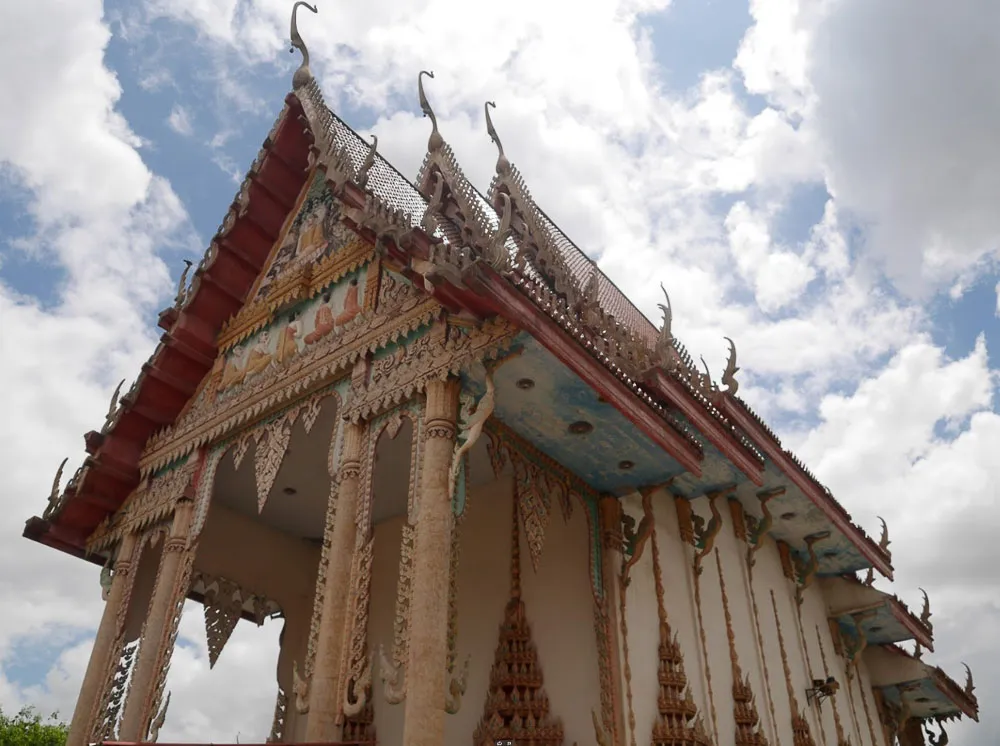
The ordination hall is one of the key areas of the temple. It may not be as large or visually dramatic as some modern temple buildings, but its importance lies in its religious function and historical atmosphere. This is where the sacred Buddha image is enshrined and where major Buddhist rites take place. The exterior and surrounding area reflect the character of an old community temple in southern Isan: modest, calm, and closely integrated with local life. Visitors who take time to walk slowly around the ordination hall will understand that the value of the temple lies not in spectacle, but in the depth of its faith and memory.
Wat Rong Man Thet feels different from major tourist temples because it sits inside the town rather than on a remote hill or large landscaped estate. The temple is closely connected to the market, roads, shops, and houses around it. This setting allows travelers to see how Buddhism is embedded in the daily rhythm of Thai community life. People do not come here only as tourists. They come to make merit, attend ceremonies, support funerals and local events, consult monks, and maintain a relationship with the temple across different stages of life.
The present abbot of Wat Rong Man Thet is Phra Khru Kalyanasutakhom, also known as Phra Manop Kalyano. He is recognized as a developing monk with a strong role in supporting local society. Beyond temple administration, he and the temple team have helped other temples and communities by assisting with tents, sound systems, and religious events. This gives Wat Rong Man Thet a very practical form of community importance. The temple continues to function not only as a sacred place, but also as a center of cooperation and social support.
For travelers interested in history, Wat Rong Man Thet should be seen as a small but meaningful doorway into the story of Nang Rong. The temple connects the local memory of Khun Luang Pha Ngua, the establishment of Nang Rong town, the expansion of Thai authority into southern Isan, and the long-term role of Buddhist temples in shaping community identity. While Buriram is often known internationally for Phanom Rung Historical Park and ancient Khmer stone sanctuaries, Wat Rong Man Thet represents another layer of history: the Buddhist community life that developed after those ancient periods and continues into the present.
Visiting Wat Rong Man Thet also helps travelers understand Nang Rong as more than a transit town. Many visitors stay in Nang Rong because it is a convenient base for Phanom Rung Historical Park, Prasat Muang Tam, and other attractions in southern Buriram. However, the town itself has cultural sites worth exploring. Wat Rong Man Thet, Wat Khun Kong, and Wat Klang Nang Rong can be visited together to create a short walking or driving route through the older religious landscape of the town. Each temple shows a different aspect of local faith, architecture, and community life.
The best way to experience Wat Rong Man Thet is to visit without rushing. Begin by paying respect to the principal Buddha image, then walk quietly around the ordination hall and temple grounds. Observe the relationship between the temple and the surrounding town. The sounds of the market, the movement of local residents, and the presence of monks and temple buildings together create a real sense of place. This is not a temple designed only for photography; it is a temple that reveals how faith continues inside an ordinary Thai town.
For Buddhist visitors, the temple is suitable for making merit, praying, and reflecting quietly. For cultural travelers, it offers insight into the way historical memory and religious practice are preserved through a community temple. For photographers, the site offers a more documentary and local style of imagery rather than grand scenic compositions. For families, it is an easy stop because the temple is close to the town center, restaurants, and local accommodation.
A typical visit may take 30 minutes to 1 hour if the goal is to pay respect and walk around the temple. Travelers who want to combine the visit with nearby temples, the market area, and local restaurants should allow more time. Since the temple is only about 1.5 km from the Nang Rong Bus Station, it is easy to reach by private car, motorcycle, local taxi, or hired vehicle. Visitors staying in central Nang Rong can include the temple in a short morning or late-afternoon itinerary before continuing to other attractions.
Getting There is straightforward. From Nang Rong Bus Station, the temple is about 1.5 km away. Travelers can use local roads within Nang Rong town to reach the temple on Sangkakritburana Road or nearby town roads. If driving from Buriram city, first follow the main route to Nang Rong District, then continue into the municipal area of Nang Rong. If coming back from Phanom Rung Historical Park or Prasat Muang Tam, the temple can be included as a short cultural stop before returning to a hotel in Nang Rong.
Visitors should dress modestly because Wat Rong Man Thet is an active Buddhist temple. Shoulders and knees should be covered when possible, and behavior should remain respectful near the ordination hall and Buddha images. If ceremonies or merit-making activities are taking place, visitors should give priority to local worshippers and avoid disturbing religious activities. Photography is generally suitable around the temple grounds, but visitors should avoid taking intrusive photos of people praying or monks performing duties.
The main areas to notice include the ordination hall, the sacred principal Buddha image, the sermon hall, the activity courtyard, the monks’ residence area, and the surrounding community setting. Each area reflects a different function of a Thai temple. The ordination hall represents ritual authority, the principal Buddha image represents faith, the sermon hall supports communal learning and ceremonies, and the courtyard serves as a place where religious and social life meet. Together, these areas make Wat Rong Man Thet a living temple rather than a static monument.
Wat Rong Man Thet is most rewarding for travelers who appreciate subtle historical places. It does not compete with the dramatic scale of Phanom Rung or the striking sandstone architecture of some modern temples in Buriram. Its charm is quieter. It lies in the continuity of faith, the memory of Nang Rong’s origins, the sacred Buddha image, and the temple’s ongoing role in community life. For travelers who want to understand local Buriram beyond headline attractions, this temple is worth including in a cultural itinerary.
In summary, Wat Rong Man Thet is an old and meaningful temple in Nang Rong District, Buriram Province. It is remembered as a temple connected with the early history of Nang Rong and the reign of King Borommaracha I of Ayutthaya. It was formerly known as Wat Aram Samakkhi and remains a center of Buddhist faith today. Its key highlights are the sacred principal Buddha image, the ordination hall, the old community-temple atmosphere, the central location in Nang Rong, and its strong connection with local identity. The temple is suitable for merit-making, cultural travel, quiet photography, and anyone who wants to understand Nang Rong more deeply before or after visiting the famous historical sites of southern Buriram.
| Name | Wat Rong Man Thet |
| Location | Nang Rong Subdistrict, Nang Rong District, Buriram Province, Thailand |
| Address | No. 30, Moo 3, Sangkakritburana Road, Nang Rong Subdistrict, Nang Rong District, Buriram 31110, Thailand |
| Highlights | Sacred principal Buddha image of Nang Rong, ordination hall, old community-temple atmosphere, and historical connection with the early formation of Nang Rong town |
| History | Local history connects the temple with the year 1352 CE during the period of Khun Luang Pha Ngua. The temple was formerly called Wat Aram Samakkhi, was formally established on March 11, 1935, and received its consecrated boundary on February 11, 1974 |
| Name Origin | The temple was originally known as Wat Aram Samakkhi and later became widely known by the local name Wat Rong Man Thet |
| Distinctive Features | An old Buddhist community temple near Nang Rong town market, with an active religious role and a strong connection to local identity |
| Travel Information | About 1.5 km from Nang Rong Bus Station. Accessible by private car, motorcycle, local taxi, or hired vehicle within Nang Rong town |
| Current Status | Open as an active Buddhist temple for worship, merit-making, and cultural visits |
| Open Days | Daily |
| Opening Hours | 08.00 – 17.00 |
| Facilities | Worship area, ordination hall, sermon hall, religious activity area, parking area, and visitor toilets |
| Main Areas / Zones | 1. Ordination Hall 2. Sacred Principal Buddha Image Of Nang Rong 3. Sermon Hall 4. Merit-Making And Activity Courtyard 5. Monks’ Residence Area 6. Surrounding Community Area Of Nang Rong Town |
| Abbot / Caretaker | Phra Khru Kalyanasutakhom (Phra Manop Kalyano), Abbot of Wat Rong Man Thet |
| Main Contact Number | 086-2525020 |
| Official Website / Official Page | Wat Rong Man Thet - Tawan Tok Nang Rong Facebook Page and Wat Rong Man Thet information page by the Nang Rong Sangha |
| Nearby Tourist Attractions | 1. Wat Khun Kong, about 1 km 2. Wat Klang Nang Rong, about 1 km 3. Nang Rong Morning Market, about 1 km 4. Thetsaban Nang Rong Health Park, about 2 km 5. Nang Rong Walking Street, about 2 km 6. Wat Nong Bot, about 9 km 7. Wat Phu Man Fah, about 12 km 8. Phanom Rung Historical Park, about 30 km |
| Nearby Restaurants | 1. Jing Nam Kha Mu, about 1 km, Tel. 044-631473, 081-7904808 2. Kiniku Japanese Curry, Nang Rong Branch, about 2 km, Tel. 099-0055456 3. CHANN Terrace, about 2 km, Tel. 065-5619353 4. Laksana Kha Mu Branch 2, about 2 km 5. Chon Ngoen Kai Yang Branch 2, about 3 km 6. SOFIT Cafe' Nang Rong, about 3 km |
| Nearby Accommodations | 1. Laksana Boutique Hotel, about 1 km 2. The Room Apartment / The Room Nangrong, about 1 km, Tel. 086-2616100 3. Socool Grand Hotel, about 2 km, Tel. 044-632333, 080-4881888 4. Bumnsaya Place, about 3 km, Tel. 085-4956929 5. Phanom Rung Puri Boutique Hotel & Resort, about 3 km, Tel. 044-632222, 086-3366618 6. Akelada Hotel, about 4 km, Tel. 084-8259214, 044-622199 |
Frequently Asked Questions (FAQ)
Q: Where is Wat Rong Man Thet located?
A: Wat Rong Man Thet is located at No. 30, Moo 3, Sangkakritburana Road, Nang Rong Subdistrict, Nang Rong District, Buriram Province, close to the old town and market area of Nang Rong.
Q: Why is Wat Rong Man Thet important?
A: The temple is remembered as an old temple of Nang Rong, formerly known as Wat Aram Samakkhi, and is connected with the local history of the town’s early formation.
Q: What is the main sacred object at Wat Rong Man Thet?
A: The main sacred object is the revered principal Buddha image of Nang Rong, also associated with Luang Pho Khao Phra Chao Yai Phra That Mongkhon.
Q: Who is the abbot of Wat Rong Man Thet?
A: The abbot is Phra Khru Kalyanasutakhom, also known as Phra Manop Kalyano.
Q: What are the opening hours of Wat Rong Man Thet?
A: The temple is open daily from 08.00 to 17.00. Morning and late afternoon are comfortable times for worship and a quiet visit.
Q: How far is Wat Rong Man Thet from Nang Rong Bus Station?
A: The temple is about 1.5 km from Nang Rong Bus Station and can be reached by private car, motorcycle, local taxi, or hired vehicle.
Q: How long should visitors spend at Wat Rong Man Thet?
A: A normal visit takes about 30 minutes to 1 hour. Travelers who want to explore nearby temples and the old town area should allow more time.
Q: What nearby places can be visited with Wat Rong Man Thet?
A: Nearby places include Wat Khun Kong, Wat Klang Nang Rong, Nang Rong Morning Market, Nang Rong Walking Street, Wat Phu Man Fah, and Phanom Rung Historical Park.
 Category: ●Places of Worship
 Group: ●Temple
Last Update : 1 MonthAgo
 Last Update : 1 MonthAgo
 Click to Access the Navigation Map GPS
Wat Rong Man Thet Map
Recommend

 Art, Culture and Heritage
 Historical Sites and Monuments(14)
 Landmarks and Memorials(2)
 Art, Craft Centres, Tradition(6)
 Museums(3)
 Educational Places
 Museum for Study(1)
Temple(74)
Museum for Study(1)
Temple(74)
 Other Sacred Sites(5)
 Suburban Living
 Village, Community(3)
 Nature and Wildlife
 National Parks and Marine Reserves(2)
 Mountain (Doi)(1)
 Dam, Reservoir, Lake(14)
 River, Canal(1)
 Bays and Beaches(1)
 Other natural attractions(2)
 Entertainment and Agricultural
 Animal camps and shows(1)
 Stadium(2)
 Farms, Parks and Ecotourism(2)
 Waterpark(1)


