
lovethailand home >Northeastern Travel Attractions >Buri Ram Travel Attractions >Satuek >Chum Saeng > Ban Non Champa Rubber Dam
TL;DR: Ban Non Champa Rubber Dam is located at Ban Non Champa, Moo 8, Chum Saeng Subdistrict, Satuek District, Buri Ram Province, open Daily, hours 08.00 – 17.00.

Ban Non Champa Rubber Dam
Open Days: Daily
Opening Hours: 08.00 – 17.00
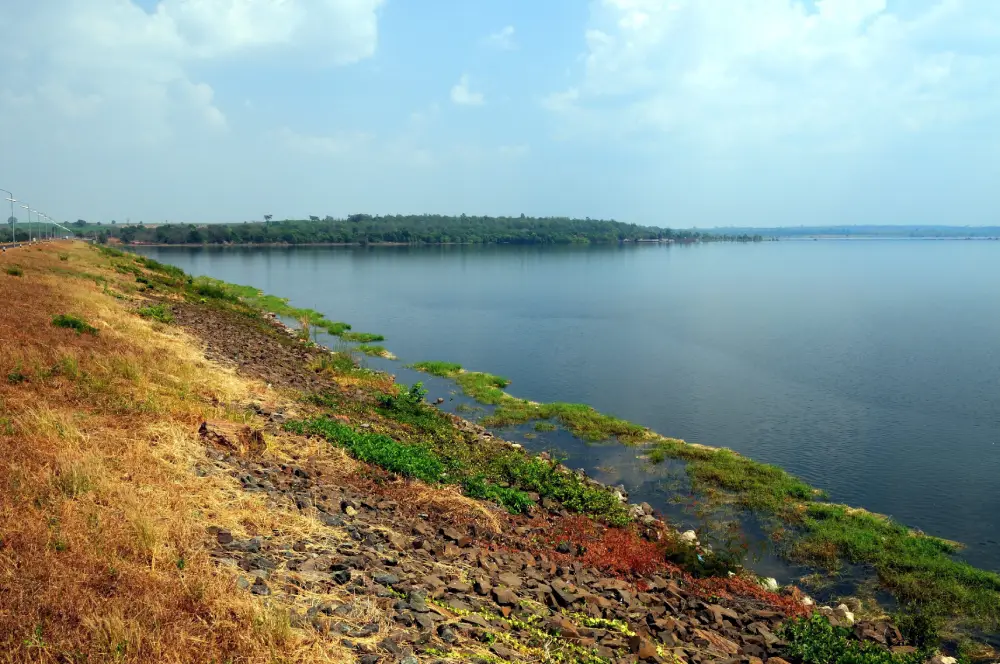
Ban Non Champa Rubber Dam in Buri Ram Province is a small community rubber dam located around Ban Non Champa, Moo 8, Chum Saeng Subdistrict, Satuek District. The dam is associated with Lam Nam Chi, a local waterway in southern Isan. It was built to store and control water, helping prevent overflow into houses and agricultural areas. It also supports local livelihoods by creating a natural food source for the community, including freshwater fish, aquatic life, and plants along the waterway. Although it is a small structure, it has significant value for the surrounding village and farming landscape.
The main importance of Ban Non Champa Rubber Dam is not its size, but its role in local water management. It helps the community control water levels during the rainy season and retain water for use when conditions become drier. In rural areas, such small water-management structures are essential because they directly support homes, farms, roads, and food resources. The dam therefore represents a practical relationship between people, water, agriculture, and nature in Satuek District.
Ban Non Champa is a rural community in Chum Saeng Subdistrict, Satuek District, Buri Ram Province. Visiting the rubber dam gives travelers a chance to see a quiet local landscape rather than a commercial tourist attraction. The area reflects everyday rural life: waterways, farming land, village roads, local temples, and natural resources used by the community. For travelers who want to understand Buri Ram beyond major landmarks, this small dam provides a grounded and authentic local perspective.
Lam Nam Chi plays an important role in the landscape of this area. Like many waterways in northeastern Thailand, it affects farming, settlement patterns, seasonal movement, and local food sources. The rubber dam at Ban Non Champa helps regulate water from this waterway so that it does not overflow too severely into residential and agricultural areas. When water is retained at a suitable level, it also supports fish, small aquatic animals, and wetland-edge plants that local people can use as natural food resources.
As a travel destination, Ban Non Champa Rubber Dam is best understood as a community-based nature stop. Visitors can view the waterway, observe the rubber dam structure, take photos of the rural scenery, and learn how a small water-control system supports village life. The site is suitable for slow travel, local storytelling, photography, and short visits during a route through Satuek District. It is not a place with large tourism facilities, but its simplicity is part of its character.
A rubber dam is a flexible water-control structure used to raise or lower water levels in a waterway. It is useful in smaller river systems and local areas where water must be managed according to seasonal conditions. During periods of high water, the structure can help control flow and reduce impact on nearby communities. During drier periods, it can help retain water for local use. This flexibility makes rubber dams suitable for rural agricultural communities.
Flood prevention is one of the most important functions of Ban Non Champa Rubber Dam. Communities near waterways can face problems when heavy rain or upstream water causes rapid flow. Without proper local control, water may affect houses, roads, fields, and public areas. The rubber dam helps reduce this risk by supporting water regulation at the village level. It is a small but meaningful part of local disaster prevention and agricultural stability.
The dam also helps maintain a natural food source for the community. When water remains in the area, the local ecosystem can support freshwater fish, small aquatic animals, shoreline plants, and other resources. This connection between water and food is an important part of rural Isan life. For visitors, the dam is not only a viewpoint. It is also a living example of how communities use natural resources carefully and continuously.
Travelers visiting Ban Non Champa Rubber Dam can see how one place can serve several roles at the same time. It is a water-control structure, a flood-prevention tool, a support system for agriculture, a natural food area, and a quiet local recreation point. This layered function makes it suitable for visitors interested in community life, local ecology, and water management in rural Thailand.
The atmosphere around the dam is most pleasant in the morning and late afternoon. Morning offers cooler air and softer light, while late afternoon is suitable for photography and quiet relaxation. During the rainy season and after the rains, the surrounding landscape becomes greener and the waterway appears more active. During the dry season, visitors can better observe the shape of the waterway and the role of the dam structure in the local environment.
For photographers, Ban Non Champa Rubber Dam offers rural visual elements such as the waterway, dam structure, farmland, village roads, trees, and community surroundings. The place is not dramatic in a commercial tourism sense, but it is strong in local storytelling. Photos taken here can communicate the relationship between people, water, agriculture, and the quiet landscape of northern Buri Ram.
Visitors should remember that this is a working community water area. It is not a large public park with full tourist services. Travelers should avoid climbing on the dam structure, entering unsafe water areas, littering, disturbing local residents, or interfering with community water use. Respectful behavior helps protect the area and keeps it useful for the people who rely on it.
Families with children should supervise them closely because areas around waterways can be slippery, uneven, or unsafe after rain. Children should not walk near the water edge alone and should not enter the water without adult supervision. Elderly visitors should choose accessible viewpoints and avoid muddy or sloped ground. Visiting during daylight is strongly recommended for safety and easier navigation.
Getting There is most convenient by private car. From Satuek District town, travel toward Chum Saeng Subdistrict and Ban Non Champa, Moo 8. The route can be followed through local roads connected with the Satuek–Ban Non Champa area. When approaching the village, visitors should use a navigation map together with local signs and may ask residents for the way to the Lam Nam Chi and the rubber dam area. Daytime travel is recommended, especially for first-time visitors.
Travelers without a private car can first reach Satuek town and then arrange local transport or a hired vehicle to Ban Non Champa. Return time should be agreed clearly in advance because village transport may not operate as frequently as urban transport. Foreign visitors and families may find a private car or hired driver more convenient, especially when combining the dam with nearby temples, restaurants, and accommodation in Satuek District.
Ban Non Champa Rubber Dam can be combined with other places in Satuek District. Visitors can stop at Wat That Champa Thong or Wat Ban Non Champa to see the local spiritual center of the village, then continue to the rubber dam and Lam Nam Chi area. A broader Satuek route can include the large Buddha statue, Wat Pracha Burana, the Mun River, local restaurants, and accommodation in Satuek town. This creates a route that combines water, community, religion, and rural life.
Wat That Champa Thong, also known locally as Wat Ban Non Champa, is important to the village as a spiritual and cultural gathering place. Visiting the temple together with the rubber dam gives travelers a better understanding of the community. The village is not only a place of water and farming, but also a place of faith, local festivals, and social memory. This makes the travel experience more complete.
Satuek District also has several attractions connected with water and local culture, such as the large Buddha statue by the Mun River, Wat Pracha Burana, the Mun River scenery, and the annual long-boat racing tradition. These attractions help show how important waterways are to Satuek. By linking Ban Non Champa Rubber Dam with Satuek town, travelers can understand water at both village and district levels.
For food, visitors should mainly plan to eat in Satuek town, where restaurants, cafes, noodle shops, and local food places are easier to find. The Ban Non Champa area is more rural and may not have dense tourism services. Calling restaurants ahead is useful, especially for groups or weekend travel. Eating in Satuek before or after visiting the dam is the most practical option.
Accommodation is also more convenient in Satuek town or nearby areas such as Nikhom Subdistrict. Satuek has hotels and resorts suitable for visitors who want access to restaurants, main roads, and Buri Ram Airport routes. Staying in Satuek makes it easier to visit Ban Non Champa Rubber Dam as a half-day local trip while still having access to town services.
For international travelers, Ban Non Champa Rubber Dam offers a very local side of Buri Ram. It is not a major landmark, but it shows how rural communities manage water, protect farmland, prevent flooding, and use natural food sources. It gives foreign visitors a clearer picture of everyday rural Thailand beyond historical parks, stadiums, and city attractions.
The beauty of Ban Non Champa Rubber Dam is quiet and contextual. The waterway, farmland, village setting, and rubber dam structure together create a meaningful local landscape. Visitors who understand the purpose of the dam will appreciate it more deeply. It is a small place, but it tells a large story about water, farming, community resilience, and the relationship between people and nature.
For travel writers and photographers, this location can be used to tell a story about small-scale water management in southern Isan. The themes include flood prevention, agricultural support, natural food resources, rural ecology, and village identity. Any photography or content creation should be done respectfully, without disturbing residents or entering private land without permission.
A practical half-day itinerary can begin in Satuek town with breakfast or coffee, continue to Ban Non Champa to visit the local temple and rubber dam, then return to Satuek town to visit the large Buddha statue, Wat Pracha Burana, or the Mun River area. This route gives travelers a balanced view of nature, community, religion, and district-level riverside life.
In summary, Ban Non Champa Rubber Dam is a small but important community water site in Chum Saeng Subdistrict, Satuek District, Buri Ram Province. It helps store water, reduce flooding, support agriculture, and maintain a natural food source for the village. It is suitable for travelers who want to observe rural water management, enjoy a simple nature stop, and understand Buri Ram at the community level.
| Name | Ban Non Champa Rubber Dam |
| Location | Ban Non Champa, Moo 8, Chum Saeng Subdistrict, Satuek District, Buri Ram Province |
| Address | Lam Nam Chi Area, Ban Non Champa, Moo 8, Chum Saeng Subdistrict, Satuek District, Buri Ram 31150, Thailand |
| Highlights | Small community rubber dam storing water from Lam Nam Chi, helping reduce flood impact on houses and farmland, and serving as a natural food source for the community |
| History | A local rubber dam built for community-level water management in Ban Non Champa, supporting flood control, water storage, agriculture, and local livelihood needs |
| Name Origin | Named after its rubber-dam structure and its location in Ban Non Champa, Chum Saeng Subdistrict, Satuek District, Buri Ram Province |
| Distinctive Features | Small rubber water-control structure on Lam Nam Chi, with rural riverside scenery, farmland, local ecology, and a community water-use landscape |
| Local Importance | Helps regulate water, reduce flooding, protect farmland, retain water for local use, and support natural food resources for Ban Non Champa community |
| Travel Information | From Satuek town, travel toward Chum Saeng Subdistrict and Ban Non Champa, Moo 8. Use the Satuek–Ban Non Champa local route and continue toward the Lam Nam Chi area |
| Current Status | Active community water area and natural riverside site open for simple local visits during suitable hours |
| Open Days | Daily |
| Opening Hours | 08.00 – 17.00 |
| Fees | No admission fee |
| Facilities | Village road access, riverside viewing area, natural resting area, nearby community temple, and restaurants / accommodation in Satuek town |
| Main Areas / Zones | Rubber dam structure, Lam Nam Chi waterway, riverside area, water-and-farmland viewpoint, natural food-resource area, and Ban Non Champa community zone |
| Caretaker | Chum Saeng Subdistrict Administrative Organization, Satuek District, Buri Ram Province, as the local authority responsible for the Chum Saeng Subdistrict area |
| Main Contact Number | Chum Saeng Subdistrict Administrative Organization Tel. 0-4466-6366-7 / 0-4460-5096 |
| Official Website / Official Page | www.chumsang.go.th / Chum Saeng Subdistrict Administrative Organization, Satuek District, Buri Ram Province |
| Nearby Tourist Attractions | 1. Wat That Champa Thong / Wat Ban Non Champa, about 1 km 2. Lam Nam Chi and Ban Non Champa Riverside Area, about 1 km 3. Wat Ban Chum Saeng, Chum Saeng Subdistrict, about 18 km 4. Large Buddha Statue, Satuek, about 26 km 5. Wat Pracha Burana, Satuek District, about 27 km 6. Mun River and Riverside Area, Satuek District, about 27 km 7. Ban Suan Rim Mun, Satuek District, about 30 km |
| Nearby Restaurants | 1. Local Restaurants Around Ban Non Champa / Nearby Communities, about 1–5 km 2. Sum Ran Cafe’ & Bistro, Satuek District, about 26 km, Tel. 081-623-2523 3. Kuai Tiao Ruea Mo Din Kin Sen Branch 228 Satuek, about 26 km, Tel. 088-583-3221 4. Dao’s Castle Satuek, about 27 km 5. Pizza By Nicole Restaurant, about 27 km 6. Local Restaurants Around Satuek Market, about 26 km |
| Nearby Accommodations | 1. Sahapattana Grand Hotel, about 25 km, Tel. 044-681-777, 044-681-555 2. Sida Resort, about 26 km, Tel. 089-722-9089 3. Mun River Resort, about 27 km, Tel. 089-578-1415 4. Pho Ngoen, about 27 km, Tel. 044-681-227 5. Ruean Mai Hom Resort, about 27 km, Tel. 081-660-6269 6. Tawan Resort, about 28 km, Tel. 044-681-258 7. Suksawat Resort, about 28 km, Tel. 091-329-7278 |
Frequently Asked Questions (FAQ)
Q: Where is Ban Non Champa Rubber Dam located?
A: Ban Non Champa Rubber Dam is located around Ban Non Champa, Moo 8, Chum Saeng Subdistrict, Satuek District, Buri Ram Province, in the Lam Nam Chi community water area.
Q: What is the main highlight of Ban Non Champa Rubber Dam?
A: Its main highlight is its role as a small rubber dam that stores water from Lam Nam Chi, helps reduce flooding, protects farmland, and supports natural food resources for the local community.
Q: What kind of travel experience is this place suitable for?
A: It is suitable for community-based nature travel, rural photography, riverside observation, and learning about small-scale local water management in Buri Ram.
Q: Is there an admission fee?
A: No. Visitors can access the natural community area during suitable visiting hours without an admission fee.
Q: When is the best time to visit Ban Non Champa Rubber Dam?
A: Morning and late afternoon are the best times because the weather is more comfortable and the light is suitable for riverside and rural landscape photography.
Q: How can travelers get to Ban Non Champa Rubber Dam?
A: From Satuek town, travel toward Chum Saeng Subdistrict and Ban Non Champa, Moo 8, using the Satuek–Ban Non Champa local route and continuing toward the Lam Nam Chi area.
Q: What nearby places can be combined with this visit?
A: Nearby places include Wat That Champa Thong, Wat Ban Chum Saeng, the Large Buddha Statue in Satuek, Wat Pracha Burana, the Mun River area, and Ban Suan Rim Mun.
Q: Is Ban Non Champa Rubber Dam suitable for foreign travelers?
A: Yes. It is suitable for foreign travelers who want to see rural Buri Ram, local water management, community food resources, and everyday life along a small waterway in southern Isan.
 Category: ●Nature and Wildlife
 Group: ●Dam, Reservoir, Lake
Last Update : 3 MonthAgo
 Last Update : 3 MonthAgo
 Click to Access the Navigation Map GPS
Ban Non Champa Rubber Dam Map
Recommend

 Art, Culture and Heritage
 Historical Sites and Monuments(14)
 Landmarks and Memorials(2)
 Art, Craft Centres, Tradition(6)
 Museums(3)
 Educational Places
 Museum for Study(1)
 Places of Worship
 Temple(74)
 Other Sacred Sites(5)
 Suburban Living
 Village, Community(3)
 National Parks and Marine Reserves(2)
 Mountain (Doi)(1)
Dam, Reservoir, Lake(14)
Mountain (Doi)(1)
Dam, Reservoir, Lake(14)
 River, Canal(1)
 Bays and Beaches(1)
 Other natural attractions(2)
 Entertainment and Agricultural
 Animal camps and shows(1)
 Stadium(2)
 Farms, Parks and Ecotourism(2)
 Waterpark(1)


