
lovethailand home >Northeastern Travel Attractions >Buri Ram Travel Attractions >Lam Plai Mat >Tha Men Chai > Phra Chedi Si Tha Men Chai
TL;DR: Phra Chedi Si Tha Men Chai is located at Inside Wat Nong Ya Plong, also known as Wat Pa Thamenchai, Lam Plai Mat District, Buri Ram Province, open Daily, hours 08.00 – 17.00.

Phra Chedi Si Tha Men Chai
Open Days: Daily
Opening Hours: 08.00 – 17.00
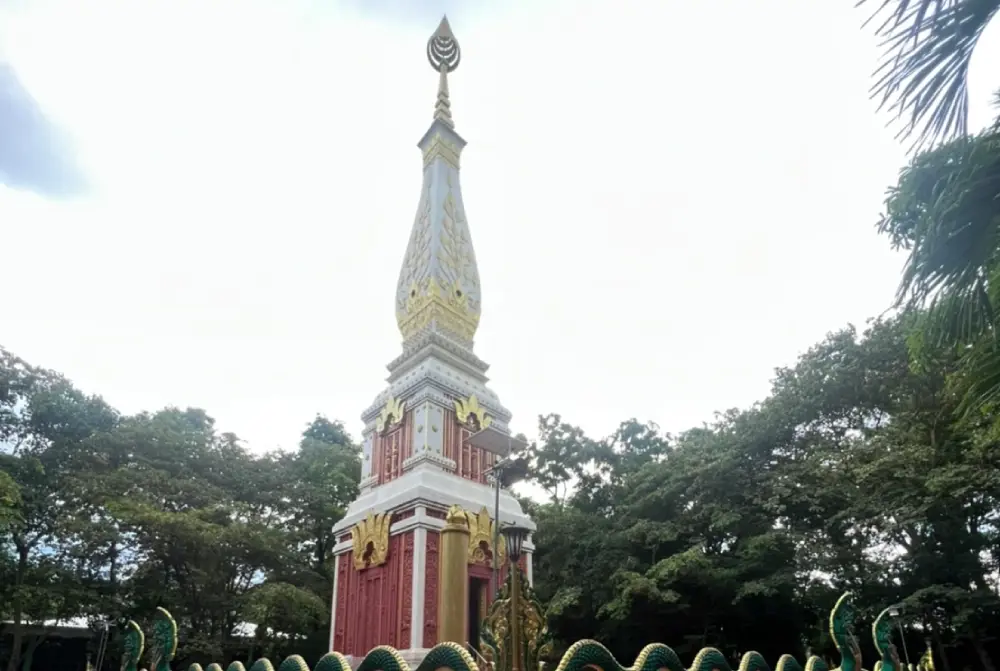
Phra Maha Chedi Si Thamenchai is a beautiful replica of Phra That Phanom located inside Wat Nong Ya Plong, also known as Wat Pa Thamenchai, in Lam Plai Mat District, Buri Ram Province. The chedi is a respected Buddhist landmark for local communities, built in the style of northeastern Thai sacred architecture. Its square base measures 5 by 5 meters, the main structure rises 29 meters, and the total height including the top finial reaches 31 meters. The site is known for its peaceful forest-temple atmosphere, sacred relics, Luang Pho Phet Buddha image, Naga-surrounded base, and well-maintained environment suitable for worship, meditation, and cultural travel.
Phra Maha Chedi Si Thamenchai, also known as Phra That Chedi Thamenchai, is one of the most meaningful Buddhist landmarks in Lam Plai Mat District, Buri Ram Province. It is located inside Wat Nong Ya Plong, or Wat Pa Thamenchai, a quiet forest temple associated with Buddhist practice, local faith, and community devotion. The temple is not a crowded tourist site, but a calm spiritual destination where visitors can pay respect to the chedi, walk peacefully around the grounds, practice mindfulness, and experience the local Buddhist culture of northeastern Thailand.
The temple is closely connected with the forest-temple tradition. Before it developed into a proper temple, the area was known as a quiet and secluded site. A novice monk from the Wat Nong Pa Phong lineage came to practice there, and local devotees were impressed by the discipline and way of practice. Over time, villagers invited monks to remain in the area, and the site gradually became a place of worship, meditation, and community merit-making. This background gives Wat Nong Ya Plong a special atmosphere: it feels less like a monumental tourist attraction and more like a living place of practice.
The main highlight of the temple is Phra Maha Chedi Si Thamenchai. The chedi was designed as a reduced-scale replica of Phra That Phanom, one of the most revered sacred stupas in the cultural world of Isan and the Mekong region. Choosing the form of Phra That Phanom was not only an architectural decision; it was also an act of cultural preservation. For people in northeastern Thailand, the shape of Phra That Phanom is immediately recognizable as a symbol of Buddhist faith, sacred relics, and regional identity. By creating a chedi in this form at Lam Plai Mat, the community established a local center of faith that connects directly with the broader spiritual landscape of Isan.
The construction of the chedi began in June 1989. Before the foundation ceremony, monks and lay devotees chanted, performed morning and evening prayers, and prepared the ground for 9 days and 9 nights. The foundation stone was laid on the full moon day of the 6th lunar month, which coincided with Visakha Bucha Day, one of the most important Buddhist holy days. This beginning gave the chedi a strong religious meaning from the start, linking the structure with the remembrance of the Buddha’s birth, enlightenment, and passing into final nirvana.
The chedi has a square base measuring 5 meters by 5 meters. The main body rises to 29 meters, and the total height including the top finial reaches 31 meters. Its vertical form is elegant, balanced, and clearly inspired by Phra That Phanom. The structure seems to lift the viewer’s attention upward, symbolizing the movement of the mind toward peace, devotion, and the Dharma. The proportions are not overwhelming, but they are strong enough to create a deep sense of reverence.
The chedi was completed on 3 May 1990, which corresponded to the full moon day of the 6th lunar month. Sacred relics were then enshrined at the top of the chedi, strengthening its role as a Buddhist object of worship. Within the temple area, visitors can also pay respect to Luang Pho Phet, a Buddha image with a lap width of 50 inches. Together, the chedi and the Buddha image form the spiritual heart of Wat Nong Ya Plong.
A striking feature of Phra Maha Chedi Si Thamenchai is the Naga enclosure surrounding the base. In Isan and Mekong Buddhist culture, the Naga is a powerful symbol connected with protection, water, fertility, and guardianship of sacred places. The Naga wall around the chedi helps define the sacred boundary and gives the whole structure a strong symbolic presence. Visitors can walk quietly around the chedi, observe its details, and use the surrounding area for prayer, circumambulation, or silent reflection.
The atmosphere of Wat Nong Ya Plong is one of its greatest strengths. The temple grounds are clean, shaded, and arranged in a way that supports worship and meditation. Unlike large city temples or busy tourist sites, this place invites visitors to slow down. The soundscape is quieter, the surroundings are greener, and the chedi stands within an environment that feels suitable for inner calm. For travelers who want to understand rural Buddhist practice in Thailand, the experience can be more meaningful than simply visiting a famous landmark.
Phra Maha Chedi Si Thamenchai is also part of the wider cultural landscape of Thamenchai and Lam Plai Mat. The area contains several important local heritage places, including Ban Kao Thamenchai Ancient Community, Chao Pho Hin Tang Shrine, the local museum at Wat Isan Thamenchai, and a 100-year-old sapodilla tree. Together, these places reveal that Thamenchai is not only a quiet rural area, but also a community with historical depth, local beliefs, and living cultural memory.
Ban Kao Thamenchai Ancient Community is especially important for travelers interested in history. The ancient settlement has a circular form with three surrounding moats. Archaeological evidence includes sandstone boundary stones, stone grinding fragments, and plain earthenware pottery shards. Visiting Phra Maha Chedi Si Thamenchai together with this ancient community allows travelers to see how faith, settlement history, and local identity continue to overlap in the same district.
Chao Pho Hin Tang Shrine is another nearby sacred place respected by the people of Thamenchai. The shrine is associated with an upright stone believed to be sacred by local residents. This kind of local guardian belief coexists naturally with Buddhist devotion in many communities of northeastern Thailand. When viewed together with the chedi, the shrine shows how local spirituality in Isan often combines Buddhist practice with older community-based sacred traditions.
For meditation-oriented visitors, Wat Nong Ya Plong is especially suitable. The forest-temple environment encourages quietness, mindfulness, and simplicity. Visitors can sit near the chedi, walk slowly around the grounds, pay respect to Luang Pho Phet, and spend time observing the body and breath. The temple is not designed for entertainment; it is a place for calming the mind. This makes it a valuable destination for people who want spiritual travel rather than only sightseeing.
From an artistic and cultural perspective, the chedi demonstrates how sacred architectural forms are transferred and reinterpreted within local communities. Phra That Phanom is a major spiritual model in Isan, and the replica form at Thamenchai brings that visual and devotional language into Lam Plai Mat District. Visitors familiar with Phra That Phanom will immediately recognize the inspiration. Those seeing this style for the first time can still appreciate the tall, elegant, and upward-reaching form that symbolizes Buddhist aspiration.
The beauty of the chedi lies in its balance between grandeur and intimacy. It is tall enough to stand out above the temple grounds, yet not so large that it feels distant from worshippers. The square base, Naga enclosure, four-directional gateways, and vertical tower create a sacred space that is easy to understand visually. The surrounding greenery softens the structure and makes the site feel peaceful rather than severe.
A visit should begin slowly. Travelers can first enter the temple respectfully, pay homage to the Buddha images, and then proceed to Phra Maha Chedi Si Thamenchai. Walking around the chedi allows visitors to observe the architectural form, Naga elements, gateways, and atmosphere of the temple grounds. Those who wish to meditate should choose a quiet time, especially in the morning or on weekdays, when the temple is less crowded.
Getting There is easiest by private car. The temple is about 12 km from Lam Plai Mat town. Travelers can drive from central Lam Plai Mat toward the Nong Bua Khok and Thamenchai area, then use navigation to Wat Nong Ya Plong or Wat Pa Thamenchai. The route is generally suitable for a local day trip, but daytime travel is recommended because village roads and local junctions are easier to follow.
Travelers coming from Buri Ram city can drive to Lam Plai Mat District and continue to the temple. The trip can be planned as a cultural route including Ban Kao Thamenchai Ancient Community, Chao Pho Hin Tang Shrine, the local museum at Wat Isan Thamenchai, and Lam Plai Mat town. This route is suitable for visitors who want a quieter side of Buri Ram, focusing on temples, community history, local shrines, and rural cultural landscapes.
Temple etiquette is important. Visitors should dress modestly, speak quietly, avoid climbing on the Naga enclosure or sacred structures, and refrain from touching the chedi unnecessarily. Photography should be respectful and should not disturb monks, practitioners, or other worshippers. Since the temple is associated with Buddhist practice, visitors should treat the grounds as a place of silence and mindfulness.
The best time to visit is in the morning, when the weather is cooler and the light gives the chedi a gentle, bright appearance. Afternoon visits are also possible, but visitors should bring water and sun protection. During the rainy season, it is wise to check road conditions and drive carefully on local roads. Those who want a quiet experience should avoid busy festival periods and choose weekdays whenever possible.
The area around Lam Plai Mat has local restaurants, cafés, and small accommodations. After paying respect at the chedi, visitors can stop in Lam Plai Mat town for food, coffee, or an overnight stay. Local accommodation such as Thanaphat Place and nearby resorts can be convenient for travelers who want to spend more time exploring the district. Advance contact is recommended during weekends or religious holidays.
In summary, Phra Maha Chedi Si Thamenchai at Wat Nong Ya Plong is a meaningful destination for travelers seeking Buddhist faith, Isan architecture, and peaceful temple surroundings. The chedi is a beautiful replica of Phra That Phanom, enshrining sacred relics and standing within a well-maintained forest temple environment. A visit here offers more than a photo opportunity; it offers a quiet encounter with local devotion, cultural preservation, and the living Buddhist landscape of Lam Plai Mat, Buri Ram Province.
| Name | Phra Maha Chedi Si Thamenchai / Phra That Chedi Thamenchai At Wat Nong Ya Plong |
| Location | Inside Wat Nong Ya Plong, also known as Wat Pa Thamenchai, Lam Plai Mat District, Buri Ram Province |
| Address | 86 Moo 5, Nong Bua Khok Subdistrict, Lam Plai Mat District, Buri Ram Province 31130, Thailand |
| Coordinates | 15.0398223, 102.9104818 |
| Highlights | A beautiful replica of Phra That Phanom, enshrining sacred relics and surrounded by Naga elements in a peaceful forest-temple environment |
| History | Construction began in June 1989. The foundation stone was laid on the full moon day of the 6th lunar month, coinciding with Visakha Bucha Day, and the chedi was completed on 3 May 1990. |
| Name Origin | The name Si Thamenchai is connected with the Thamenchai area and the community’s intention to build a sacred chedi inspired by Phra That Phanom to preserve Isan Buddhist culture. |
| Distinctive Features | Square base measuring 5 by 5 meters, 29 meters high, 31 meters including the finial, with a Naga enclosure and four-directional gateways |
| Important Sacred Objects | Sacred relics enshrined at the top of the chedi, Luang Pho Phet Buddha image with a lap width of 50 inches, and Naga elements around the chedi base |
| Main Areas / Zones | 1. Phra Maha Chedi Si Thamenchai Zone 2. Luang Pho Phet Worship Area 3. Circumambulation And Worship Courtyard Around The Chedi 4. Meditation And Quiet Forest Temple Area 5. Pavilion And Visitor Reception Area 6. Walking Paths, Shaded Areas, And Restful Temple Environment |
| Abbot / Caretaker | Phra Khru Kittithammathon |
| Important Activities | Chedi worship, merit-making, candlelight circumambulation on Buddhist holy days, meditation practice, and the annual community worship ceremony for the great chedi |
| Current Status | Active forest temple, meditation site, and faith-based cultural attraction in Lam Plai Mat District, Buri Ram Province |
| Open Days | Daily |
| Opening Hours | 08.00 – 17.00 |
| Fees | No Admission Fee |
| Facilities | Parking area, worship area, pavilions, meditation area, walking path around the chedi, rest areas, and toilets |
| Main Contact Number | 081-874-5863 |
| Travel Information | The temple is about 12 km from Lam Plai Mat town. Private car is recommended. Set the destination as Wat Nong Ya Plong or Wat Pa Thamenchai, Lam Plai Mat District, Buri Ram Province. |
| Nearby Tourist Attractions | 1. Ban Kao Thamenchai Ancient Community, about 2 km 2. Chao Pho Hin Tang Shrine, about 3 km 3. Wat Isan Thamenchai Local Museum, about 3 km 4. 100-Year-Old Sapodilla Tree, Ban Thamenchai, about 4 km 5. Khlong Plai Mat, about 12 km |
| Nearby Restaurants | 1. Klong-Na Cafe Buriram, about 12 km, Tel. 096-236-1986 2. Na Cafe Lam Plai Mat, about 13 km, Tel. 097-273-2223 3. Permpoon Kha Mu Lam Plai Mat, about 13 km, Tel. 044-660-202 4. The Palm Cafe Buriram, about 15 km, Tel. 080-192-9738 5. Lamoon Garden Buriram, about 18 km, Tel. 086-388-5715, 084-658-5718 |
| Nearby Accommodations | 1. Thanaphat Place Lam Plai Mat, about 13 km, Tel. 095-194-7955 2. Greenhouse Resort Lam Plai Mat, about 14 km, Tel. 044-661-909, 088-074-8238 3. Play La Ploen Boutique Resort, Khu Mueang District, about 38 km 4. Laksana Boutique Hotel, Nang Rong, about 55 km 5. Phanomrungpuri Hotel, Nang Rong, about 57 km |
Frequently Asked Questions (FAQ)
Q: Where is Phra Maha Chedi Si Thamenchai located?
A: It is located inside Wat Nong Ya Plong, also known as Wat Pa Thamenchai, in Lam Plai Mat District, Buri Ram Province.
Q: Why is Phra Maha Chedi Si Thamenchai important?
A: It is a replica of Phra That Phanom, built to preserve Isan Buddhist culture. It enshrines sacred relics and serves as a spiritual center for the Lam Plai Mat community.
Q: When was Phra Maha Chedi Si Thamenchai built?
A: Construction began in June 1989. The foundation stone was laid on the full moon day of the 6th lunar month, and the chedi was completed on 3 May 1990.
Q: What are the main highlights of the chedi?
A: The highlights include its Phra That Phanom-inspired form, square base, Naga enclosure, four-directional gateways, sacred relics, Luang Pho Phet Buddha image, and peaceful forest-temple setting.
Q: What are the opening hours of Wat Nong Ya Plong?
A: The temple is open daily from 08.00 to 17.00.
Q: Is there an admission fee?
A: No. There is no admission fee, but visitors may make merit or donate according to their faith.
Q: Who is the abbot of Wat Nong Ya Plong?
A: The abbot and caretaker is Phra Khru Kittithammathon.
Q: What nearby places can travelers visit after the chedi?
A: Nearby places include Ban Kao Thamenchai Ancient Community, Chao Pho Hin Tang Shrine, Wat Isan Thamenchai Local Museum, the 100-Year-Old Sapodilla Tree, and Khlong Plai Mat.
 Category: ●Places of Worship
 Group: ●Other Sacred Sites
Last Update : 3 MonthAgo
 Last Update : 3 MonthAgo
 Click to Access the Navigation Map GPS
Phra Chedi Si Tha Men Chai Map
Recommend

 Art, Culture and Heritage
 Historical Sites and Monuments(14)
 Landmarks and Memorials(2)
 Art, Craft Centres, Tradition(6)
 Museums(3)
 Educational Places
 Museum for Study(1)
 Temple(74)
Other Sacred Sites(5)
Temple(74)
Other Sacred Sites(5)
 Suburban Living
 Village, Community(3)
 Nature and Wildlife
 National Parks and Marine Reserves(2)
 Mountain (Doi)(1)
 Dam, Reservoir, Lake(14)
 River, Canal(1)
 Bays and Beaches(1)
 Other natural attractions(2)
 Entertainment and Agricultural
 Animal camps and shows(1)
 Stadium(2)
 Farms, Parks and Ecotourism(2)
 Waterpark(1)


