
lovethailand home >Northeastern Travel Attractions >Buri Ram Travel Attractions >Pa Kham >Pa Kham > Wat Pho Yoi
TL;DR: Wat Pho Yoi is located at Ban Pakham, Village No. 1, Pakham Subdistrict, Pakham District, Buriram Province, open Daily, hours Daytime visits are recommended.
Wat Pho Yoi
Open Days: Daily
Opening Hours: Daytime visits are recommended
Wat Pho Yoi, located in Ban Pakham, Village No. 1, Pakham Subdistrict, Pakham District, Buriram Province, is a community temple with outstanding historical and archaeological significance. Although the temple itself is not usually studied as an old architectural monument, it is highly important because it preserves a remarkable group of Khmer-period antiquities found in and around the area, including 5 lintels, 3 boundary stones, 5 stone pillars, a doorframe fragment, and a yoni base associated with a Shiva lingam. For travelers interested in Khmer art, local history, and hidden cultural sites in Buriram, Wat Pho Yoi is one of the most meaningful places in Pakham District.
The temple is more than a place of worship for the local community. It functions as a living repository of ancient objects that reflect the deep historical layers of the area. Within its grounds, visitors can see carved stone pieces that point to earlier religious structures, likely connected with the Khmer cultural sphere that once extended across the lower northeastern region of Thailand. These remains make Wat Pho Yoi especially valuable because they show how ancient sacred objects continue to exist within an active Buddhist temple and local village setting.
Wat Pho Yoi is situated near the main intersection of Pakham District, making it relatively easy to reach from Buriram city, Nang Rong District, and nearby areas. From Buriram city, travelers can take Highway 208 on the Buriram – Nang Rong route. After reaching Nang Rong District, turn left onto Highway 2118, the Nang Rong – Pakham route. At the Pakham District junction, turn left again, and the temple will be found near the intersection on the right-hand side. Its accessible location makes it suitable for a half-day or full-day cultural route together with Ban Khok Ngio Prasat, Nong Hong Sanctuary, Lam Nang Rong Dam, and other sites in the area.
The most important highlights of Wat Pho Yoi are its Khmer lintels. One lintel placed in front of the principal Buddha image, on the right side, is carved with an image of Indra riding the three-headed elephant Erawan. Indra is shown within an ornate arch, surrounded by floral motifs. This lintel is said to have been moved from Ban Khok Prasat, also known as Ban Khok Ngio Prasat, located approximately 3 kilometers to the north. The image of Indra on Erawan is a powerful motif in Khmer art and reflects the relationship between Hindu-Brahmanical belief and ancient religious monuments in the lower Isan region.
The lintel on the left side in front of the principal Buddha image depicts a narrative scene showing the offering of women to a powerful figure, possibly a king or a deity. Several seated figures appear within an architectural frame, surrounded by floral decoration. At both ends of the lintel, outward-facing dragons are shown disgorging floral scrolls. This combination of human figures, sacred setting, vegetation patterns, and mythical creatures reveals the skill of the ancient craftsmen and the symbolic language used in Khmer stone carving.
Behind the principal Buddha image is another important lintel on the right side. It depicts Shiva riding Nandi, the sacred bull, within an ornate arch above a kala face. The kala holds garland bands with both hands, while smaller figure motifs appear within lotus-based arches. This lintel is especially significant because the presence of Shiva riding the bull connects the site with Shaivite belief. When considered together with the yoni base preserved at the temple, it suggests that the surrounding area may once have been associated with Hindu ritual structures before later Buddhist use.
Another lintel kept on a monk’s residence shows Indra riding Erawan above a kala face, with the kala grasping garland bands. Standing lions appear beside Indra. The combination of Indra, Erawan, kala, garlands, and lions reflects a rich iconographic vocabulary connected with protection, divine power, and sacred space. These lintels should not be seen simply as decorative stones. They are historical documents carved in stone, preserving religious concepts and artistic forms from the Khmer period.
Based on their artistic characteristics, the lintels at Wat Pho Yoi can be dated approximately to the 16th Buddhist century, corresponding to the Khleang and Baphuon styles of Khmer art. Features such as the kala face, garland motifs, floral scrolls, divine figures, and architectural arches help place these works within a broader Khmer artistic tradition. For general visitors, understanding this approximate date helps turn the experience of seeing the lintels into a deeper encounter with the ancient cultural landscape of Buriram.
Other ancient objects at the temple are also highly important. These include stone pillars carved with yogi figures inside decorative arches, boundary stones placed around the ordination hall, boundary stones carved with Dharma wheel motifs, and a yoni base related to a Shiva lingam. The boundary stones are connected with Buddhist sacred space, while the yogi pillars and yoni base point to Hindu religious associations. The presence of these different objects in one temple suggests layers of religious transformation and cultural continuity in the Pakham area.
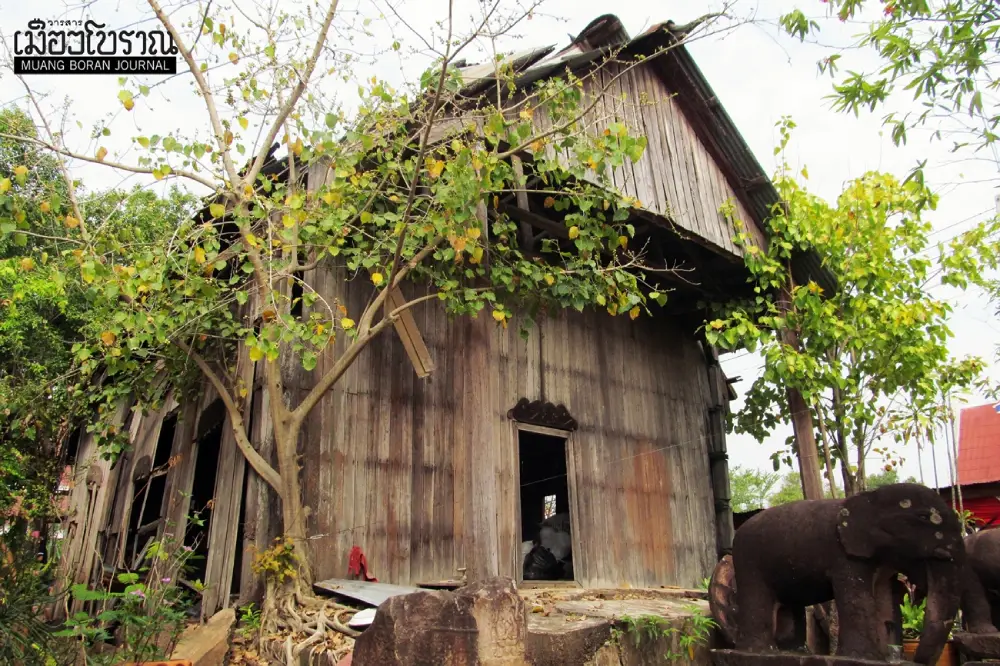
The location of Wat Pho Yoi has also been interpreted as a possible former arogyasala, or ancient hospital chapel, associated with the reign of King Jayavarman VII. Arogyasala sites were built as part of a Buddhist Mahayana network and are found in various areas of northeastern Thailand. At Wat Pho Yoi, the wooden ordination hall stands on an older laterite base, which may have belonged to an ancient monument or prasat structure. This makes the site particularly important because the present temple may be standing directly above or beside earlier Khmer-period remains.
Behind the ordination hall there are traces of an ancient rectangular pond. In the context of Khmer and Buddhist sacred sites, ponds were not merely practical water sources. They were often part of the layout of religious spaces and could be connected with ritual, cosmology, and settlement planning. When the pond is considered together with the laterite base, lintels, boundary stones, stone pillars, and yoni base, Wat Pho Yoi becomes a site that should be understood as a layered cultural landscape rather than a simple modern temple.
Another significant piece of evidence is the Dan Pakham inscription, which is associated with an arogyasala. Documents by French explorers mention that this inscription came from this temple, although the site was referred to as Wat Pakham. This connection gives Wat Pho Yoi additional historical importance. It indicates that the temple area was known to early scholars and explorers as a place linked with ancient inscriptions and Khmer-period religious infrastructure.
Wat Pho Yoi is therefore a valuable site for learning history in an authentic setting. Visitors encounter not only a modern Buddhist temple but also a cluster of archaeological evidence, including Khmer lintels, Buddhist boundary stones, a laterite base, an ancient pond, and material associated with Hindu and Buddhist beliefs. These elements reveal a long and complex history in which different religious traditions and communities occupied or reused the same sacred space over time.
From a travel perspective, Wat Pho Yoi is ideal for people interested in the historical routes of southern Isan. While Phanom Rung Historical Park and Muang Tam Sanctuary represent large and well-managed Khmer monuments, Wat Pho Yoi shows another side of cultural heritage: ancient objects preserved within a local temple and village environment. This gives visitors a closer view of how archaeological remains remain connected to living communities in present-day Buriram.
Visitors should take time to observe each lintel carefully. Begin with the Indra-on-Erawan lintel, then compare it with the narrative lintel and the Shiva-on-Nandi lintel. Look for the kala faces, garland bands, dragons, lions, floral scrolls, and architectural frames. These details help reveal the meaning and craftsmanship of Khmer art. Visitors should avoid touching, climbing on, or moving any ancient objects, because they are fragile cultural heritage pieces that belong not only to the temple but also to the wider historical memory of the community.
The old wooden ordination hall at Wat Pho Yoi adds another layer of interest. It stands on a raised laterite base, believed to be part of an older monument. This relationship between a later Buddhist structure and an earlier archaeological foundation shows how sacred spaces are reused and reinterpreted across time. Conservation work related to the old ordination hall also reflects ongoing efforts by relevant agencies to preserve the temple’s cultural heritage.
The temple remains an active Buddhist site with resident monks and community religious activities. At the same time, it serves as a place where ancient objects are preserved. Recent temple information lists the abbot as Phra Khru Pho Thammanukun. The presence of an active monastic community makes Wat Pho Yoi a living temple, while the preserved Khmer objects make it an archaeological and cultural learning site. This dual identity is one of the reasons the temple is so important.
Wat Pho Yoi can be used as a starting point for exploring Pakham District. Ban Khok Ngio Prasat, which is associated with one of the lintels preserved at the temple, is located approximately 3 kilometers away. Other nearby places include We Fought Monument, Nong Hong Sanctuary, Lam Nang Rong Dam, and Wat Khao Angkhan. A half-day route can include Wat Pho Yoi and Ban Khok Ngio Prasat, while a full-day route can continue toward Lam Nang Rong Dam or other heritage sites in nearby districts.
The atmosphere of Wat Pho Yoi is calm and suitable for slow cultural travel. It is best visited by travelers who want to learn, observe, and understand the historical context of the objects on site. Families and students can use the temple as an outdoor learning space for local history, Khmer art, and cultural preservation. Unlike a museum, the objects here remain within a living temple environment, which allows visitors to understand how heritage continues to exist within everyday community life.
Getting There is most convenient by private car or rental car. From Buriram city, take Highway 208 toward Nang Rong District. At Nang Rong, turn left onto Highway 2118, the Nang Rong – Pakham route. At the Pakham District junction, turn left, and Wat Pho Yoi will be located near the intersection on the right-hand side. Travelers coming from Nang Rong can use Highway 2118 directly. Those wishing to continue to Ban Khok Ngio Prasat can proceed approximately 3 kilometers north from the area.
Visitors should dress respectfully, keep noise low, and remember that Wat Pho Yoi is still an active Buddhist temple. Since the temple preserves many ancient objects, visitors should not touch or disturb them. If any part of the old ordination hall or ancient-object area is under repair or restricted, visitors should follow temple signs or instructions. Responsible travel is essential because even small damage to an ancient object can permanently affect historical evidence that cannot be replaced.
Wat Pho Yoi deserves greater recognition as one of the important cultural sites of Pakham District. Its importance lies not in grand scale, but in the density of historical evidence found within one community temple. The lintels, boundary stones, stone pillars, yoni base, laterite foundation, ancient pond, and connection with the Dan Pakham inscription make the temple a valuable site for understanding the ancient cultural landscape of Buriram.
For travelers who want to understand Buriram beyond famous monuments and major tourist attractions, Wat Pho Yoi offers a quieter and more detailed perspective. It is a temple where worship, archaeology, Khmer art, local memory, and community life meet. A visit here is both a spiritual experience and a cultural learning journey, making Wat Pho Yoi one of the most meaningful hidden heritage destinations in Pakham District.
| Name | Wat Pho Yoi |
| Location | Ban Pakham, Village No. 1, Pakham Subdistrict, Pakham District, Buriram Province |
| Address | Ban Pakham, Village No. 1, Pakham Subdistrict, Pakham District, Buriram Province 31220, Thailand |
| Place Type | Community Buddhist temple and preservation site for Khmer-period antiquities in Pakham District |
| Highlights | 5 Khmer lintels, 3 boundary stones, 5 stone pillars, a doorframe fragment, a yoni base, laterite foundation, old wooden ordination hall, and evidence possibly connected with an arogyasala |
| History / Period | The important lintels at the temple are dated approximately to the 16th Buddhist century, corresponding to the Khleang and Baphuon styles of Khmer art. |
| Name Origin | The temple name is connected with Ban Pakham, and older survey documents referred to this area as Wat Pakham. |
| Distinctive Features | A living community temple that preserves multiple Khmer-period objects and has an old wooden ordination hall standing on an older laterite base. |
| Key Evidence | Lintels of Indra riding Erawan, Shiva riding Nandi, a narrative offering scene, boundary stones with Dharma wheel motifs, yogi stone pillars, yoni base, ancient pond, and the Dan Pakham inscription associated with an arogyasala |
| Main Areas / Zones | Old wooden ordination hall Area in front of the principal Buddha image where lintels are kept Boundary stone and stone pillar preservation areas Laterite ancient base Ancient pond remains behind the ordination hall Monk residence area where another lintel is preserved |
| Facilities | Temple courtyard, religious activity area, and parking space within or near the temple depending on local conditions |
| Abbot / Caretaker | Phra Khru Pho Thammanukun |
| Travel Information | From Buriram city, take Highway 208 to Nang Rong District, then turn left onto Highway 2118 toward Pakham. At the Pakham District junction, turn left. The temple is located near the intersection on the right-hand side. |
| Current Status | Open as a community Buddhist temple and an important preservation site for ancient objects in Pakham District. Visitors should view the antiquities with care. |
| Open Days | Daily |
| Opening Hours | Daytime visits are recommended |
| Official Website / Official Page | Facebook Page: Wat Pho Yoi Pakham Buriram |
| Nearby Tourist Attractions | 1. Ban Khok Ngio Prasat, about 3 km 2. We Fought Monument, about 16 km 3. Nong Hong Sanctuary, about 16 km 4. Lam Nang Rong Dam, about 16 km 5. Wat Khao Angkhan, about 16 km |
| Nearby Restaurants | 1. Le Loft Bar & Restaurant, about 2 km, Tel. 097-1610594, 094-3109913 2. Wonder Cup Cafe, about 1 km 3. Kan Eng Restaurant, about 1 km 4. Nok Cafe, about 12 km, Tel. 064-4528297 5. Phaka Restaurant By Ratri Resort, about 8 km, Tel. 064-1588222 6. Khrua Lung Ter, about 8 km, Tel. 084-9323302 |
| Nearby Accommodations | 1. Aromdee Resort Buriram, about 1 km 2. Athome Pakham, about 1 km, Tel. 092-9635369, 093-3964664 3. Sawatdee Ratreesawat Resort, about 1 km, Tel. 089-5854858, 080-1641700, 098-5924490 4. Sabaidee Resort Pakham, about 3 km, Tel. 096-8692259 5. Pakham Garden Resort, about 4 km, Tel. 093-3804814, 090-9763889 |
Frequently Asked Questions (FAQ)
Q: Where is Wat Pho Yoi located?
A: Wat Pho Yoi is located in Ban Pakham, Village No. 1, Pakham Subdistrict, Pakham District, Buriram Province, near the main junction of Pakham District.
Q: Why is Wat Pho Yoi important?
A: The temple is important because it preserves several Khmer-period antiquities, including lintels, boundary stones, stone pillars, a yoni base, and evidence possibly connected with an ancient arogyasala.
Q: What images are carved on the lintels at Wat Pho Yoi?
A: The lintels include carvings of Indra riding Erawan, Shiva riding Nandi, a narrative offering scene, kala faces, garland motifs, dragons, lions, and floral patterns.
Q: How old are the ancient objects at Wat Pho Yoi?
A: The important lintels are dated approximately to the 16th Buddhist century, corresponding to the Khleang and Baphuon styles of Khmer art.
Q: Is Wat Pho Yoi connected with an arogyasala?
A: The laterite base, ancient pond, and the Dan Pakham inscription suggest that the area may have been connected with an arogyasala in the past.
Q: Who is the abbot of Wat Pho Yoi?
A: Recent temple information lists the abbot as Phra Khru Pho Thammanukun.
Q: How can travelers get to Wat Pho Yoi?
A: From Buriram city, take Highway 208 to Nang Rong District, then turn left onto Highway 2118 toward Pakham. At the Pakham District junction, turn left; the temple is near the intersection on the right-hand side.
Q: What nearby places can be visited with Wat Pho Yoi?
A: Nearby places include Ban Khok Ngio Prasat, We Fought Monument, Nong Hong Sanctuary, Lam Nang Rong Dam, and Wat Khao Angkhan.
 Category: ●Places of Worship
 Group: ●Temple
Last Update : 4 MonthAgo
 Last Update : 4 MonthAgo
 Click to Access the Navigation Map GPS
 Art, Culture and Heritage
 Historical Sites and Monuments(14)
 Landmarks and Memorials(2)
 Art, Craft Centres, Tradition(6)
 Museums(3)
 Educational Places
 Museum for Study(1)
Temple(74)
Museum for Study(1)
Temple(74)
 Other Sacred Sites(5)
 Research and Development
 Royal Project(1)
 Suburban Living
 Village, Community(3)
 Nature and Wildlife
 National Parks and Marine Reserves(2)
 Mountain (Doi)(1)
 Dam, Reservoir, Lake(14)
 River, Canal(1)
 Bays and Beaches(1)
 Other natural attractions(2)
 Entertainment and Agricultural
 Animal camps and shows(1)
 Stadium(2)
 Farms, Parks and Ecotourism(2)
 Waterpark(2)
 Travel Articles, Recipes
 Travel Review, Food Review(1)


