
lovethailand home >Northeastern Travel Attractions >Buri Ram Travel Attractions >Na Pho >Don Kok > Na Pho Silk Weaving Village
TL;DR: Na Pho Silk Weaving Village is located at Na Pho Subdistrict, Na Pho District, Buri Ram Province, open Daily, hours 09.00 – 16.00, with advance contact recommended for group visits.

Na Pho Silk Weaving Village
Open Days: Daily
Opening Hours: 09.00 – 16.00, with advance contact recommended for group visits
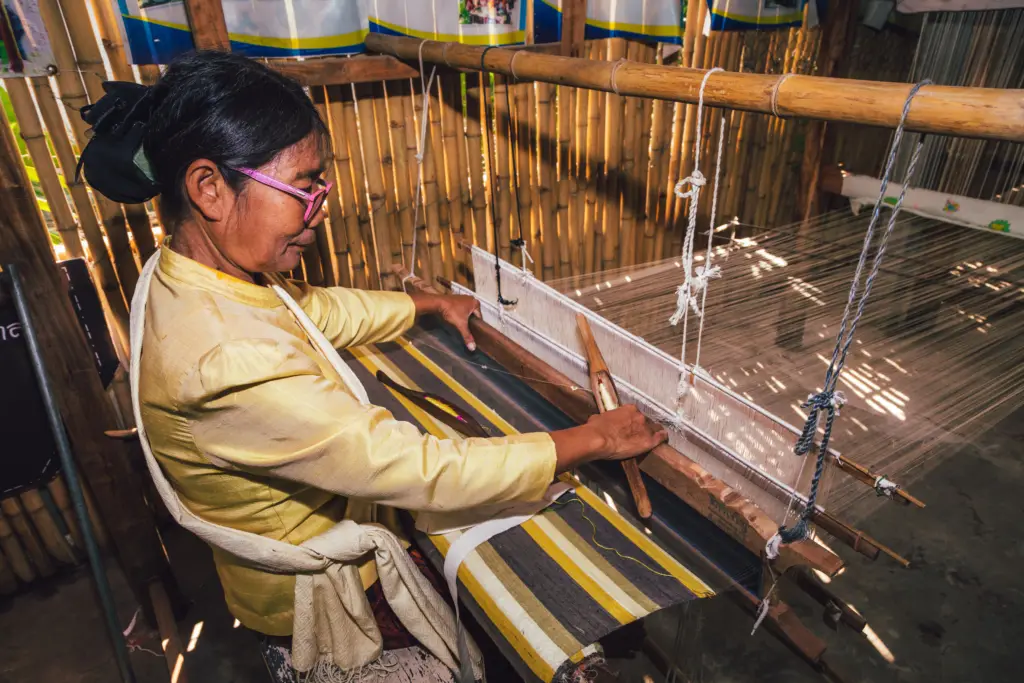
Na Pho Silk Weaving Village, also known as Na Pho District Handicraft Center, is a major silk-weaving destination in Na Pho District, Buri Ram Province. The community is especially known for mudmee silk and red-hemmed silk skirts, locally called pha sin tin daeng, an important textile identity shared by Na Pho and Phutthaisong communities. The village received support in improving skills, production methods, patterns, forms, and color use from the Special Arts and Crafts Center under Her Majesty Queen Sirikit The Queen Mother. Today, Na Pho is a meaningful destination for travelers who want to learn about Isan silk, buy textiles directly from community producers, and connect silk heritage with nearby cultural sites such as Wat Tha Riab, Khlong Phang Chu, Wat Hong, Phra Chao Yai, and Prang Ku Suan Taeng.
Na Pho Silk Weaving Village in Buri Ram Province is one of the most important textile destinations in the northern part of the province. Located in Na Pho District, the village and its handicraft center are known for handwoven silk, especially mudmee silk and the distinctive red-hemmed silk skirt. For international travelers, this is not simply a place to buy Thai silk. It is a living community where textiles are connected with family memory, local identity, craftsmanship, and the long cultural history of southern Isan.
Na Pho District Handicraft Center serves as a gathering place for community textile products. It brings together the works of local weavers, especially silk and cotton textiles with local patterns. Visitors can see a range of products, compare different weaving styles, and learn how the identity of Na Pho appears in color, motif, texture, and form. The center also helps make the craft more accessible to travelers who may not have time to visit every weaving household in the district.
The heart of Na Pho silk is mudmee, an ikat technique in which patterns are created on the threads before weaving. Instead of printing or painting a design onto finished cloth, the weaver ties sections of silk thread before dyeing. When the threads are dyed, untied, and placed on the loom, the pattern slowly appears as the fabric is woven. This method requires planning, memory, precision, and long experience. A fine mudmee textile is therefore a work of both design and discipline.
The most recognizable textile identity of Na Pho is the red-hemmed silk skirt, known in Thai as pha sin tin daeng. It is also called sin hua daeng tin daeng, sin tin daeng, or sin mi ruat in local usage. The skirt is woven entirely from silk, with bright red sections at the head and hem of the skirt and mudmee patterns in the body. This textile is strongly associated with Na Pho and Phutthaisong communities and has been part of local dress culture for generations. It is often worn during ceremonies, festivals, merit-making occasions, and important family events.
The beauty of Na Pho silk lies in the balance between traditional structure and handwoven individuality. The red hem gives the cloth a strong and dignified presence, while the mudmee section expresses the creativity of the weaver. Patterns may draw inspiration from nature, local belief, plants, flowers, animals, geometric forms, or older motifs adapted for contemporary use. Each piece carries both visual beauty and cultural meaning.
The development of Na Pho silk was strengthened by support from the Special Arts and Crafts Center under Her Majesty Queen Sirikit The Queen Mother. This support helped improve craftsmanship, production methods, pattern quality, textile forms, and the use of color. The result is a textile tradition that remains rooted in local knowledge while reaching higher standards of quality. Na Pho silk has therefore become important not only as a local product, but also as a symbol of cultural preservation and community pride.
Visitors to the handicraft center can find many types of products, including mudmee silk, red-hemmed silk skirts, plain silk, shawls, scarves, shoulder cloths, silk cloth for tailoring, cotton textiles, and processed textile products. These items are suitable for personal use, formal clothing, gifts, and collection. Those interested in Thai textiles should take time to compare the quality of thread, density of weaving, clarity of patterns, and color combinations.
Buying silk at Na Pho has value beyond shopping. It supports local weavers and keeps income within the community. It also helps younger generations see that textile knowledge can remain a meaningful occupation. When visitors buy directly from the source, they help preserve a craft economy built on skill, patience, and intergenerational transmission. A silk piece from Na Pho is therefore both a beautiful object and a link to the lives of the people who made it.
For travelers who want a deeper experience, advance contact is recommended. Some activities, such as weaving demonstrations, mudmee tying, or explanation of local textile techniques, may need preparation. Group visits, school trips, study tours, and cultural tourism groups should arrange their visit in advance so the community can prepare speakers, demonstrations, and a suitable learning sequence.
The main areas of interest include the handicraft center, silk product display area, red-hemmed skirt section, community weaving group area, demonstration area by arrangement, processed product area, and nearby community routes. These areas help visitors understand silk as a product, a process, and a cultural identity. The experience is most meaningful when travelers slow down, ask questions respectfully, and listen to the stories behind each textile.
Na Pho District also has a quiet local charm. Travelers can combine the silk village with old temples, local markets, small community attractions, and nearby historical sites. The area offers a different experience from the better-known southern Buri Ram route around Phanom Rung. Here, the focus is on silk, community life, local temples, and smaller cultural landmarks that remain closely connected with everyday life.
Nearby places that pair well with a visit include Wat Tha Riab, an old temple in Na Pho District; Khlong Phang Chu, a local waterway and natural landscape; Wat Hong and Phra Chao Yai in Phutthaisong District; and Prang Ku Suan Taeng in Ban Mai Chaiyaphot District. These destinations allow travelers to build a cultural route that includes textile heritage, Buddhist devotion, rural landscapes, and ancient monuments.
Prang Ku Suan Taeng is especially meaningful for travelers interested in ancient Khmer heritage. Located not far from Na Pho, the monument adds a historical layer to the journey. Combining Na Pho silk with Prang Ku Suan Taeng gives visitors both intangible heritage, represented by living weaving knowledge, and tangible heritage, represented by an ancient architectural site. This makes the route rich and balanced.
Getting There is easiest by private car. Use the Buri Ram – Phutthaisong route on Highway 2074, then connect with Highway 202 at around kilometer 21. From that junction, take the road into Na Pho District for about 10 km. Travelers can set the destination as Na Pho District Handicraft Center, 9 Soi Thetsaban 9, Na Pho Subdistrict, Na Pho District, Buri Ram Province.
Travelers using public transportation should first reach Na Pho or Phutthaisong town, then arrange local transport to the handicraft center. Since several nearby attractions are spread across rural and community areas, private car or hired local vehicle is the most convenient option. This is especially useful for visitors who want to combine the handicraft center with Wat Tha Riab, Khlong Phang Chu, Wat Hong, or Prang Ku Suan Taeng in the same trip.
The best time to visit is in the morning or early afternoon, when the center is open and visitors can spend enough time viewing textiles and speaking with local coordinators. During the hot season, visitors should bring drinking water, a hat, or an umbrella. During the rainy season, it is wise to check local road conditions before traveling. For group visits, contact in advance to ensure that the community is ready to receive visitors.
Responsible behavior is important when visiting a weaving community. Visitors should ask permission before taking photographs of weavers, looms, threads, or private workspaces. They should not touch silk threads, tools, or finished products without permission. Bargaining should be polite and fair because handmade silk reflects many hours of skilled labor. Respect for the craftsperson is part of the value of cultural travel.
Those buying silk should consider the intended use. For tailored clothing, choose a piece with enough length and suitable texture. For gifts, scarves, shawls, and smaller textile products are practical choices. For collectors, red-hemmed silk skirts or locally distinctive mudmee patterns are especially meaningful because they express the identity of Na Pho most clearly.
Na Pho Silk Weaving Village is suitable for families, students, study groups, textile designers, Thai craft lovers, cultural travelers, and international visitors who want to understand Thai silk at the source. Children can learn where silk comes from. Designers can study color and pattern structures. Travelers can see how a traditional craft still supports community life. The experience reveals that Thai silk is not only a luxury textile, but also a living cultural practice.
In summary, Na Pho Silk Weaving Village and Na Pho District Handicraft Center are valuable destinations for anyone interested in Thai silk, Isan textile culture, and community-based travel. The village is known for mudmee silk and red-hemmed silk skirts, supported by royal arts and crafts development while remaining rooted in local knowledge. A visit here offers more than shopping; it offers a direct encounter with the hands, stories, colors, and patterns that continue to define Na Pho’s textile identity.
| Name | Na Pho Silk Weaving Village / Na Pho District Handicraft Center |
| Location | Na Pho Subdistrict, Na Pho District, Buri Ram Province |
| Address | 9 Soi Thetsaban 9, Na Pho Subdistrict, Na Pho District, Buri Ram Province 31230, Thailand |
| Highlights | A well-known handwoven silk destination in Buri Ram, especially famous for mudmee silk and red-hemmed silk skirts, with products gathered from local weaving communities |
| History / Development | The village is a silk-weaving source, especially for mudmee silk. Its craftsmanship, production methods, patterns, forms, and color use were supported and developed by the Special Arts and Crafts Center under Her Majesty Queen Sirikit The Queen Mother. |
| Name Origin | The name refers to the Na Pho communities and handicraft center that gather the district’s silk-weaving wisdom as a learning and product center. |
| Distinctive Features | Mudmee silk, red-hemmed silk skirts, local patterns, refined color use, and handwoven techniques rooted in southern Isan textile culture |
| Main Products | Mudmee Silk, Red-Hemmed Silk Skirts, Plain Silk, Tailoring Cloth, Shawls, Scarves, Shoulder Cloths, Local Cotton Textiles, And Processed Silk Products |
| Main Areas / Zones | 1. Na Pho District Handicraft Center Zone 2. Mudmee Silk Display And Sales Zone 3. Red-Hemmed Silk Skirt And Local Textile Zone 4. Community Weaving Group Zone 5. Weaving And Mudmee Demonstration Zone By Arrangement 6. Processed Product And Souvenir Zone 7. Na Pho Community Cultural Route Zone |
| Caretaker / Coordinator | Na Pho District Handicraft Center, Pho Phatthana Community Silk Weaving Group Moo 13, Na Pho Silk Entrepreneurs, And Na Pho Municipality |
| Contact Numbers | Na Pho District Handicraft Center Tel. 044-686-253 Na Pho Handicraft Center Group Tel. 081-967-3849 Na Pho Municipality Tel. 044-686-114 Pai Mai Shop Tel. 097-924-0612 Pha Toomthong Shop Tel. 044-686-044 |
| Important Activities | Viewing and buying mudmee silk, learning about red-hemmed silk skirts, studying handwoven textiles, visiting community product displays, arranging silk study visits, and connecting the trip with nearby cultural attractions |
| Current Status | Active community handicraft center and local silk product destination in Na Pho District, Buri Ram Province |
| Open Days | Daily |
| Opening Hours | 09.00 – 16.00, with advance contact recommended for group visits or study visits |
| Facilities | Product display area, silk sales area, visitor reception point, community product learning area, nearby parking, and local shops |
| Travel Information | Take Highway 2074 on the Buri Ram – Phutthaisong route and connect with Highway 202 at around kilometer 21. From the junction, turn toward Na Pho District for about 10 km. Set the destination as Na Pho District Handicraft Center, 9 Soi Thetsaban 9, Na Pho Subdistrict, Na Pho District, Buri Ram Province. |
| Nearby Tourist Attractions | 1. Wat Tha Riab, Na Pho District, about 4 km 2. Wat Pa Nong Bua Rong, Phutthaisong District, about 8 km 3. Khlong Phang Chu, Na Pho District, about 10 km 4. Phra Prang Wat That, Ban Du, Na Pho District, about 10 km 5. Wat Hong / Phra Chao Yai, Phutthaisong District, about 14 km 6. Prang Ku Suan Taeng, Ban Mai Chaiyaphot District, about 14 km |
| Nearby Restaurants | 1. Dino Shabu Na Pho, about 1 km, Tel. 086-390-0988 2. Jungle Cafe Na Pho Buriram, about 1 km, Tel. 085-374-3003 3. U_na Cafe, about 4 km, Tel. 082-639-3647 4. Sixteen Cafe, Na Pho District, about 5 km, Tel. 087-244-1565 5. Khrua Khun Ploy, Na Pho District, about 5 km 6. Baan Suan Phi Nong, Na Pho District, about 6 km |
| Nearby Accommodations | 1. Ying Lee Lalla Resort, Ban Khu Subdistrict, Na Pho District, about 8 km, Tel. 083-336-6044, 094-987-7772 2. Pha Toomthong Homestay / Shop, Na Pho, about 1 km, Tel. 044-686-044 3. Rung Arun Resort, Phutthaisong District, about 18 km, Tel. 083-384-1652 4. Boonmanee Resort, Phutthaisong District, about 20 km, Tel. 081-725-7249 5. Ruean Phet Sawoei Resort, Phutthaisong District, about 22 km, Tel. 089-580-0148 6. Phufa Resort, Phutthaisong District, about 26 km, Tel. 091-662-2646 |
Frequently Asked Questions (FAQ)
Q: Where is Na Pho Silk Weaving Village located?
A: Na Pho Silk Weaving Village and Na Pho District Handicraft Center are located in Na Pho Subdistrict, Na Pho District, Buri Ram Province. The handicraft center is at 9 Soi Thetsaban 9, Na Pho Subdistrict.
Q: What is Na Pho Silk Weaving Village known for?
A: It is known for mudmee silk and red-hemmed silk skirts, a distinctive textile identity of Na Pho and Phutthaisong communities in northern Buri Ram.
Q: Who supported the development of Na Pho silk craftsmanship?
A: The community received support in improving skills, production methods, patterns, forms, and color use from the Special Arts and Crafts Center under Her Majesty Queen Sirikit The Queen Mother.
Q: What are the opening hours of Na Pho District Handicraft Center?
A: It is open daily from 09.00 to 16.00. Advance contact is recommended for group visits or study visits.
Q: What products can visitors buy?
A: Visitors can buy mudmee silk, red-hemmed silk skirts, plain silk, tailoring cloth, shawls, scarves, shoulder cloths, local cotton textiles, and processed silk products.
Q: How can travelers get to Na Pho Silk Weaving Village?
A: Take Highway 2074 on the Buri Ram – Phutthaisong route and connect with Highway 202 at around kilometer 21. From there, turn toward Na Pho District for about 10 km.
Q: What nearby attractions can travelers visit after the silk village?
A: Nearby attractions include Wat Tha Riab, Wat Pa Nong Bua Rong, Khlong Phang Chu, Phra Prang Wat That, Wat Hong / Phra Chao Yai, and Prang Ku Suan Taeng.
Q: Who should visit Na Pho Silk Weaving Village?
A: It is suitable for families, students, study groups, textile designers, Thai craft lovers, cultural travelers, and international visitors who want to learn about Thai silk from a real community source.
 Category: ●Suburban Living
 Group: ●Village, Community
Last Update : 3 MonthAgo
 Last Update : 3 MonthAgo
 Click to Access the Navigation Map GPS
Na Pho Silk Weaving Village Map
Recommend

 Art, Culture and Heritage
 Historical Sites and Monuments(14)
 Landmarks and Memorials(2)
 Art, Craft Centres, Tradition(6)
 Museums(3)
 Educational Places
 Museum for Study(1)
 Places of Worship
 Temple(74)
 Other Sacred Sites(5)
Village, Community(3)
Other Sacred Sites(5)
Village, Community(3)
 Nature and Wildlife
 National Parks and Marine Reserves(2)
 Mountain (Doi)(1)
 Dam, Reservoir, Lake(14)
 River, Canal(1)
 Bays and Beaches(1)
 Other natural attractions(2)
 Entertainment and Agricultural
 Animal camps and shows(1)
 Stadium(2)
 Farms, Parks and Ecotourism(2)
 Waterpark(1)


