
lovethailand home >Northeastern Travel Attractions >Buri Ram Travel Attractions >Pa Kham >Pa Kham > Ban Khok Ngio Sanctuary (Prasat Ban Khok Ngio)
TL;DR: Ban Khok Ngio Sanctuary (Prasat Ban Khok Ngio) is located at Inside Wat Khok Ngio, Ban Khok Ngio, Pakham Subdistrict, Pakham District, Buriram Province, open Daily, hours Daytime Visits Are Recommended.
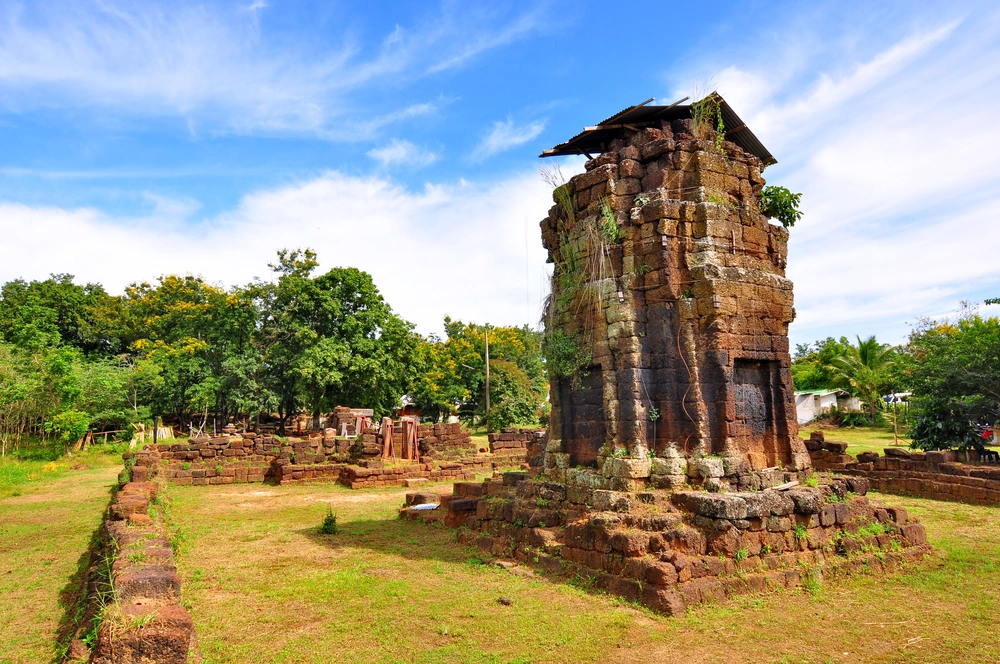
Ban Khok Ngio Sanctuary (Prasat Ban Khok Ngio)
Open Days: Daily
Opening Hours: Daytime Visits Are Recommended
Prasat Khok Ngio, also known as Prasat Wat Khok Ngio or Prasat Ban Khok Prasat, is a Khmer archaeological site located inside Wat Khok Ngio in Pakham District, Buriram Province. It stands on Highway 348, the Nang Rong – Pakham route, about 3 km before Pakham town. The site is especially important because it is an Arokayasala, or Mahayana Buddhist healing sanctuary, built during the reign of King Jayavarman VII in the 18th Buddhist century. Its plan includes a main sanctuary tower, a library-like building or vihara, an enclosure wall, an eastern gateway, and a sacred pond. Key evidence includes a bronze inscription, images of Bhaisajyaguru and Avalokitesvara, and an older Gajalakshmi lintel that reveals a deeper artistic history behind the site.
Prasat Khok Ngio is located in Pakham Subdistrict, Pakham District, Buriram Province, inside Wat Khok Ngio. It is a relatively small Khmer monument, but it has major historical importance because it represents an Arokayasala, or religious healing sanctuary, from the reign of King Jayavarman VII. The site reveals a side of Khmer civilization that goes beyond grand royal temples. It shows how religion, healing, public welfare, and Mahayana Buddhist compassion were brought together in a local community setting.
The site is known by several names, including Prasat Khok Ngio, Prasat Wat Khok Ngio, Prasat Ban Khok Prasat, and Prasat Ban Khok Ngio. All these names refer to the same Khmer monument in the grounds of Wat Khok Ngio, Ban Khok Ngio, Pakham Subdistrict. The name Khok Ngio comes from the local village and temple name, while Khok Prasat reflects the idea of a raised area or mound associated with a sanctuary. These names show that the monument has continued to live within local memory and religious life.
Prasat Khok Ngio stands behind Wat Khok Ngio on the Nang Rong – Pakham route, Highway 348, about 3 km before reaching Pakham town. Its location makes it a meaningful stop for travelers moving between Nang Rong and Pakham or for those planning a historical route linking Phanom Rung, Prasat Mueang Tam, Wat Khao Phra Angkhan, Prasat Nong Hong, and other Khmer sites in southern Buriram.
Architecturally, Prasat Khok Ngio is a Mahayana Buddhist sanctuary built of laterite and sandstone. Its overall plan is rectangular and faces east. The main elements include a central sanctuary tower, a vihara or library-like building, an enclosure wall, an entrance gateway, and a sacred pond. This layout is typical of Arokayasala sites built during the reign of King Jayavarman VII. The parts of the site were not arranged randomly. Each element had a function related to worship, healing, water use, ritual movement, and sacred space.
The main sanctuary tower is the heart of the compound. It faces east, the direction associated with sunrise, beginning, purification, and ritual entry in Khmer sacred architecture. The tower is built of laterite and sandstone and has a square plan measuring about 5 x 5 meters. It has its true entrance on the east side, while the other 3 sides are false doors. This arrangement creates a clear ritual axis and preserves the balanced appearance of the shrine on all sides.
Laterite was used as the main building material because it is strong, locally available, and suitable for structural walls and bases. Sandstone was used for more refined or stronger architectural components, including door frames, decorative columns, lintels, and carved elements. This combination reflects Khmer technical knowledge. Laterite gave the building mass and durability, while sandstone allowed detailed carving and sacred imagery.
To the southeast of the main sanctuary stands a building usually identified as a vihara or bannalai. In Khmer religious architecture, a bannalai is often associated with sacred texts, ritual objects, or auxiliary ceremonial functions. In the context of an Arokayasala, such a building may have been connected with ritual activities, religious objects, or healing-related ceremonies. Its presence shows that Prasat Khok Ngio was not a single isolated shrine but a complete sacred compound.
The sanctuary tower and the bannalai are enclosed by a laterite wall. This enclosure marks the boundary between ordinary space and sacred healing space. Visitors in the past entered through the eastern gateway, moving from the outer area into the ritual interior. The enclosed compound therefore created a formal transition into a place of worship and healing.
The eastern gateway, or gopura, served as the main entrance to the Arokayasala. It directed movement into the compound and aligned with the east-facing main sanctuary. This layout controlled the experience of those entering the site, whether they were patients, monks, ritual specialists, attendants, travelers, or local residents seeking healing and protection.
Outside the enclosure wall to the northeast lies the sacred pond of the sanctuary. Water was essential in an Arokayasala. It served practical needs for patients and attendants, but it also had ritual meaning. Water was associated with purification, healing, fertility, and spiritual renewal. The pond was therefore part of the therapeutic and religious environment of the site.
Prasat Khok Ngio is interpreted as one of the 102 Arokayasala healing sanctuaries established under King Jayavarman VII in the 18th Buddhist century. Jayavarman VII was one of the most important Khmer kings and is closely associated with Mahayana Buddhism. His public works included hospitals, rest houses, roads, and religious sanctuaries across the empire. These sites expressed royal merit and the king’s role as a protector and healer of his people.
The religious meaning of Arokayasala sites is closely connected with Mahayana Buddhism, especially the cult of Bhaisajyaguru, the Medicine Buddha. In the ancient world, healing was not separated from religious belief in the way it is today. Patients may have received care through rest, water, herbal treatment, ritual, prayer, and devotion to healing deities and bodhisattvas. Prasat Khok Ngio therefore preserves evidence of a holistic view of health in ancient Khmer society.
Important evidence from Prasat Khok Ngio includes 2 sandstone divine figures: Bhaisajyaguru and the Bodhisattva Avalokitesvara. Bhaisajyaguru is associated with healing and medicine, while Avalokitesvara is associated with compassion and the salvation of beings. The presence of these figures strongly supports the identity of the site as a Mahayana Buddhist healing sanctuary.
Another key piece of evidence is a curved bronze inscription measuring 13.5 x 21.7 cm. The inscription, written in Khmer script, records a religious offering by King Jayavarman VII to the Arokayasala at Virendrapura in the Saka year 1115, corresponding to 1736 BE. This inscription gives Prasat Khok Ngio exceptional historical value because it links the site directly with Jayavarman VII and the Arokayasala system.
The name Virendrapura in the inscription is important because it suggests that the area once held a defined place within the Khmer network of settlements and religious foundations. The bronze inscription allows the site to be studied not only through architecture but also through written evidence. This makes Prasat Khok Ngio one of the important sites for understanding royal donations, healing sanctuaries, and Mahayana Buddhism in lower northeastern Thailand.
Excavation also revealed a sandstone lintel carved with Gajalakshmi in the Khleang – early Baphuon style, dated around the late 16th Buddhist century. The lintel shows the goddess Lakshmi seated on a lotus, flanked by elephants raising their trunks above her. Below the lotus base is a kirtimukha or kala face holding a garland. This lintel is older than the Arokayasala itself, suggesting that it may have been reused from another Khmer sanctuary or brought from an earlier sacred site nearby.
The presence of architectural fragments from different periods gives Prasat Khok Ngio a layered history. The site does not tell only an 18th Buddhist century story. It also points to older artistic traditions in the Pakham area. The Gajalakshmi lintel may represent reuse, movement of sacred materials, or continuity of sacred space. This makes the site more complex and more valuable for art-historical study.
In 2011, the regional Fine Arts office carried out archaeological clearing at Prasat Khok Ngio. Later, during 2020 – 2021, restoration work was undertaken on the main sanctuary, bannalai or vihara, and enclosure wall using anastylosis, a method of reassembling original architectural parts as accurately as the evidence allows. This conservation work makes the plan of the Arokayasala easier to understand today while respecting the original archaeological remains.
A visit to Prasat Khok Ngio should begin with the overall plan. Notice that the sanctuary faces east, that the enclosure wall surrounds the compound, that the gateway controls the entrance, that the main tower stands on the central axis, and that the bannalai stands to the southeast. Then observe the details of laterite blocks, sandstone elements, doorway frames, restoration traces, and the sacred pond to the northeast. This approach helps visitors understand how the compound functioned as a healing sanctuary.
From the perspective of medical history, Prasat Khok Ngio is a valuable example of the link between healing and religion. A Khmer Arokayasala was not a hospital in the modern clinical sense. It was a place where the body, mind, faith, ritual, and social care were understood together. The site therefore reflects an ancient worldview in which illness and healing were part of a wider religious and cosmic order.
Compared with Phanom Rung or Prasat Mueang Tam, Prasat Khok Ngio is smaller and quieter, but its significance is not smaller. The great sanctuaries reveal royal religion, monumental architecture, and refined sculpture. Prasat Khok Ngio reveals public welfare, medical care, and the spread of Mahayana Buddhist institutions into local communities. Together, these different types of monuments give a more complete view of Khmer civilization in Buriram.
Pakham District also sits within a meaningful travel zone connecting Nang Rong, Chaloem Phra Kiat, Lahan Sai, and Non Din Daeng. Visitors to Prasat Khok Ngio can continue to Wat Pho Yoi, Prasat Nong Ta Si, Wat Khao Phra Angkhan, Prasat Nong Hong, Phanom Rung Historical Park, and Prasat Mueang Tam. This route reveals a diverse network of temples, communities, volcanic landscapes, reservoirs, and Khmer heritage sites in southern Buriram.
For travelers interested in Khmer art, the most important point is the coexistence of artistic evidence from different periods. The Gajalakshmi lintel belongs to an older Khleang – early Baphuon style, while the Arokayasala plan and Mahayana Buddhist sculptures belong to the Jayavarman VII period. This layered evidence shows that Khmer sites often changed over time through reuse, reconstruction, and reinterpretation.
For photography, Prasat Khok Ngio is best captured through wide views of the enclosure and main sanctuary, close-up images of sandstone frames, the texture of restored laterite blocks, and the relationship between the sanctuary and its pond. Morning or late afternoon light gives the laterite better texture. Visitors should avoid climbing on the monument, touching fragile fragments, or moving any stone pieces.
Getting There is easiest by private car, rental car, or hired local vehicle. From Nang Rong, take Highway 348 toward Pakham. Before reaching Pakham town by about 3 km, enter the Wat Khok Ngio area, where the ancient sanctuary stands behind the temple. From Buriram city, travel toward Nang Rong and continue to Pakham. The journey normally takes around 1 to 1.5 hours depending on traffic and route conditions.
Because the sanctuary is located within a working Buddhist temple, visitors should park respectfully, avoid blocking temple access, dress modestly, speak quietly, and respect both the ancient monument and the current religious space. This is not only an archaeological site but also part of a living community and temple environment.
Visitors should not climb on the enclosure wall, the main sanctuary, or laterite blocks. They should not scratch stone surfaces, move architectural fragments, leave waste, or use the monument as a seating area. Every stone and fragment has archaeological value and helps preserve the history of the site.
A normal visit takes about 30 to 45 minutes. Visitors who want to study the layout, read interpretation panels, and understand the Arokayasala system may spend about 1 hour. Those interested in art history should pay special attention to the bronze inscription, Mahayana Buddhist figures, Gajalakshmi lintel, and the relationship between the main sanctuary, bannalai, enclosure, and pond.
Prasat Khok Ngio is therefore a valuable stop for travelers who want to understand Buriram through Mahayana Buddhism and the Arokayasala system. It is not merely a small Khmer ruin behind a temple. It is evidence of ancient healing, compassion, royal public works, and local religious life under King Jayavarman VII. Visiting this site makes the Khmer heritage of Buriram more complete by adding the human and healing dimension behind the monumental temples.
In the broader historical travel route, Prasat Khok Ngio expands the story from the Phanom Rung – Mueang Tam area into Pakham and Non Din Daeng. It helps travelers follow the legacy of Jayavarman VII through healing sanctuaries, rest houses, and local Khmer monuments. For students, cultural travelers, local historians, and international visitors, Prasat Khok Ngio is one of the key places for understanding how ancient Khmer civilization connected religion, medicine, community, and royal power.
| Name | Prasat Khok Ngio |
| Alternative Names | Prasat Wat Khok Ngio, Prasat Ban Khok Prasat, Prasat Ban Khok Ngio |
| Location | Inside Wat Khok Ngio, Ban Khok Ngio, Pakham Subdistrict, Pakham District, Buriram Province |
| Address | Wat Khok Ngio, Ban Khok Ngio, Pakham Subdistrict, Pakham District, Buriram 31220, Thailand |
| Coordinates | 14.463536, 102.727704 |
| Highlights | A Mahayana Buddhist Arokayasala Or Healing Sanctuary From The Reign Of King Jayavarman VII, With A Main Sanctuary Tower, Bannalai, Enclosure Wall, Eastern Gopura, Sacred Pond, And A Bronze Inscription Referring To The Arokayasala At Virendrapura |
| History | 18th Buddhist Century, Reign Of King Jayavarman VII, Associated With The 102 Mahayana Buddhist Arokayasala Healing Sanctuaries Of The Khmer Empire |
| Name Origin | Named After Ban Khok Ngio And Wat Khok Ngio, Where The Monument Is Located. The Name Ban Khok Prasat Reflects The Raised Local Area Associated With The Sanctuary. |
| Distinctive Features | Built Of Laterite And Sandstone, With A Rectangular Overall Plan Facing East. The Main Sanctuary Has A Square Plan Of About 5 x 5 Meters, A True Eastern Entrance, And False Doors On The Other 3 Sides. |
| Main Areas / Zones | 1. Main Laterite And Sandstone Sanctuary Tower 2. Eastern Entrance Of The Main Sanctuary 3. Three False Doors 4. Vihara Or Bannalai To The Southeast 5. Rectangular Enclosure Wall 6. Eastern Gopura Or Entrance Gateway 7. Sacred Pond To The Northeast 8. Wat Khok Ngio Area Around The Monument |
| Key Evidence | Curved Bronze Inscription, Bhaisajyaguru, Avalokitesvara, Vajrapani Riding Garuda, Gajalakshmi Lintel In Khleang – Early Baphuon Style, Doorway Columns, Tools, And Pottery Fragments |
| Excavation / Restoration | Archaeological Clearing Was Carried Out In 2011. Restoration Of The Main Sanctuary, Bannalai Or Vihara, And Enclosure Wall Was Undertaken By Anastylosis During 2020 – 2021. |
| Travel Information | On Highway 348, The Nang Rong – Pakham Route, About 3 Km Before Pakham Town. Best Reached By Private Car, Rental Car, Or Hired Local Vehicle. |
| Current Status | Khmer Archaeological Site Inside Wat Khok Ngio, Used As A Learning Site For Arokayasala, Mahayana Buddhism, And Khmer Heritage In Pakham District |
| Open Days | Daily |
| Opening Hours | Daytime Visits Are Recommended |
| Fees | No Admission Fee |
| Facilities | Parking Area Inside The Temple, Walking Access To The Monument, Active Temple Grounds, Shaded Areas, And Local Shops In The Community Or Pakham Town |
| Caretaker | The Fine Arts Department Through Fine Arts Office 10 Nakhon Ratchasima, Together With Wat Khok Ngio And Ban Khok Ngio Community |
| Abbot Of Wat Khok Ngio | Phra Khru Wibun Yanasathit |
| Main Contact Number | Fine Arts Office 10 Nakhon Ratchasima, Tel. 044-471-518 Buriram Local Natural And Cultural Environment Conservation Unit, Tel. 044-611-221 Ext. 7601 Map-Listed Site Contact, Tel. 099-253-4221 |
| Nearby Tourist Attractions | 1. Wat Pho Yoi, About 3 Km 2. Prasat Nong Ta Si, About 4 Km 3. Wat Khao Phra Angkhan, About 14 Km 4. Prasat Nong Hong, Non Din Daeng District, About 18 Km 5. Tham Pet Thong, About 18 Km 6. Phanom Rung Historical Park, About 24 Km, Tel. 044-666-251 7. Prasat Mueang Tam, About 28 Km, Tel. 044-666-251 8. Kuti Ruesi Ban Khok Mueang, About 27 Km |
| Nearby Restaurants | 1. Jum’s Restaurant, New Menu, BBQ, Drinks, About 9 Km, Tel. 093-067-6434 2. Krua Ban Rao, About 10 Km, Tel. 098-441-4240 3. Rim Rua Restaurant, About 12 Km, Tel. 093-457-2053 4. The Cottage LahanSai, About 16 Km, Tel. 065-746-7193 5. Khon-La-Yum Lahan Sai Restaurant, About 15 Km, Tel. 061-267-1998 6. Phloen Lin Cafe Isan Restaurant, About 15 Km, Tel. 063-662-4455 7. Pirum Restaurant And Coffee, About 17 Km, Tel. 092-541-7889 |
| Nearby Accommodations | 1. Pakham Gardens Resort, About 6 Km, Tel. 092-714-4899 2. Nichapa Resort, About 14 Km, Tel. 093-462-5624 3. Cozy Shiroi Resort, About 19 Km, Tel. 044-110-001 4. The Park Nangrong Resort, About 19 Km, Tel. 044-633-778 5. S.S. Hotel Nangrong, About 20 Km, Tel. 044-631-288 6. Socool Grand Hotel, About 20 Km, Tel. 044-632-333 7. Sorriso House Resort, About 22 Km, Tel. 080-989-9956 |
Frequently Asked Questions (FAQ)
Q: Where Is Prasat Khok Ngio Located?
A: Prasat Khok Ngio is located inside Wat Khok Ngio, Ban Khok Ngio, Pakham Subdistrict, Pakham District, Buriram Province, on Highway 348 about 3 km before Pakham town.
Q: Does Prasat Khok Ngio Have Other Names?
A: Yes. It is also known as Prasat Wat Khok Ngio, Prasat Ban Khok Prasat, and Prasat Ban Khok Ngio. These names refer to the same Khmer monument inside Wat Khok Ngio.
Q: Why Is Prasat Khok Ngio Important?
A: It is a Mahayana Buddhist Arokayasala, or healing sanctuary, built during the reign of King Jayavarman VII. It also has a bronze inscription referring to the Arokayasala at Virendrapura.
Q: What Are The Main Highlights Of Prasat Khok Ngio?
A: The highlights include the Arokayasala plan with a main sanctuary tower, bannalai, enclosure wall, gopura, and sacred pond, as well as evidence such as Bhaisajyaguru, Avalokitesvara, a bronze inscription, and a Gajalakshmi lintel.
Q: When Was Prasat Khok Ngio Built?
A: It is associated with the 18th Buddhist century during the reign of King Jayavarman VII, when Mahayana Buddhist healing sanctuaries were widely established across the Khmer Empire.
Q: Is There An Admission Fee?
A: No. There is no admission fee, but visitors should dress respectfully and behave appropriately because the monument is located inside a temple.
Q: What Nearby Places Can Be Visited Together With Prasat Khok Ngio?
A: Nearby places include Wat Pho Yoi, Prasat Nong Ta Si, Wat Khao Phra Angkhan, Prasat Nong Hong, Phanom Rung Historical Park, Prasat Mueang Tam, and Kuti Ruesi Ban Khok Mueang.
Q: What Should Visitors Be Careful About?
A: Visitors should not climb on the monument, scratch stone surfaces, move laterite or sandstone fragments, leave waste, or disturb the temple area.
 Category: ●Art, Culture and Heritage
 Group: ●Historical Sites and Monuments
Last Update : 4 MonthAgo
 Last Update : 4 MonthAgo
 Click to Access the Navigation Map GPS
Ban Khok Ngio Sanctuary (Prasat Ban Khok Ngio) Map
Recommend
 Historical Sites and Monuments(14)
 Landmarks and Memorials(2)
 Art, Craft Centres, Tradition(6)
 Museums(3)
 Educational Places
 Museum for Study(1)
 Places of Worship
 Temple(74)
 Other Sacred Sites(5)
 Research and Development
 Royal Project(1)
 Suburban Living
 Village, Community(3)
 Nature and Wildlife
 National Parks and Marine Reserves(2)
 Mountain (Doi)(1)
 Dam, Reservoir, Lake(14)
 River, Canal(1)
 Bays and Beaches(1)
 Other natural attractions(2)
 Entertainment and Agricultural
 Animal camps and shows(1)
 Stadium(2)
 Farms, Parks and Ecotourism(2)
 Waterpark(2)
 Travel Articles, Recipes
 Travel Review, Food Review(1)


