
lovethailand home >Northeastern Travel Attractions >Buri Ram Travel Attractions >Muang Buri Ram >Nai Muang > Isan Wedding Traditions
TL;DR: Isan Wedding Traditions. Highlights include Khan Mak Procession, Dowry Presentation, Asking Forgiveness From Parents, Elder-Respect Ritual, Bai Sri Su Kwan, Wrist-Tying, Egg-Feeding.
Isan Wedding Traditions
Ceremony Days: Based On An Auspicious Date And The Readiness Of Both Families
Ceremony Time: Usually Held From Morning To Midday, Followed By A Lunch Or Evening Celebration
Isan Wedding Traditions in Buri Ram Province represent one of the most meaningful family and community ceremonies in northeastern Thailand. Known in many local communities as “Kin Dong,” an Isan wedding is not simply a celebration of 2 people in love. It is a ceremony that formally connects 2 families, 2 kinship networks, and often an entire village community. Through rituals such as the groom’s procession, the presentation of dowry, asking forgiveness from parents, Bai Sri Su Kwan, wrist-tying, egg-feeding, gift-giving, and the final blessing of the couple, the wedding becomes a powerful cultural expression of love, gratitude, respect, blessing, and social acceptance.
In Buri Ram Province, Isan wedding traditions are especially interesting because the province is culturally diverse. Buri Ram is home to Thai Lao, Thai Khmer, Thai Kui or Suai, and Thai Khorat communities. Each community may have its own language, ritual details, songs, food, and family customs, yet the core values of the wedding remain closely shared. These values include respect for parents and elders, gratitude toward ancestors, the joining of 2 families, the calling of the couple’s spirits, and the blessing of a new household by relatives and community members.
An Isan wedding is therefore much more than a legal or social event. It is a rite of transition. The bride and groom are publicly recognized as a married couple, while their families become related through marriage. The groom is accepted into the bride’s family, the bride is connected to the groom’s family, and both sides begin a new relationship as kin. This is the deeper meaning of the word Kin Dong. It refers not only to a feast, but also to becoming related through marriage and sharing family life from that moment onward.
For many families in Buri Ram, marriage is also a ceremony of gratitude. The bride and groom are expected to show respect and thanks to their parents, who gave birth to them, raised them, supported them, and guided them into adulthood. The moment when the couple kneels before their parents and senior relatives is one of the most emotional parts of the wedding. It is an act of apology, gratitude, and blessing. The couple asks forgiveness for anything they may have done wrong, while the elders give advice about marriage, patience, family responsibility, and the importance of building a peaceful household.
The preparation for an Isan wedding usually begins with discussions between the couple and both families. Important topics include the auspicious date, the venue, the number of guests, the ceremonial sequence, the dowry, the groom’s procession, the Bai Sri tray, gifts for elders, food, music, and accommodation for relatives. If the wedding is held at home, the family must prepare different areas for the procession, the dowry ceremony, the elder-respect ceremony, the Bai Sri Su Kwan ritual, wrist-tying, the meal, and guest reception. If the ceremony is held at a hotel, restaurant, or community hall, the family often adapts the traditional rituals into a more modern setting.
An auspicious date remains important in many Isan families. Some families consult monks, respected elders, ritual specialists, or local Brahmin-style masters to select a suitable day and time. Others choose a date based on family convenience, especially when relatives travel from different provinces. Whether the date is chosen through traditional calculation or practical planning, the purpose remains the same: to begin married life with blessings, family support, and a sense of emotional readiness.
Before the wedding day, relatives and neighbors often help with the preparation. The bride’s family prepares the house or venue, while the groom’s family prepares the procession, the dowry, and senior representatives for the formal request. Women in the family may help cook, arrange flowers, prepare trays, and organize gifts, while men may set up tables, chairs, tents, sound systems, and other equipment. This cooperation is one of the most beautiful aspects of an Isan wedding. The event belongs not only to the couple, but to the wider family and community.
The wedding day often begins with the groom’s Khan Mak procession. Relatives of the groom walk together carrying ceremonial trays, flowers, candles, incense, gifts, and dowry items. The procession is colorful, joyful, and lively. In some communities, traditional music, khaen, drums, folk songs, or molam performances accompany the procession. The groom’s procession is not simply a walk to the bride’s home. It is a public expression of sincerity and respect, showing that the groom and his family have come properly to ask for the bride in accordance with local custom.
When the procession arrives at the bride’s home or ceremonial area, the bride’s relatives may create symbolic gates or barriers. These are sometimes known as silver and golden gates. The exchange between both sides is often playful but respectful. Representatives of the bride’s side may ask why the procession has come, and the groom’s side answers that they have come to ask for the bride. Small gifts or symbolic payments may be given to pass through the gates. This moment creates warmth and laughter while still preserving the formal meaning of the ceremony.
In some Isan communities, a foot-washing ritual for the groom is performed before he enters the bride’s house or ceremonial space. A younger relative of the bride may wash or wipe the groom’s feet on banana leaves or in a prepared vessel. The meaning is both practical and symbolic. It welcomes the groom into the bride’s family with respect and marks the beginning of a new relationship. The groom often gives a small reward to the person performing the ritual, adding a sense of affection and humor to the moment.
The next stage usually involves the formal request and the presentation of the dowry. The dowry is not only a financial matter. It represents sincerity, readiness, and respect toward the bride’s family. Senior representatives from the groom’s side present the agreed items, while the bride’s elders acknowledge and accept the request. The ceremony may then continue with the ring exchange, gift-giving to elders, the asking-for-forgiveness ritual, or the Bai Sri Su Kwan ceremony, depending on each family’s sequence.
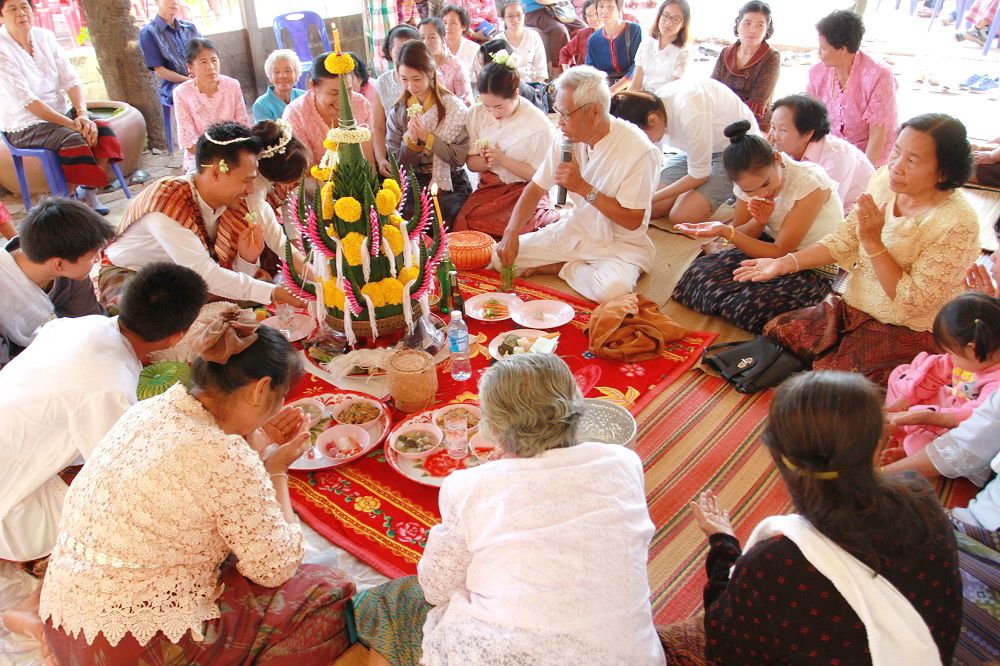
The ritual of asking forgiveness from parents and elders is deeply important. The bride and groom kneel before their parents and senior relatives, offer gifts, and ask forgiveness for past mistakes, whether intentional or unintentional. Elders give blessings and practical advice for married life. They may speak about patience, forgiveness, earning a living together, respecting both families, and maintaining harmony between husband and wife. This moment often brings tears because it formally expresses gratitude between generations.
The spiritual heart of an Isan wedding is the Bai Sri Su Kwan ceremony. This ritual is based on the traditional belief in kwan, the vital spirit or life essence of a person. During major life transitions such as marriage, the kwan should be called back and encouraged to stay with the couple. The ritual blesses the bride and groom with stability, happiness, protection, fertility, prosperity, and family harmony. It is one of the most sacred and intimate parts of the wedding.
The Bai Sri tray is arranged with great care. It may include banana leaves, flowers, popped rice, boiled eggs, sticky rice, bananas, sugarcane, white cotton threads, and other auspicious items according to local custom. The bride and groom sit near the tray while parents, elders, relatives, and respected guests sit around them. A ritual specialist known as a Mor Kwan, Mor Sut, or local Brahmin-style master recites the calling-of-the-spirit verses. The words invite the couple’s kwan to return, stay with their bodies, stay with their home, stay with their marriage, and remain with prosperity and well-being.
The Mor Kwan or ritual master plays a central role in the ceremony. This person must understand ritual language, ceremonial order, local beliefs, and the symbolic meaning of each object. The blessing words are often poetic and may include Isan language, formal Thai, or older ritual expressions. The content usually blesses the couple with lasting love, children, prosperity, good health, successful work, protection from misfortune, and harmony between the 2 families.
After the calling-of-the-spirit ritual, elders and guests tie white cotton threads around the wrists of the bride and groom. This wrist-tying ritual is one of the most memorable parts of an Isan wedding. The white thread symbolizes purity, blessing, protection, and the relationship between the couple and their community. Each elder ties a thread while giving a personal blessing. Some blessings are short and simple, while others are long and emotional. Together, they create a circle of goodwill around the newly married couple.
Another meaningful custom is the feeding of a boiled egg or food to the bride and groom. The egg represents completeness, unity, fertility, and fullness of life. In some families, the egg is shared between the bride and groom. In others, elders feed the couple while giving blessings. The atmosphere is warm and affectionate, expressing the hope that the couple will begin married life with abundance, emotional fulfillment, and family support.
The wrist-tying and egg-feeding rituals make Isan weddings feel especially intimate. Guests are not merely spectators. They can participate by tying threads, giving blessings, and sharing in the emotional beginning of the couple’s married life. This direct contact between elders, relatives, friends, and the couple creates a strong family atmosphere that distinguishes Isan weddings from many formal ceremonial styles.
After Bai Sri Su Kwan, some families give gifts to the couple or exchange ceremonial gifts with elders. These may include money, gold, silk, traditional cloth, pha sin, pha khao ma, pillows, household items, or objects useful for starting a new home. The meaning is not only economic. The gifts show support for the couple’s new household and symbolize the willingness of both families to help the marriage begin on a stable foundation.
The sending-off ceremony, or the symbolic sending of the bride and groom into married life, may also be performed. Elders give final advice about living together, respecting each other, caring for parents on both sides, solving problems with patience, and building a secure family. Some families keep this ritual simple at home, while others adapt it into a modern hotel or banquet setting. The essential meaning remains the same: the couple receives guidance before beginning life as husband and wife.
Music and celebration are also important in Isan weddings in Buri Ram. After the main rituals, many weddings continue with a festive meal and entertainment. Molam, khaen music, drums, folk songs, luk thung music, or modern bands may be included. Music transforms the wedding from a solemn family ceremony into a joyful community celebration. Elders, relatives, friends, and young people can all participate in their own way, whether by blessing the couple, sharing food, singing, dancing, or simply enjoying the atmosphere.
Food is another central part of the wedding. Feeding guests is a way of showing hospitality and generosity. The menu may include Isan dishes, Thai dishes, seasonal food, and large shared meals suitable for many guests. Common foods may include larb, grilled chicken, som tam, sticky rice, soups, curries, desserts, and drinks. In traditional village weddings, relatives and neighbors often help prepare the food. The wedding meal therefore represents abundance and cooperation as much as hospitality.
The role of parents is extremely important in Isan wedding culture. Parents are not only witnesses to the marriage. They give permission, receive respect, offer blessings, and pass family wisdom to the next generation. When the bride and groom bow before them, the act expresses the value of gratitude that lies at the heart of Isan family life. For the bride’s family, the ceremony welcomes the groom as a new relative. For the groom’s family, it expresses trust that their son will care for his wife and honor his new family connections.
The role of the community is also essential. In many Isan villages, a wedding is a shared event. Neighbors help prepare food, arrange the venue, welcome guests, manage tables, clean up, and assist with countless small tasks. This support strengthens local relationships and shows the couple that their marriage is recognized by the surrounding community. The wedding becomes a social bond, not only a private promise.
Modern Isan weddings have changed in many ways. Some couples now hold ceremonies in hotels, restaurants, halls, or wedding venues instead of private homes. Some combine Isan customs with central Thai wedding elements such as water-pouring ceremonies, formal engagement rituals, reception programs, and photography sessions. These adaptations do not weaken the tradition when the core meanings are preserved. Respect for elders, Bai Sri Su Kwan, wrist-tying, family blessing, and community participation remain the emotional center of the wedding.
The most important part of preserving Isan wedding culture is not copying every external detail exactly, but understanding what each ritual means. The procession shows sincerity. The dowry expresses respect and readiness. Asking forgiveness honors parents and elders. Bai Sri Su Kwan calls back the couple’s spirits and blesses their transition. Wrist-tying transfers blessings from the community. The feast shares happiness with relatives and neighbors. When these meanings are understood, the tradition remains alive whether the wedding is held at home, in a temple, in a community hall, or in a hotel.
Because Buri Ram is culturally diverse, wedding details may vary from district to district. Thai Khmer communities may have certain songs, words, or ritual details that differ from Thai Lao communities. Kui or Suai families may preserve particular beliefs or symbolic practices. Thai Khorat communities may blend Isan and Khorat customs. These differences give Buri Ram weddings richness and variety while still sharing the common values of family respect, elder blessing, and the joining of 2 families.
Foreign travelers who are invited to an Isan wedding in Buri Ram should understand that the ceremony carries deep cultural meaning. Guests should dress politely, respect the ritual space, avoid loud conversation during the Bai Sri Su Kwan ceremony, and observe elders before participating. If invited to tie a wrist thread, it is appropriate to do so gently and offer a simple blessing. If unsure what to say or do, guests can follow the example of senior relatives or ask the host family respectfully.
Good manners are important. Guests should not touch ritual objects without permission, should not step in front of the ritual master during key moments, and should avoid joking about local language or ceremonial words. Photography is often allowed, but guests should avoid intrusive behavior during emotional moments such as asking forgiveness from parents, Bai Sri Su Kwan, wrist-tying, and the blessing of elders. Respectful participation allows visitors to experience the warmth of Isan culture more deeply.
Visitors who attend a wedding in Buri Ram can also explore cultural and city attractions nearby. In Buri Ram city, King Rama I Monument, Buriram City Pillar Shrine, Buriram Castle, Chang Arena, and Khao Kradong Forest Park are convenient places to visit. Those with more time can travel to Phanom Rung Historical Park and Prasat Muang Tam to understand the ancient Khmer heritage of the province. Combining a wedding experience with local sightseeing gives visitors a richer view of Buri Ram as both a living cultural province and a historical destination.
Getting There depends on the wedding location. If the ceremony is in Buri Ram city, visitors can arrive by train, bus, private car, or flight to Buri Ram Airport and then continue into town. If the wedding is held in districts such as Nang Rong, Prakhon Chai, Lam Plai Mat, Ban Kruat, Satuek, or Non Din Daeng, travelers should confirm the exact location in advance and arrange a private car or local transport. Many Isan weddings are held at family homes or village venues that may not be directly served by public transportation.
The best time for an Isan wedding depends on the auspicious date, family readiness, and the season. Many ceremonies begin in the morning with the groom’s procession, dowry presentation, elder-respect ritual, Bai Sri Su Kwan, and wrist-tying, followed by a meal or celebration at midday or in the evening. During the rainy season, tents and backup spaces are important. During the hot season, shade, drinking water, and ventilation should be prepared. The cool season is often comfortable for outdoor community weddings.
What keeps Isan wedding traditions meaningful today is their ability to connect the past with the present. Bai Sri Su Kwan, wrist-tying, and elder-respect rituals are old customs, but they continue to answer emotional needs in modern life. Young couples still want blessings from parents, acceptance from relatives, warmth from the community, and confidence at the beginning of married life. Tradition is therefore not outdated. It is a cultural language that allows families to express love, gratitude, forgiveness, and blessing in a graceful and memorable way.
Isan wedding traditions in Buri Ram Province are therefore much more than a celebration of romance. They are living cultural ceremonies that unite families, relatives, elders, neighbors, and the community. Every stage—from the formal request, Khan Mak procession, dowry, asking forgiveness from parents, Bai Sri Su Kwan, wrist-tying, egg-feeding, gift-giving, sending-off, and festive meal—reflects gratitude, respect, belief in kwan, family love, and the communal spirit of Isan people. This tradition remains one of Buri Ram’s meaningful forms of living heritage, warm, beautiful, and deeply human in every generation.
| Tradition Name | Isan Wedding Traditions In Buri Ram Province / Kin Dong |
| Ceremony Location | Family Homes, Temples, Community Halls, Hotels, Restaurants, Or Wedding Venues In Buri Ram Province, Depending On The Families |
| Travel Reference Area | Buri Ram City, Buri Ram Province |
| Highlights | Khan Mak Procession, Dowry Presentation, Asking Forgiveness From Parents, Elder-Respect Ritual, Bai Sri Su Kwan, Wrist-Tying, Egg-Feeding, Sending-Off Ceremony, And A Festive Meal With Isan Music Or Folk Performance |
| Importance | A Ceremony That Joins The Bride And Groom, Their Families, Relatives, And Community While Expressing Gratitude, Respect For Elders, Belief In Kwan, And The Beginning Of Married Life With Blessings |
| Name Origin | Kin Dong Refers To A Wedding Feast And The Formation Of Kinship Between 2 Families Through Marriage |
| Distinctive Features | Strong Emphasis On Bai Sri Su Kwan And Wrist-Tying, With Elders And Community Members Blessing The Couple Directly |
| Ceremony Days | Based On An Auspicious Date And The Readiness Of Both Families |
| Ceremony Time | Usually Begins In The Morning With The Procession, Dowry Presentation, Elder-Respect Ritual, Bai Sri Su Kwan, And Wrist-Tying, Followed By A Lunch Or Evening Celebration |
| Participation Fee | No Admission Fee; Participation Is By Invitation From The Host Family |
| Caretakers / Ritual Leaders | Parents And Elders Of Both Families, Senior Negotiators, Mor Kwan, Mor Sut Or Local Brahmin-Style Ritual Master, And Buddhist Monks If The Family Includes A Buddhist Ceremony |
| Important Ritual Objects | Khan Mak Trays, Dowry Items, Bai Sri Tray, White Cotton Wrist Threads, Boiled Eggs, Sticky Rice, Flowers, Incense, Candles, Elder-Respect Gifts, Silk Cloth, Pha Sin, Pha Khao Ma, And Gifts For Senior Relatives |
| Main Areas / Zones | Procession Reception Area Formal Request And Dowry Area Parent-Forgiveness And Elder-Respect Area Bai Sri Su Kwan Area Wrist-Tying And Egg-Feeding Area Sending-Off Area Meal And Folk Music Celebration Area |
| Travel Information | For Weddings In Buri Ram City, Visitors Can Travel By Train, Bus, Private Car, Or Flight To Buri Ram Airport And Continue Into Town. For Weddings In Other Districts, Confirm The Exact Venue And Arrange A Private Car Or Local Transport In Advance |
| Visitor Etiquette | Dress Politely, Respect Elders, Avoid Disturbing The Bai Sri Su Kwan Ceremony, Do Not Touch Ritual Objects Without Permission, And Join Wrist-Tying Or Blessing With Respect |
| Current Status | Still Practiced In Many Families And Communities In Buri Ram Province, With Modern Adaptations For Homes, Hotels, Halls, Restaurants, And Wedding Venues |
| Nearby Tourist Attractions | 1. King Rama I Monument, About 1 km 2. Buriram City Pillar Shrine, About 1 km 3. Buriram Castle, About 3 km 4. Chang Arena, About 4 km 5. Khao Kradong Forest Park, About 6 km |
| Nearby Restaurants | 1. London Steak Buriram, About 1 km, Tel. 044-115213 2. Osteria Italia, About 1 km, Tel. 044-634653 3. Bella Italia, About 1 km, Tel. 065-809-0098 4. Slainte Bar & Restaurant, About 1 km, Tel. 065-230-2786 5. Baan Chay Nam Restaurant, About 3 km, Tel. 044-620713 |
| Nearby Accommodations | 1. B2 Buriram Boutique And Budget Hotel, About 2 km, Tel. 044-110866 2. Tulip Boutique Hotel Buriram, About 2 km, Tel. 044-612032 3. Cresco Hotel Buriram, About 4 km, Tel. 044-634901 4. Amari Buriram United, About 4 km, Tel. 044-111444 5. Chill D Resort Buriram, About 4 km, Tel. 044-110724 |
Frequently Asked Questions (FAQ)
Q: What is an Isan wedding in Buri Ram commonly called?
A: In many communities, it is called Kin Dong, meaning a wedding ceremony and feast that joins 2 families through marriage.
Q: What is the most important ritual in an Isan wedding?
A: Bai Sri Su Kwan and wrist-tying are among the most important rituals because they call back the couple’s spirits and allow elders and community members to bless the marriage.
Q: Does an Isan wedding in Buri Ram have to be held at home?
A: No. It may be held at a family home, temple, community hall, hotel, restaurant, or wedding venue, as long as the families preserve the key rituals that are meaningful to them.
Q: What does the Mor Kwan or Mor Sut do during the wedding?
A: The Mor Kwan or Mor Sut leads the Bai Sri Su Kwan ceremony, recites the spirit-calling verses, and blesses the couple for happiness, stability, prosperity, and family harmony.
Q: Why are white threads tied around the wrists of the bride and groom?
A: The white threads symbolize purity, blessing, protection, and the bond between the couple, their families, and the wider community.
Q: What does egg-feeding mean in an Isan wedding?
A: The boiled egg represents completeness, unity, fertility, and abundance. Feeding the egg to the couple is a blessing for a full and happy married life.
Q: Can foreign guests join an Isan wedding ceremony?
A: Yes, if invited by the host family. Foreign guests should dress politely, observe the elders, and participate respectfully when invited to tie wrist threads or give blessings.
Q: What attractions can visitors see after attending a wedding in Buri Ram city?
A: Visitors can continue to King Rama I Monument, Buriram City Pillar Shrine, Buriram Castle, Chang Arena, and Khao Kradong Forest Park.
 Category: ●Art, Culture and Heritage
 Group: ●Art, Craft Centres, Tradition
Last Update : 3 MonthAgo
 Last Update : 3 MonthAgo
Recommend

 Historical Sites and Monuments(14)
 Landmarks and Memorials(2)
Art, Craft Centres, Tradition(6)
Landmarks and Memorials(2)
Art, Craft Centres, Tradition(6)
 Museums(3)
 Educational Places
 Museum for Study(1)
 Places of Worship
 Temple(74)
 Other Sacred Sites(5)
 Suburban Living
 Village, Community(3)
 Nature and Wildlife
 National Parks and Marine Reserves(2)
 Mountain (Doi)(1)
 Dam, Reservoir, Lake(14)
 River, Canal(1)
 Bays and Beaches(1)
 Other natural attractions(2)
 Entertainment and Agricultural
 Animal camps and shows(1)
 Stadium(2)
 Farms, Parks and Ecotourism(2)
 Waterpark(1)


