
lovethailand home >Northeastern Travel Attractions >Buri Ram Travel Attractions >Huai Rat >Huai Racha > Wat Asok Nimittaram
TL;DR: Wat Asok Nimittaram is located at Huai Racha Subdistrict, Huai Rat District, Buri Ram 31000, open Daily, hours 08.00 – 17.00.
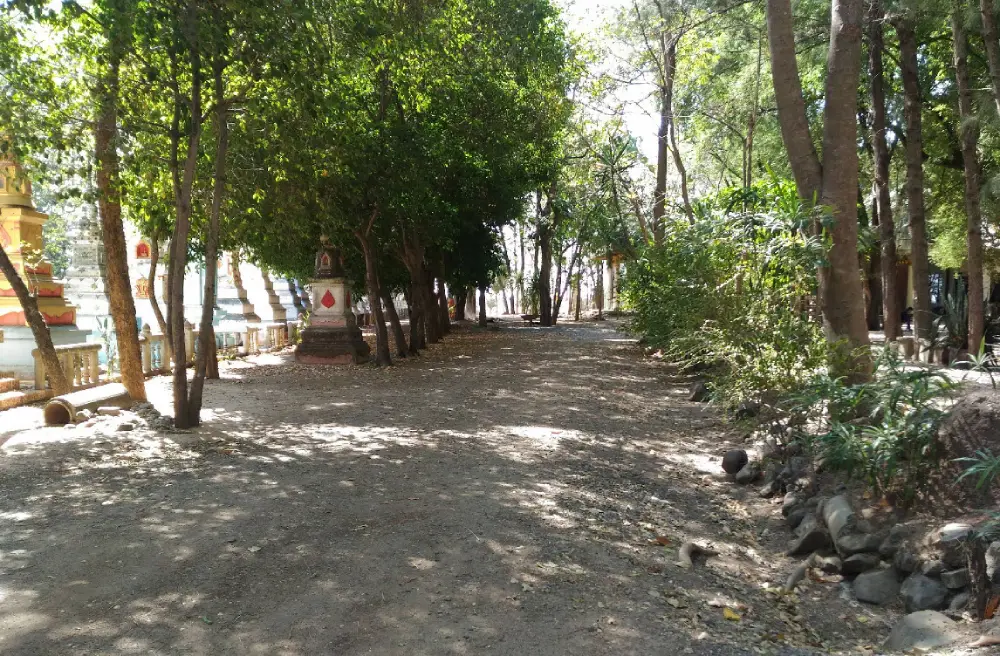
Wat Asok Nimittaram
Open Days: Daily
Opening Hours: 08.00 – 17.00
Wat Asok Nimittaram is a Buddhist temple located in Huai Racha Subdistrict, Huai Rat District, Buri Ram Province. It is a local Mahanikaya temple set on a raised earthen mound in the middle of rice fields. From a distance, the temple appears almost like a small island surrounded by farmland. This distinctive landscape makes Wat Asok Nimittaram different from many village temples because its beauty is not based on grandeur or commercial tourism. Its appeal lies in its quiet setting, its connection with rice-field life, and its role as a place for Sunday Dhamma practice in the Huai Rat community.
The temple is also known locally as Wat Khok Sung, a name that reflects its position on higher ground. In rural northeastern Thailand, place names often come from real landscape features. The word khok refers to a raised mound or higher patch of land, while sung means high. The local name therefore helps visitors understand the temple’s setting immediately: it stands above the surrounding fields, visible from afar and separated from the flat agricultural landscape around it.
Wat Asok Nimittaram is best visited as a peaceful cultural and spiritual destination rather than a crowded tourist attraction. Travelers who come here can pay respect, make merit, observe the temple atmosphere, and enjoy the calm view of the surrounding rice fields. The experience begins even before reaching the temple because the route passes through rural farmland. This gradual approach from the road into the open fields creates a sense of transition from everyday movement into a quieter Buddhist space.
The temple’s rice-field setting is one of its strongest identities. In the rainy season, the surrounding fields become green and fresh. Before harvest, the fields turn golden and warm. During the dry season, visitors can see the structure of the farmland, pathways, and the raised temple mound more clearly. Each season gives the temple a different character, making Wat Asok Nimittaram a place where Buddhist life and agricultural landscape are closely connected.
Wat Asok Nimittaram is a local temple under the Mahanikaya order and is recorded as a registered temple from 1941. This status places it within the formal Buddhist system while still preserving its role as a community temple. In Thailand, a local temple like this exists through the faith and support of villagers. People come to make merit, offer food, join ceremonies, participate in meditation, and maintain the temple as a shared spiritual center.
The current abbot of Wat Asok Nimittaram is Phra Khru Wisutthi Thammarot. As abbot, he oversees the temple, religious activities, and the spiritual needs of the community. The temple continues to serve local Buddhists through Buddhist holy day merit-making, Sunday practice activities, offerings, sermons, Kathin ceremonies, robe offerings, ordinations, funerary rites, and community merit-making events. This makes the temple a living Buddhist site rather than only a quiet rural landmark.
One of the most important features of Wat Asok Nimittaram is its Sunday Dhamma practice activity. Sunday is a practical day for working people, students, and families to come to the temple. The activity allows participants to chant, listen to Dhamma, meditate, reflect on themselves, and spend time in a peaceful environment. For travelers interested in Thai Buddhist practice, this role gives the temple a deeper meaning beyond sightseeing.
The landscape supports the temple’s meditation atmosphere. Open rice fields, wind, natural light, and distance from dense town areas help create calmness. Visitors who come here for quiet reflection may find the setting easier for mindfulness than a busy city temple. The temple is therefore suitable for those who want a simple and sincere Buddhist experience, especially people who appreciate silence, rural scenery, and slow travel.
Raised temple sites in rural Thailand often have practical and symbolic value. A higher mound is safer from standing water and easier to see across the fields. It also gives visitors the feeling of entering a distinct sacred space. At Wat Asok Nimittaram, this feeling is especially clear because the temple appears as a small island in the middle of rice fields. Walking or driving toward the temple becomes part of the spiritual experience.
The route to the temple is part of its identity. Local people know Wat Asok Nimittaram as a temple reached through rice-field surroundings, and the approach creates a memorable view. The road or bridge-like access through farmland does more than connect the temple to the outside. It shapes the way visitors experience the place. The temple gradually appears ahead, while the fields on both sides emphasize the calm and rural atmosphere of Huai Racha.
Inside the temple, important areas include the Buddhist worship zone, the principal Buddha image area, the temple courtyard, the Dhamma practice area, and quiet spaces where visitors can rest or reflect. Wat Asok Nimittaram is not designed as a large-scale tourist complex. Its value comes from simplicity and spiritual use. Visitors should walk calmly, speak quietly, and respect people who come for worship or meditation.
As a community temple, Wat Asok Nimittaram supports many forms of Buddhist activity. These include Buddhist holy day merit-making, food offerings, chanting, Dhamma listening, Sunday meditation practice, Kathin ceremonies, robe offerings, ordinations, funerary rites, and family merit-making. Such activities keep the temple connected with the daily and seasonal life of local people.
The temple is suitable for travelers who want to see the quieter side of Buri Ram. Many visitors know Buri Ram for Khmer temples, football, motorsport, or large provincial attractions. Wat Asok Nimittaram offers a different experience: a rural Buddhist temple surrounded by rice fields. It allows travelers to understand how local temples remain connected with farming communities, seasonal rhythms, and personal faith.
Those who visit during the rice-growing season will see the temple surrounded by green fields. Those who visit near harvest season will see golden rice fields and a warmer rural atmosphere. In the dry season, the temple’s mound and field paths become more visible. This seasonal change makes the temple especially meaningful for photographers and cultural travelers, although photography should always be done respectfully and without disturbing worshippers.
Wat Asok Nimittaram can be combined with other important places in Huai Rat District. Wat Prasat Sung, known for Luang Pho Ong Dam and local sacred legends, is one of the most meaningful nearby temples. While Wat Prasat Sung is known for its stories of sacred objects and local faith, Wat Asok Nimittaram is known for its quiet rice-field setting and Sunday Dhamma practice. Visiting both temples gives travelers a broader picture of Buddhist life in Huai Rat.
Wat Chaeng Samorathet is another nearby historic temple that pairs well with Wat Asok Nimittaram. It has a long temple history and formal Buddhist significance. A route including Wat Asok Nimittaram, Wat Chaeng Samorathet, and Wat Prasat Sung allows travelers to see three different temple identities in one district: a rice-field temple, an old community temple, and a temple with strong local sacred legends.
Wat Rat Rangsan can also be included in the route. It is a Mahanikaya local temple with complete monastic facilities and a strong role in community religious life. Combining Wat Asok Nimittaram with Wat Rat Rangsan helps visitors understand both the landscape-based identity of a rural temple and the administrative and social role of a community temple.
Ban Sanuan Nok Silk Tourism Village adds a cultural dimension to the journey. The community is known for silk weaving, mulberry cultivation, silkworm raising, silk reeling, Mudmee patterning, old houses, an old market, Ram Trot performance, and local food. Travelers who visit Wat Asok Nimittaram and then continue to Ban Sanuan Nok can experience both rural Buddhist faith and living community culture within Huai Rat District.
Getting There from Buri Ram city, travel toward Huai Rat District, then continue into Huai Racha Subdistrict and follow local roads to Wat Asok Nimittaram, also known as Wat Khok Sung. The distance from Buri Ram city is about 18–20 km, depending on the starting point and route. Private car, motorcycle, or locally arranged transport is recommended. When using navigation apps, search for Wat Asok Nimittaram, Huai Racha Subdistrict, Huai Rat District, Buri Ram Province, or Wat Khok Sung Huai Racha.
Visitors should allow about 45 minutes to 1 hour for a calm visit. This gives enough time to pay respect, make merit, observe the rice-field landscape, and spend a few quiet moments in the temple grounds. Those who want to join Sunday Dhamma practice should plan their schedule carefully, dress modestly, and arrive with a respectful attitude toward meditation activities.
Respectful behavior is important. Visitors should dress modestly, speak quietly, avoid disturbing monks and meditation participants, and take photographs only in appropriate areas. If people are chanting, meditating, or listening to Dhamma, visitors should keep distance and avoid disruptive behavior. The temple is a place of practice, not only a scenic viewpoint.
Food options are available in Huai Rat District and Buri Ram city. Mona Cafe Huai Rat is a convenient nearby option for food, drinks, and coffee. Local meals can also be arranged through Ban Sanuan Nok community, while Buri Ram city offers more restaurant and café choices such as The Tower Cafe & Hangout, Bamboo Bar Buriram, and Muang Pizza Buriram. Planning food stops in advance is useful because rural restaurants may be spread out.
Accommodation options are available near Huai Rat and in Buri Ram city. Baan Sanuan Resort and Ban Sanuan Nok community homestays are suitable for travelers who want to stay close to local culture and the silk tourism route. Those who prefer city hotels can stay at Best Western Royal Buriram Hotel, The Sita Princess Buriram, or Ray Hotel Buriram. The best choice depends on whether the trip focuses on Huai Rat community culture or broader travel around Buri Ram Province.
Overall, Wat Asok Nimittaram is a meaningful rural Buddhist temple where landscape, meditation, and community faith meet. Its raised mound in the rice fields gives it a memorable visual identity, while its Sunday Dhamma practice gives it a living spiritual role. For foreign travelers, the temple offers a quiet and authentic way to understand how Buddhism remains connected with farming life, village rhythm, and local faith in Buri Ram.
| Name | Wat Asok Nimittaram |
| Local Name | Wat Khok Sung |
| Location | Huai Racha Subdistrict, Huai Rat District, Buri Ram 31000 |
| Address | Huai Racha Subdistrict, Huai Rat District, Buri Ram Province, Thailand |
| English Name | Wat Asok Nimittaram |
| Highlights | A peaceful temple on a raised mound in the middle of rice fields, known for its island-like landscape, calm atmosphere, Sunday Dhamma practice, and rural Buddhist character in Huai Rat District |
| History / Temple Status | A local Mahanikaya Buddhist temple recorded as a registered temple from 1941 and serving as a religious center of Huai Racha community |
| Name Origin / Site Character | The local name Wat Khok Sung reflects the temple’s raised mound setting in the rice fields, while Wat Asok Nimittaram is the temple’s formal Buddhist name |
| Distinctive Features | Rice-field temple landscape, rural access route, peaceful surroundings, and a setting suitable for mindfulness and quiet reflection |
| Main Activities | Sunday Dhamma practice, Buddhist holy day merit-making, Kathin ceremony, robe offering, ordination ceremonies, memorial merit-making, and important Buddhist festival activities |
| Traditions / Rituals | Chanting, Dhamma listening, meditation, Sunday practice, food offerings, Buddhist holy day merit-making, and community religious ceremonies |
| Travel Information | From Buri Ram city, travel toward Huai Rat District, then continue into Huai Racha Subdistrict and follow local roads to Wat Asok Nimittaram or Wat Khok Sung. The distance is about 18–20 km. Private car, motorcycle, or locally arranged transport is recommended |
| Current Status | An active local Mahanikaya Buddhist temple and a Sunday Dhamma practice site for the community |
| Open Days | Daily |
| Opening Hours | 08.00 – 17.00 |
| Facilities | Temple courtyard, merit-making area, principal Buddha image worship area, Dhamma practice area, quiet resting space, and rice-field access route |
| Main Areas / Zones | Buddhist worship area, principal Buddha image area, Sunday Dhamma practice space, temple courtyard, raised temple mound, and rice-field landscape viewpoint |
| Abbot / Caretaker | Phra Khru Wisutthi Thammarot |
| Entrance Fee | Free Admission |
| Local Administrative Contact | Huai Rat Subdistrict Municipality, Tel. 044-696-170 |
| Nearby Tourist Attractions | 1. Wat Prasat Sung And Luang Pho Ong Dam, about 3 km 2. Wat Chaeng Samorathet, Huai Rat Subdistrict, about 6 km 3. Wat Rat Rangsan, Huai Rat Subdistrict, about 6 km 4. Ban Sanuan Nok Silk Tourism Village, about 10 km 5. Buri Ram City, about 18 km |
| Nearby Restaurants | 1. Mona Cafe Huai Rat, about 6 km, Tel. 093-027-8299 2. Ban Sanuan Nok Local Food Service, about 10 km, Tel. 085-411-4435, 094-979-2887 3. The Tower Cafe & Hangout Buriram, about 18 km, Tel. 044-666-305 4. Bamboo Bar Buriram, about 19 km, Tel. 044-625-577 5. Muang Pizza Buriram, about 19 km, Tel. 044-612-032, 062-138-9432 |
| Nearby Accommodations | 1. Baan Sanuan Resort, about 10 km, Tel. 084-496-8579 2. Ban Sanuan Nok Community Homestay, about 10 km, Tel. 085-411-4435, 094-979-2887 3. Best Western Royal Buriram Hotel, about 18 km, Tel. 044-666-600 4. The Sita Princess Buriram, about 19 km, Tel. 087-050-4864, 098-291-6649 5. Ray Hotel Buriram, about 20 km, Tel. 044-110-767 |
Frequently Asked Questions (FAQ)
Q: Where is Wat Asok Nimittaram located?
A: Wat Asok Nimittaram is located in Huai Racha Subdistrict, Huai Rat District, Buri Ram Province 31000. It is also known locally as Wat Khok Sung.
Q: What makes Wat Asok Nimittaram special?
A: The temple is set on a raised mound in the middle of rice fields, giving it an island-like appearance and a peaceful rural atmosphere suitable for worship and reflection.
Q: Who is the current abbot of Wat Asok Nimittaram?
A: The current abbot of Wat Asok Nimittaram is Phra Khru Wisutthi Thammarot.
Q: What day does Wat Asok Nimittaram hold Dhamma practice activities?
A: Wat Asok Nimittaram is known as a place for Sunday Dhamma practice, including chanting, Dhamma listening, meditation, and quiet reflection.
Q: What are the opening days and opening hours of Wat Asok Nimittaram?
A: The temple is open daily from 08.00 to 17.00. It is suitable for worship, merit-making, and cultural travel in Huai Rat District.
Q: Is there an entrance fee at Wat Asok Nimittaram?
A: There is no entrance fee. Visitors can enter for worship, merit-making, and peaceful sightseeing during opening hours.
Q: What nearby places can visitors combine with Wat Asok Nimittaram?
A: Visitors can combine the trip with Wat Prasat Sung, Wat Chaeng Samorathet, Wat Rat Rangsan, Ban Sanuan Nok Silk Tourism Village, and Buri Ram city.
Q: How can travelers get to Wat Asok Nimittaram?
A: From Buri Ram city, travel toward Huai Rat District, then continue into Huai Racha Subdistrict and follow local roads to Wat Asok Nimittaram or Wat Khok Sung. A private car, motorcycle, or locally arranged transport is recommended.
 Category: ●Places of Worship
 Group: ●Temple
Last Update : 3 MonthAgo
 Last Update : 3 MonthAgo
 Click to Access the Navigation Map GPS
Wat Asok Nimittaram Map
Recommend

 Art, Culture and Heritage
 Historical Sites and Monuments(14)
 Landmarks and Memorials(2)
 Art, Craft Centres, Tradition(6)
 Museums(3)
 Educational Places
 Museum for Study(1)
Temple(74)
Museum for Study(1)
Temple(74)
 Other Sacred Sites(5)
 Suburban Living
 Village, Community(3)
 Nature and Wildlife
 National Parks and Marine Reserves(2)
 Mountain (Doi)(1)
 Dam, Reservoir, Lake(14)
 River, Canal(1)
 Bays and Beaches(1)
 Other natural attractions(2)
 Entertainment and Agricultural
 Animal camps and shows(1)
 Stadium(2)
 Farms, Parks and Ecotourism(2)
 Waterpark(1)


