
lovethailand home >Northeastern Travel Attractions >Buri Ram Travel Attractions >Huai Rat >Huai Rat > Wat Prasat Sung
TL;DR: Wat Prasat Sung is located at Moo 7, Huai Rat Subdistrict, Huai Rat District, Buri Ram 31000, open Daily, hours 08.00 – 17.00.
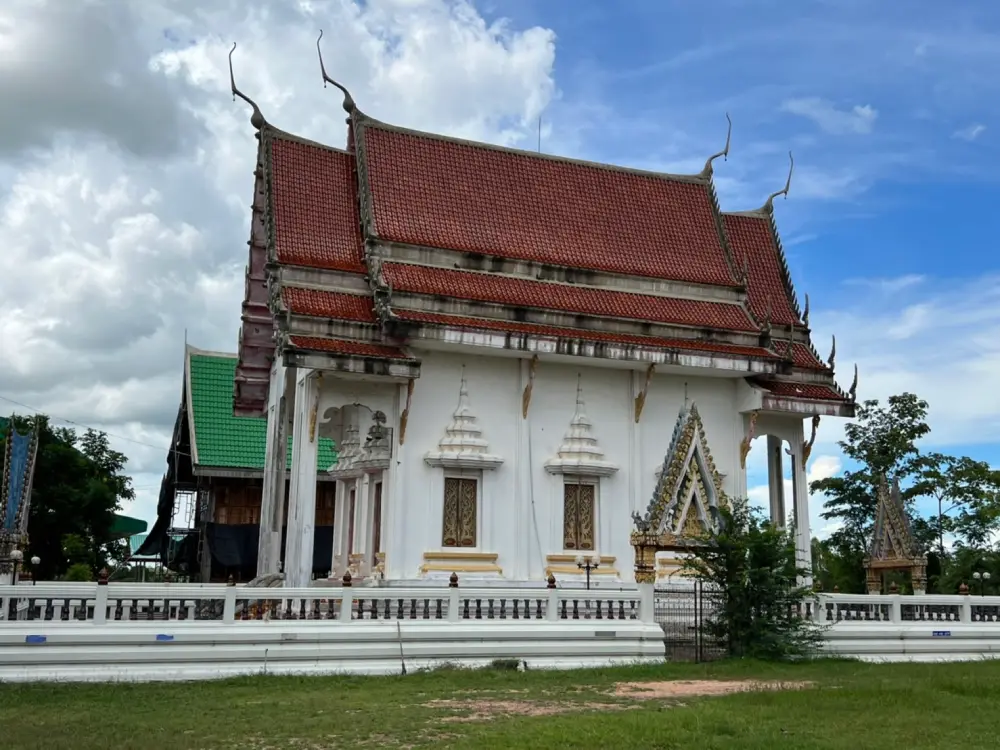
Wat Prasat Sung
Open Days: Daily
Opening Hours: 08.00 – 17.00
Wat Prasat Sung is a Buddhist temple located in Moo 7, Huai Rat Subdistrict, Huai Rat District, Buri Ram Province. It is an important local temple for Ban Phet community and one of the most meaningful spiritual places in Huai Rat District. The temple is known for its layered local legends, including Luang Ta Phu, the first abbot and founder of the temple, the sacred Bodhi tree he planted, the three prasat-style structures once used as Dhamma and food-offering halls, Luang Pho Ong Dam, the revered black Buddha image believed by local people to be a smiling Buddha, and the sacred stone known as Hin Sila Saksit. For foreign travelers, Wat Prasat Sung offers a quiet and authentic experience of rural Buddhist faith in Buri Ram.
The character of Wat Prasat Sung comes from the close relationship between Buddhist practice and local belief. It is not a commercial tourist attraction built for crowds. Its value lies in the way the temple preserves stories, sacred objects, community memory, and living religious practice. Visitors who come here can make merit, pay respect to Luang Pho Ong Dam, learn about the sacred Bodhi tree, observe the temple grounds, and understand how local temples in Thailand often serve as both religious centers and keepers of village legends.
The early history of the temple is connected with Luang Ta Phu, who is remembered as the first abbot and the monk who established Wat Prasat Sung. In the beginning, the temple had three prasat-style structures used as a Dhamma hall and a food-offering hall. These spaces supported meditation, Buddhist teaching, merit-making, communal meals, and other religious activities. This reflects the traditional role of a rural Thai temple as a place where spiritual practice, generosity, and community gathering come together.
Luang Ta Phu also planted a Bodhi tree within the temple grounds. Local tradition says that he made a wish that after his passing, if he reached heaven, the Bodhi tree would become beautiful. After he passed away, the tree grew beautifully, just as he had wished. For local people, this Bodhi tree is not simply a large tree providing shade. It is a living symbol of the founder’s merit, intention, and continuing presence in community memory.
The Bodhi tree carries deep Buddhist meaning because it is associated with the enlightenment of the Buddha. At Wat Prasat Sung, its meaning becomes even more local and intimate through the story of Luang Ta Phu. Villagers also tell a belief that if a branch of the Bodhi tree breaks toward a certain direction, news of someone’s death in the community may follow. Travelers should approach this story respectfully. Whether one shares the belief or not, it is part of the local spiritual imagination and should be treated as community heritage rather than a curiosity.
Another major sacred focus of Wat Prasat Sung is Luang Pho Ong Dam, the revered black Buddha image enshrined in the temple ordination hall. This image is deeply respected by local people and is widely remembered through the story that it is a smiling Buddha image. Local legend says that a nun once meditated and saw a Buddha image that revealed its name as “Dam,” meaning black. The person who commissioned the image was Nai Thun. The makers were Nai Pen and Nai Hian, and the person who offered the image to the temple was Palat Khiao. These names remain part of the living story of the image.
Local belief says that those with merit may see Luang Pho Ong Dam smile or even blink. Such stories are common in Thai Buddhist communities, where sacred images are often experienced not only as religious objects but also as living presences within the hearts of worshippers. At Wat Prasat Sung, Luang Pho Ong Dam is therefore more than a statue. It is a focus of devotion, prayer, blessing, and personal faith. Visitors should enter the ordination hall quietly, pay respect calmly, and avoid behavior that may disturb local worshippers.
Wat Prasat Sung is also known for Hin Sila Saksit, the sacred stone with a strong local legend. The story says that Luang Ta Phaeo once led temple boys to bring stones from beside the road to use as supports for a stove while preparing khao yaku, also called khao thip, a traditional ceremonial rice preparation. While Luang Ta Phaeo was lighting the fire, another elderly monk came and warned that the stone was about to crack. Luang Ta Phaeo then asked the temple boys to move the stone beneath the Dhamma pavilion.
Later, temple boys who were playing under the Dhamma pavilion saw the stone moving and told the adults, but at first no one believed them. The story continues that people who disrespected or mocked the stone became seriously ill and could not be cured by doctors. After they asked forgiveness from the stone for the offense, their condition improved. Local people then built a small pavilion for the stone and named it Hin Sila Saksit, the sacred stone. This story shows how local faith can transform an ordinary object into a sacred focus through shared experience and community memory.
The legends of Luang Ta Phu, the Bodhi tree, Luang Pho Ong Dam, and Hin Sila Saksit give Wat Prasat Sung its distinctive cultural identity. The temple is not only a place to make merit but also a place where stories, belief, and local history are preserved. These stories help villagers maintain a strong emotional connection with the temple. They also help visitors understand lower Isan Buddhism as something lived through memory, reverence, sacred places, and community storytelling.
Today, Wat Prasat Sung is an active local Buddhist temple. The current abbot is Phra Khru Sirinanthakhosit, and the temple has 7 resident monks. This confirms that the temple continues to function as a living religious site. Resident monks support daily and seasonal Buddhist activities such as merit-making, Buddhist holy day ceremonies, Kathin offerings, robe offerings, ordinations, funerary rites, blessings, and community religious events.
The temple covers about 15 rai of land. Its important areas include the ordination hall where Luang Pho Ong Dam is enshrined, the temple courtyard, the Bodhi tree area associated with Luang Ta Phu, the sacred stone pavilion, merit-making spaces, and areas used for community religious activities. Visitors should take time to walk slowly through the temple grounds because each area carries a different part of the temple’s story.
Wat Prasat Sung is also recognized as a cultural and religious site worth preserving. Its value is not only architectural but also spiritual and communal. Conservation of a place like this means protecting the temple grounds, sacred objects, oral traditions, local legends, and the relationship between the temple and villagers. Visitors can support this value by behaving respectfully, not touching sacred objects without permission, not climbing or leaning on religious structures, and not treating local beliefs as entertainment.
The temple is suitable for travelers who want to worship in Buri Ram, learn about local Buddhist legends, visit Luang Pho Ong Dam, and understand community faith in Huai Rat District. It is especially meaningful for travelers interested in local spirituality rather than only famous monuments. The temple’s charm lies in the depth of its stories and the quiet sincerity of its religious atmosphere.
Wat Prasat Sung can be combined with several nearby places in Huai Rat District. Wat Chaeng Samorathet, Ban Sanuan Nok Silk Tourism Village, Wat Sanuan Nok, Wat Pa Lelai or Wat Ban Mai, and Buri Ram city can all be included in the same travel route. This makes the temple suitable for a half-day or full-day cultural itinerary. Travelers may begin with Luang Pho Ong Dam at Wat Prasat Sung, continue to other old temples or the silk village, and then end the day with food or accommodation in Buri Ram city.
Wat Chaeng Samorathet is a nearby historic temple that pairs well with Wat Prasat Sung. While Wat Prasat Sung is strongly associated with Luang Pho Ong Dam, the Bodhi tree, and sacred stone legends, Wat Chaeng Samorathet is known for its long temple history and formal Buddhist status. Visiting both temples allows travelers to see different dimensions of Buddhist heritage in the same district.
Ban Sanuan Nok Silk Tourism Village adds a cultural dimension to the route. The community is known for mulberry cultivation, silkworm raising, silk reeling, Mudmee patterning, silk weaving, Ram Trot performance, old houses, an old market, and local food. Combining Wat Prasat Sung with Ban Sanuan Nok allows visitors to see both religious heritage and living community culture in Huai Rat District.
Wat Pa Lelai, also known as Wat Ban Mai, is another meaningful temple in the district. It has a long history, educational park status, and a role connected with Buddhist learning and practice. A route that includes Wat Prasat Sung, Wat Pa Lelai, and Wat Chaeng Samorathet gives travelers a broader understanding of old temples, local faith, meditation, and Buddhist education in Huai Rat.
Getting There from Buri Ram city, travel toward Huai Rat District and continue to Huai Rat Subdistrict, Moo 7. The temple can be reached by private car, motorcycle, or locally arranged transport. When using navigation apps, search for Wat Prasat Sung, Huai Rat Subdistrict, Huai Rat District, Buri Ram Province, or use the coordinates 14.9907736, 103.1958313 to avoid confusion with similarly named temples in other provinces.
Visitors should allow about 45 minutes to 1.5 hours for the temple. This gives enough time to pay respect inside the ordination hall, worship Luang Pho Ong Dam, visit the Bodhi tree, see the sacred stone pavilion, and walk quietly around the temple grounds. Morning and late afternoon are generally comfortable times to visit because the weather is cooler and the temple atmosphere is peaceful.
Respectful behavior is essential. Visitors should dress modestly, speak quietly, avoid disturbing monks and local worshippers, and avoid touching sacred objects unless permission is given. Local legends should be treated with respect even if visitors come from different cultural or religious backgrounds. At Wat Prasat Sung, faith and story are part of the temple’s identity.
Food options are available in Huai Rat District and Buri Ram city. Mona Cafe Huai Rat is a convenient nearby stop for food, drinks, and coffee. Travelers can also arrange local food through Ban Sanuan Nok community or continue to Buri Ram city for more choices, including The Tower Cafe & Hangout, Bamboo Bar Buriram, and Muang Pizza Buriram. Planning food stops in advance is useful because rural restaurants may be spread out.
Accommodation is available near Huai Rat and in Buri Ram city. Baan Sanuan Resort and Ban Sanuan Nok community homestays are suitable for travelers who want to stay near the cultural community and silk tourism route. Those who prefer city hotels can choose Best Western Royal Buriram Hotel, The Sita Princess Buriram, or Ray Hotel Buriram. The best option depends on whether the trip focuses on Huai Rat community culture or broader travel around Buri Ram Province.
Overall, Wat Prasat Sung is a meaningful community temple where Buddhist devotion, local legends, sacred objects, and village memory meet. Luang Ta Phu, the Bodhi tree, Luang Pho Ong Dam, and Hin Sila Saksit are all part of the temple’s identity. For foreign travelers, the temple offers a rare opportunity to understand how local Buddhist faith is preserved through stories, worship, and community continuity in rural Buri Ram.
| Name | Wat Prasat Sung |
| Location | Moo 7, Huai Rat Subdistrict, Huai Rat District, Buri Ram 31000 |
| Address | Ban Phet, Moo 7, Huai Rat Subdistrict, Huai Rat District, Buri Ram Province, Thailand |
| Coordinates | 14.9907736, 103.1958313 |
| Highlights | Luang Pho Ong Dam, the revered black Buddha image; the smiling Buddha legend; Luang Ta Phu’s Bodhi tree; the sacred stone Hin Sila Saksit; and the story of three prasat-style structures used as Dhamma and food-offering halls |
| History | Wat Prasat Sung was founded by Luang Ta Phu, the first abbot, who established the temple as a Buddhist religious center for Ban Phet community. The temple covers about 15 rai and remains an active local Buddhist temple |
| Name Origin / Site Character | The temple name is associated with the three prasat-style structures in its early history, used as a Dhamma hall, food-offering hall, meditation area, and Buddhist activity space |
| Distinctive Features | A local temple with strong community legends, including Luang Ta Phu, the Bodhi tree, Luang Pho Ong Dam, and Hin Sila Saksit |
| Important Buddha Image | Luang Pho Ong Dam, the revered black Buddha image enshrined in the ordination hall and remembered by local people through the smiling Buddha legend |
| Important Sacred Objects | Luang Ta Phu’s Bodhi tree and Hin Sila Saksit, the sacred stone with a local pavilion for worship |
| Traditions / Rituals | Buddhist holy day merit-making, Kathin ceremony, robe offering, ordination ceremonies, memorial merit-making, worship of Luang Pho Ong Dam, and respectful worship of Hin Sila Saksit |
| Travel Information | From Buri Ram city, travel toward Huai Rat District and continue to Huai Rat Subdistrict, Moo 7. Private car, motorcycle, or locally arranged transport is recommended. Search with the full temple name, subdistrict, district, and province |
| Current Status | An active local Buddhist temple and spiritual center of Ban Phet community in Huai Rat Subdistrict |
| Open Days | Daily |
| Opening Hours | 08.00 – 17.00 |
| Facilities | Ordination hall, temple courtyard, merit-making area, Luang Pho Ong Dam worship area, Bodhi tree area, sacred stone pavilion, and Buddhist activity space |
| Main Areas / Zones | Buddhist worship area, Luang Pho Ong Dam ordination hall, Luang Ta Phu Bodhi tree area, Hin Sila Saksit pavilion, temple courtyard, merit-making area, and community religious activity space |
| Abbot / Caretaker | Phra Khru Sirinanthakhosit |
| Resident Monks | 7 monks |
| Local Administrative Contact | Huai Rat Subdistrict Municipality, Tel. 044-696-170 |
| Nearby Tourist Attractions | 1. Wat Chaeng Samorathet, Huai Rat Subdistrict, about 6 km 2. Ban Sanuan Nok Silk Tourism Village, about 8 km 3. Wat Sanuan Nok, Sanuan Subdistrict, about 8 km 4. Wat Pa Lelai (Wat Ban Mai), Sam Waeng Subdistrict, about 10 km 5. Buri Ram City, about 16 km |
| Nearby Restaurants | 1. Mona Cafe Huai Rat, about 5 km, Tel. 093-027-8299 2. Ban Sanuan Nok Local Food Service, about 8 km, Tel. 085-411-4435, 094-979-2887 3. The Tower Cafe & Hangout Buriram, about 17 km, Tel. 044-666-305 4. Bamboo Bar Buriram, about 18 km, Tel. 044-625-577 5. Muang Pizza Buriram, about 18 km, Tel. 044-612-032, 062-138-9432 |
| Nearby Accommodations | 1. Baan Sanuan Resort, about 8 km, Tel. 084-496-8579, 064-786-4626 2. Ban Sanuan Nok Community Homestay, about 8 km, Tel. 085-411-4435, 094-979-2887 3. Best Western Royal Buriram Hotel, about 17 km, Tel. 044-666-600 4. The Sita Princess Buriram, about 18 km 5. Ray Hotel Buriram, about 19 km |
Frequently Asked Questions (FAQ)
Q: Where is Wat Prasat Sung located?
A: Wat Prasat Sung is located in Moo 7, Huai Rat Subdistrict, Huai Rat District, Buri Ram Province 31000.
Q: Why is Wat Prasat Sung important?
A: Wat Prasat Sung is an important community temple in Huai Rat District, known for Luang Ta Phu, the sacred Bodhi tree, Luang Pho Ong Dam, and Hin Sila Saksit.
Q: What is Luang Pho Ong Dam at Wat Prasat Sung?
A: Luang Pho Ong Dam is the revered black Buddha image enshrined in the temple ordination hall. Local people remember it through the legend of the smiling Buddha image.
Q: What is the story of Hin Sila Saksit?
A: Hin Sila Saksit is the sacred stone connected with the story of Luang Ta Phaeo, temple boys, and a stone once brought for use during the preparation of khao yaku. Local people later built a pavilion for worship.
Q: Who is the current abbot of Wat Prasat Sung?
A: The current abbot of Wat Prasat Sung is Phra Khru Sirinanthakhosit.
Q: What are the opening days and opening hours of Wat Prasat Sung?
A: The temple is open daily from 08.00 to 17.00. It is suitable for worship, merit-making, and local cultural travel in Huai Rat District.
Q: What nearby places can visitors combine with Wat Prasat Sung?
A: Visitors can combine the trip with Wat Chaeng Samorathet, Ban Sanuan Nok Silk Tourism Village, Wat Sanuan Nok, Wat Pa Lelai, and Buri Ram city.
Q: How can travelers get to Wat Prasat Sung?
A: From Buri Ram city, travel toward Huai Rat District and continue to Huai Rat Subdistrict, Moo 7. A private car, motorcycle, or locally arranged transport is recommended.
 Category: ●Places of Worship
 Group: ●Temple
Last Update : 3 MonthAgo
 Last Update : 3 MonthAgo
 Click to Access the Navigation Map GPS
 Art, Culture and Heritage
 Historical Sites and Monuments(14)
 Landmarks and Memorials(2)
 Art, Craft Centres, Tradition(6)
 Museums(3)
 Educational Places
 Museum for Study(1)
Temple(74)
Museum for Study(1)
Temple(74)
 Other Sacred Sites(5)
 Suburban Living
 Village, Community(3)
 Nature and Wildlife
 National Parks and Marine Reserves(2)
 Mountain (Doi)(1)
 Dam, Reservoir, Lake(14)
 River, Canal(1)
 Bays and Beaches(1)
 Other natural attractions(2)
 Entertainment and Agricultural
 Animal camps and shows(1)
 Stadium(2)
 Farms, Parks and Ecotourism(2)
 Waterpark(1)


