
lovethailand home >Northeastern Travel Attractions >Buri Ram Travel Attractions >Lam Plai Mat >Ban Yang > Wat Pho Yoi
TL;DR: Wat Pho Yoi is located at Ban Yang, Ban Yang Subdistrict, Lam Plai Mat District, Buriram Province, open Daily, hours 08.00 – 17.00.
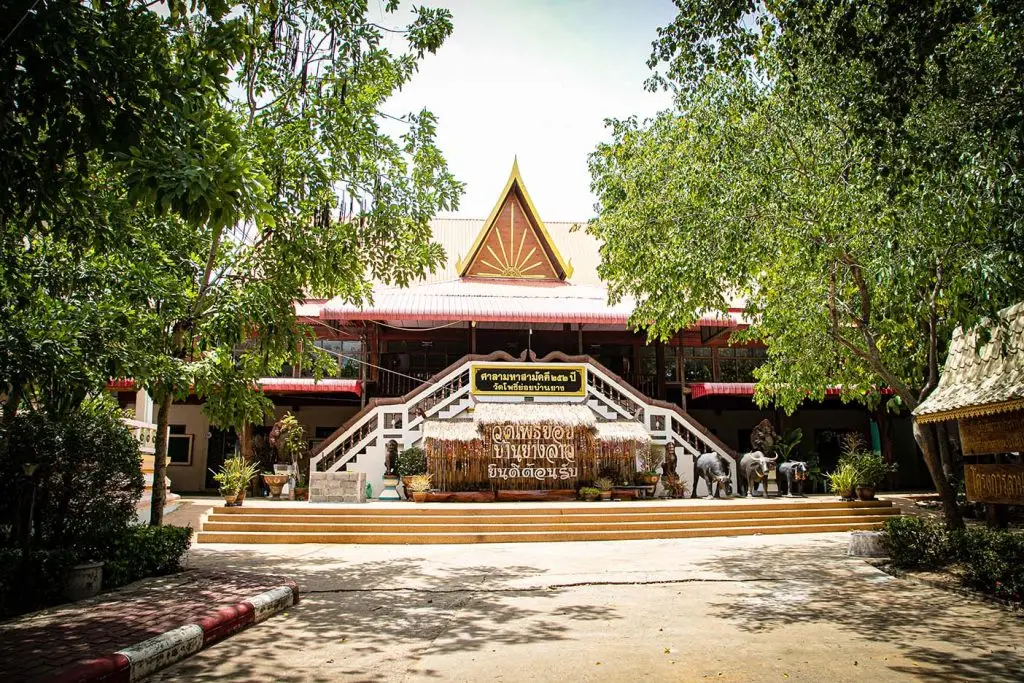
Wat Pho Yoi
Open Days: Daily
Opening Hours: 08.00 – 17.00
Wat Pho Yoi is located in Ban Yang, Ban Yang Subdistrict, Lam Plai Mat District, Buriram Province. It is one of the old community temples of Lam Plai Mat and an important spiritual center for the people of Ban Yang. The temple is associated with the story of Pho Phia Khan, an early Lao-born community leader who is believed to have helped establish the village, the community, and the temple. Today, Wat Pho Yoi remains significant for its old Buddha image with long ears, its annual Tak Bat Thewo tradition after Buddhist Lent, and its distinctive local dress culture in which men wear sarongs and women wear traditional tube skirts when entering the temple.
For travelers who want to understand Buriram beyond major tourist attractions, Wat Pho Yoi offers a meaningful view of a living Isan temple. This is not a temple known mainly for grand architecture or large-scale tourism. Its value lies in local history, inherited faith, community memory, and the way the people of Ban Yang continue to preserve customs connected with temple life. A visit to Wat Pho Yoi is therefore a visit to a temple, a village history, and a cultural identity at the same time.
Wat Pho Yoi is a local Buddhist temple under the Mahanikaya order. Temple records identify its establishment in 2301 BE, while the temple received its official consecrated boundary on August 8, 2013. In local memory, the temple is also remembered through its 100th anniversary celebration held in 2010. These layers of recorded history and community memory show how deeply the temple is tied to Ban Yang and the people who have sustained it for generations.
The history of Wat Pho Yoi is closely connected with Pho Phia Khan. Local tradition holds that he was of Lao origin and was one of the early figures who led people to settle in the area, build homes, form the community, and establish the temple. Several old family lines in Ban Yang, such as Chat Damdi, Chat Sak, and Phia Khantha, are remembered in relation to the village’s early settlement. These names are more than family labels. They are part of the cultural memory that explains how Ban Yang developed and why Wat Pho Yoi remains central to the identity of the community.
The name Wat Pho Yoi is linked with the landscape of the temple area, where bodhi trees were once found around the temple and nearby spaces. In Buddhism, the bodhi tree carries deep religious meaning because it is associated with the Buddha’s enlightenment. The name therefore suggests shade, refuge, spiritual grounding, and the presence of Buddhism in the life of the village. The temple name itself becomes a reminder of both nature and faith.
One of the most important sacred objects at Wat Pho Yoi is its old Buddha image enshrined inside the ordination hall. Local people believe that this image was shaped by early Lao settlers. Its most distinctive feature is its long ears, a rare characteristic that is not commonly seen today. The image is therefore valuable not only as an object of worship, but also as an expression of village craftsmanship, Buddhist devotion, and the cultural roots of Ban Yang.
The long-eared Buddha image should be viewed with respect. For the people of Ban Yang, it represents the faith of earlier generations and the continuity of the community. It is not simply an old statue. It is a sacred image that connects present-day villagers with their ancestors, their settlement history, and their Buddhist way of life. Visitors entering the ordination hall should behave quietly, dress modestly, avoid disturbing worshippers, and refrain from touching sacred objects without permission.
Wat Pho Yoi is currently under the care of Phra Sri Pariyattithada, Assistant Professor Dr., who serves as the abbot of the temple and as Deputy Ecclesiastical Provincial Governor of Buriram. He has served as abbot of Wat Pho Yoi since 2002 and also holds important roles in Buddhist education and monastic administration. His leadership gives the temple significance beyond the local village level and connects Wat Pho Yoi with the wider Buddhist community of Buriram Province.
Another unique feature of Wat Pho Yoi is its local dress culture. In the Ban Yang community, men traditionally do not wear trousers when entering the temple; instead, they wear a sarong. Women wear a traditional tube skirt. This custom reflects respect, modesty, and local identity. For foreign travelers, this is one of the most memorable aspects of the temple because it shows that temple culture is not only about buildings and rituals, but also about the way people prepare themselves physically and mentally before entering a sacred space.
The sarong and tube skirt tradition is more than clothing. It represents a cultural code of respect. When villagers enter the temple, they adjust their appearance, manners, and state of mind. This creates a clear distinction between ordinary daily life and sacred temple space. Visitors who dress respectfully or choose clothing that aligns with local modesty help show consideration for the community and the temple’s inherited customs.
The most important annual tradition at Wat Pho Yoi is Tak Bat Thewo, held around the end of Buddhist Lent. This ceremony is connected with the Buddhist belief in the Buddha’s descent from Tavatimsa Heaven after teaching the Dhamma to his mother. At Wat Pho Yoi, villagers gather to make merit, offer food to monks, and preserve a long-standing community tradition. The event is especially meaningful because it combines Buddhist faith with local dress culture and the shared identity of Ban Yang.
During the Tak Bat Thewo period, the temple becomes more active than usual. Families, elders, children, and community members gather at the temple with offerings. Men wearing sarongs and women wearing tube skirts create a dignified and beautiful atmosphere. The ceremony is not only a religious event; it is also a moment when the community comes together, younger generations observe local customs, and the temple continues its role as the heart of village life.
Wat Pho Yoi is also meaningful for travelers interested in Lao-Isan cultural heritage. The story of Pho Phia Khan and the belief that the old Buddha image was created by Lao settlers show how migration, settlement, Buddhism, and community identity developed together. This gives the temple a depth that cannot be understood through a quick visit alone. The more time visitors spend learning the story, the more clearly they can see why the temple is important to Ban Yang.
The temple is suitable for many types of travelers. Buddhist visitors can pay respect to the old Buddha image. Cultural travelers can learn about sarong and tube-skirt traditions. History-oriented visitors can explore the story of Pho Phia Khan and the old families of Ban Yang. Families can use the visit to teach children about village history, respect for sacred spaces, and the importance of preserving local customs.
Visitors should make sure they are traveling to Wat Pho Yoi in Ban Yang, Ban Yang Subdistrict, Lam Plai Mat District, Buriram Province, because there are other temples in Buriram with very similar names. Using the village name Ban Yang and the coordinates 14.86509, 102.86934 will help ensure accurate navigation. This is especially important for travelers using map applications or planning a route from other districts.
Getting There is easiest by private car or rental car. From Lam Plai Mat town, travel toward Ban Yang Subdistrict and Ban Yang village, about 17 km away. From Buriram city, travel toward Lam Plai Mat District and continue to Ban Yang, about 50 km in total. The temple can be visited as a half-day cultural trip or combined with nearby places such as Lam Plai Mat Railway Station, Khlong Plai Mat, Wat Chaeng Talat Pho, and Play La Ploen in Khu Mueang District.
The best time to visit is in the morning or late afternoon, when the weather is more comfortable. Travelers who want to experience local tradition should visit around the end of Buddhist Lent during the Tak Bat Thewo ceremony. Those who prefer a quieter visit should come on normal weekdays, when they can spend time paying respect, observing the old Buddha image, and learning about the temple’s history more calmly.
For photography, Wat Pho Yoi offers strong cultural-documentary moments, especially during merit-making events and the Tak Bat Thewo ceremony. However, photography should always be done respectfully. Visitors should avoid disturbing monks or worshippers and should ask permission before photographing people, especially during religious rituals.
In the broader travel context of Buriram, Wat Pho Yoi adds an important local dimension. Buriram is widely known for Khmer sanctuaries, sports tourism, and major attractions, but temples like Wat Pho Yoi show the quieter cultural life of rural communities. The temple represents old village faith, Lao-Isan roots, Buddhist art, traditional clothing, and seasonal merit-making. These elements make it a meaningful destination for travelers who want to see a deeper side of the province.
In summary, Wat Pho Yoi in Ban Yang, Lam Plai Mat District, Buriram Province is an old community temple with historical, religious, and cultural value. It preserves the story of Pho Phia Khan, the identity of old Ban Yang families, a rare long-eared Buddha image, the Tak Bat Thewo tradition, and the beautiful custom of wearing sarongs and tube skirts to the temple. For travelers interested in local Buddhism and Isan cultural heritage, Wat Pho Yoi is a quiet but deeply meaningful place to visit.
| Name | Wat Pho Yoi |
| Location | Ban Yang, Ban Yang Subdistrict, Lam Plai Mat District, Buriram Province |
| Address | Ban Yang Subdistrict, Lam Plai Mat District, Buriram Province 31130, Thailand |
| Coordinates | 14.86509, 102.86934 |
| Highlights | An old temple of Ban Yang with a rare long-eared Buddha image, the Tak Bat Thewo tradition, and a distinctive sarong and tube-skirt dress culture |
| History | A local Buddhist temple under the Mahanikaya order. Temple records identify its establishment in 2301 BE and its consecrated boundary on August 8, 2013. The community also held a 100th anniversary celebration in 2010. |
| Name Origin | The name Wat Pho Yoi is linked with the bodhi trees that once grew around the temple and nearby areas. |
| Distinctive Features | A historic community temple connected with Pho Phia Khan, early Lao settlement, old Ban Yang family lines, a long-eared Buddha image, and traditional temple dress customs |
| Important Buddha Image | An old long-eared Buddha image enshrined inside the ordination hall, believed by local people to have been created by early Lao settlers of Ban Yang |
| Annual Tradition | Tak Bat Thewo after Buddhist Lent, an important community merit-making tradition |
| Cultural Dress Tradition | Men traditionally wear sarongs and women wear tube skirts when entering the temple, reflecting modesty and respect for the sacred space. |
| Travel Information | About 17 km from Lam Plai Mat town via Ban Yang Subdistrict, and about 50 km from Buriram city via Lam Plai Mat District |
| Current Status | An active local Buddhist temple and spiritual center of Ban Yang, Lam Plai Mat District |
| Open Days | Daily |
| Opening Hours | 08.00 – 17.00 |
| Facilities | Worship area, ordination hall, temple hall, religious activity area, and parking space within the temple grounds |
| Main Areas / Zones | Ordination hall, old long-eared Buddha image, merit-making area, temple hall, and space for the Tak Bat Thewo tradition |
| Abbot / Caretaker | Phra Sri Pariyattithada, Assistant Professor Dr., Deputy Ecclesiastical Provincial Governor of Buriram |
| Resident Monks | 14 monks |
| Official Website / Official Page | Facebook: Wat Pho Yoi |
| Nearby Tourist Attractions | 1. Wat Pho Yoi Ban Yang, Inside The Temple Area 2. Ban Yang Community, About 1 km 3. Lam Plai Mat Railway Station, About 17 km 4. Khlong Plai Mat, About 18 km 5. Wat Chaeng Talat Pho, About 18 km 6. Play La Ploen, Khu Mueang District, About 38 km |
| Nearby Restaurants | 1. Jacky Cafe’ Lam Plai Mat, About 17 km, Tel. 064-974-8087 2. i want cafe Lam Plai Mat, About 17 km, Tel. 097-335-9366 3. Kinnara Cafe’, About 19 km, Tel. 094-514-3880 4. Suan Ahan Lao Rim Tang, Lam Plai Mat District, About 19 km 5. Play La Pirom At Play La Ploen Boutique Resort, About 38 km, Tel. 087-799-4936, 087-798-1039 |
| Nearby Accommodations | 1. Thanaphat Place Lam Plai Mat, About 17 km, Tel. 095-194-7955 2. Play La Ploen Boutique Resort, About 38 km, Tel. 087-797-6425 3. Ban Sanuan Resort, About 35 km 4. Paradise Resort Buriram, About 50 km 5. Diamond Grand Hotel Buriram, About 50 km |
Frequently Asked Questions (FAQ)
Q: Where is Wat Pho Yoi located?
A: Wat Pho Yoi is located in Ban Yang, Ban Yang Subdistrict, Lam Plai Mat District, Buriram Province, Thailand.
Q: Why is Wat Pho Yoi important?
A: Wat Pho Yoi is an old community temple connected with the history of Ban Yang, the story of Pho Phia Khan, a rare long-eared Buddha image, and traditional temple dress culture.
Q: What is special about the Buddha image at Wat Pho Yoi?
A: The temple’s old Buddha image is known for its long ears and is believed by local people to have been created by early Lao settlers of Ban Yang.
Q: Who is the abbot of Wat Pho Yoi?
A: The abbot is Phra Sri Pariyattithada, Assistant Professor Dr., who also serves as Deputy Ecclesiastical Provincial Governor of Buriram.
Q: What annual tradition is held at Wat Pho Yoi?
A: The temple holds the Tak Bat Thewo merit-making tradition around the end of Buddhist Lent.
Q: What should visitors wear at Wat Pho Yoi?
A: Visitors should dress modestly. The local tradition is for men to wear sarongs and women to wear traditional tube skirts when entering the temple.
Q: How can travelers get to Wat Pho Yoi?
A: The easiest way is by private car or rental car. From Lam Plai Mat town, travel toward Ban Yang Subdistrict and use the coordinates 14.86509, 102.86934 for accurate navigation.
Q: What nearby places can be visited with Wat Pho Yoi?
A: Nearby places include Ban Yang Community, Lam Plai Mat Railway Station, Khlong Plai Mat, Wat Chaeng Talat Pho, and Play La Ploen in Khu Mueang District.
 Category: ●Places of Worship
 Group: ●Temple
Last Update : 3 MonthAgo
 Last Update : 3 MonthAgo
 Click to Access the Navigation Map GPS
 Art, Culture and Heritage
 Historical Sites and Monuments(14)
 Landmarks and Memorials(2)
 Art, Craft Centres, Tradition(6)
 Museums(3)
 Educational Places
 Museum for Study(1)
Temple(74)
Museum for Study(1)
Temple(74)
 Other Sacred Sites(5)
 Suburban Living
 Village, Community(3)
 Nature and Wildlife
 National Parks and Marine Reserves(2)
 Mountain (Doi)(1)
 Dam, Reservoir, Lake(14)
 River, Canal(1)
 Bays and Beaches(1)
 Other natural attractions(2)
 Entertainment and Agricultural
 Animal camps and shows(1)
 Stadium(2)
 Farms, Parks and Ecotourism(2)
 Waterpark(1)


