
lovethailand home >Northeastern Travel Attractions >Buri Ram Travel Attractions >Lam Plai Mat >Tha Men Chai > Wat Isan Thamen Chai
TL;DR: Wat Isan Thamen Chai is located at Moo 1, Thamen Chai Subdistrict, Lam Plai Mat District, Buriram Province, open Daily, hours 08.00 – 17.00.

Wat Isan Thamen Chai
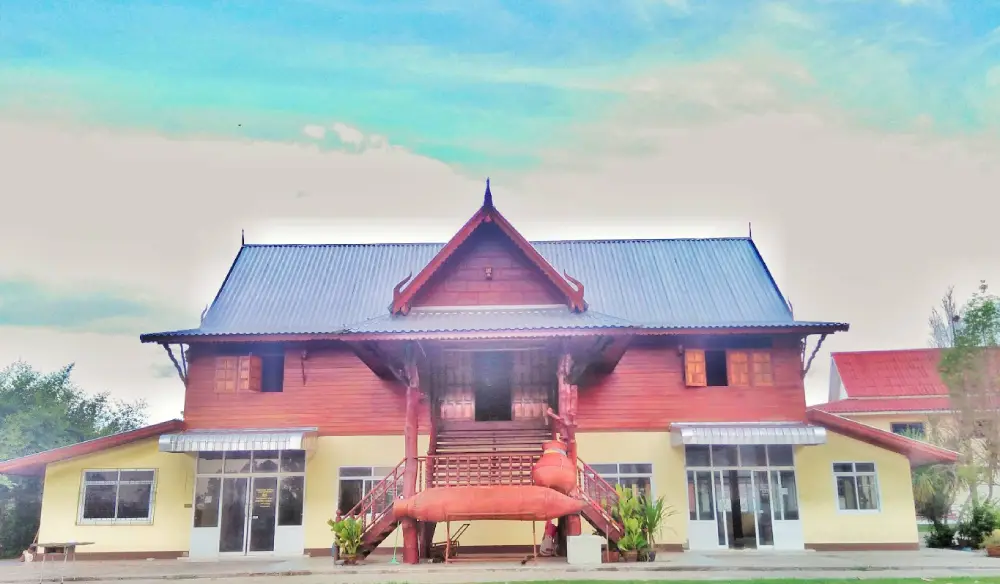
Open Days: Daily
Opening Hours: 08.00 – 17.00
Wat Isan Thamen Chai is located in Moo 1, Thamen Chai Subdistrict, Lam Plai Mat District, Buriram Province. It is one of the oldest and most historically meaningful temples in Lam Plai Mat District. The temple was established before 1932 and is remembered as the first temple in the area to have a district ecclesiastical chief, as well as the first temple associated with an ordination preceptor. For travelers interested in local Buddhist history, community heritage, ancient settlements, and temple-based learning, Wat Isan Thamen Chai offers a depth of cultural value that goes far beyond a typical temple visit.
The temple is important not only as a Buddhist place of worship, but also as a cultural and historical center of Ban Thamen Chai Ancient Community. Around the temple area, traces of earlier settlement, old religious boundaries, sandstone fragments, pottery, human bone fragments, palm-leaf manuscripts, and local objects have been preserved. These details make Wat Isan Thamen Chai a valuable destination for visitors who want to understand how religion, archaeology, community memory, and everyday life are connected in rural Isan.
Wat Isan Thamen Chai was built before 1932, which means it has existed through major periods of change in modern Thai history. Its continued presence reflects the long relationship between Buddhism and the people of Lam Plai Mat District. In the past, temples were not only places for ceremonies, but also centers of education, social organization, community leadership, and moral guidance. Wat Isan Thamen Chai clearly reflects this broader role of a Thai village temple.
The fact that Wat Isan Thamen Chai was the first temple in the area to have a district ecclesiastical chief gives it special significance in the history of the local Sangha administration. A district ecclesiastical chief is responsible for supervising monastic affairs across a wider area, while an ordination preceptor plays a crucial role in Buddhist ordination ceremonies. These roles show that the temple was once a major religious center for the district, not merely a small local monastery.
The setting of Wat Isan Thamen Chai is closely linked with Ban Thamen Chai Ancient Community. This ancient settlement has an oval-shaped layout and is surrounded by several layers of moats. It is located near Lam Plai Mat stream, which flows toward the Mun River system. The landscape suggests that this area was suitable for settlement in earlier periods and helps explain why the temple became a significant spiritual and cultural center for the local community.
Within the temple grounds, the ordination hall is one of the most important areas. Around the ordination hall are stone boundary markers, known in Thai as sema stones, as well as sandstone fragments that may have been parts of older architecture or ritual objects. These features add historical depth to the temple and show that the site has long been associated with sacred space, religious practice, and local identity.
One of the most notable areas near the ordination hall is a small pavilion where human bone fragments and earthenware pottery fragments found in the ancient community have been collected and preserved. These objects were discovered by local residents and brought to the temple for safekeeping. They provide an important connection between the living community and the people who inhabited this area in the distant past.
The temple also preserves other archaeological and cultural objects received from local villagers. These include glazed pottery associated with ancient Khmer culture, earthenware vessels, traditional fermented-fish jars, and everyday tools. The act of collecting and preserving these objects at the temple shows how a local Buddhist temple can function as a community archive, protecting objects that might otherwise be lost.
Wat Isan Thamen Chai is also home to a local museum. The museum preserves a wide range of cultural objects, including 44 bundles of Buddhist palm-leaf manuscripts written in Tham Isan and Khom Thai scripts. Their contents include Jataka stories, Abhidhamma texts, folk tales, and Buddhist moral narratives. These manuscripts are especially valuable because they show how Buddhist knowledge, literature, and local wisdom were transmitted before modern printed books became widely available.
The palm-leaf manuscripts are among the most meaningful objects at the temple. They are not simply old written materials. They represent a learning tradition in which monks and local scholars copied, read, taught, and preserved Buddhist knowledge through the temple system. For foreign travelers, these manuscripts offer a rare window into the intellectual and religious culture of Isan communities in earlier times.
The local museum also keeps a sandalwood Buddha image, which reflects the Isan belief in making merit through the creation of sacred images. Wooden Buddha images are closely connected with village faith and local craftsmanship. Unlike large royal or state-sponsored Buddha images, many wooden images were created through the devotion of ordinary people, making them important expressions of community-based Buddhism.
In addition to religious objects, the museum preserves everyday items such as pottery, old cooking utensils, metal tools, betel-nut containers, musical instruments, and household objects. These items help visitors understand local history through ordinary life. They show how people cooked, worked, stored food, made offerings, played music, and maintained social relationships in the past.
Another important part of the temple is the Wat Isan Thamen Chai Library. The library was established on November 1, 1992, to collect books for public study. Located inside the calm and shady temple grounds, it has served the general public and has also accepted donated old books. This library gives the temple another educational role, linking Buddhist space with reading, learning, and the sharing of knowledge.
The temple library is significant because it shows that Wat Isan Thamen Chai is not only a historical and religious site, but also a place of continuing education. A temple library makes books accessible in a familiar community space. It also turns the act of donating books into a form of public merit, allowing knowledge to circulate from one person to another through the temple.
Together, the local museum and the temple library make Wat Isan Thamen Chai an unusually rich cultural site. The temple preserves both ancient and modern forms of knowledge: palm-leaf manuscripts, donated books, archaeological objects, household tools, ritual objects, and local stories. Visitors can therefore experience the temple as a place of worship, a museum, a library, and a community memory center at the same time.
Another nearby sacred site is Chao Pho Hin Tang Shrine, located about 100 metres south of the ancient community, before Thamen Chai Railway Station and the market area along the railway. The shrine is respected by people in Thamen Chai and nearby areas. Its presence alongside Wat Isan Thamen Chai shows the coexistence of Buddhist practice and local sacred beliefs within the same community landscape.
The cultural background of Thamen Chai is layered and diverse. Evidence from the area points to ancient settlement, Khmer cultural influence, Lan Xang-related migration, and the presence of Thai-Chinese communities around the market. Visiting Wat Isan Thamen Chai therefore helps travelers understand a broader cultural story: one in which Buddhism, ancient settlement, local spirits, trade, and community life developed together over time.
Today, Wat Isan Thamen Chai is an active local Buddhist temple. The abbot is Phra Khru Chai Thammakhut, also known as Samat, who is also associated with the ecclesiastical administration of Thamen Chai Subdistrict. The temple has 6 resident monks and continues to serve as a place for Buddhist worship, merit-making, community ceremonies, and cultural preservation.
Visitors should begin their visit by paying respect at the temple and observing the ordination hall. They can then spend time around the old boundary stones, the small pavilion with archaeological remains, the local museum, and the library. Some areas may contain fragile or culturally sensitive objects, so visitors should ask politely before touching, photographing, or entering storage areas.
For history-oriented travelers, Wat Isan Thamen Chai deserves a slow visit. The temple is not best understood through quick sightseeing. Its value lies in details: stone markers, sandstone fragments, pottery, human remains, palm-leaf manuscripts, a wooden Buddha image, and donated books. Each of these elements tells part of the story of Thamen Chai as a living community with a deep historical foundation.
For families and students, the temple can be an excellent informal learning site. Children can see that history is not only found in textbooks. It can be found in temples, old objects, local museums, libraries, and the names of villages and shrines. A visit to Wat Isan Thamen Chai can help young people connect Buddhism, archaeology, reading culture, and local identity in a practical way.
From a travel perspective, Wat Isan Thamen Chai can be included in a cultural route through Lam Plai Mat District. Visitors can combine the temple with Ban Thamen Chai Ancient Community, Chao Pho Hin Tang Shrine, Thamen Chai Railway Station, the railway-side market area, Wat Chaeng Talat Pho, Khlong Plai Mat, and Play La Ploen in Khu Mueang District. This route gives a broader view of local culture, history, faith, and everyday life in Buriram.
The temple is especially suitable for travelers who prefer quiet cultural destinations rather than crowded tourist attractions. It does not rely on grand architecture or large-scale visual spectacle. Its strength lies in historical depth, community memory, and the preservation of local knowledge. Visitors who come with curiosity and respect will gain a much richer experience than those who come only for photographs.
Visitors should dress modestly, speak quietly, and respect the temple as an active Buddhist place of worship. Objects in the museum and archaeological areas should not be touched without permission. Photography should be done with care, especially around sacred objects, manuscripts, and human remains. Responsible visiting helps protect the cultural materials preserved by the temple and community.
The best time to visit is in the morning or late afternoon, when the weather is more comfortable. Visitors who want to study the museum and library in detail should allow at least 1 hour. A slower visit gives enough time to appreciate the temple’s role as a religious site, historical archive, learning space, and community heritage center.
Getting There is most convenient by private car or rental car. From Lam Plai Mat town, travel toward Thamen Chai Subdistrict and Moo 1, Ban Thamen Chai. The temple can be visited as a half-day cultural trip or combined with nearby sites in Lam Plai Mat and Khu Mueang districts. Travelers coming from Buriram city should allow about 1 hour, depending on the chosen route and road conditions.
Travelers without private transport should check local transportation options in Lam Plai Mat in advance, because the temple is located in a subdistrict community rather than a major tourist zone. Having a private vehicle makes it easier to visit nearby places such as Chao Pho Hin Tang Shrine, Thamen Chai Railway Station, local restaurants in Lam Plai Mat, and Play La Ploen in Khu Mueang District.
In summary, Wat Isan Thamen Chai in Moo 1, Thamen Chai Subdistrict, Lam Plai Mat District, Buriram Province is a historically important temple with multiple layers of value. It is an old temple built before 1932, a site linked with early ecclesiastical leadership in the district, the home of a temple library established on November 1, 1992, and a local museum preserving palm-leaf manuscripts, archaeological objects, religious images, and everyday artifacts from Ban Thamen Chai Ancient Community. For travelers seeking a deeper understanding of Isan culture, this temple is one of the most meaningful places in Lam Plai Mat.
| Name | Wat Isan Thamen Chai |
| Location | Moo 1, Thamen Chai Subdistrict, Lam Plai Mat District, Buriram Province |
| Address | Thamen Chai Subdistrict, Lam Plai Mat District, Buriram Province 31130, Thailand |
| Highlights | An old temple of Lam Plai Mat District, established before 1932, with early links to district ecclesiastical leadership, a temple library, and a local museum |
| History | A historic temple built before 1932 and associated with Ban Thamen Chai Ancient Community, an ancient settlement with moats and several types of cultural evidence |
| Distinctive Features | Ordination hall, stone boundary markers, sandstone fragments, pavilion with archaeological remains, local museum, and temple library |
| Wat Isan Thamen Chai Library | Established on November 1, 1992, to collect books for public study; open to the general public and accepts donated old books |
| Local Museum | Preserves 44 bundles of palm-leaf manuscripts, a sandalwood Buddha image, pottery, tools, household objects, and artifacts from Ban Thamen Chai Ancient Community |
| Key Evidence | Sema stones, sandstone fragments, human bone fragments, earthenware pottery, glazed pottery, palm-leaf manuscripts, and a sandalwood Buddha image |
| Travel Information | Best reached by private car or rental car from Lam Plai Mat town toward Thamen Chai Subdistrict and Moo 1, Ban Thamen Chai |
| Current Status | An active local Buddhist temple and historic cultural site in Thamen Chai Subdistrict, Lam Plai Mat District |
| Open Days | Daily |
| Opening Hours | 08.00 – 17.00 |
| Facilities | Worship area, ordination hall, temple hall, library, local museum, and parking space within the temple grounds |
| Main Areas / Zones | Ordination hall, sema stone area, archaeological pavilion, local museum, temple library, and areas connected with Ban Thamen Chai Ancient Community |
| Abbot / Caretaker | Phra Khru Chai Thammakhut (Samat) |
| Resident Monks | 6 monks |
| Official Website / Official Page | Facebook: Wat Isan Thamen Chai |
| Nearby Tourist Attractions | 1. Wat Isan Thamen Chai Local Museum, Inside The Temple 2. Ban Thamen Chai Ancient Community, About 0.1 km 3. Chao Pho Hin Tang Shrine, About 0.1 km 4. Thamen Chai Railway Station And Railway Market Area, About 0.2 km 5. Wat Chaeng Talat Pho, About 15 km 6. Khlong Plai Mat, About 17 km 7. Play La Ploen, Khu Mueang District, About 30 km |
| Nearby Restaurants | 1. i want cafe Lam Plai Mat, About 17 km, Tel. 097-335-9366 2. Jacky Cafe’ Lam Plai Mat, About 17 km, Tel. 064-974-8087 3. Kinnara Cafe’, About 19 km, Tel. 094-514-3880 4. Suan Ahan Lao Rim Tang, Lam Plai Mat District, About 19 km 5. Play La Pirom At Play La Ploen Boutique Resort, About 30 km, Tel. 087-799-4936, 087-798-1039 |
| Nearby Accommodations | 1. Thanaphat Place Lam Plai Mat, About 17 km, Tel. 095-194-7955 2. Play La Ploen Boutique Resort, About 30 km 3. Ban Sanuan Resort, About 34 km 4. Paradise Resort Buriram, About 50 km 5. Diamond Grand Hotel Buriram, About 50 km |
Frequently Asked Questions (FAQ)
Q: Where is Wat Isan Thamen Chai located?
A: Wat Isan Thamen Chai is located in Moo 1, Thamen Chai Subdistrict, Lam Plai Mat District, Buriram Province, Thailand.
Q: Why is Wat Isan Thamen Chai historically important?
A: The temple was built before 1932 and is remembered as the first temple in the area to have a district ecclesiastical chief and the first temple associated with an ordination preceptor.
Q: When was the Wat Isan Thamen Chai Library established?
A: The library was established on November 1, 1992, to collect books for public study and to serve the general public.
Q: What can visitors see inside Wat Isan Thamen Chai?
A: Visitors can see the ordination hall, sema stones, archaeological remains, local museum, temple library, palm-leaf manuscripts, a sandalwood Buddha image, pottery, and cultural objects from Ban Thamen Chai Ancient Community.
Q: Who is the abbot of Wat Isan Thamen Chai?
A: The abbot is Phra Khru Chai Thammakhut (Samat), who is also associated with the ecclesiastical administration of Thamen Chai Subdistrict.
Q: What are the opening hours of Wat Isan Thamen Chai?
A: The temple is open daily from 08.00 to 17.00.
Q: Is Wat Isan Thamen Chai suitable for foreign travelers?
A: Yes. It is suitable for travelers interested in old temples, local museums, Buddhist manuscripts, ancient communities, Isan culture, and community-based heritage in Buriram.
Q: What nearby places can be visited with Wat Isan Thamen Chai?
A: Nearby places include Ban Thamen Chai Ancient Community, Chao Pho Hin Tang Shrine, Thamen Chai Railway Station, Wat Chaeng Talat Pho, Khlong Plai Mat, and Play La Ploen.
 Category: ●Places of Worship
 Group: ●Temple
Last Update : 3 MonthAgo
 Last Update : 3 MonthAgo
 Click to Access the Navigation Map GPS
Wat Isan Thamen Chai Map
Recommend

 Art, Culture and Heritage
 Historical Sites and Monuments(14)
 Landmarks and Memorials(2)
 Art, Craft Centres, Tradition(6)
 Museums(3)
 Educational Places
 Museum for Study(1)
Temple(74)
Museum for Study(1)
Temple(74)
 Other Sacred Sites(5)
 Suburban Living
 Village, Community(3)
 Nature and Wildlife
 National Parks and Marine Reserves(2)
 Mountain (Doi)(1)
 Dam, Reservoir, Lake(14)
 River, Canal(1)
 Bays and Beaches(1)
 Other natural attractions(2)
 Entertainment and Agricultural
 Animal camps and shows(1)
 Stadium(2)
 Farms, Parks and Ecotourism(2)
 Waterpark(1)


