
lovethailand home >Northeastern Travel Attractions >Buri Ram Travel Attractions >Muang Buri Ram >Samet > Wat Phra Phutthabat Khao Kradong
TL;DR: Wat Phra Phutthabat Khao Kradong is located at At the foot of Khao Kradong, near Khao Kradong Forest Park, Samet Subdistrict, Mueang Buri Ram District, Buri Ram Province, open Daily, hours 08.00 – 18.00.

Wat Phra Phutthabat Khao Kradong
Open Days: Daily
Opening Hours: 08.00 – 18.00
Wat Phra Phutthabat Khao Kradong in Buri Ram Province is an important Buddhist temple located at the foot of Khao Kradong, an extinct volcanic hill in Samet Subdistrict, Mueang Buri Ram District. The temple is known for its replica Buddha footprint, Phra Suphatthara Bophit Buddha image, the 297-step Naga staircase, the ancient volcanic crater, a lava suspension bridge, and panoramic views over Buri Ram city. It is one of the best places in Buri Ram for travelers who want to combine Buddhist worship, local history, volcanic landscapes, and cultural experiences in one visit.
Wat Phra Phutthabat Khao Kradong is located at the foot of Khao Kradong, within the wider Khao Kradong Forest Park area in Samet Subdistrict, Mueang Buri Ram District, Buri Ram Province. The temple belongs to the Maha Nikaya Buddhist order and occupies an area of 57 rai. More than a local temple, it is a deeply meaningful religious and cultural landmark for the people of Buri Ram. Its setting beside an extinct volcano gives the temple a distinctive atmosphere where Buddhist faith, natural scenery, geological history, and local identity are closely connected.
The temple is bordered to the north by the road leading up Khao Kradong, to the south by the land of Mrs. Thongphun Kaeo-orasan, to the east by the Khao Kradong Forest Park area, and to the west by Highway 219, the Buri Ram–Prakhon Chai route. It is approximately 6 km from Buri Ram city, around kilometer markers 6–7. This convenient location makes Wat Phra Phutthabat Khao Kradong easy to include in a half-day or full-day itinerary together with Chang Arena, Chang International Circuit, Buriram Castle, the Lower Northeastern Cultural Centre, and other attractions in Buri Ram city.
The temple was first established in 1955 by Chao Athikan Boonma Pannapachoto, a meditation teacher who initiated the construction of the temple on an original plot of 5 rai. The land for the temple was donated by Master Sergeant Kham Silakun, also known as Kaeo-orasan, and Mr. Phun Maniwan. From the beginning, the temple was shaped by the shared faith of monks, local leaders, and villagers who wanted to create a Buddhist centre at Khao Kradong for the surrounding community.
Its modest beginning on 5 rai of land later developed into a temple area of 57 rai, reflecting the growing role of the temple as a spiritual centre for Buri Ram residents. When the temple was first founded, Khao Kradong was still a largely natural landscape surrounded by woodland and volcanic terrain. Building a temple here was not only a religious act but also the foundation of a place where Buddhism, nature, and local memory could coexist.
In 1978, Wat Phra Phutthabat Khao Kradong was officially recognized as a legally established temple. This gave the temple a clear status as a community temple in Samet Subdistrict, Mueang Buri Ram District. Later, Phra Khru Satchanurak, widely known as Luang Pho Thiang, continued developing the temple after Chao Athikan Boonma. He completed the ubosot and received the royal grant of the consecrated boundary, measuring 29 metres in length. He also developed several permanent religious structures within the temple compound.
Luang Pho Thiang played a major role in shaping the temple during its important period of expansion. His work was not limited to constructing buildings; he also helped establish the temple as a centre for Buddhist ceremonies and local religious life. With strong support from people in Buri Ram and other provinces, Wat Phra Phutthabat Khao Kradong gradually became an important temple that continues to be respected by the local community today.
Today, Wat Phra Phutthabat Khao Kradong remains an active Buddhist temple with resident monks and continuing religious activities. The current abbot is Phra Khru Panyaphanaphirat. This makes the temple more than a tourist attraction. It is a living temple where monks, local residents, merit-making, annual festivals, and daily Buddhist practice are still present. Visitors should therefore dress respectfully, behave calmly, and remember that this is both a sacred site and a public cultural attraction.
The importance of Wat Phra Phutthabat Khao Kradong comes from its rare setting on a volcanic landscape. Khao Kradong is an extinct volcano with a visible crater, surrounded by woodland and nature trails. This gives the temple a different feeling from many urban temples. Visitors can experience the peaceful atmosphere of a Buddhist site while also exploring one of the most distinctive volcanic landscapes in Buri Ram, a province often described as part of Thailand’s volcanic heritage.
The replica Buddha footprint is one of the key sacred elements connected to the temple’s name. The name Wat Phra Phutthabat Khao Kradong reflects both Buddhist devotion and the hill on which the temple stands. The name Khao Kradong is also linked to the older Khmer-derived name “Phanom Kradong,” meaning a mountain shaped like a turtle shell. Over time, the pronunciation evolved into Khao Kradong, the name commonly used today.
The wider Khao Kradong area contains several important attractions that strengthen the temple’s value as a cultural and nature-based travel destination. The most famous landmark is Phra Suphatthara Bophit, the large Buddha image located on the summit of Khao Kradong. Local people and travelers come here to pay respect and make merit. The open area in front of the Buddha image also serves as a viewpoint where visitors can enjoy sweeping views over Buri Ram city, especially in the early morning and late afternoon.
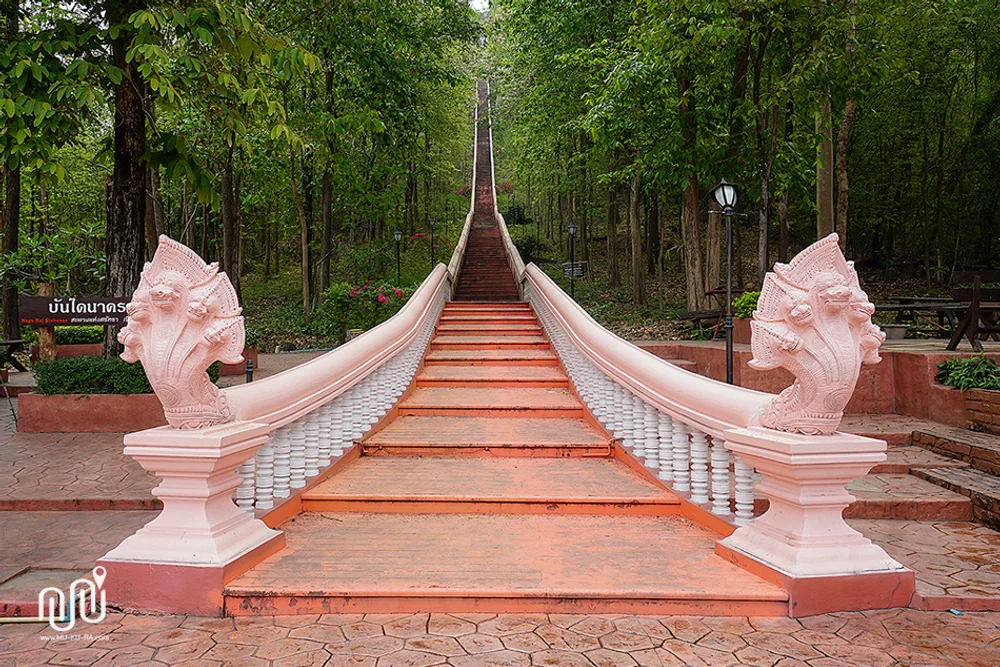
The 297-step Naga staircase is another iconic feature of Khao Kradong. It is not merely a walkway to the summit but also a symbolic route of faith. Walking up the staircase gives visitors a sense of gradual ascent from the foot of the hill to the sacred area above. Along the way, travelers pass through a green and peaceful atmosphere. Those who are elderly, traveling with small children, or unable to climb the stairs can use the road that leads directly to the upper parking area near Phra Suphatthara Bophit.
In addition to the Buddha image and the replica Buddha footprint, Khao Kradong is home to an ancient volcanic crater that offers an important geological experience. The crater is hundreds of thousands of years old and helps visitors understand that Buri Ram is not only known for Khmer temples and sports venues, but also for its volcanic landscape. Travelers can walk around the crater area, observe volcanic rocks, see native plants, and learn about the dry dipterocarp forest that grows on volcanic soil.
The lava suspension bridge is another popular photo spot in the area. It crosses part of the volcanic crater and allows visitors to view the landscape from a different angle. Many travelers come here to take photos, enjoy the forest atmosphere, and experience the unique terrain of Khao Kradong. Since the area is both a natural site and close to a Buddhist temple, visitors should walk carefully, avoid loud noise, and keep the environment clean.
The surrounding nature trail and local vegetation make Khao Kradong more than a religious stop. The dry dipterocarp forest represents the natural character of the lower northeastern region of Thailand, while volcanic soil creates a distinctive environment for native plants and small wildlife. Travelers interested in nature should spend time walking slowly through the area, reading information signs, and observing the relationship between rock, soil, vegetation, and the volcanic landscape.
For cultural travelers, Wat Phra Phutthabat Khao Kradong is also associated with important local festivals. One of the best-known events is the procession carrying a long saffron cloth up the volcanic hill to pay respect to the great Buddha image. Another important annual tradition is the merit-making ceremony of Kuan Khao Thip and Tak Bat Thewo during the end of Buddhist Lent. These events show that the temple is still a living cultural space, not merely a scenic viewpoint or a photo landmark.
The Tak Bat Thewo ceremony at Khao Kradong has a distinctive character because monks descend from the volcanic hill along the Naga staircase while Buddhist devotees offer alms below. The image of monks walking down from a volcanic hill crowned by a large Buddha image creates a powerful sense of faith and place. Travelers visiting during the end of Buddhist Lent should check the event schedule in advance and allow extra travel time, as the area can become very crowded.
The saffron cloth procession up the volcanic hill is another event that gives Khao Kradong its special identity. The ceremony involves carrying cloth up to the great Buddha image as an act of devotion. Visitors who come during this festival can see local cultural performances, traditional dress, community participation, and a lively atmosphere. At the same time, respectful behavior is essential because the event is both a cultural celebration and a Buddhist religious ceremony.
The best time to visit Wat Phra Phutthabat Khao Kradong is in the morning or late afternoon, when the temperature is more comfortable and the light is better for photography. Midday can be hot, especially around the open summit area and viewpoint. Visitors who plan to climb the 297-step staircase should bring drinking water, wear comfortable walking shoes, and take breaks if needed. For older travelers or families with young children, driving to the upper area is the more convenient option.
Visitors coming to worship should dress appropriately for a Buddhist temple. Clothing should be modest, and hats or sunglasses should be removed when entering sacred areas. Travelers should respect monks, local worshippers, and religious objects. Photography is welcome in many areas, but visitors should avoid posing disrespectfully with Buddha images or sacred structures. If photographing monks or local people, asking permission first is always the most respectful approach.
Wat Phra Phutthabat Khao Kradong is suitable for family trips because it offers experiences for different age groups. Elderly visitors can reach the summit by car, families can pay respect to the Buddha image together, children and students can learn about volcanoes and local ecology, and photography lovers can enjoy the Naga staircase, the great Buddha image, the lava suspension bridge, and the city view. Spending around 2–3 hours here allows visitors to explore the main highlights without rushing.
From a local history perspective, the temple reflects the relationship between Buddhism, community effort, and the development of public religious space in Buri Ram. It began with donated land and the vision of a meditation monk, later developed with an ubosot, permanent structures, ceremonies, and community support. Visiting this temple is therefore not only about seeing a beautiful place, but also about understanding the faith and cooperation that have shaped this sacred site for more than 60 years.
Khao Kradong is also an important symbol of Buri Ram’s identity. The province is known for Khmer heritage, stone sanctuaries, sports culture, and volcanic landscapes. A visit to Wat Phra Phutthabat Khao Kradong helps travelers understand this broader identity. In one place, visitors can encounter a local temple, a replica Buddha footprint, a revered Buddha image, a forested hill, and the remains of an extinct volcano.
Getting There from Buri Ram city is straightforward. Take Highway 219, the Buri Ram–Prakhon Chai route, for about 6 km toward Prakhon Chai. Around kilometer markers 6–7, follow the signs to the Khao Kradong area. Visitors with private cars can drive into the area and either park at the lower section to climb the Naga staircase or continue by road to the upper parking area near Phra Suphatthara Bophit. Travelers without private transport can hire a songthaew, local taxi, or tuk-tuk from Buri Ram city, but should agree on the fare and return time in advance.
If starting from Buri Ram Railway Station or the city centre, the journey is short and convenient. This makes Wat Phra Phutthabat Khao Kradong an excellent half-day destination. Travelers can leave the city in the morning, pay respect at the temple, visit the volcanic crater, walk across the lava suspension bridge, and return to town for lunch or continue to Chang Arena and Buriram Castle. This route is ideal for those with limited time who still want to experience the spiritual, natural, and modern sides of Buri Ram.
Drivers should be prepared for some uphill sections, although the overall route is accessible for ordinary cars. Extra care is needed during weekends, public holidays, and festival periods, when traffic and parking demand increase. There are parking areas and basic visitor services, but arriving early is recommended during major events.
Facilities in the area include parking, road access to the summit, small shops, drink stalls, rest areas, photo spots, viewpoints, and occasional souvenir areas. Visitors should bring drinking water, a hat, or an umbrella, especially if they plan to walk around the natural areas and volcanic crater. Keeping the area clean is important because the site is both a Buddhist temple and a conservation landscape with local plants and wildlife.
There is generally no admission fee to visit the area. Travelers can make donations according to their faith and spend only on transport, food, drinks, or souvenirs. This makes Wat Phra Phutthabat Khao Kradong and the surrounding Khao Kradong area an accessible destination for local residents, Thai travelers, and international visitors who want to explore Buri Ram beyond its stadiums and ancient Khmer temples.
The most pleasant visiting hours are around 08.00–10.00 in the morning or 16.00–18.00 in the late afternoon. These periods offer cooler weather, softer light for photography, and enough time to enjoy the main attractions. If visiting during the rainy season, the greenery is especially refreshing, but visitors should be careful of slippery surfaces and wear suitable shoes.
For travelers staying overnight in Buri Ram, the area around Khao Kradong has several accommodation options, from boutique hotels close to nature to hotels near Chang Arena and city-centre properties. Nearby restaurants include local Isan food, roast duck restaurants, cafes, and casual eateries. This makes it easy to combine a temple visit with local dining and sightseeing around Buri Ram city.
As a travel destination, Wat Phra Phutthabat Khao Kradong deserves a place near the top of any Buri Ram itinerary. It is close to the city, easy to reach, and offers much more than a simple photo stop. Visitors can learn about the temple’s foundation in 1955, its official recognition in 1978, the development of its religious buildings, the replica Buddha footprint, the great Buddha image, the volcanic crater, and the panoramic city view, all within one compact area.
For visitors interested in Buddhist and cultural sites in northeastern Thailand, Wat Phra Phutthabat Khao Kradong shows how a local temple can also function as a community landmark, a nature-based attraction, and a cultural learning space. Its beauty is not limited to architecture or scenery. Its true value lies in the way faith, local history, volcanic terrain, and community devotion come together in one meaningful place.
In summary, Wat Phra Phutthabat Khao Kradong is one of the most rewarding cultural and spiritual attractions in Buri Ram Province. Travelers can trace its history from its founding in 1955, its official establishment in 1978, the development work of Phra Khru Satchanurak, and its current role under Phra Khru Panyaphanaphirat. Combined with Phra Suphatthara Bophit, the replica Buddha footprint, the Naga staircase, the volcanic crater, and views over Buri Ram city, the temple offers both spiritual value and a memorable travel experience.
| Name | Wat Phra Phutthabat Khao Kradong |
| Location | At the foot of Khao Kradong, near Khao Kradong Forest Park, Samet Subdistrict, Mueang Buri Ram District, Buri Ram Province |
| Address | Moo 9, Samet Subdistrict, Mueang Buri Ram District, Buri Ram Province 31000, Thailand |
| Coordinates | Replica Buddha Footprint Area: 14.9404532, 103.0931308 |
| Highlights | Replica Buddha footprint, Phra Suphatthara Bophit, 297-step Naga staircase, ancient volcanic crater, lava suspension bridge, and Buri Ram city viewpoint |
| History | Founded in 1955 by Chao Athikan Boonma Pannapachoto. Officially established as a temple in 1978. Later developed further by Phra Khru Satchanurak, also known as Luang Pho Thiang. |
| Name Origin | The temple name refers to the Buddha footprint and its location on Khao Kradong. The hill’s older name, Phanom Kradong, is linked to a Khmer expression meaning a turtle-shell-shaped mountain. |
| Distinctive Features | An active Buddhist temple set on an extinct volcanic landscape, combining religious worship, nature, geological interest, and city views in one place |
| Travel Information | From Buri Ram city, take Highway 219 toward Prakhon Chai for about 6 km. Visitors may drive to the upper area or park below and climb the 297-step Naga staircase. |
| Current Status | An active community temple open for worship, merit-making, and sightseeing in the Khao Kradong area |
| Open Days | Daily |
| Opening Hours | 08.00 – 18.00 |
| Fees | No Admission Fee |
| Facilities | Parking area, road access to the summit, small shops, drink stalls, rest areas, photo spots, viewpoints, and occasional souvenir stalls |
| Main Areas / Zones | 1. Temple Compound And Ubosot 2. Replica Buddha Footprint 3. Phra Suphatthara Bophit On The Summit 4. 297-Step Naga Staircase 5. Khao Kradong Volcanic Crater 6. Lava Suspension Bridge 7. Nature Trail 8. Buri Ram City Viewpoint |
| Abbot / Caretaker | Phra Khru Panyaphanaphirat |
| Main Contact Number | 044-611-977 |
| Official Website / Official Page | Facebook Page: Wat Phra Phutthabat Khao Kradong |
| Nearby Tourist Attractions | 1. Khao Kradong Forest Park / Khao Kradong Volcanic Crater, about 1 km 2. Chang Arena, about 5 km 3. Buriram Castle, about 5 km 4. Chang International Circuit, about 6 km 5. Lower Northeastern Cultural Centre, Buriram Rajabhat University, about 8 km 6. Buri Ram City Pillar Shrine, about 8 km |
| Nearby Restaurants | 1. Wandeedee Restaurant & Coffee House Buriram, about 1 km, Tel. 061-082-2427 2. Kuay Tiao Hoy Kha - Bong Pa On Hoy Kha 1, about 2 km 3. Buriram Roast Duck, about 2 km, Tel. 080-157-9666 4. Song Phi Nong Dinosaur Buriram Restaurant, about 3 km, Tel. 081-264-4862, 086-258-8850 5. Ped Yang Khu Mueang Buriram Branch, about 5 km, Tel. 061-651-2131 |
| Nearby Accommodations | 1. T-Rex Buriram Boutique Hotel, about 1 km, Tel. 081-821-8882 2. Modena By Fraser Buriram, about 3 km, Tel. 044-118-188 3. Cresco Hotel Buriram, about 4 km, Tel. 044-634-901 4. Amari Buriram United, about 5 km, Tel. 044-111-444 5. The Crystal Hotel Buriram, about 5 km, Tel. 044-634-678, 084-935-0678 6. Fortune Hotel Buriram, about 6 km, Tel. 044-163-800 |
Frequently Asked Questions (FAQ)
Q: Where is Wat Phra Phutthabat Khao Kradong located?
A: Wat Phra Phutthabat Khao Kradong is located in Moo 9, Samet Subdistrict, Mueang Buri Ram District, Buri Ram Province, near Khao Kradong Forest Park and about 6 km from Buri Ram city.
Q: What are the main highlights of Wat Phra Phutthabat Khao Kradong?
A: The main highlights include the replica Buddha footprint, Phra Suphatthara Bophit Buddha image, the 297-step Naga staircase, the volcanic crater, the lava suspension bridge, and panoramic views of Buri Ram city.
Q: Is there an entrance fee for Wat Phra Phutthabat Khao Kradong?
A: No. There is generally no admission fee. Visitors may make donations according to their faith.
Q: How can travelers get to Wat Phra Phutthabat Khao Kradong?
A: From Buri Ram city, take Highway 219 toward Prakhon Chai for about 6 km. Visitors can drive to the upper area or park below and climb the 297-step Naga staircase.
Q: Who is the abbot of Wat Phra Phutthabat Khao Kradong?
A: The abbot is Phra Khru Panyaphanaphirat.
Q: What is the best time to visit Wat Phra Phutthabat Khao Kradong?
A: Morning and late afternoon are the most comfortable times to visit. The weather is cooler, the light is better for photography, and visitors can enjoy walking, worshipping, and sightseeing more comfortably.
Q: Can visitors drive up to the summit area?
A: Yes. Visitors can drive up to the upper area near Phra Suphatthara Bophit, which is convenient for elderly travelers, families with children, and visitors who do not want to climb the staircase.
Q: How much time should travelers spend at Wat Phra Phutthabat Khao Kradong?
A: Travelers should allow at least 2–3 hours to worship, see the replica Buddha footprint, visit the volcanic crater, take photos at the lava suspension bridge, and enjoy the city view.
 Category: ●Places of Worship
 Group: ●Temple
Last Update : 1 WeekAgo
 Last Update : 1 WeekAgo
 Click to Access the Navigation Map GPS
Wat Phra Phutthabat Khao Kradong Map
Recommend

 Art, Culture and Heritage
 Historical Sites and Monuments(14)
 Landmarks and Memorials(2)
 Art, Craft Centres, Tradition(6)
 Museums(3)
 Educational Places
 Museum for Study(1)
Temple(74)
Museum for Study(1)
Temple(74)
 Other Sacred Sites(5)
 Suburban Living
 Village, Community(3)
 Nature and Wildlife
 National Parks and Marine Reserves(2)
 Mountain (Doi)(1)
 Dam, Reservoir, Lake(14)
 River, Canal(1)
 Bays and Beaches(1)
 Other natural attractions(2)
 Entertainment and Agricultural
 Animal camps and shows(1)
 Stadium(2)
 Farms, Parks and Ecotourism(2)
 Waterpark(1)


