
lovethailand home >Northeastern Travel Attractions >Buri Ram Travel Attractions >Huai Rat >Sa Nuan > Wat Sanuan Nok
TL;DR: Wat Sanuan Nok is located at 1/1 Moo 2, Sanuan Subdistrict, Huai Rat District, Buri Ram 31000, open Daily, hours 08.00 – 17.00.

Wat Sanuan Nok
Open Days: Daily
Opening Hours: 08.00 – 17.00
Wat Sanuan Nok is a local Buddhist temple located at 1/1, Moo 2, Sanuan Subdistrict, Huai Rat District, Buri Ram Province. It is one of the most culturally meaningful temples in Ban Sanuan Nok, a community widely known for silk weaving, Khmer-influenced local culture, traditional houses, community-based tourism, and a deep relationship between temple life and village identity. For travelers who want to understand Buri Ram beyond major landmarks, Wat Sanuan Nok offers a quiet but valuable introduction to rural Buddhist life, local history, and the living culture of a Thai-Khmer community in lower northeastern Thailand.
The temple is especially meaningful because it stands at the heart of Ban Sanuan Nok, a small village in Huai Rat District where silk production has been passed down for generations. Visitors who come to Wat Sanuan Nok can easily connect the temple visit with community tourism activities such as learning about mulberry cultivation, silkworm raising, silk reeling, dyeing, Mudmee tying, weaving, and silk product making. This makes the temple not only a place of worship but also a gateway to one of Buri Ram’s important cultural communities.
Historically, Wat Sanuan Nok was first known by villagers as “Wat Isan” because the temple was located toward the northeastern side of the village. This kind of name reflects how rural Thai communities often named places according to practical geography. Later, during the administration of the Sangha under Chao Athikan Wirot Asoko, then the ecclesiastical chief of Sawai Chik Subdistrict, the name was changed because “Wat Isan” was also used by another nearby temple. The temple then became known as Wat Sanuan Nok, a name that clearly connects it with Ban Sanuan and its position outside the inner part of the village.
The distinction between Wat Sanuan Nok and Wat Sanuan Nai is important for understanding the village landscape. Ban Sanuan has 2 temples. Wat Sanuan Nai is located deeper inside the village, while Wat Sanuan Nok stands closer to the outer part of the community. The name “Nok” means outside, and “Nai” means inside. The name Wat Sanuan Nok therefore tells visitors something about the geography and social organization of the village. It is a temple name rooted in the lived experience of local people.
Wat Sanuan Nok originally covered 3 rai and 90 square wah. The temple received its first Wisungkhamsima around 1885, with a boundary measuring 25 meters wide. A Phatthasima ceremony was later performed around 1890. These details show that the temple has long held an established religious status within the community. In Thai Buddhism, Wisungkhamsima is important because it designates a sacred boundary for formal monastic ceremonies such as ordination. This gives Wat Sanuan Nok a deep religious foundation dating back more than a century.
During the period of Phra Khru Prachit Silakhun, also known as Luang Pho Phrom Kantasilo, the temple expanded significantly. In 1990, he purchased additional land to enlarge the temple grounds. Today, the temple covers 18 rai and 49 square wah. This expansion reflects the temple’s growing role in religious activities, community gatherings, and local cultural life. A larger temple space allowed for more religious facilities, activity areas, and community use, making Wat Sanuan Nok an even stronger center for Ban Sanuan Nok.
The temple later received a second royal grant of Wisungkhamsima on 9 August 2004. The new boundary measures 32 meters wide and 42 meters long. This second royal grant marks another major stage in the temple’s development. It confirms the temple’s continuing importance as a proper place for Buddhist monastic ceremonies and strengthens its role in the religious life of Huai Rat District. For travelers, this history helps explain why Wat Sanuan Nok is more than a simple village temple.
The temple’s documentary history also includes a certification of temple status dated 3 August 1983 by Chamluang Wutthichan, Director-General of the Department of Religious Affairs, and land title information covering 18 rai and 49 square wah. These administrative details may appear technical, but they are important because they show how the temple’s religious and legal status became firmly established. Wat Sanuan Nok is therefore a temple with both living community value and documented historical continuity.
Phra Khru Prachit Silakhun, or Phrom Kantasilo, is one of the most important figures in the temple’s modern history. He was a former abbot of Wat Sanuan Nok and a former ecclesiastical district chief of Huai Rat. He played a central role in developing the temple, expanding its land, and strengthening its function as a religious center. He passed away on 16 January 2018, but his memory remains important to disciples and local people. Annual merit-making events are held to remember his contribution, making the temple a place of both worship and remembrance.
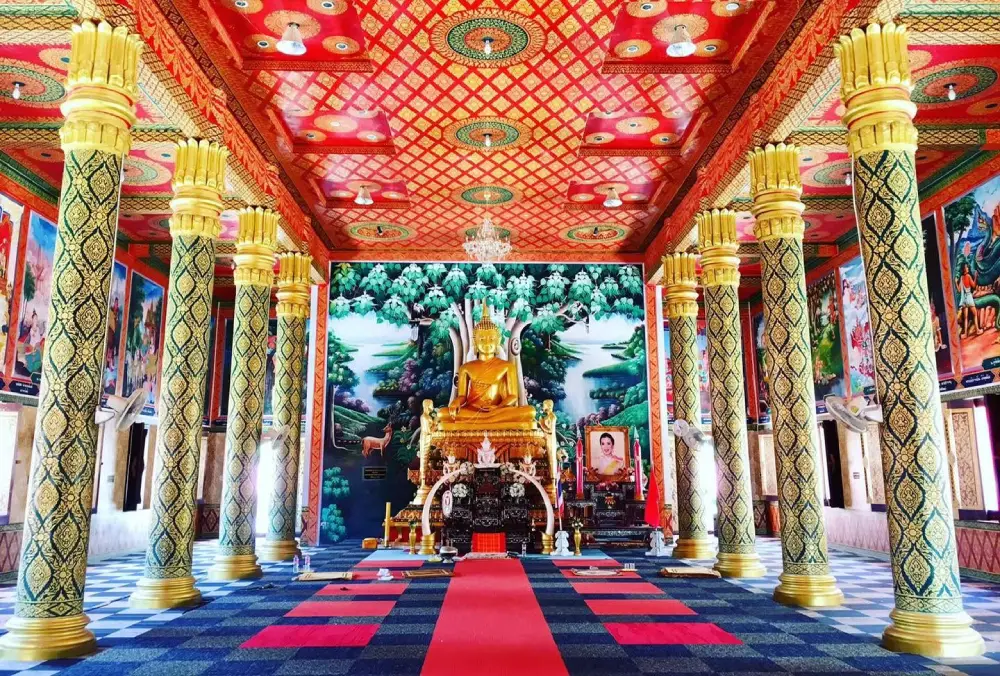
One of the distinctive features of Wat Sanuan Nok is that it has 2 ordination halls standing side by side. Inside, the temple houses beautiful principal Buddha images that serve as the spiritual focus for worshippers. The paired ordination halls make the temple visually and historically interesting. They also help visitors understand the development of the temple across different periods. For those interested in local temple architecture, Wat Sanuan Nok offers a meaningful example of a community temple that has evolved while preserving its older religious identity.
Wat Sanuan Nok is also one of the main points in the Ban Sanuan Nok community tourism route. The community is known for silk-making knowledge that covers every step of production, from growing mulberry trees and raising silkworms to silk reeling, degumming, dyeing, Mudmee patterning, weaving, and product creation. This complete silk-learning process allows visitors to see how local knowledge is transformed into textiles. The temple provides a cultural anchor for this experience because Buddhist life and silk-making are both deeply connected with village identity.
Ban Sanuan Nok is also known for “Ram Trot,” a traditional performance associated with Khmer cultural roots. The performance was originally connected with inviting people to join merit-making activities. It has both slow and fast rhythms and reflects the close relationship between Buddhist festivals, music, dance, and community participation. When viewed together with Wat Sanuan Nok, Ram Trot reveals how the temple and community traditions work together to keep local culture alive.
The community also has an old market and old houses over 100 years old. These places help visitors see how people in Ban Sanuan Nok lived in the past. The old houses preserve household objects, ritual areas, and local memory. One important cultural space is the “Pakham room,” connected with local belief and ritual practice. Together, Wat Sanuan Nok, the old houses, the market, and the silk-learning bases create a complete cultural route that allows travelers to experience the village through religion, architecture, food, textiles, and memory.
Ban Sanuan Nok has a deeper historical landscape as well. The village is located on a round mound-like settlement area with earthen embankments and moats. Archaeological traces found in the community include ancient earthen ridges, old moats, pottery fragments, slag from metal smelting, ancient burial jars containing bones, sandstone, bricks, and traces of an old earthen ordination hall. These details show that the village has historical depth beyond its current identity as a silk tourism community. Wat Sanuan Nok stands within this layered cultural landscape.
The name Sanuan itself comes from a local tree known as the Sanuan tree. The area was once a dense forest where many of these trees grew. Over time, settlers came to live in the area, and the community became known as Ban Sanuan. The temple name therefore reflects the natural environment from which the community emerged. Understanding the name helps travelers see the connection between forest, settlement, village identity, and religious space.
Ban Sanuan Nok is associated with the Thai-Khmer or Khmer-speaking communities of lower Isan. Local people have preserved elements of language, dress, food, belief, and textile knowledge. This gives the temple a cultural setting that differs from temples in many other regions of Thailand. Wat Sanuan Nok is not only a Buddhist temple; it is a temple within a living ethnic and cultural community. This makes it especially interesting for foreign travelers who want to understand Thailand’s regional diversity.
During Buddhist festivals and merit-making events, Wat Sanuan Nok becomes the gathering place of the village. People come together for Kathin ceremonies, robe offerings, annual merit-making, funerary rites, and Buddhist holy days. Villagers prepare food, organize offerings, welcome guests, and participate in rituals. These events strengthen relationships between generations and keep the temple at the center of community life. The temple’s value is therefore found not only in buildings but also in the people who continue to use and care for it.
Wat Sanuan Nok is best visited slowly. Visitors should take time to see the 2 ordination halls, pay respect to the principal Buddha images, observe the temple grounds, and understand the connection between the temple and the surrounding village. The experience is not about quick sightseeing. It is about reading the cultural landscape carefully. Families with children can use the visit to learn about temple history, Buddhist boundaries, the former name Wat Isan, the role of Luang Pho Phrom, and the silk heritage of Ban Sanuan Nok.
Travel to Wat Sanuan Nok is convenient because the village is about 2 km from Huai Rat District Office and about 12 km from Buri Ram city. The village lies along the rural road connecting Huai Rat and Krasang. Visitors can travel by private car, motorcycle, or local transport. The location also makes it possible to combine the temple with silk-learning activities, the old village market, traditional houses, and local food experiences within a half-day or full-day itinerary.
Getting There from Buri Ram city, travel toward Huai Rat District, then continue to Sanuan Subdistrict and Ban Sanuan Nok. Search for Wat Sanuan Nok, Sanuan Subdistrict, Huai Rat District, Buri Ram Province when using navigation apps. Travelers who want to join community tourism activities should contact the Ban Sanuan Nok silk tourism community in advance, especially for silk demonstrations, Ram Trot performances, old house visits, or local meals.
Visitors should dress modestly, speak quietly, and respect monks and local worshippers. The temple is an active religious site and a community space. Photography should be done respectfully, especially during ceremonies. If visitors join community activities, they should follow the guidance of local hosts. A respectful attitude makes the visit more meaningful and helps preserve the dignity of both the temple and the village.
The community offers homestays and local-style accommodation for travelers who want to stay overnight. Staying in Ban Sanuan Nok allows visitors to experience the village more deeply than a short stop. They can enjoy local food, learn about silk production, see household life, and experience the warmth of the community. Baan Sanuan Resort is also located nearby, while additional hotels are available in Buri Ram city for travelers who prefer more urban facilities.
Food options include local meals arranged through the community tourism group and restaurants or cafés in nearby Huai Rat and Buri Ram city. For travelers interested in culture, local food is part of the experience. Ban Sanuan Nok is known for unique Thai-Khmer food traditions, including local dishes and rare snacks such as khanom tot ma, a distinctive traditional sweet associated with Khmer-speaking communities in lower Isan.
Silk is one of the most important cultural elements connected with Wat Sanuan Nok and its surrounding community. Silk weaving is not merely a craft. It involves seasons, household labor, mulberry trees, silkworms, silk threads, natural dyes, patterns, and the patience of weavers. Visitors who go from the temple to the silk-learning bases will see how religious life and local livelihood are connected. Silk is part of ceremonies, clothing, community pride, and local identity.
The old houses of Ban Sanuan Nok also help complete the story of the temple. If the temple represents faith, the old houses represent memory, and the silk-learning bases represent living knowledge. Together, these places make Ban Sanuan Nok a complete cultural destination. Travelers who only stop briefly at the temple may miss the deeper story, while those who explore the surrounding community can understand how religion, family, craft, and history are woven together.
For history-oriented travelers, Wat Sanuan Nok is valuable because it stands in a community with archaeological traces and a long settlement history. The temple itself has documented Buddhist history through its Wisungkhamsima and Phatthasima, while the village has older traces in the form of moats, embankments, pottery, metal-smelting remains, burial jars, sandstone, bricks, and old earthen religious architecture. A visit here is therefore a chance to read both Buddhist history and community archaeology in the same landscape.
The value of Wat Sanuan Nok lies in its deep connection with the community. It grew from a 3-rai temple into an 18-rai religious center. It received sacred Buddhist boundaries in different historical periods. It preserves the memory of a respected former abbot. It stands in a silk-weaving village that still keeps Khmer language, Ram Trot, traditional houses, old markets, and local food alive. These layers make the temple valuable for both local people and cultural travelers.
Wat Sanuan Nok is therefore suitable for travelers who want to visit a peaceful temple in Buri Ram, learn about an old community temple in Huai Rat District, and experience the living culture of Ban Sanuan Nok. The temple is most rewarding when visited together with the village. Its beauty is not found in a single monument but in the relationship between the temple, its 2 ordination halls, the principal Buddha images, its historical names, Luang Pho Phrom, the old houses, silk weaving, Ram Trot, and the everyday life of the people of Ban Sanuan Nok.
| Name | Wat Sanuan Nok |
| Location | 1/1 Moo 2, Sanuan Subdistrict, Huai Rat District, Buri Ram 31000 |
| Address | Ban Sanuan Nok, Moo 2, Sanuan Subdistrict, Huai Rat District, Buri Ram Province, Thailand |
| Community Coordinates | 14.937222829307377, 103.18245134926863 |
| Highlights | An old community Buddhist temple with 2 ordination halls, beautiful principal Buddha images, and a close connection with Ban Sanuan Nok silk tourism community |
| History | The temple originally covered 3 rai and 90 square wah. It received Wisungkhamsima around 1885 and performed the Phatthasima ceremony around 1890. The temple expanded in 1990 to 18 rai and 49 square wah and received a second royal grant of Wisungkhamsima on 9 August 2004 |
| Name Origin | The temple was formerly called Wat Isan because it stood northeast of the village. It was later renamed Wat Sanuan Nok to distinguish it from Wat Sanuan Nai, which is located deeper inside the village |
| Distinctive Features | The temple has 2 ordination halls standing side by side, principal Buddha images, and a strong role as a religious and cultural center of Ban Sanuan Nok |
| Traditions / Rituals | Buddhist holy day merit-making, Kathin ceremony, robe offering, annual merit-making, memorial merit-making for Phra Khru Prachit Silakhun, and community tourism activities connected with silk weaving, Ram Trot, old houses, and the old market |
| Travel Information | From Buri Ram city, travel toward Huai Rat District, then continue to Sanuan Subdistrict and Ban Sanuan Nok. The village is about 12 km from Buri Ram city and about 2 km from Huai Rat District Office. Private car, motorcycle, and local transport are convenient options |
| Current Status | An active local Buddhist temple and cultural learning point connected with Ban Sanuan Nok community tourism |
| Open Days | Daily |
| Opening Hours | 08.00 – 17.00 |
| Facilities | Restrooms, Buddhist activity areas, ordination halls, temple courtyard, community activity areas, and access to Ban Sanuan Nok cultural tourism route |
| Main Areas / Zones | Buddhist worship area, 2 ordination halls, principal Buddha images, merit-making area, temple courtyard, and community activity area |
| Important Former Abbot | Phra Khru Prachit Silakhun (Phrom Kantasilo), former abbot of Wat Sanuan Nok and former ecclesiastical district chief of Huai Rat, passed away on 16 January 2018 |
| Community Tourism Contact | Ban Sanuan Nok Silk Tourism Community, Tel. 085-411-4435, 095-801-1693, 087-435-3237 |
| Nearby Tourist Attractions | 1. Ban Sanuan Nok Silk Tourism Village, about 0 km 2. Ban Sanuan Nok Old House, about 0 km 3. Ban Sanuan Nok Old Market, about 0 km 4. Wat Sanuan Nai, about 1 km 5. Buri Ram City, about 12 km |
| Nearby Restaurants | 1. Local Food Service In Ban Sanuan Nok Community, about 0 km, Tel. 085-411-4435, 095-801-1693, 087-435-3237 2. Ban Sanuan Nok Community Tourism Meal Service, about 0 km, Tel. 085-411-4435, 095-801-1693, 087-435-3237 3. The Tower Cafe & Hangout Buriram, about 12 km 4. Bamboo Bar Buriram, about 13 km 5. Muang Pizza Buriram, about 13 km |
| Nearby Accommodations | 1. Baan Sanuan Resort, about 1 km, Tel. 084-496-8579 2. Ban Sanuan Nok Community Homestay, about 0 km, Tel. 085-411-4435, 095-801-1693, 087-435-3237 3. Best Western Royal Buriram Hotel, about 12 km 4. The Sita Princess Buriram, about 13 km 5. Ray Hotel Buriram, about 14 km |
Frequently Asked Questions (FAQ)
Q: Where is Wat Sanuan Nok located?
A: Wat Sanuan Nok is located at 1/1 Moo 2, Sanuan Subdistrict, Huai Rat District, Buri Ram Province 31000, within Ban Sanuan Nok silk tourism community.
Q: Why is Wat Sanuan Nok important?
A: It is an old community Buddhist temple with a long religious history, 2 ordination halls, beautiful principal Buddha images, and a strong connection with Ban Sanuan Nok’s silk culture.
Q: Why was Wat Sanuan Nok formerly called Wat Isan?
A: Villagers called it Wat Isan because the temple was located northeast of the village. It was later renamed Wat Sanuan Nok to distinguish it from Wat Sanuan Nai.
Q: What are the opening days and opening hours of Wat Sanuan Nok?
A: The temple is open daily from 08.00 to 17.00. It is suitable for worship, merit-making, and cultural visits connected with Ban Sanuan Nok community.
Q: What is special inside Wat Sanuan Nok?
A: The temple has 2 ordination halls standing side by side and beautiful principal Buddha images, making it one of the important temples in Huai Rat District.
Q: What nearby places should visitors combine with Wat Sanuan Nok?
A: Visitors can combine the trip with Ban Sanuan Nok Silk Tourism Village, the old house, the old market, Wat Sanuan Nai, and Buri Ram city.
Q: What cultural experiences are found in Ban Sanuan Nok?
A: Ban Sanuan Nok is known for Hang Krarok silk, mulberry cultivation, silkworm raising, Ram Trot performance, old houses, old market, khanom tot ma, and Thai-Khmer community culture.
Q: How can travelers get to Wat Sanuan Nok?
A: From Buri Ram city, travel toward Huai Rat District, then continue to Sanuan Subdistrict and Ban Sanuan Nok. The distance is about 12 km from Buri Ram city and about 2 km from Huai Rat District Office.
 Category: ●Places of Worship
 Group: ●Temple
Last Update : 4 MonthAgo
 Last Update : 4 MonthAgo
 Click to Access the Navigation Map GPS
 Art, Culture and Heritage
 Historical Sites and Monuments(14)
 Landmarks and Memorials(2)
 Art, Craft Centres, Tradition(6)
 Museums(3)
 Educational Places
 Museum for Study(1)
Temple(74)
Museum for Study(1)
Temple(74)
 Other Sacred Sites(5)
 Research and Development
 Royal Project(1)
 Suburban Living
 Village, Community(3)
 Nature and Wildlife
 National Parks and Marine Reserves(2)
 Mountain (Doi)(1)
 Dam, Reservoir, Lake(14)
 River, Canal(1)
 Bays and Beaches(1)
 Other natural attractions(2)
 Entertainment and Agricultural
 Animal camps and shows(1)
 Stadium(2)
 Farms, Parks and Ecotourism(2)
 Waterpark(2)
 Travel Articles, Recipes
 Travel Review, Food Review(1)


