
lovethailand home >Northeastern Travel Attractions >Buri Ram Travel Attractions >Ban Dan >Ban Dan > Wat Ban Dan
TL;DR: Wat Ban Dan is located at No. 27, Moo 3, Ban Dan Subdistrict, Ban Dan District, Buri Ram 31000, open Daily, hours 08.00 – 17.00.

Wat Ban Dan
Open Days: Daily
Opening Hours: 08.00 – 17.00
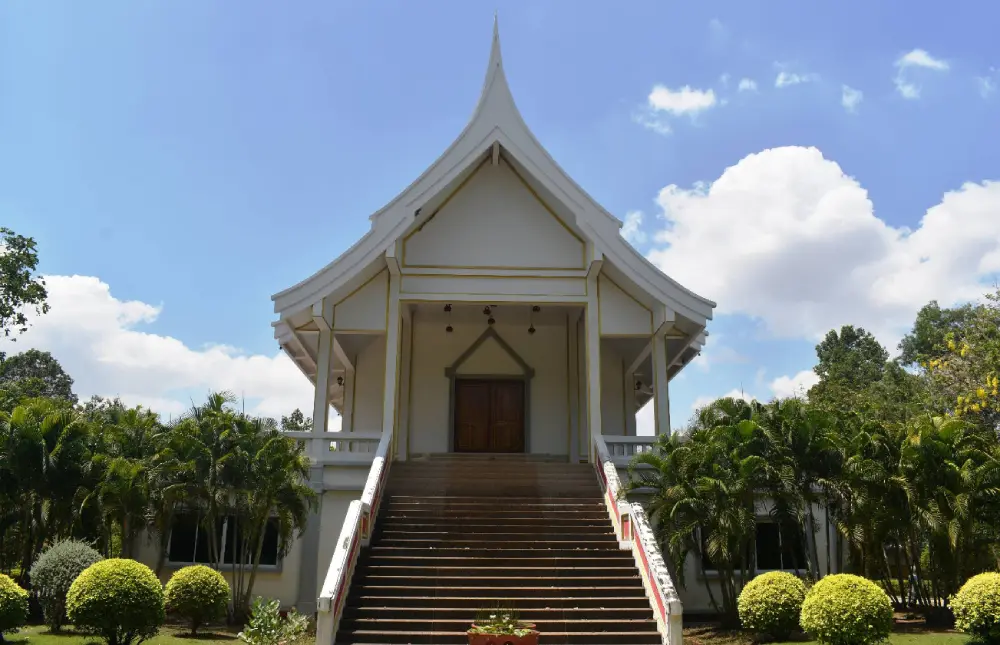
Wat Ban Dan is located at No. 27, Moo 3, Ban Dan Subdistrict, Ban Dan District, Buri Ram Province. It is a local Buddhist temple under the Mahanikaya order and one of the important community temples of Ban Dan District. The temple was established in 1940 and currently covers 14 rai, 6 ngan, and 27 square wah. Its origin is closely connected with the faith of local leaders and villagers, especially Nai Raem Mukdaram, a former village headman at that time, and Nai Khrun Wongchan, who donated 7 rai, 3 ngan, and 17 square wah of land for the construction of the temple. Wat Ban Dan is therefore a temple built from community faith and continues to serve as a center of Buddhism, education, moral training, and local activities.
The importance of Wat Ban Dan does not come only from its age. The temple is meaningful because it shows how a rural Thai Buddhist temple can support both religious life and community development. It is used for merit-making, Buddhist holy day ceremonies, Kathin offerings, robe offerings, ordinations, funerals, memorial merit-making, and local traditions. At the same time, the temple also plays an educational role through Dhamma study, training for monks and novices, and vocational courses for students and local people. For foreign travelers, Wat Ban Dan offers a clear example of Buddhism as a living part of village life rather than only a place of worship.
The temple began with the intention of local people who wanted a Buddhist center for their community. Nai Raem Mukdaram and Nai Khrun Wongchan played an essential role in the early period because the donation of land gave the community a permanent place for religious activities. A land donation for a temple is a deeply meaningful act in Thai Buddhist culture. It allows the land to become a place where generations of people can make merit, listen to Dhamma, educate children, hold ceremonies, and seek emotional support during both joyful and difficult moments.
In the early period, the community invited Achan Thui, a disciple of Luang Pho Ming of Wat Ban Khok, to serve as the temple’s first spiritual leader. Achan Thui guided local devotees in developing the temple and constructing permanent religious structures. His leadership helped organize community faith into concrete action. This kind of early monastic leadership is essential in rural temple history because temples often grow gradually through shared labor, donations, and long-term commitment from monks and villagers.
Historical temple records identify Wat Ban Dan as being located at Ban Tun, Moo 3, Ban Dan Subdistrict. The temple’s original land covered 7 rai, 3 ngan, and 17 square wah. Its boundaries were described as follows: to the north, a public road; to the south, private land; to the east, a public canal; and to the west, a public road. These details show that the temple is closely integrated into the local village landscape. It is not separated from the community but stands among roads, homes, and shared public resources.
The location of a temple is important in rural Thailand. A community temple must be easy for villagers to reach because it supports repeated activities throughout the year. Wat Ban Dan’s relationship with public roads and a canal reflects its role as a practical and accessible religious center. People can come for morning offerings, Buddhist holy day ceremonies, funerals, ordinations, community meetings, and educational programs without difficulty.
Wat Ban Dan has several monastic structures that support its religious and community roles. These include a sermon hall, monk residences, a funeral merit-making hall, temple courtyard, and areas for community activities. The sermon hall is used for Dhamma listening, chanting, merit-making, and gatherings. Monk residences support the resident monks, while the funeral merit-making hall allows the temple to serve families during times of loss. These buildings show how a Thai temple supports the full cycle of community life.
The sermon hall is especially important because it connects monks and laypeople directly. On merit-making days, villagers gather there to listen to Dhamma, offer food, take precepts, prepare ceremonies, and meet one another. In many rural temples, the sermon hall is the heart of community activity. Wat Ban Dan follows this pattern, using the temple space not only for ritual but also for education, social connection, and moral formation.
The funeral merit-making hall also reflects the temple’s role in local life. When families face the death of a loved one, the temple becomes a place for chanting, remembrance, merit-making, and community support. Relatives, neighbors, monks, and friends come together in a dignified setting. This function is one of the reasons local temples remain deeply important in Thai society. They support people in times of both happiness and grief.
The list of former abbots of Wat Ban Dan reflects the continuity of temple care across generations. Recorded abbots include Phra Thongyu, Phra Thui, Phra Laen, Phra Salak, Phra Nun, Phra Sawai, Phra Lek, Phra Ban, Phra Prakit Kantasilo, and later monks who continued the temple’s development. Each monk helped preserve and guide the temple according to the needs of his period. This continuity is part of the reason Wat Ban Dan remains meaningful today.
In the modern period, Wat Ban Dan has been under the leadership of Phra Khru Si Panya Wikrom, formerly known as Phra Maha Bunruang Panyawachiro. He was appointed abbot on 4 July 2006. Under his leadership, the temple has continued to improve, restore, and develop its facilities while expanding its educational and community roles. His work has helped make Wat Ban Dan a temple that supports both spiritual practice and practical learning.
Phra Khru Si Panya Wikrom has an educational and Dhamma-teaching background. This has shaped the temple’s identity as a place of learning. The temple provides training for monks and novices before and after morning and evening chanting, both during and outside the rains retreat. Regular training helps monks and novices understand Dhamma, discipline, and their responsibilities as members of the Sangha. In this way, the temple becomes a training environment for monastic life.
Wat Ban Dan also offers Dhamma and Buddhist studies at the primary, intermediate, and advanced levels. These programs allow monks, novices, young people, and laypeople to learn Buddhist principles in a structured way. Dhamma education covers moral conduct, the life of the Buddha, Buddhist sayings, basic discipline, and teachings that can be applied in daily life. This makes the temple an important local center for Buddhist learning.
The temple’s educational role extends beyond Buddhist studies. Wat Ban Dan has provided vocational training for students and local people in cooperation with the Ban Dan District Non-Formal Education Service Center and Satuek Industrial and Community Education College. One of the courses offered was computer training. This shows that the temple has adapted to social change and has used its space to support useful skills for modern life.
Computer training in a temple setting may seem unusual to some foreign travelers, but it shows the flexible role of Thai temples. A temple can be both a place of Dhamma and a place where local people gain skills that help them in education, work, and daily life. Wat Ban Dan therefore connects spiritual development with practical community development. This combination is one of the temple’s strongest identities.
The temple also has a pre-primary child training center that opened in 1993. This continues the traditional role of Thai temples as places of early learning. Children can begin their education in an environment shaped by discipline, respect, and Buddhist values. Even when the learning is basic, the temple setting helps young children absorb manners, community awareness, and moral foundations from an early age.
Wat Ban Dan is therefore a complete community temple. It supports religious ceremonies, Dhamma education, monastic training, child education, and vocational learning. On Buddhist holy days, local people come to offer food, take precepts, listen to sermons, and make merit. These practices allow people to pause from ordinary work, reflect on their conduct, and spend meaningful time with their families in a peaceful environment.
Kathin and robe-offering ceremonies are important annual activities at Wat Ban Dan. Such events bring together villagers, former residents, relatives, and supporters. People help prepare food, arrange the temple grounds, welcome guests, and offer donations. These ceremonies are not only religious rituals. They also renew social relationships and keep people connected with their home community.
Wat Ban Dan is suitable for travelers who want to understand the real role of a community temple in Buri Ram. It is not defined by grand architecture or commercial tourism. Its value lies in its origin from donated land, the continuity of monastic leadership, its educational programs, and its service to villagers. Visitors should approach the temple as a living religious and community space, not only as a place for photographs.
In travel terms, Wat Ban Dan can be combined easily with Wat Rahan, also known as Ko Kaeo Thudongkhasathan, which is also located in Ban Dan District. Wat Rahan is known for Phra Maha That Rattanachedi Si Buriram, Buddha relics, and its connection with Luang Pu Chanraem Khemasiri. Visiting Wat Ban Dan and Wat Rahan together allows travelers to see two different sides of Buddhism in the same district: a community temple focused on education and social service, and a meditation temple with a major sacred chedi.
Nearby cafés and local stops such as Muangpae Cafe, Nahug Napang Cafe & Homestay, Jungle Cafe Ban Dan, and O2 Oxygen Cafe Ban Dan make the route more convenient. Travelers can visit Wat Ban Dan, stop for food or drinks, and continue to Wat Rahan or Buri Ram city. This route is suitable for families, cultural travelers, and visitors who prefer a slow and relaxed itinerary.
The Centre of Southern Northeast Culture at Buri Ram Rajabhat University is another place that pairs well with Wat Ban Dan. It helps visitors understand the wider historical and cultural background of lower northeastern Thailand. A route from Wat Ban Dan to the cultural center and then to Buri Ram city gives travelers a broader view of local Buddhism, education, history, and regional identity.
Getting There from Buri Ram city, travel toward Ban Dan District along the Buri Ram–Satuek route, then continue to Ban Dan Subdistrict and Moo 3. The distance from Buri Ram city is about 15–18 km, depending on the starting point and route. Private car, motorcycle, or locally arranged transport is recommended. When using navigation apps, search for Wat Ban Dan, Ban Dan Subdistrict, Ban Dan District, Buri Ram Province.
Visitors should allow about 30 minutes to 1 hour for Wat Ban Dan. Those who want to understand the temple’s educational background and community role may spend longer walking through the sermon hall area, monastic residence area, funeral merit-making hall, temple courtyard, and learning spaces. Travelers who also plan to visit Wat Rahan or nearby cafés should plan a half-day trip.
Respectful behavior is important. Visitors should dress modestly, speak quietly, and respect monks, novices, and local people who use the temple for real religious and educational activities. If Dhamma classes, monastic training, or community events are taking place, visitors should avoid disturbing the activity and take photographs only in appropriate areas. A community temple should be visited with awareness that it is part of local daily life.
Food options near the temple include Jungle Cafe Ban Dan, O2 Oxygen Cafe Ban Dan, Muangpae Cafe, and Nahug Napang Cafe & Homestay. Travelers who want more choices can continue to Buri Ram city. Choosing a food stop depends on the itinerary. Ban Dan cafés are suitable for a local rural atmosphere, while Buri Ram city offers more variety.
Accommodation options are available in both Ban Dan District and Buri Ram city. Nahug Napang Cafe & Homestay is suitable for travelers who want to stay close to Ban Dan’s rural setting. Those who prefer city hotels can stay at Best Western Royal Buriram Hotel, Ray Hotel Buriram, B2 Buriram Boutique & Budget Hotel, or Amari Buriram United. Staying in Ban Dan is convenient for temple-focused travel, while staying in Buri Ram city is better for wider travel around the province.
Overall, Wat Ban Dan is valuable for its history, community role, religious continuity, and educational mission. It began from land donated by local people, developed into a Buddhist center in 1940, and continued to grow through generations of monastic leadership. Under Phra Khru Si Panya Wikrom, the temple has continued to support Dhamma education, vocational learning, and community development. For foreign travelers, Wat Ban Dan offers a meaningful view of Buddhism as lived practice within a local Thai community.
Wat Ban Dan should be understood as a temple where Buddhism is connected with real life. It is connected with land donation, local leadership, monastic training, Dhamma study, children’s education, vocational computer training, funerals, ordinations, merit-making, and annual temple events. A visit here helps travelers see that Buddhism in rural Thailand is not limited to sacred images or ceremonies. It also includes learning, service, community cooperation, and the long-term development of people.
| Name | Wat Ban Dan |
| Location | No. 27, Moo 3, Ban Dan Subdistrict, Ban Dan District, Buri Ram 31000 |
| Address | Ban Tun / Moo 3, Ban Dan Subdistrict, Ban Dan District, Buri Ram Province, Thailand |
| Sangha Affiliation | Mahanikaya Order |
| Temple Status | Local Buddhist Temple |
| Highlights | A historic community temple in Ban Dan District, established in 1940 through the faith of Nai Raem Mukdaram and Nai Khrun Wongchan, known for Dhamma education, monastic training, and vocational computer courses for the community |
| History | Wat Ban Dan was established in 1940 from donated land of 7 rai, 3 ngan, and 17 square wah. The temple has developed into a community Buddhist center with a current area of 14 rai, 6 ngan, and 27 square wah |
| Founders / Land Donors | Nai Raem Mukdaram, former village headman, and Nai Khrun Wongchan, who donated 7 rai, 3 ngan, and 17 square wah of land for temple construction |
| Early Monastic Leader | Achan Thui, a disciple of Luang Pho Ming of Wat Ban Khok, served as an early abbot and led villagers in developing the temple |
| Original Boundary | North: public road; South: private land; East: public canal; West: public road |
| Monastic Buildings | Sermon hall, monk residences, funeral merit-making hall, temple courtyard, and community religious activity areas |
| Educational Role | Training for monks and novices before and after morning and evening chanting, Dhamma and Buddhist studies at primary, intermediate, and advanced levels, and a pre-primary child training center in the temple |
| Vocational Role | Vocational courses for students and local people in cooperation with Ban Dan District Non-Formal Education Service Center and Satuek Industrial and Community Education College, including computer training |
| Traditions / Rituals | Buddhist holy day merit-making, food offerings, Dhamma listening, precept-taking, Kathin ceremony, robe offering, ordination ceremonies, funerals, memorial merit-making, and important Buddhist festival activities |
| Travel Information | From Buri Ram city, travel toward Ban Dan District along the Buri Ram–Satuek route, then continue to Ban Dan Subdistrict and Moo 3. The distance is about 15–18 km. Private car, motorcycle, or locally arranged transport is recommended |
| Current Status | An active Mahanikaya local Buddhist temple and a community center for religious activities, Dhamma education, and local learning in Ban Dan Subdistrict |
| Open Days | Daily |
| Opening Hours | 08.00 – 17.00 |
| Facilities | Sermon hall, monk residences, funeral merit-making hall, temple courtyard, merit-making area, Dhamma study area, vocational training area, and community activity space |
| Main Areas / Zones | Buddhist worship area, sermon hall, monastic residence area, funeral merit-making hall, temple courtyard, Dhamma study area, vocational training area, and ceremony area |
| Abbot / Caretaker | Phra Khru Si Panya Wikrom (Phra Maha Bunruang Panyawachiro) |
| Date Appointed As Abbot | 4 July 2006 |
| Entrance Fee | Free Admission |
| Local Administrative Contact | Ban Dan Subdistrict Municipality, Tel. 044-664-099 |
| Nearby Tourist Attractions | 1. Wat Rahan (Ko Kaeo Thudongkhasathan), about 6 km 2. Muangpae Cafe, Non Khwang Subdistrict, Ban Dan District, about 5 km, Tel. 098-618-4887 3. Nahug Napang Cafe & Homestay, Ban Dan District, about 7 km, Tel. 092-639-9926, 091-655-6297 4. Centre Of Southern Northeast Culture, Buri Ram Rajabhat University, about 16 km, Tel. 044-611-221 Ext. 7601, 088-595-2464 5. Chang Arena And Buriram Castle, about 22 km |
| Nearby Restaurants | 1. Jungle Cafe Ban Dan Branch, about 2 km, Tel. 089-960-8802 2. O2 Oxygen Cafe Ban Dan, about 2 km, Tel. 094-552-2299 3. Muangpae Cafe, about 5 km, Tel. 098-618-4887 4. Nahug Napang Cafe & Homestay, about 7 km, Tel. 092-639-9926, 091-655-6297 5. Café De Bu Buriram, about 18 km, Tel. 089-057-5857 |
| Nearby Accommodations | 1. Nahug Napang Cafe & Homestay, Ban Dan District, about 7 km, Tel. 092-639-9926, 091-655-6297 2. Best Western Royal Buriram Hotel, about 17 km, Tel. 044-666-600, 098-585-2046 3. Ray Hotel Buriram, about 18 km, Tel. 044-110-767 4. B2 Buriram Boutique & Budget Hotel, about 18 km, Tel. 044-110-866 5. Amari Buriram United, about 22 km, Tel. 044-111-444 |
Frequently Asked Questions (FAQ)
Q: Where is Wat Ban Dan located?
A: Wat Ban Dan is located at No. 27, Moo 3, Ban Dan Subdistrict, Ban Dan District, Buri Ram Province 31000.
Q: When was Wat Ban Dan established?
A: Wat Ban Dan was established in 1940 through the faith of local community leaders and land donors.
Q: Who donated the land for Wat Ban Dan?
A: Nai Raem Mukdaram, a former village headman, and Nai Khrun Wongchan were key figures in the early period. The donated land covered 7 rai, 3 ngan, and 17 square wah.
Q: Who is the abbot of Wat Ban Dan?
A: The abbot of Wat Ban Dan is Phra Khru Si Panya Wikrom, formerly known as Phra Maha Bunruang Panyawachiro. He was appointed abbot on 4 July 2006.
Q: What educational roles does Wat Ban Dan have?
A: The temple provides training for monks and novices, offers Dhamma and Buddhist studies at primary, intermediate, and advanced levels, and has a pre-primary child training center.
Q: What vocational role does Wat Ban Dan have?
A: The temple has provided vocational courses for students and local people in cooperation with local education agencies, including computer training.
Q: What are the opening days and opening hours of Wat Ban Dan?
A: The temple is open daily from 08.00 to 17.00. It is suitable for worship, merit-making, and learning about a community temple in Ban Dan District.
Q: What nearby places can visitors combine with Wat Ban Dan?
A: Visitors can combine the trip with Wat Rahan or Ko Kaeo Thudongkhasathan, Muangpae Cafe, Nahug Napang Cafe & Homestay, the Centre of Southern Northeast Culture, and Buri Ram city.
 Category: ●Places of Worship
 Group: ●Temple
Last Update : 3 MonthAgo
 Last Update : 3 MonthAgo
 Click to Access the Navigation Map GPS
 Art, Culture and Heritage
 Historical Sites and Monuments(14)
 Landmarks and Memorials(2)
 Art, Craft Centres, Tradition(6)
 Museums(3)
 Educational Places
 Museum for Study(1)
Temple(74)
Museum for Study(1)
Temple(74)
 Other Sacred Sites(5)
 Suburban Living
 Village, Community(3)
 Nature and Wildlife
 National Parks and Marine Reserves(2)
 Mountain (Doi)(1)
 Dam, Reservoir, Lake(14)
 River, Canal(1)
 Bays and Beaches(1)
 Other natural attractions(2)
 Entertainment and Agricultural
 Animal camps and shows(1)
 Stadium(2)
 Farms, Parks and Ecotourism(2)
 Waterpark(1)


