
lovethailand home >Northeastern Travel Attractions >Buri Ram Travel Attractions >Phutthaisong >Ban Waeng > Wat Borom Khongkha
TL;DR: Wat Borom Khongkha is located at Ban Waeng, Moo 1, Ban Waeng Subdistrict, Phutthaisong District, Buri Ram Province, Thailand, open Daily, hours 08.00 – 17.00.
Wat Borom Khongkha
Open Days: Daily
Opening Hours: 08.00 – 17.00
Wat Borom Khongkha is located in Ban Waeng, Moo 1, Ban Waeng Subdistrict, Phutthaisong District, Buri Ram Province. It is one of the old and culturally important community temples of Phutthaisong. The temple was established in 1811 and was originally called Wat Takhro, a name connected with the many takhro trees that once grew around the temple area. In 1846, the name was changed to Wat Khongkha because the temple stood near Lam Huai Muai, a local stream. In 1902, the temple name was changed again to Wat Borom Khongkha, the name still used today. The sequence of names reflects the landscape, waterway, community memory, and gradual development of Ban Waeng.
Wat Borom Khongkha is a local Buddhist temple under the Mahanikaya order. It received its consecrated boundary on 12 March 1909, giving the temple a formal sacred boundary for important monastic ceremonies. This status shows that the temple has played an official and continuous role in Buddhist life for the people of Ban Waeng. For more than two centuries, Wat Borom Khongkha has served as a place for worship, ordination, merit-making, community gatherings, Buddhist learning, and the preservation of local cultural memory.
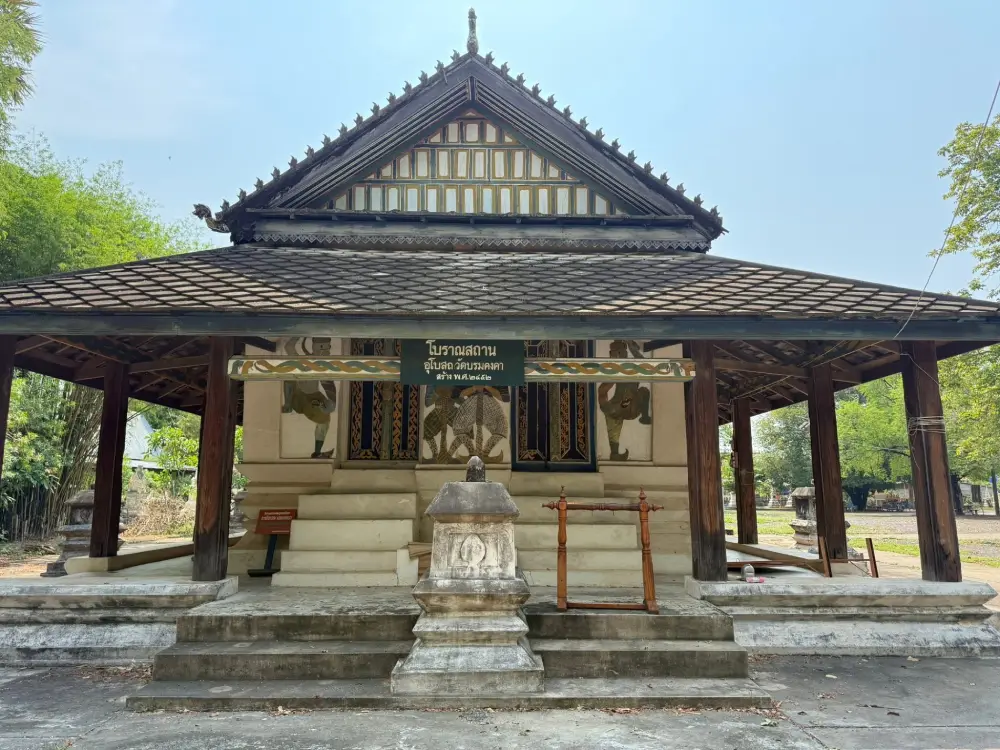
The most important feature of Wat Borom Khongkha is its old ordination hall. The hall was built in 1926 and measures 15 meters wide and 17 meters long. It is a reinforced concrete structure in a Thai architectural style. Inside the hall are mural paintings that were registered by the Fine Arts Department in 1996. The building is therefore not only a sacred place for Buddhist ceremonies, but also an important example of community-based Buddhist art in Buri Ram.
The old ordination hall is meaningful because it represents local religious architecture rather than grand royal temple architecture. Its value lies in its age, sacred function, and connection with village life. For generations, villagers used this hall for Buddhist ceremonies, ordinations, chanting, merit-making, and community religious events. The building therefore carries both artistic value and emotional value for the people of Ban Waeng.
Inside the ordination hall is a Buddha image in the Subduing Mara posture. The image has a lap width of 19 inches and a height of 24 inches. The Subduing Mara posture represents spiritual victory over temptation and inner obstacles. In a historic ordination hall surrounded by old murals, this Buddha image becomes the spiritual center of the space and continues to be respected by local worshippers.
Local stories about the principal Buddha image, including the theft of its ceremonial parasol and jeweled eyes, show the vulnerability of community heritage. When sacred objects are damaged or stolen, the loss is not only material. It affects the memory, dignity, and faith of the community. This is one reason Wat Borom Khongkha is important as a site that calls for careful protection and responsible cultural management.
The murals and stucco works inside the old ordination hall are especially valuable. They preserve visual evidence of local Buddhist belief, artistic style, and craftsmanship. In the past, temple murals were important tools for teaching Buddhism. They helped villagers understand moral lessons, Buddhist stories, and religious values through images at a time when books and modern media were less widely available in rural communities.
The stucco elements also show the skill of local artisans. Such works should not be treated as ordinary old surfaces that can be freely repaired. They are historical evidence. Old plaster, color layers, cracks, and traces of age all help tell the story of the building. Conservation must therefore be careful and technically informed. Inappropriate repairs, even when made with good intentions, can damage original evidence and reduce the historical value of the structure.
Wat Borom Khongkha provides an important lesson in community heritage conservation. In the past, well-meaning local repairs caused damage to parts of the old ordination hall. This kind of situation occurs at many old temples in Thailand. People love the temple and want to improve it, but historic buildings require conservation methods, not ordinary renovation. Making something look new is not the same as preserving its historical truth.
The Fine Arts Department has carried out conservation work on the murals of Wat Borom Khongkha. The work included recording damage, removing damaged or swollen sections that had previously been stabilized, cleaning them, and reinstalling them in their original locations. This approach reflects a conservation principle that values original material and historical authenticity. The goal is not to repaint or replace the old work, but to keep the surviving original art as stable and truthful as possible.
Wat Borom Khongkha is therefore an excellent place to understand the challenges of protecting local heritage. Visitors should see the temple not only as a place to make merit, but also as a living case study of how communities, monks, government agencies, and visitors can help care for fragile cultural heritage. The temple shows that heritage preservation depends on knowledge, respect, and cooperation.
The history of the temple’s names is also worth studying. Wat Takhro reflects the natural landscape and trees that once surrounded the temple. Wat Khongkha reflects the connection with Lam Huai Muai, a nearby stream. Wat Borom Khongkha reflects a later naming that gave the temple a more formal and dignified identity. These names are not just labels. They are historical traces of place, water, environment, and community development.
Ban Waeng is part of Phutthaisong District, a culturally rich area of northern Buri Ram. The community has long been connected with Buddhism, local ceremonies, family rituals, and Isan village life. Wat Borom Khongkha has served as a central space where villagers gather for Buddhist holy days, ordinations, Kathin ceremonies, robe offerings, family merit-making, and community events. The temple is therefore part of the social memory of Ban Waeng.
The recorded line of abbots shows the long continuity of the temple. Names such as Phra Chot, Phra Saen, Phra Ek, Phra Ngao, Phra Nu, Phra Palat, Phra Long, Phra Kong, Phra Mi, Phra Singh, Phra Phim, Phra Wong, Phra Khru Phutthaphong Phiphat, Phra Bunmi, Phra Bua Chanutevo, Phra Sa Yasodharo, Phra Khru Sinlawat Wibun, and Phra Khru Prachak Thammakowit show how the temple was guided by many generations of monks. Current ecclesiastical information identifies Phra Khru Bowon Yanasathit (Noi) as the abbot of Wat Borom Khongkha.
The temple also played a role in education. Historical records mention a Dhamma study school that opened in 1926 and an adult school that opened in 1973. This shows the traditional role of Thai temples in rural education. Before modern school systems were fully developed, temples often served as places where people learned literacy, morality, Buddhist teachings, and community values.
For cultural travelers, Wat Borom Khongkha offers several layers of meaning. The first layer is its founding in 1811. The second is the change of names from Wat Takhro to Wat Khongkha and finally Wat Borom Khongkha. The third is the old ordination hall and its murals. The fourth is the conservation issue surrounding the fragile historic structure. The fifth is the continuing role of the temple in Ban Waeng community life. Together, these layers make the temple much more than an old religious site.
Visitors should behave carefully because the old ordination hall and mural paintings are fragile cultural assets. Shoulders and knees should be covered, shoes should be removed before entering sacred spaces, and voices should be kept low. Visitors should not touch murals, stucco work, old walls, or the Buddha image. Flash photography should be avoided near old paintings because light and heat can affect fragile materials.
Photography should be done respectfully. If monks or local worshippers are using the temple, visitors should keep a proper distance and avoid interrupting religious activities. The most meaningful way to experience an old temple like Wat Borom Khongkha is to spend time observing details: old plaster, faded colors, wall cracks, stucco traces, and the atmosphere of a place that has carried community faith for generations.
Getting There is convenient by private car, rental car, or local transport. From Buri Ram city, travel toward Phutthaisong District, then continue to Ban Waeng Subdistrict. The temple is located in Ban Waeng, Moo 1. Travelers without a private vehicle can first reach Phutthaisong town and then hire local transport to the temple. The temple can be combined easily with other cultural and religious sites in Phutthaisong District.
A practical cultural route can begin at Wat Borom Khongkha to pay respect to the Buddha image and study the old ordination hall. Travelers can then continue to Phra Chao Yai at Wat Hong, Bueng Sa Bua, Wat Manee Chan, Wat Thep Rangsan, the Ban Hua Saphan silk community, Loeng Bo Water Park, and Play La Ploen. This route gives visitors a broad view of Phutthaisong through old temples, sacred Buddha images, local art, community life, and leisure attractions.
Wat Borom Khongkha is suitable for visitors interested in old temples, registered mural paintings, local Buddhist art, community heritage, and conservation issues. A meaningful visit should take at least 45 minutes to one hour. Visitors should take time to pay respect, walk quietly around the old ordination hall, study the surviving artwork, and understand why careful conservation is important for community temples.
The temple is also useful as an outdoor classroom. Teachers, students, artists, and heritage learners can study temple history, architecture, mural conservation, local craftsmanship, Buddhist education, and the relationship between a temple and its surrounding community. Seeing the actual site helps learners understand the meaning of community heritage more clearly than reading about it alone.
Food, cafés, and accommodations are available in Phutthaisong town and nearby areas. Visitors can plan meals before or after visiting the temple and stay overnight in Phutthaisong if they want to explore Wat Borom Khongkha, Wat Manee Chan, Wat Hong, Wat Thep Rangsan, and other local sites at a slower pace. Small resorts and local accommodations make the district suitable for cultural travelers who prefer less crowded destinations.
For foreign visitors, Wat Borom Khongkha offers a deeper view of Thai community temples. It shows that Thailand’s religious heritage is not limited to large royal temples or famous tourist landmarks. Small community temples can hold centuries of history, fragile murals, local craftsmanship, stories of damage and preservation, and the emotional memory of villagers. This makes Wat Borom Khongkha an important stop for travelers who want to understand local Buddhist culture in Buri Ram.
Wat Borom Khongkha should be developed and visited with care. Its value lies in its age, authenticity, old ordination hall, murals, stucco work, and community connection. Responsible cultural tourism should help protect these qualities rather than erase them. With cooperation among the temple, community, government agencies, and respectful visitors, Wat Borom Khongkha can continue to be both a sacred place and a meaningful heritage learning site of Phutthaisong District.
In summary, Wat Borom Khongkha is an old temple in Ban Waeng with a history beginning in 1811. It was first known as Wat Takhro, later became Wat Khongkha, and finally received the name Wat Borom Khongkha in 1902. The temple received its consecrated boundary in 1909 and contains an old ordination hall built in 1926, with murals registered by the Fine Arts Department. For travelers interested in old temples, Isan mural art, community heritage, and cultural travel in Buri Ram, Wat Borom Khongkha is a significant and meaningful destination.
| Name | Wat Borom Khongkha |
| Former Names | Wat Takhro / Wat Khongkha |
| Location | Ban Waeng, Moo 1, Ban Waeng Subdistrict, Phutthaisong District, Buri Ram Province, Thailand |
| Address | 82 Ban Waeng, Moo 1, Ban Waeng Subdistrict, Phutthaisong District, Buri Ram 31120, Thailand |
| Highlights | A temple with more than 200 years of history, an old ordination hall, registered mural paintings, and stucco work reflecting local Buddhist art of Ban Waeng community |
| History | Established in 1811 as Wat Takhro, renamed Wat Khongkha in 1846 because of its location near Lam Huai Muai, and renamed Wat Borom Khongkha in 1902 |
| Monastic Affiliation | Local Buddhist Temple, Mahanikaya Order |
| Consecrated Boundary | Received on 12 March 1909. The consecrated boundary measures 15 meters wide and 17 meters long |
| Temple Area | 9 rai and 75 square wah |
| Old Ordination Hall | Built in 1926, 15 meters wide and 17 meters long, reinforced concrete structure in Thai style, with mural paintings registered by the Fine Arts Department in 1996 |
| Important Elements | Old ordination hall, ancient mural paintings, stucco work, Buddha image in the Subduing Mara posture, sermon hall, monks’ residences, multi-purpose pavilion, and funeral pavilion |
| Sacred Object | Buddha image in the Subduing Mara posture, 19 inches wide at the lap and 24 inches high |
| Artistic Value | The murals and stucco work are local Buddhist art evidence reflecting religious belief, community craftsmanship, and the historical memory of Ban Waeng |
| Conservation | The Fine Arts Department carried out mural conservation by recording damage, removing damaged or swollen sections, cleaning them, and reinstalling them in their original locations |
| Abbot / Caretaker | Phra Khru Bowon Yanasathit (Noi) |
| Important Line Of Abbots | 1. Phra Chot, 1811 – 1824 2. Phra Saen, 1824 – 1836 3. Phra Ek, 1836 – 1844 4. Phra Ngao, 1844 – 1850 5. Phra Nu, 1850 – 1865 6. Phra Palat, 1865 – 1874 7. Phra Long, 1874 – 1879 8. Phra Kong, 1879 – 1885 9. Phra Mi, 1885 – 1890 10. Phra Singh, 1890 – 1893 11. Phra Phim, 1893 – 1898 12. Phra Wong, 1898 – 1920 13. Phra Khru Phutthaphong Phiphat, 1920 – 1941 14. Phra Bunmi, 1941 – 1942 15. Phra Bua Chanutevo, 1942 – 1948 16. Phra Sa Yasodharo, 1948 – 1955 17. Phra Khru Sinlawat Wibun, 1955 – 1992 18. Phra Khru Prachak Thammakowit, from 1993 onward |
| Temple Structures | Ordination hall, sermon hall, 3 monks’ residences, multi-purpose pavilion, and funeral pavilion |
| Historical Education Role | A Dhamma study school opened in 1926, and an adult school opened in 1973 |
| Travel Information | Accessible by private car or local transport from Buri Ram city to Phutthaisong District, then onward to Ban Waeng Subdistrict. Travelers without a private car can first reach Phutthaisong town and hire local transport to the temple |
| Current Status | Open as a local Buddhist temple and heritage learning site for old ordination hall, murals, and community Buddhist art |
| Open Days | Daily |
| Opening Hours | 08.00 – 17.00 |
| Facilities | Worship area, old ordination hall, sermon hall, multi-purpose pavilion, funeral pavilion, temple courtyard, and heritage walking area |
| Main Areas / Zones | Old Ordination Hall Zone Mural Painting And Stucco Work Zone Principal Buddha Image Worship Zone Sermon Hall Zone Multi-Purpose Pavilion Zone Funeral Pavilion Zone Temple Courtyard And Community History Learning Zone |
| Nearby Tourist Attractions | 1. Phra Chao Yai At Wat Hong / Wat Hong Buri Ram, about 10 km 2. Bueng Sa Bua, about 10 km 3. Wat Manee Chan, Ban Mafueng, about 11 km 4. Wat Thep Rangsan, Ban Hua Saphan, about 13 km 5. Ban Hua Saphan Silk Tourism Community, about 14 km 6. Wat Pa Nong Bua Rong, about 18 km 7. Loeng Bo Water Park, Hai Sok Subdistrict, about 20 km 8. Khlong Phang Chu, Na Pho District, about 22 km 9. Play La Ploen, Khu Mueang District, about 38 km |
| Nearby Restaurants | 1. Bypass Pub & Restaurant Phutthaisong, about 9 km, Tel. 081-877-8347 2. Bobby Bang Cafe Phutthaisong, about 10 km, Tel. 091-870-0587 3. Growth Cafe’ Bistro & Bar, about 10 km, Tel. 096-168-7699 4. Hom Laeng Isan Food And Jim Jum Phutthaisong, about 10 km, Tel. 099-413-5396 5. Krua Baifern Phutthaisong, about 10 km, Tel. 062-170-8994 6. Baifern / Baifern Food And Mart, about 10 km, Tel. 044-655-434 |
| Nearby Accommodations | 1. Suan Palm Resort, about 2 km, Tel. 081-113-9806 2. Rachata Resort, about 10 km, Tel. 081-049-2045 3. Pho Fa Rung Resort, about 10 km, Tel. 089-424-0367 4. Phufa Resort, about 13 km, Tel. 091-659-2466, 091-662-2646 5. Prankamon Resort, about 15 km, Tel. 080-760-8833 6. Ban Suan Saen Suk Resort, about 15 km, Tel. 081-790-3041 |
Frequently Asked Questions (FAQ)
Q: Where is Wat Borom Khongkha located?
A: Wat Borom Khongkha is located in Ban Waeng, Moo 1, Ban Waeng Subdistrict, Phutthaisong District, Buri Ram Province, Thailand.
Q: What were the former names of Wat Borom Khongkha?
A: The temple was originally called Wat Takhro, later renamed Wat Khongkha, and finally renamed Wat Borom Khongkha in 1902.
Q: When was Wat Borom Khongkha established?
A: Wat Borom Khongkha was established in 1811 and received its consecrated boundary on 12 March 1909.
Q: What is the main highlight of Wat Borom Khongkha?
A: The main highlight is the old ordination hall with ancient mural paintings, stucco work, and more than two centuries of temple history.
Q: Why are the mural paintings at Wat Borom Khongkha important?
A: The murals are important examples of local Buddhist art and were registered by the Fine Arts Department in 1996.
Q: Who is the abbot of Wat Borom Khongkha?
A: The abbot of Wat Borom Khongkha is Phra Khru Bowon Yanasathit (Noi).
Q: What attractions can be visited together with Wat Borom Khongkha?
A: Nearby attractions include Phra Chao Yai at Wat Hong, Bueng Sa Bua, Wat Manee Chan, Wat Thep Rangsan, Ban Hua Saphan Silk Tourism Community, Loeng Bo Water Park, and Play La Ploen.
Q: How should visitors behave at Wat Borom Khongkha?
A: Visitors should dress respectfully, keep quiet, avoid touching the murals or stucco work, avoid flash photography near old paintings, and respect the temple as both a sacred place and a community heritage site.
 Category: ●Places of Worship
 Group: ●Temple
Last Update : 3 MonthAgo
 Last Update : 3 MonthAgo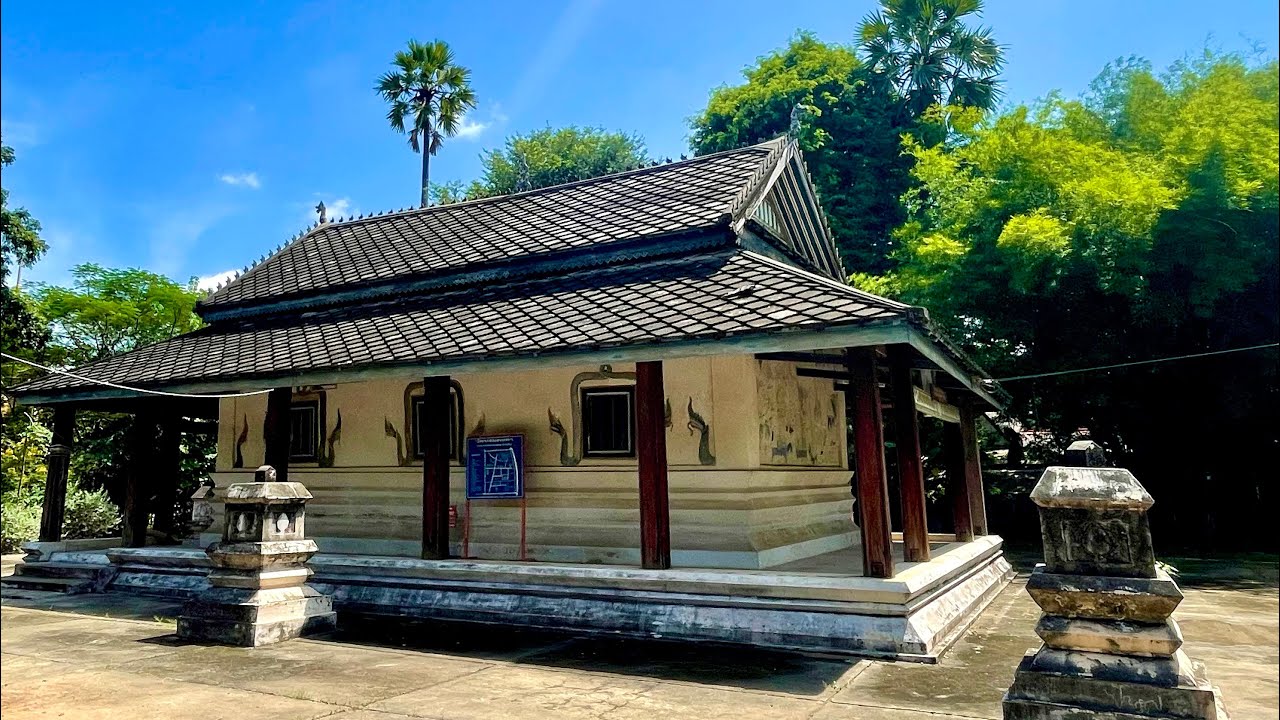
 Click to Access the Navigation Map GPS
Wat Borom Khongkha Map
Recommend

 Art, Culture and Heritage
 Historical Sites and Monuments(14)
 Landmarks and Memorials(2)
 Art, Craft Centres, Tradition(6)
 Museums(3)
 Educational Places
 Museum for Study(1)
Temple(74)
Museum for Study(1)
Temple(74)
 Other Sacred Sites(5)
 Suburban Living
 Village, Community(3)
 Nature and Wildlife
 National Parks and Marine Reserves(2)
 Mountain (Doi)(1)
 Dam, Reservoir, Lake(14)
 River, Canal(1)
 Bays and Beaches(1)
 Other natural attractions(2)
 Entertainment and Agricultural
 Animal camps and shows(1)
 Stadium(2)
 Farms, Parks and Ecotourism(2)
 Waterpark(1)


